 How to read Quran

For many Muslims, the desire to read the Quran collides with uncertainty—unfamiliar letters, elusive sounds, and the fear of pronouncing Allah’s words incorrectly. Online learning has quietly transformed this struggle into an accessible, guided journey rooted in clarity, patience, and authentic transmission.
Reading the Quran online succeeds when structure replaces guesswork. Certified teachers, step-by-step progression from Arabic letters to Tajweed, and consistent daily practice form a complete pathway that carries beginners from isolated sounds to confident, fluent recitation grounded in correct pronunciation.
1. Choose a Structured Online Platform to Read Quran Online
The foundation of successful Quran reading begins with selecting the right digital learning environment. Not all online Quran platforms provide systematic progression or qualified instruction.
Look for Certified Qari Instructors
Your online platform must employ teachers who hold recognized Ijazah certifications. These credentials verify that instructors possess authentic chains of transmission back to the Prophet Muhammad (peace be upon him).
Certified instructors understand the precise articulation points (Makharij) of each Arabic letter. They can correct subtle pronunciation errors that self-learning often misses.
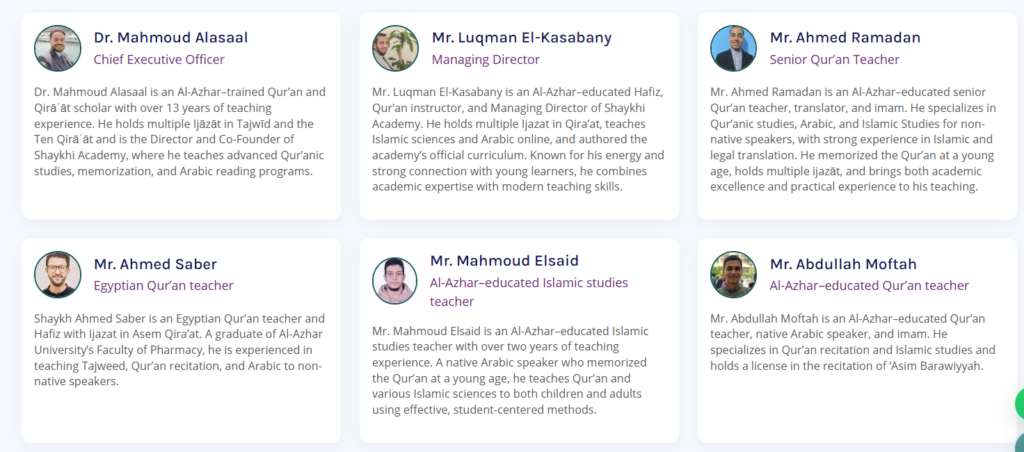
Meet our Quran teachers and find the perfect match for your trial session
Verify Interactive One-on-One Classes
Group recordings cannot replace live interaction when learning to read Quran online. Individual sessions allow teachers to observe your mouth movements and tongue positioning in real-time.
This personalized attention ensures you develop correct habits from the beginning. Bad pronunciation patterns become increasingly difficult to correct once ingrained.
Read Also: How to Read the Quran?
2. Start with Arabic Alphabet Recognition to Read Quran Online
Before attempting Quranic verses, you must master the 28 Arabic letters in their isolated forms. Each letter possesses unique characteristics that affect pronunciation and Tajweed application.
Arabic letters divide into two main categories: heavy (Tafkheem) and light (Tarqeeq). Understanding this distinction early prevents common reading mistakes.
Practice Letter Shapes in Different Positions
Arabic letters change shape depending on their position: initial, medial, final, or isolated. This complexity challenges beginners but follows consistent patterns.
Start by writing each letter form repeatedly. Muscle memory reinforces visual recognition, making reading progression smoother and more natural.
ب appears as بـ (initial), ـبـ (medial), ـب (final), and ب (isolated). Practice these variations daily until recognition becomes automatic.
Learn Proper Articulation Points (Makharij)
Each Arabic letter emerges from specific areas in the mouth and throat. The letter ق (Qaaf) originates from the deepest part of the tongue near the throat.
Incorrect articulation changes meanings entirely. The letters ك (Kaaf) and ق (Qaaf) sound similar to untrained ears but have completely different Makharij.
Shots Videos from Our Courses
Start Your Quran Learning Journey Today
Join Quran Reading Academy and begin structured, step-by-step Quran reading with expert guidance.
Try your first class for freeRead also: Can Adults Learn to Read Quran?
3. Master Harakat Vowel Marks
Harakat are the vowel markings that give Arabic letters their sounds. Without understanding Fathah, Kasrah, and Dammah, reading Quran remains impossible.
Fathah ( َ ) produces an “ah” sound. Kasrah ( ِ ) creates an “ee” sound. Dammah ( ُ ) generates an “oo” sound.
Practice Short Vowel Combinations
Begin by reading individual letters with each Harakat marking. For example, practice بَ (ba), بِ (bi), بُ (bu) until the sounds become natural.
This foundational exercise appears simple but builds the core skill for Quran reading. Many beginners rush past this stage and struggle later.
Understand Sukoon and Tanween Marks
Sukoon ( ْ ) indicates the absence of a vowel, creating a stopped consonant sound. Tanween marks ( ً ٍ ٌ ) produce double vowel sounds ending with “n.”
These markings appear frequently throughout the Quran. Misreading them disrupts the rhythm and meaning of verses.
The following table illustrates the different Harakat effects:
| Mark | Name | Sound | Example |
| َ | Fathah | “ah” | بَ (ba) |
| ِ | Kasrah | “ee” | بِ (bi) |
| ُ | Dammah | “oo” | بُ (bu) |
| ْ | Sukoon | Absence of a vowel | بْ (b) |
4. Follow Noorani Qaida Methodology
Noorani Qaida represents the most effective systematic approach for non-Arabic speakers. This time-tested method progresses through graduated lessons that build upon each other.
Each lesson introduces new letter combinations and reading rules incrementally. Students master one concept completely before advancing to more complex patterns.
Complete Each Qaida Lesson Thoroughly
Rushing through Noorani Qaida lessons undermines the entire learning process. Each page requires practice until reading becomes fluent and error-free.
Your instructor should test pronunciation accuracy before permitting progression. This quality control ensures solid foundations for later Quranic reading.
The Quran Reading Academy’s Noorani Qaida Course follows authentic Qaida progression with modern interactive tools and personalized pacing.
Start Reading the Quran Today with Our Noorani Qaida Course

Practice Connecting Letters While Reading
As you advance through Qaida lessons, you’ll encounter letters joined together. Connected letters ( بِسْمِ ) require smooth transitions between sounds without pausing.
This skill separates choppy reading from fluent recitation. Practice connected letter combinations slowly at first, gradually increasing speed while maintaining accuracy.
5. Apply Basic Tajweed Rules
Tajweed transforms mechanical reading into beautiful recitation. These rules govern pronunciation, elongation, and characteristics that preserve the Quran’s revealed form.
Begin with fundamental rules before advanced applications. The rules of Noon Sakinah and Meem Sakinah appear most frequently in Quranic text.
Learn the Four Rules of Noon Sakinah
When ن with Sukoon or Tanween appears before certain letters, four different rules apply: Izhar, Idgham, Iqlab, and Ikhfa.
Izhar (clear pronunciation) occurs before throat letters. Idgham (merging) happens with specific letters that absorb the Noon sound completely or partially.
Practice Madd (Elongation) Rules
Madd rules dictate how long to stretch certain vowel sounds. Natural Madd extends for two counts, while connected Madd may extend four to six counts.
Incorrect Madd duration changes the aesthetic flow of recitation. Listen to qualified Qaris repeatedly to internalize proper elongation timing.
Consider this example from Surah Al-Fatihah:
ٱلْحَمْدُ لِلَّهِ رَبِّ ٱلْعَـٰلَمِينَ
Alhamdu lillahi rabbil ‘aalameen
“[All] praise is [due] to Allah, Lord of the worlds.” (Al-Fatihah 1:2)
The elongation in “aalameen” requires proper Madd application for correct recitation.
These rules initially seem overwhelming but become natural with consistent practice. Our Quran Tajweed Course breaks down each rule with audio examples and exercises.
Join Our Quran Tajweed Course with a Free Trial

6. Establish Daily Practice Schedule to Read Quran Online Consistently
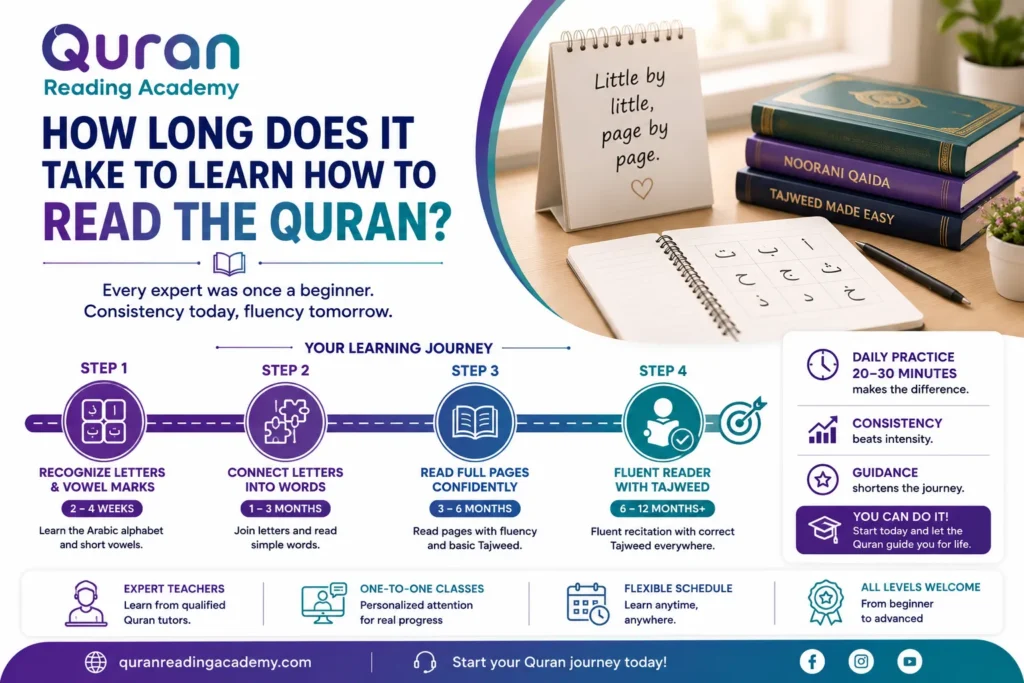
Consistency determines success more than study duration. Twenty minutes of daily practice outperforms sporadic two-hour sessions in building reading proficiency.
Your brain requires regular exposure to Arabic letter patterns for recognition to become automatic. Irregular practice forces constant relearning of previously covered material.
Create a Structured Weekly Timetable
Designate specific times for different practice elements. Allocate separate sessions for letter recognition, Harakat practice, Qaida lessons, and Tajweed rule application.
This structured approach ensures balanced skill development. The following timetable example provides a foundation you can adapt:
| Day | Morning (15 min) | Evening (15 min) |
| Monday | Letter Writing Practice | Qaida Lesson Review |
| Tuesday | Harakat Reading Drills | New Qaida Lesson |
| Wednesday | Tajweed Rule Study | Previous Lesson Repetition |
| Thursday | Letter Connection Practice | Tajweed Application Exercise |
| Friday | Surah Al-Fatihah Practice | Teacher Session Preparation |
Review Previous Lessons Before New Material
Never advance without reviewing what you’ve already learned. Dedicate the first five minutes of each session to reading previously mastered pages.
This review strengthens retention and builds reading fluency. It also reveals areas needing additional attention before they become permanent weaknesses.
The Reading and Memorizing the Quran Course integrates systematic review cycles that prevent knowledge decay while progressing forward.
Join our Quran Hifz Course with a Free Trial

7. Use Technology Tools
Modern digital tools enhance traditional Quran reading instruction. Interactive apps, pronunciation software, and visual aids accelerate learning when used properly.
However, technology supplements teacher guidance but never replaces it. Automated feedback cannot detect subtle pronunciation errors only trained instructors recognize.
Select Quality Quran Reading Applications
Choose apps featuring accurate Tajweed-colored text that highlights different rule applications. Color-coding helps visual learners identify where specific rules apply.
Look for applications with word-by-word translation and audio from recognized Qaris. Hearing proper pronunciation repeatedly trains your ear before attempting recitation yourself.
Record and Analyze Your Recitation
Recording your practice sessions provides objective feedback. Listen to your recordings compared against professional Qaris to identify improvement areas.
This self-assessment develops critical listening skills essential for independent Quran reading. You’ll begin hearing mistakes yourself before teachers point them out.
Our instructors encourage students to share recordings between sessions. This allows targeted feedback on specific verses causing difficulty.
Start Your Quran Learning Journey Today
Join Quran Reading Academy and begin structured, step-by-step Quran reading with expert guidance.
Try your first class for free8. Start Reading Simple Surahs
After completing Noorani Qaida, begin with shorter Surahs from Juz Amma. These chapters contain simpler vocabulary and sentence structures perfect for beginners.
Surah Al-Ikhlas, Surah Al-Falaq, and Surah An-Nas provide excellent starting points. Their brevity allows complete focus on pronunciation accuracy.
Master Surah Al-Fatihah Completely
Every Muslim must recite Al-Fatihah in daily prayers. Invest significant time perfecting this chapter’s pronunciation and Tajweed application.
Each letter and vowel in Al-Fatihah requires precise articulation. Mistakes in this frequently-recited Surah perpetuate throughout your prayer life.
Progress to Longer Passages Gradually
Once comfortable with short Surahs, advance to medium-length chapters. Surah Yaseen and Surah Ar-Rahman represent intermediate difficulty levels.
9. Join Live Classes to Read Quran Online with Expert Guidance
Self-directed learning has limitations when mastering Quran reading. Live instruction with qualified teachers accelerates progress and prevents incorrect habit formation.
Interactive classes provide immediate error correction impossible through pre-recorded content. Teachers observe your mouth positioning and adjust tongue placement in real-time.
Benefit from Personalized Correction
Every student makes unique pronunciation mistakes based on their native language interference. Arabic sounds non-existent in English create specific challenges for English speakers.
Certified instructors identify these individual error patterns quickly. They provide customized exercises targeting your specific weak areas rather than generic practice.
The Quran Reading Academy matches students with instructors experienced in teaching their native language backgrounds. This specialization addresses predictable pronunciation challenges proactively.
Participate in Regular Assessment
Scheduled assessments measure progress objectively and identify knowledge gaps. These evaluations ensure steady advancement through curriculum stages without foundational weaknesses.
Assessment feedback guides focus areas for upcoming practice sessions. This data-driven approach optimizes learning efficiency significantly.
10. Develop Consistent Recitation Habits
Initial enthusiasm fades without sustainable practice routines. Building Quran reading into daily habits ensures lifelong engagement with Allah’s words.
Start with manageable commitments you can maintain indefinitely. Reading one page daily surpasses sporadic ambitious sessions that burn out quickly.
Set Realistic Reading Goals
Begin with five minutes of daily Quran reading practice. Gradually increase duration as the habit strengthens rather than starting with unsustainable hour-long commitments.
Quality focus during short sessions exceeds distracted reading during lengthy periods. Your mind retains more from concentrated practice.
Track Progress and Celebrate Milestones
Maintain a reading journal documenting completed lessons and mastered Surahs. Visible progress markers motivate continued effort during challenging periods.
Celebrate significant achievements like completing Noorani Qaida or finishing your first Juz. These milestones represent substantial accomplishments worthy of recognition.
The Quran Hifz Course builds upon strong reading foundations, offering structured memorization for students who master reading proficiency first.
Our Students Reviews
Start Your Quran Learning Journey Today
Join Quran Reading Academy and begin structured, step-by-step Quran reading with expert guidance.
Try your first class for freeStart Your Quran Reading Journey with The Quran Reading Academy
Learning to read Quran online requires structured methodology, qualified instruction, and consistent practice. These steps provide the roadmap from complete beginner to confident reader.
The Quran Reading Academy offers comprehensive programs designed specifically for non-Arabic speakers:
- Certified Qari instructors with Ijazah credentials and years of teaching experience
- Personalized one-on-one sessions tailored to your learning pace and schedule
- Noorani Qaida Course, Quran Tajweed Course, and Online Quran Reading Course with Tajweed
- Flexible scheduling accommodating students across global time zones
- Al-Menhaj Book resources providing structured reading foundations
Book your free trial class today and begin reading Allah’s words with proper pronunciation and Tajweed application. Insha’Allah, your Quran reading journey starts now.
Check out our top courses to help you read the Quran with confidence:
- Quran Reading Course With Tajweed
- Noorani Qaida Course
- Quran Reading Course for Beginners
- Quran Reading Classes for Adults
- Quran Reading Classes for Sisters
- Quran Reading Classes for Kids
- Quran Hifz Course
- Arabic Reading Practice Course
- Quranic Arabic Course
Book your free class today—it’s the perfect start to learning the Quran

Conclusion
Effective Quran reading begins with strong foundations: recognizing Arabic letters, mastering articulation points, and understanding vowel markings. These essentials prevent early mistakes and ensure that pronunciation develops accurately, preserving both meaning and rhythm from the very first verses.
Systematic methods like Noorani Qaida and foundational Tajweed rules transform reading into disciplined recitation. When lessons are mastered sequentially and reviewed consistently, fluency emerges naturally, allowing learners to connect letters, apply elongation rules, and recite with confidence.
Long-term success depends on sustainable habits and expert guidance. Short daily practice, live corrective feedback, and gradual progression through selected Surahs anchor Quran reading as a lifelong act of worship rather than a temporary learning goal.
Related Articles
How to read Quran







Leave a Reply