 Quran Reading Plans
Consistency with the Quran rarely breaks because of intention; it breaks under the weight of unstructured days. Between work, family, and mental fatigue, good intentions dissolve without a clear system that turns reading into a grounded, repeatable practice rather than an occasional spiritual burst.
A structured Quran reading timetable replaces guesswork with clarity. By aligning goals, skill level, and available time, it transforms reading into a sustainable routine—whether the aim is steady fluency, Tajweed mastery, deep study, or completing regular Khatmahs without pressure or burnout.
Build Your Personalized Quran Reading Planner Step by Step
A Quran reading planner goes beyond simple scheduling. It incorporates your learning goals, current skill level, and realistic time availability into a comprehensive framework.
Begin by assessing where you are now. Can you read Arabic letters fluently? Do you apply basic Tajweed rules? Your starting point determines your planner’s structure and progression pace.
1. Define Your Quran Reading Goals
Clarify what you want to achieve. Some aim to complete one Khatmah (full Quran) monthly. Others focus on perfecting Tajweed in selected Surahs before progressing further.
Short-term goals might include mastering specific Tajweed rules or completing certain Juz’. Long-term goals could involve memorizing particular Surahs while maintaining reading consistency across the entire Quran.
Write goals using specific, measurable language. Instead of “read better,” state “apply correct Qalqalah in five pages daily without errors.” Specific targets enable accurate progress tracking.
2. Calculate Your Daily Reading Portions
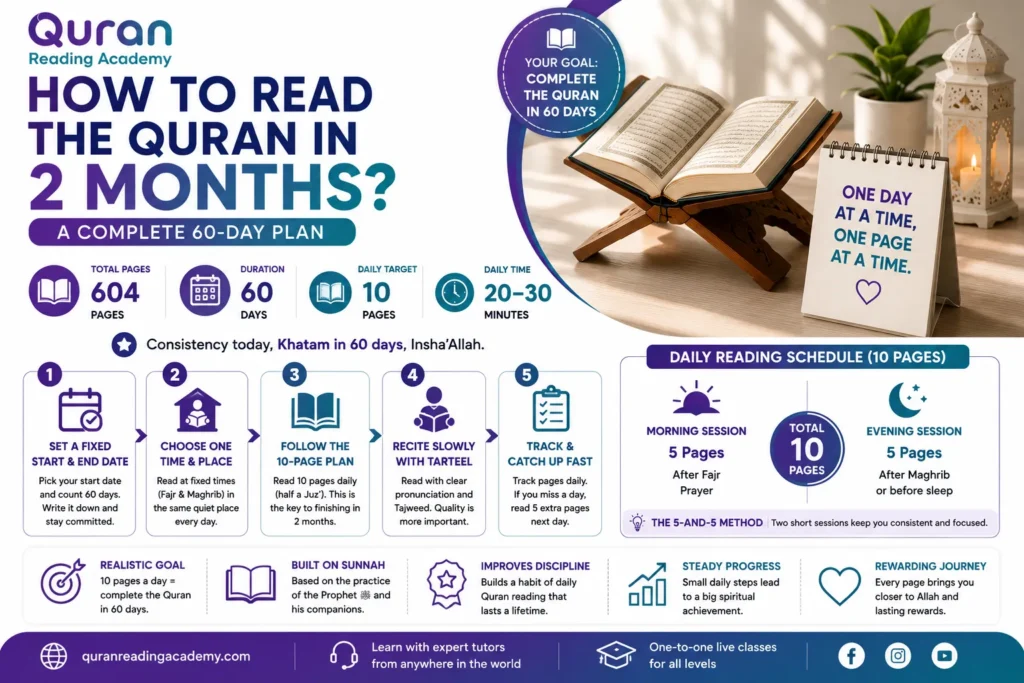
The Quran contains 604 pages in the standard Madani Mushaf. To complete one Khatmah monthly, you must read approximately twenty pages daily.
| Completion Goal | Daily Pages | Daily Time (Approx.) | Skill Level Required |
| 1 Month Khatmah | 20 pages | 40-60 minutes | Intermediate/Advanced |
| 2 Month Khatmah | 10 pages | 20-30 minutes | Beginner/Intermediate |
| 3 Month Khatmah | 7 pages | 25-40 minutes | Beginner |
| 6 Month Khatmah | 20 | 15-35 minutes | Complete Beginner |
Adjust based on your Tajweed accuracy. Reading slowly with correct rules implementation surpasses rushing through pages with numerous mistakes. Quality always precedes quantity in Quranic recitation.
3. Incorporate Review Sessions
Review prevents forgetting previously read portions. The most effective Quran reading planners balance new reading with regular revision of completed sections.
Implement the 70-30 rule: dedicate seventy percent of your time to new reading and thirty percent to reviewing previous Juz’. This maintains familiarity across the entire Quran rather than temporary recognition.
Students in the Quran Tajweed Course learn that revision strengthens Tajweed rule application. Rules practiced repeatedly become automatic, allowing focus to shift toward meaning and reflection during reading.
Join Our Quran Tajweed Course with a Free Trial

Read also: How Long to Read the Quran?
Creating an Effective Quran Reading Schedule for Busy Lifestyles
Western Muslims often juggle demanding careers, family responsibilities, and community commitments. Your Quran reading schedule must accommodate reality while maintaining spiritual priorities.
Flexibility with accountability is the balance. Fixed reading times provide structure, but life happens. Build buffer days into monthly schedules for inevitable disruptions without guilt.
Shorter, consistent sessions outperform lengthy, sporadic ones. Fifteen quality minutes daily with proper Tajweed application beats hour-long weekend sessions where fatigue causes careless mistakes.
1. Weekly Quran Reading Schedule Template
A weekly structure provides rhythm while allowing daily variation. This template accommodates different energy levels and commitments throughout the week.
| Day | Primary Reading Time | Portion Size | Focus Area |
| Monday | After Fajr | 4 pages | New reading with Tajweed |
| Tuesday | After Fajr | 4 pages | New reading with Tajweed |
| Wednesday | Lunch break | 3 pages | Review previous week |
| Thursday | After Fajr | 4 pages | New reading with Tajweed |
| Friday | After Jumu’ah | 5 pages | New reading with reflection |
| Saturday | After Fajr | 4 pages | New reading with Tajweed |
| Sunday | Before Maghrib | 6 pages | Review entire week’s reading |
Modify portion sizes based on your current reading speed and accuracy. Beginners should halve these portions initially, focusing on precision rather than page count completion.
2. Monthly Khatmah Completion Plan
Completing the Quran monthly requires disciplined adherence to your schedule. The standard Madani Mushaf divides into thirty Juz’, making one Juz’ daily a logical approach.
However, not all Juz’ are equal in difficulty. Early Juz’ contain longer Surahs with complex vocabulary. Later Juz’ feature shorter Surahs with simpler language but require careful Tajweed attention.
Allocate extra time for Juz’ 1-10 which contain Al-Baqarah, Aal-Imran, and An-Nisa. These require slower, more deliberate reading compared to Juz’ 28-30 which you might complete faster.
The Quran Recitation Course teaches strategic pacing across different Quran sections. Certified instructors help students navigate varying difficulties while maintaining monthly completion targets without compromising Tajweed accuracy.
3. Quarterly Deep-Study Schedule
Some prefer depth over speed. A quarterly schedule allows thorough study of Quranic text, Tafseer integration, and advanced Tajweed mastery simultaneously.
Read five pages daily with translation and brief Tafseer notes. This slower pace completes one Khatmah every four months while building profound understanding of verses.
| Month | Juz’ Coverage | Weekly Review Day | Deep Study Focus |
| Month 1 | Juz’ 1-3 | Friday | Surah Al-Baqarah themes |
| Month 2 | Juz’ 4-6 | Friday | Surah Aal-Imran and An-Nisa |
| Month 3 | Juz’ 7-9 | Friday | Surah Al-Ma’idah and Al-An’am |
| Month 4 | Juz’ 10-12 | Friday | Consolidation and full review |
This approach suits students in the Quranic Arabic Course who want to connect Arabic grammar understanding with actual Quran reading practice.
Join Quranic Arabic Course With a Free Trial

Read also: When Is the Best Time to Read Quran Throughout Your Day?
4. Ramadan Intensive Quran Reading Timetable
Ramadan offers unique opportunity for accelerated Quran engagement. Many Muslims aim to complete the entire Quran during this blessed month through structured daily reading.
The traditional Taraweeh prayer approach divides the Quran into thirty portions, one completed nightly. Your personal reading can mirror this structure or adopt alternative pacing.
| Daily Reading Slot | Portion | Approximate Duration | Additional Activity |
| After Fajr | 10 pages | 20-25 minutes | Reflection on meanings |
| Before Iftar | 10 pages | 20-25 minutes | Tajweed-focused reading |
| After Taraweeh | Review 20 pages | 15-20 minutes | Silent review recitation |
This intensive schedule completes one full Khatmah in thirty days while incorporating review. Adjust portions based on your reading speed and Ramadan commitments.
Shots Videos from Our Courses
Start Your Quran Learning Journey Today
Join Quran Reading Academy and begin structured, step-by-step Quran reading with expert guidance.
Try your first class for freePractical Quran Reading Timetables for Different Skill Levels
Your current proficiency determines appropriate Quran reading timetable complexity. Beginners need foundational skill-building schedules. Advanced readers can handle ambitious multi-Khatmah plans simultaneously.
Mismatched timetables cause frustration and eventual abandonment. A beginner attempting advanced schedules experiences constant failure. An advanced reader following beginner pace feels unchallenged and loses motivation.
1. Quran Reading Timetable for Pre-Reading Phase
If you cannot read Arabic letters fluently yet, your first timetable focuses on literacy acquisition rather than Quran completion.
Al-Menhaj Book provides structured progression through Arabic letter recognition, vowel marks, and basic reading mechanics. Dedicate your initial three months to mastering this foundation before attempting actual Quran reading.
Explore The Best Quran Reading Book
| Day | Primary Focus | Practical Exercise | Daily Goal |
| 1–2 | Letter Recognition | Point and name (random order) | 100% accuracy on Alif to Yaa |
| 3–4 | Harakat (Short Vowels) | Fatha, Kasra, Damma drills | Sounding out 2-letter combos |
| 5 | Joining Shapes | Initial, Medial, and Final forms | Recognizing letters inside words |
| 6 | Basic Madd | Natural elongation (2 counts) | Distinguishing long vs. short vowels |
| 7 | Cumulative Review | Reviewing the week’s progress | Zero hesitation on simple 3-letter words |
Spend 15 minutes just listening to a Qari while following along with your finger, even if you can’t read the words yet.
Don’t move to the next “level” until you can identify every letter in a random sequence within two seconds.
2. Quran Reading Timetable for Developing Fluency
Intermediate readers recognize the letters and vowels but the “flow” isn’t there. You might find yourself hesitating, correcting your mistakes every other word, or reading at a very slow pace. That’s okay. Your goal here is building muscle memory.
Focus on accuracy first; the speed will show up on its own once your brain stops having to “calculate” every vowel.
| Activity | Content | Method | Focus Point |
| The New | 3 Pages | Read out loud; stop at every error | No “back-tracking” or stuttering |
| The Glue | 5 Previous Pages | Speed reading for patterns | Visual recognition of common words |
| The Polish | 10 Specific Verses | Repeat 5x each for smoothness | Connecting words without a gap |
| The Listen | Audio Check | Mimic a Qari for 15 minutes | Matching the rhythm and breath |
Read your 3 new pages with a heavy focus on Tajweed. Review the pages you read yesterday to reinforce recognition.
If a specific verse trips you up, don’t just move on. Repeat it until it feels like second nature.
3. Quran Reading Timetable for Advanced Readers (Tajweed Mastery)
Advanced readers have the fluency down but want to reach perfection. This is where you balance the quantity of a Khatmah with the quality of advanced rules.
At this stage, you should be aiming for at least one Juz a day while keeping your ears open for the subtle stuff—proper Madd lengths, precise Qalqalah, and accurate Idgham.
| Component | Target Quantity | Advanced Application | Quality Control |
| Main Reading | 1 Juz (20 pages) | Consistent speed (Hadr/Tadwir) | Maintain 4/5 count Madds throughout |
| Technical Drill | 5 Selected Pages | Focus on Sifat (Attributes) | Precision in heavy vs. light letters |
| Audit Session | 15–20 Minutes | Record & Listen to “Trouble Spots” | Mark mistakes in a dedicated Mushaf |
| Memory Link | 2 Pages | Recite from memory (Hifz review) | Strengthening the mental connection |
Record yourself regularly. You’ll hear things in a recording—like a shortened Ghunnah or a “shaky” vowel—that you completely miss while you’re actually reading.
If Madd Al-Lazim is giving you trouble, spend thirty minutes reciting only verses that contain that rule.
Even at this level, check in with a teacher occasionally. We all develop “blind spots” in our recitation over time.
Our Students Reviews
Start Your Quran Learning Journey Today
Join Quran Reading Academy and begin structured, step-by-step Quran reading with expert guidance.
Try your first class for freeStart Your Structured Quran Reading Journey with The Quran Reading Academy
Implementing a Quran reading timetable transforms sporadic reading into consistent spiritual practice. The detailed schedules and planners in this guide provide frameworks adaptable to any skill level or lifestyle demands.
The Quran Reading Academy offers comprehensive support for your Quran reading journey through:
- Certified Qaris and Qariahs providing expert Tajweed instruction
- Personalized timetables matching your specific goals and availability
- Flexible class scheduling accommodating Western time zones
- One-on-one attention ensuring proper reading mechanics from day one
- Al-Menhaj Book integration for beginners needing foundational literacy
Book your free trial class today and receive a customized Quran reading timetable designed specifically for your current level and completion goals.
Check out our top courses to help you read the Quran with confidence:
- Quran Reading Course With Tajweed
- Noorani Qaida Course
- Quran Reading Course for Beginners
- Quran Reading Classes for Adults
- Quran Reading Classes for Sisters
- Quran Reading Classes for Kids
- Quran Hifz Course
- Arabic Reading Practice Course
- Quranic Arabic Course
Book your free class today—it’s the perfect start to learning the Quran

Conclusion
A well-designed Quran reading timetable creates rhythm, not rigidity. When goals are defined, portions calculated realistically, and review embedded into the process, consistency becomes a natural outcome rather than a constant struggle driven by guilt or urgency.
Different skill levels demand different structures. Beginners require literacy-focused schedules, intermediate readers need fluency-building balance, and advanced reciters must refine precision alongside quantity. Matching the timetable to ability preserves motivation and protects long-term commitment.
When structure meets flexibility, Quran reading integrates seamlessly into daily life. With adaptable planners, realistic pacing, and expert guidance when needed, sustained engagement with the Quran becomes achievable—regardless of lifestyle demands or starting point.
Related Articles
Quran Reading Plans







Leave a Reply