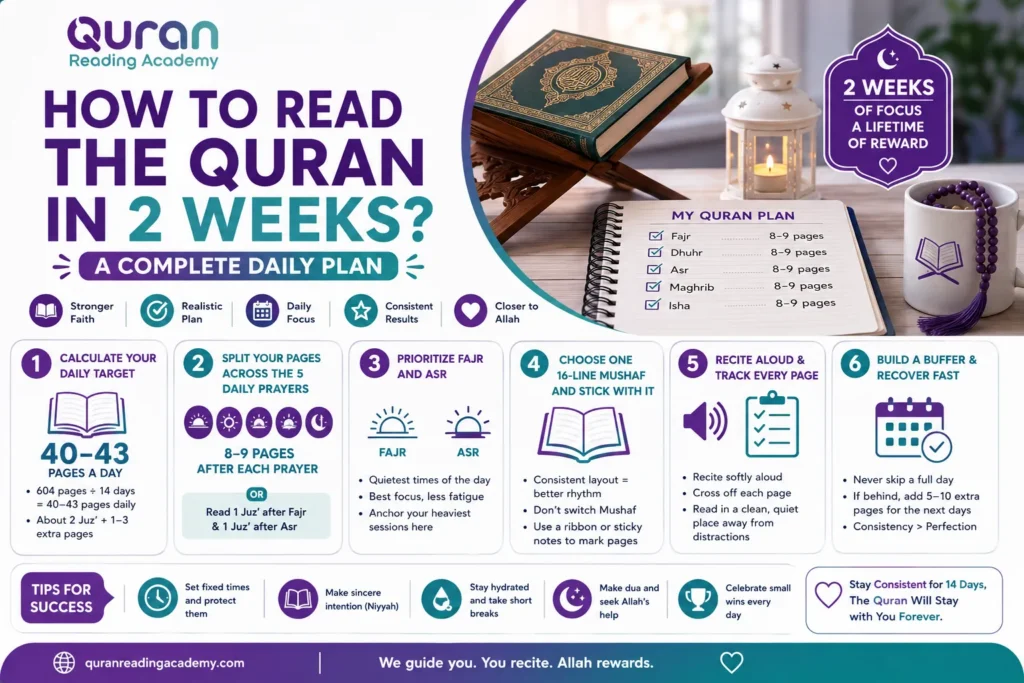
 Quran Reading Plans
Opening the Quran for the first time often brings a mix of longing and hesitation. The script looks unfamiliar, the sounds feel elusive, and uncertainty creeps in quickly. Yet every fluent reader once stood at that same threshold, unsure where the path would truly begin.
A structured Quran reading plan removes that uncertainty by breaking progress into clear stages. Starting with Arabic letters, then Harakat, Sukoon, and Tajweed foundations, the journey gradually moves toward reading full Surahs and complete Juz with confidence, accuracy, and sustainable daily consistency.
1. Every Quran Reading Plan for Beginners Starts with Arabic Alphabet Mastery
Before attempting any Quranic text, you must master the 28 Arabic letters. This foundation determines your entire reading journey.
The Arabic alphabet differs fundamentally from Latin scripts. Each letter has 2-4 forms depending on position (isolated, initial, medial, final). This complexity requires systematic daily practice.
Initial Week Arabic Letter Recognition Schedule
Dedicate 15-20 minutes daily to letter practice. Consistency matters more than duration during this critical phase.
| Day | Letters to Learn | Practice Method | Repetitions |
| 1-2 | ب ت ث | Visual tracing, pronunciation | 20 times each |
| 3-4 | ج ح خ | Shape recognition, sound practice | 20 times each |
| 5-6 | د ذ ر ز | Writing practice, oral repetition | 15 times each |
| 7 | Review all 10 letters | Mixed recognition drills | 30 minutes total |
Write each letter repeatedly while pronouncing it correctly. This dual engagement strengthens memory pathways between visual recognition and sound production.
Arabic Letter Connection Practice Phase
After recognizing isolated letters, practice connecting them. Arabic’s cursive nature requires understanding how letters join together.
Focus on initial and medial forms first. These appear most frequently in Quranic text. Practice connecting 2-3 letters before attempting longer combinations.
The Quran Reading Academy’s Noorani Qaida Course introduces letters through a proven sequence. Letters are grouped by similarity in shape, not alphabetical order. This method accelerates recognition and prevents confusion.
Start Reading the Quran Today with Our Noorani Qaida Course

2. Your First Month in Quran Reading Plan for Beginners Should Focus on Harakat
Harakat (vowel marks) transform Arabic reading from impossible to accessible. Without mastering these short vowels, Quranic reading remains guesswork.
The three primary Harakat are Fatha (أَ), Kasra (إِ), and Damma (أُ). Each produces a distinct short vowel sound that changes word meaning entirely.
Spend weeks 2-4 exclusively on Harakat practice. Don’t rush to actual Quranic verses yet. Solid Harakat mastery prevents years of mispronunciation habits.
Week Two Through Four Harakat Mastery Schedule
This phase builds reading fluency systematically. Each week introduces new vowel combinations while reinforcing previous learning.
| Week | Focus Area | Daily Practice Duration | Key Skill Developed |
| 2 | Fatha with all letters | 20 minutes | Open vowel recognition |
| 3 | Kasra and Damma combinations | 25 minutes | Vowel differentiation |
| 4 | Mixed Harakat reading drills | 30 minutes | Automatic vowel reading |
Practice reading 3-letter words with mixed Harakat. The Noorani Qaida Course provides graduated word lists specifically designed for this progression.
Avoid actual Quranic text during this month. Simplified practice words allow you to focus purely on Harakat mechanics without Tajweed complexity.
Shots Videos from Our Courses
Start Your Quran Learning Journey Today
Join Quran Reading Academy and begin structured, step-by-step Quran reading with expert guidance.
Try your first class for freeRead also: Ramadan Quran Reading Chart and Schedule
3. The Second Month in Quran Reading Plan for Beginners Introduces Sukoon and Tanween
After Harakat fluency, introduce Sukoon (ــْ) and Tanween marks. These elements appear constantly in Quranic verses and require separate focused practice.
Sukoon indicates letter silence—no vowel follows. This concept confuses beginners accustomed to languages where every letter produces sound.
Tanween adds nasal “n” sound at word endings. The three Tanween types (ـً ـٍ ـٌ) mirror Fatha, Kasra, and Damma patterns.
Weeks Five Through Eight Sukoon and Tanween Practice Structure
Gradual introduction prevents overwhelming beginners. Each element receives dedicated attention before combination practice begins.
Start week 5 with Sukoon recognition. Practice identifying where sounds stop within words. This skill directly impacts Quranic pronunciation accuracy.
Week 6 introduces Tanween systematically. Begin with Tanween Fath (ـً) since it’s most common. Add Tanween Kasr (ـٍ) and Tanween Damm (ـٌ) progressively.
Enroll in Our Quran Reading Course for Beginners with a Free Trial

| Week | Primary Element | Practice Volume | Expected Outcome |
| 5 | Sukoon recognition | 50 words daily | Confident silence marking |
| 6 | Tanween Fath introduction | 40 words daily | Nasalization accuracy |
| 7 | All Tanween types | 60 words daily | Differentiation between types |
| 8 | Mixed Sukoon and Tanween | 70 words daily | Natural reading flow |
4. Month Three in Quran Reading Plan for Beginners Tackles Madd and Shaddah
Madd (prolongation) and Shaddah (emphasis) represent intermediate reading skills. These elements affect recitation beauty and rule compliance simultaneously.
Madd extends vowel sounds to specific measured lengths. Three primary lengths exist: 2 counts, 4-5 counts, and 6 counts. Accurate counting requires practice with a teacher.
Shaddah doubles a letter’s pronunciation. The mark (ــّ) combines with Harakat to create emphasized sounds. Mispronouncing Shaddah changes word meanings in Quranic text.
Weeks Nine Through Twelve Madd and Shaddah Integration Schedule
This month transitions from pure reading mechanics to Tajweed application. Each week layers complexity onto established skills.
Begin with natural Madd only. Practice extending vowels attached to Alif (ا), Waw (و), and Ya (ي). Use a timer or metronome for accurate counting.
| Week | Skill Focus | Practice Method | Daily Duration |
| 9 | Natural Madd (2 counts) | Timed vowel extension | 25 minutes |
| 10 | Shaddah with all Harakat | Letter doubling drills | 30 minutes |
| 11 | Combined Madd and Shaddah | Structured word reading | 35 minutes |
| 12 | Review and speed building | Fluency exercises | 40 minutes |
The Quran Tajweed Course becomes essential during month three. Madd lengths require auditory feedback that self-learners cannot provide themselves accurately.
Practice Shaddah initially with familiar letters. The combination of doubling and vowel marks creates unique sounds that need supervised correction.
Join Our Quran Tajweed Course with a Free Trial

Read also: Daily Quran Reading Plan And Schedule
5. After Three Months Your Quran Reading Plan for Beginners Reaches Short Surahs
Month four marks the exciting transition to actual Quranic text. Start with Juz Amma—the final section containing shorter Surahs perfect for beginners.
Begin with Surah Al-Ikhlas (112). This four-verse Surah contains essential reading elements without overwhelming length. Its theological importance motivates consistent practice.
Read each verse 20 times before progressing. Repetition builds muscle memory for Quranic word patterns. These patterns recur throughout the entire Quran.
Months Four Through Six Short Surah Reading Schedule
Systematic progression through Juz Amma builds confidence and competence simultaneously. Each Surah introduces new vocabulary while reinforcing established reading skills.
| Month | Surahs to Complete | Average Verses | Focus Area |
| 4 | Al-Ikhlas through An-Nas (112-114) | 2-6 verses each | Basic recitation confidence |
| 5 | Al-Masad through At-Takwir (111-81) | 5-29 verses each | Stamina and consistency |
| 6 | Abasa through An-Naba (80-78) | 40-46 verses each | Longer passage fluency |
Don’t memorize during this phase unless naturally occurring. Focus exclusively on reading accuracy and Tajweed application. The Quran Recitation Course provides structured feedback throughout this critical stage.
Join Our Quran Recitation Course with a Free Trial

Practice each Surah with Mushaf (physical Quran) and audio simultaneously. Listen to recitation by Sheikh Mahmoud Khalil Al-Hussary or Sheikh Mishary Rashid Alafasy while following text.
Reading Verification and Error Correction Protocol
Self-assessment proves difficult during initial Quranic reading. Record yourself reciting each Surah. Listen alongside expert recitation to identify discrepancies.
Common beginner errors include skipping Sukoon, rushing through Madd, and mispronouncing emphatic letters. These mistakes require expert identification and correction strategies.
Start Your Quran Learning Journey Today
Join Quran Reading Academy and begin structured, step-by-step Quran reading with expert guidance.
Try your first class for free6. Six Month in Quran Reading Plan for Beginners Expands to Medium Length Surahs
After completing Juz Amma, progress to medium-length Surahs in Juz 29 and 28. These sections contain frequently recited chapters essential for daily prayers.
Surah Al-Mulk (67) makes an excellent starting point. Its 30 verses provide manageable length while introducing new vocabulary and grammatical structures.
Continue with Surah Al-Qalam (68), Al-Haqqah (69), and Al-Ma’arij (70). These Surahs gradually increase reading stamina while maintaining achievable daily goals.
Months Seven Through Nine Medium Surah Progression Plan
Allocate 45-60 minutes daily during this phase. Longer Surahs require increased concentration and consistent practice sessions.
| Month | Target Surahs | Recommended Pace | Weekly Review |
| 7 | Al-Mulk, Al-Qalam, Al-Haqqah | 1 Surah per 10 days | Previous month’s Surahs |
| 8 | Al-Ma’arij through Al-Jinn | 1 Surah per week | Juz Amma rotation |
| 9 | Al-Muzzammil through Al-Muddaththir | 1 Surah per week | Complete Juz 29 |
Review previously learned Surahs weekly. Without consistent review, reading accuracy deteriorates quickly. Rotate through Juz Amma during each week’s practice.
7. Advanced Quran Reading Plan for Beginners Covers Full Juz Reading
Months 10-12 focus on reading complete Juz portions. This skill proves essential for Ramadan Taraweeh participation and personal Quran completion goals.
Start with Juz 30 (Amma Juz) which you’ve already practiced extensively. Read the entire Juz in one sitting to build endurance.
Progress to Juz 29, then 28. Work backward through the Quran since later Juz contain shorter verses and simpler vocabulary structures.
Year One Complete Juz Reading Schedule
This final quarter establishes sustainable long-term reading habits. Completing multiple Juz builds confidence for approaching the entire Quran.
| Month | Juz Target | Daily Reading Goal | Completion Strategy |
| 10 | Juz 30 complete | 2-3 pages | Multiple complete readings |
| 11 | Juz 29 and 28 | 3-4 pages | Single complete reading each |
| 12 | Juz 27 introduction | 4-5 pages | Progressive daily increase |
By month 12, you should comfortably read 4-5 Quran pages daily with proper Tajweed. This pace allows Quran completion within approximately two months.
The Quran Hifz Course becomes accessible after achieving this reading level. However, ensure reading remains effortless before adding memorization burden.
Join Our Quran Hifz Course with a Free Trial

Understanding Quranic Arabic Words Enhances Reading Experience
While not mandatory for reading, basic Quranic Arabic vocabulary enriches understanding. The Quranic Arabic Course teaches frequently occurring words that appear across multiple Surahs.
Common words like رَبّ (Rabb – Lord), رَحْمَة (Rahmah – Mercy), and صَلَاة (Salah – Prayer) repeat hundreds of times. Recognizing these creates natural comprehension alongside reading.
Maintaining Your Quran Reading Plan for Beginners Requires Daily Consistency
After completing one year’s structured plan, establish sustainable maintenance routines. Reading skills deteriorate rapidly without consistent practice.
Dedicate minimum 20-30 minutes daily to Quranic reading. This duration maintains proficiency while fitting realistic daily schedules.
Set monthly Quran completion as long-term goal. Reading one Juz daily completes the entire Quran monthly. This practice was common among early Muslim scholars.
Our Students Reviews
Start Your Quran Learning Journey Today
Join Quran Reading Academy and begin structured, step-by-step Quran reading with expert guidance.
Try your first class for freeStart Your Quran Reading Plan for Beginners with The Quran Reading Academy
You now possess a complete roadmap from Arabic alphabet recognition to confident Quranic reading. Implementation with expert guidance accelerates progress significantly.
The Quran Reading Academy offers personalized instruction that adapts to your exact learning pace. Certified tutors provide immediate correction preventing embedded pronunciation errors.
Our Noorani Qaida Course systematically builds Arabic reading foundations that make Quranic text accessible within months, not years. One-on-one attention ensures you master each element before progression.
Book your free trial class today to experience structured, expert-led Quran reading instruction. Start your transformation from uncertain beginner to confident Quran reader with qualified support every step forward.
Check out our top courses to help you read the Quran with confidence:
- Quran Reading Course With Tajweed
- Noorani Qaida Course
- Quran Reading Course for Beginners
- Quran Reading Classes for Adults
- Quran Reading Classes for Sisters
- Quran Reading Classes for Kids
- Quran Hifz Course
- Arabic Reading Practice Course
- Quranic Arabic Course
Book your free class today—it’s the perfect start to learning the Quran

Conclusion
A beginner-friendly Quran reading plan succeeds because it respects sequence. Mastering letters, vowels, and pronunciation rules before touching full verses prevents confusion and builds accuracy that lasts. Each phase strengthens the next, creating steady, measurable progress rather than rushed familiarity.
Consistency emerges as the real engine of growth. Short, focused daily sessions compound into fluency, stamina, and confidence. From Juz Amma to longer Surahs, regular review ensures skills remain sharp while reading speed and comprehension naturally improve over time.
With structured guidance, reading the Quran becomes approachable, not intimidating. What begins as letter recognition matures into confident page-by-page reading, opening the door to deeper engagement, long-term completion goals, and a lifelong relationship with the Quranic text.
Related Articles
Quran Reading Plans







Leave a Reply