 benefits of reading quran

There is something uniquely powerful about opening the Quran before the day pulls you in every direction. The early morning hours, particularly the time surrounding Fajr prayer, carry a quality of mental clarity and spiritual receptivity that no other part of the day can match.
The benefits of reading Quran in the morning extend well beyond spiritual reward. Morning recitation sharpens pronunciation awareness, accelerates Tajweed retention, strengthens long-term memorization, and sets a tone of focus and calm that carries through the entire day. The evidence for this comes from both divine guidance and the practical experience of Quran teachers and students alike.
1- Morning Recitation is Specifically Honored in the Quran and Sunnah
The Quran does not treat all reading times as equal. Allah (SWT) singles out the Fajr recitation by name, a distinction that no other prayer time receives in the same explicit way.
وَقُرْءَانَ ٱلْفَجْرِ ۖ إِنَّ قُرْءَانَ ٱلْفَجْرِ كَانَ مَشْهُودًا
Wa qur’āna al-fajr, inna qur’āna al-fajri kāna mashhūdā
“And [observe] the Qur’an of dawn. Indeed, the recitation of dawn is ever witnessed.” (Al-Isra 17:78)
The word mashhūdā (witnessed) refers to the angels of night and day both being present at Fajr time. Classical scholars, including Ibn Kathir, explained that this makes the Fajr recitation in the prayer uniquely observed — attended by a gathering of angels unlike any other time of day.
The Prophet ﷺ also specifically invoked blessings on the early morning hours. In a well-known narration recorded in Musnad Ahmad, he said: “O Allah, bless my nation in its early mornings.” This blessing directly encompasses any act of worship — including Quran reading — performed in those hours.
2- The Morning Recitation Boosts Brain Focus and Memory Retention
One of the most compelling and practical benefits of reading Quran in the morning is what happens in the brain during the post-Fajr window.
After sleep, the prefrontal cortex — responsible for focus, pattern recognition, and language processing — is at its daily peak of availability.
Cortisol, the body’s natural alertness hormone, rises sharply in the first hour after waking. This is known in neuroscience as the Cortisol Awakening Response (CAR).
During this window, the brain is exceptionally receptive to new linguistic input — including Arabic letter recognition, vowel differentiation, and Tajweed rule application.
3- Reading Quran in the Morning Produces Faster Arabic Letter and Vowel Recognition
For students working through foundational Arabic reading, the morning hours provide the clearest cognitive window for letter-to-sound mapping. This is the precise skill that Arabic reading beginners struggle with most — and the morning brain handles it most efficiently.
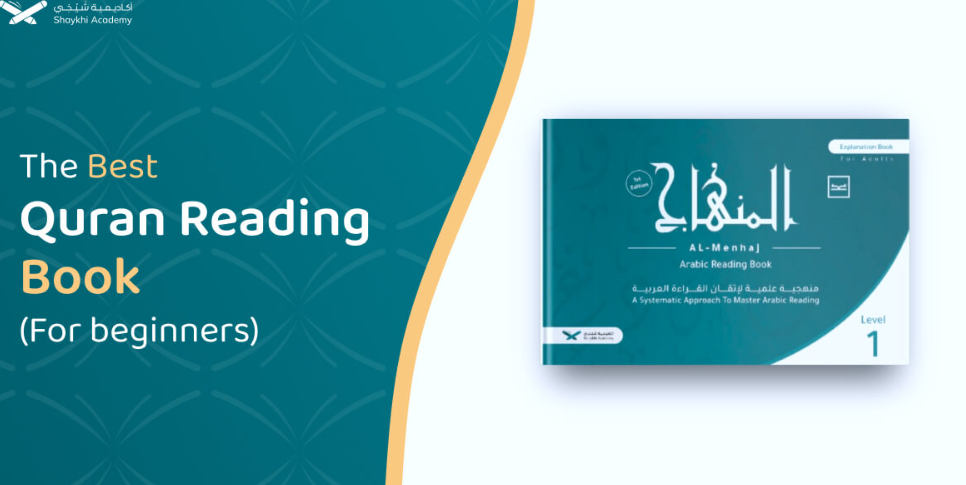
Students using the Al-Menhaj Book — the foundational Arabic reading resource authored by Luqman ElKasabany at The Quran Reading Academy — consistently progress faster when their daily lesson review happens in the morning rather than late evening.
Explore The Best Quran Reading Book
4- Morning Quran Recitation Strengthens Recalling Tajweed Rules
Learning Tajweed rules learners involves layered pattern recognition as follows:
- Identifying the rule trigger (like a Noon Sakinah followed by specific letters)
- Selecting the correct ruling (Idgham, Ikhfa, Iqlab, or Izhar)
- Executing the correct articulation simultaneously. This multi-step process demands cognitive sharpness.
Interestingly, morning recitation, when the mind is uncluttered, allows these layers to be applied deliberately and correctly — building the neural pathways that eventually make Tajweed application automatic.
Shots Videos from Our Courses
Start Your Quran Learning Journey Today
Join Quran Reading Academy and begin structured, step-by-step Quran reading with expert guidance.
Try your first class for free5- Quran Recitation in the Morning Offers the Optimal Conditions for Tajweed Accuracy
Tajweed cannot be applied correctly under mental fatigue or time pressure. The articulation points (Makharij) of Arabic letters require precise, intentional placement of the tongue, lips, and throat — physical precision that diminishes when the mind is tired or distracted.
The morning provides a convergence of conditions that support accurate Tajweed practice: a rested voice, a clear mind, and the absence of accumulated daily stress. This is why the classical tradition of Quran scholars always began their recitation and teaching sessions at dawn.
Join Our Quran Tajweed Course with a Free Trial

6- Strengthening Daily Memorization Progress
Memorization scholars across generations — from Ibn al-Jazari to contemporary Quran teachers — have identified the post-Fajr period as the most productive time for new memorization. The reason is both spiritual and neurological.
On the spiritual side, the barakah (blessing) of the morning hours covers everything done within them. On the cognitive side, new material learned immediately after sleep benefits from the brain’s freshly consolidated state — it enters long-term memory with less interference than material learned later in the day.
Read also: Benefits of Reading Quran at Night
7- A Consistent Morning Routine Accelerates Hifz Progress Significantly
Students working toward full Quran memorization through a Quran Hifz Course are universally advised to assign new verse memorization to the morning and revision of previous portions to other parts of the day.
This is a pedagogical principle grounded in how memory encoding actually works.
New information competes with everything the brain has already processed that day. In the morning, that competition is minimal.
A student who reviews three new verses after Fajr retains them far more reliably than one who reviews the same three verses after work or school.
Join Our Quran Hifz Course with a Free Trial

8- Morning Recitation allows Clear Voice and Articulation
From a vocal physiology standpoint, the throat and vocal cords are well-rested after sleep. Your Voice is at its Best During Morning Recitation. Heavy Arabic letters — such as ص (Saad), ض (Daad), ط (Ta), and ظ (Dha) — require deep, controlled resonance from the throat that is easier to produce when the voice is fresh.
The following table illustrates how morning conditions affect the production of key Tajweed elements:
| Tajweed Element | Morning Advantage | Risk When Fatigued |
| Heavy letters (Tafkheem) | Full throat resonance available | Thin, light production — rule violated |
| Ghunnah (nasalization) | Nasal passage clear and resonant | Congestion or fatigue reduces quality |
| Qalqalah (echo) | Sharp, crisp echo from rested vocal cords | Weak or swallowed echo |
| Madd (prolongation) | Controlled breath supports full length | Shortened Madd due to breath weakness |
Students enrolled in The Quran Reading Academy’s Online Quran Reading Course with Tajweed who schedule their sessions in the morning consistently report greater accuracy in applying these rules compared to evening sessions.
Read also: Benefits of Reading Quran
9- Establishing a Protective Spiritual Shield for the Day
Classical scholars described consistent Fajr recitation as a form of daily spiritual fortification. The Quran read at dawn accompanies the person through their day in a way that late-night or afternoon recitation simply doesn’t replicate.
This is expressed through the lived experience of countless Muslims and reinforced by the prophetic tradition.
10- Building the Most Durable Long-Term Quran Reading Habit
Habit research consistently shows that morning routines have the highest completion rates of any scheduled activity. The reason is straightforward — morning is the only time of day that hasn’t yet been disrupted by competing priorities, unexpected demands, or accumulated fatigue.
For Quran reading specifically, anchoring the practice to Fajr prayer creates the strongest possible habit cue. The prayer itself becomes the automatic trigger for recitation — and over time, one feels incomplete without the reading that follows.
11- Creating Measurable Improvements in Daily Focus and Mood
Muslim practitioners and researchers studying the effects of sacred text recitation on wellbeing have documented consistent improvements in concentration, emotional regulation, and a general sense of purposefulness on days that begin with Quran reading.
This isn’t incidental. Starting the day with the words of Allah activates a frame of mindfulness and gratitude that genuinely influences decision-making, patience, and resilience throughout the hours that follow.
Families who want to instill this habit in their children early will find Quran Reading Classes for Kids at The Quran Reading Academy particularly valuable — because when children experience structured morning reading as part of a class routine, it transfers naturally into their personal morning habits at home.
Book your kid a FREE trial in the best Quran reading classes

A Structured Morning Quran Reading Schedule for Every Learning Level
Building a morning Quran reading habit requires matching the routine to your current level — not following a one-size-fits-all approach. The following schedule offers a practical starting point for readers at different stages:
| Learning Level | Best Time Slot | Morning Focus | Duration |
| Complete Beginner | Immediately after Fajr | Arabic letter and Harakat review (Al-Menhaj Book) | 15 min |
| Early Reader | After Fajr + sunrise | Slow recitation of short Surahs with Tajweed check | 20 min |
| Intermediate | After Fajr prayer | One page fluency practice with self-correction | 25 min |
| Memorization Student | Before and after Fajr | New verse memorization before; revision after | 30–40 min |
The key principle across all levels is consistency over quantity. Fifteen focused minutes every morning outperforms an hour of irregular, distracted reading. This is a principle that every certified instructor at The Quran Reading Academy reinforces with students from the very first session.
Meet our Quran teachers and find the perfect match for your trial session
Our Students Reviews
Start Your Quran Learning Journey Today
Join Quran Reading Academy and begin structured, step-by-step Quran reading with expert guidance.
Try your first class for freeBuild Your Morning Quran Reading Habit with The Quran Reading Academy
Morning recitation is one of the most spiritually and cognitively powerful practices a Muslim can establish. The right guidance makes every minute of that blessed time count.
The Quran Reading Academy offers:
- Certified Quran instructors specializing in non-Arabic speaker instruction at all levels
- Flexible morning scheduling to fit your Fajr routine
- Beginner-friendly resources including the Al-Menhaj Book and Noorani Qaida Course
- Quran Reading Classes for kids, adults, sisters, and new Muslims
- Online Quran Reading Course with Tajweed for structured recitation improvement
Check out our top courses to help you read the Quran with confidence:
- Quran Reading Course With Tajweed
- Noorani Qaida Course
- Quran Reading Course for Beginners
- Quran Reading Classes for Adults
- Quran Reading Classes for Sisters
- Quran Reading Classes for Kids
- Quran Hifz Course
- Arabic Reading Practice Course
- Quranic Arabic Course
Book your free class today—it’s the perfect start to learning the Quran
Conclusion
Benefits of Quran reading in the Morning stands apart from reading at any other time — backed by explicit Quranic recognition, prophetic practice, and the neurological reality of how the rested mind absorbs and retains Arabic language and Tajweed rules most effectively.
The post-Fajr window is not simply a good time to read — it is the time Allah specifically described as witnessed, the time the Prophet ﷺ invoked blessings upon, and the time that classical Quran scholars consistently identified as the foundation of serious recitation development.
Whether you are a complete beginner still learning Arabic letters or an intermediate reader refining your Tajweed, anchoring your practice to the morning creates a habit that compounds beautifully. Each consistent morning session builds upon the last — and over time, Alhamdulillah, the Quran becomes the most natural part of how your day begins.
Related Articles
benefits of reading quran









Leave a Reply