 Quran
Quran
Every Muslim who opens the Quran receives more than spiritual guidance. The health benefits of reading Quran span mental clarity, emotional resilience, cardiovascular regulation, and cognitive sharpness. Modern research now confirms what believers have practiced for over fourteen centuries.
Quran recitation activates specific neurological and physiological responses that promote healing. Regular engagement with the sacred text lowers stress hormones, strengthens memory pathways, and creates a measurable state of inner calm that protects against chronic illness. Here are the most significant benefits backed by scripture and clinical evidence.
1. The Quran Provides Spiritual Healing and Recovery
Allah describes the Quran itself as a source of cure and mercy for those who believe. This divine declaration establishes the theological basis for every physical and psychological benefit that follows.
The following verse makes this promise explicit and direct.
a. Surah Al-Isra Verse on Cure and Mercy
وَنُنَزِّلُ مِنَ ٱلۡقُرۡءَانِ مَا هُوَ شِفَآءٌ وَرَحۡمَةٌ لِّلۡمُؤۡمِنِينَ
(Wa nunazzilu minal-Qur’āni mā huwa shifā’un wa raḥmatun lil-mu’minīn)
(“And We send down of the Quran that which is healing and mercy for the believers.”)
The word “shifā'” in Arabic carries a meaning broader than physical cure. It encompasses emotional restoration, psychological relief, and spiritual renewal.
b. Surah Yunus Verse on Heart Healing
يَـٰٓأَيُّهَا ٱلنَّاسُ قَدۡ جَآءَتۡكُم مَّوۡعِظَةٌ مِّن رَّبِّكُمۡ وَشِفَآءٌ لِّمَا فِى ٱلصُّدُورِ وَهُدًى وَرَحۡمَةٌ لِّلۡمُؤۡمِنِينَ
(Yā ayyuhan-nāsu qad jā’atkum maw’iẓatun min Rabbikum wa shifā’un limā fiṣ-ṣudūri wa hudan wa raḥmatun lil-mu’minīn)
(“O mankind, there has come to you instruction from your Lord and healing for what is in the breasts and guidance and mercy for the believers.”)
Allah addresses all of mankind here, not only believers. The phrase “mā fiṣ-ṣudūr” refers to everything within the chest cavity, including the heart, lungs, and the emotional center.
This means both physical organs and psychological states fall under the scope of Quranic healing. A practitioner who understands this distinction recites with deeper conviction and purpose.
2. The Quran Recitation Helps Reduce Stress and Anxiety
Daily Quran reading produces a measurable calming effect on the nervous system. This benefit extends beyond subjective feelings into documented physiological changes.
a. Quran Recitation May Support Relaxation and Lower Stress
Vocal recitation of Arabic phonemes engages the vagus nerve, the longest cranial nerve connecting the brain to the heart, lungs, and digestive tract. Vagal stimulation triggers parasympathetic dominance.
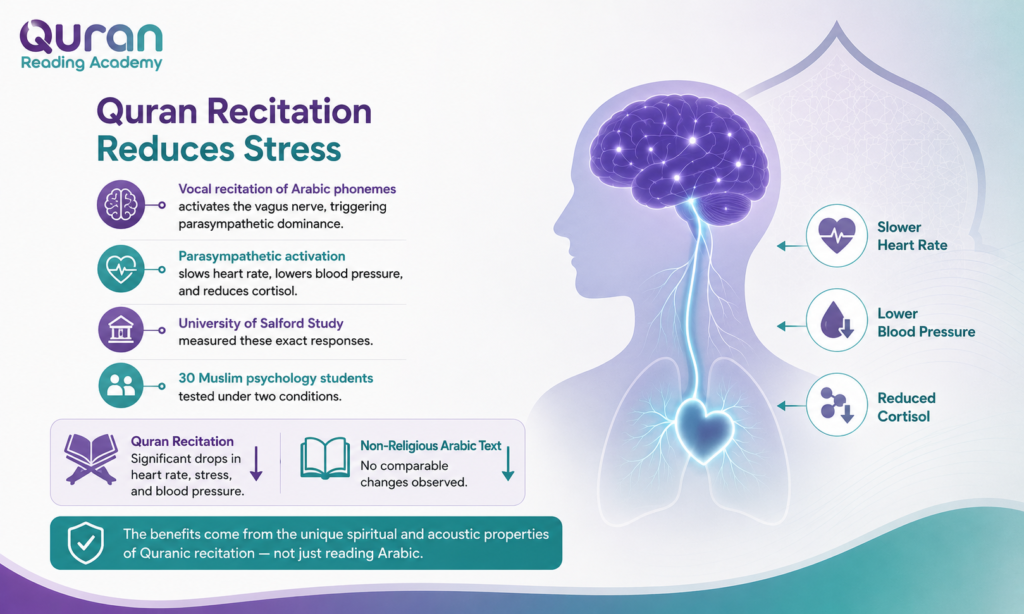
Parasympathetic activation slows heart rate, lowers blood pressure, and reduces circulating cortisol. A study at the University of Salford in the United Kingdom measured these exact responses.
Researchers tested 30 Muslim psychology students under two conditions. One group read the Quran while the other read a non-religious Arabic text.
The Quran group showed significant drops in heart rate, perceived stress, and blood pressure. The control group reading secular Arabic showed no comparable changes.
This finding isolates the spiritual and acoustic properties of Quranic recitation as the active variable, not simply the act of reading Arabic.
Read also: 10 Benefits Of Reading The Quran In Arabic
b. Tarteel Encourages Slow, Controlled Breathing
Tarteel recitation requires controlled, elongated breathing at specific stopping points. Each breath cycle during proper Tajweed mirrors diaphragmatic breathing techniques used in clinical anxiety treatment.
The elongated exhalation during madd letters activates the relaxation response. This is the same mechanism that yoga practitioners and meditation experts use to calm the autonomic nervous system.
A reader who practices Tajweed rules daily trains the respiratory system toward a pattern that naturally reduces anxiety without any pharmaceutical intervention.
Quran Reading Academy offers a dedicated Quran Tajweed Course that builds correct breathing mechanics alongside precise articulation rules.
Learn Tajweed with certified instructors and strengthen both recitation and respiratory health
3. The Quran Reading Supports Memory and Cognitive Health
Quran reading demands simultaneous engagement of visual processing, auditory decoding, linguistic analysis, and motor speech coordination. This multi-channel activation builds cognitive reserve over time.
a. Quran Recitation Engages Memory and Learning
The hippocampus, located in the temporal lobe, serves as the brain’s memory consolidation center. Quran recitation activates this region through combined auditory and vocal processing.
Repeated activation of the hippocampus promotes neuroplasticity. Neural connections strengthen and multiply with each recitation session, building a denser memory network.
Irish researchers studying rote learning found that extended memorization exercises improve neural plasticity. Participants aged 55 to 70 showed measurable hippocampal growth after consistent practice.
Quran memorization applies this same principle with an added layer of melodic recitation that engages additional temporal lobe circuits.
Read also: 10 Benefits of Reading Quran Daily
b. Quran Memorization and Age-Related Cognitive Health
A study conducted by the Alzheimer’s Association examined 580 participants aged 20 to 40. Half had memorized portions of the Quran while the other half had not.
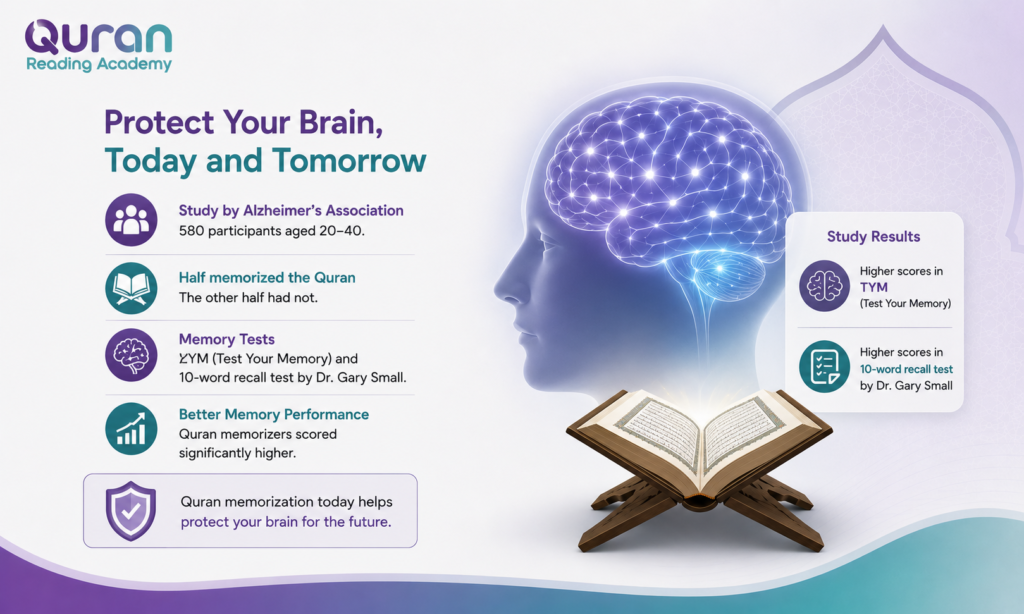
Results showed that Quran memorizers scored significantly higher on both the TYM (Test Your Memory) assessment and the 10-word recall test designed by Dr. Gary Small.
The Prophet Muhammad (peace be upon him) connected Quran recitation directly to preservation from decline.
عَنْ عُثْمَانَ بْنِ عَفَّانَ رضي الله عنه قَالَ: قَالَ رَسُولُ اللَّهِ صلى الله عليه وسلم: خَيْرُكُمْ مَنْ تَعَلَّمَ الْقُرْآنَ وَعَلَّمَهُ
(‘An ‘Uthmāna ibn ‘Affān raḍiyallāhu ‘anhu qāla: qāla Rasūlullāhi ṣallallāhu ‘alayhi wa sallam: khayrukum man ta’allamal-Qur’āna wa ‘allamah)
(“The best of you are those who learn the Quran and teach it.”)
Sahih al-Bukhari 5027
The Prophet (peace be upon him) placed Quran learners at the highest rank among the Muslim community. Active learning and recitation engage the brain in ways that passive reading of any other text cannot match.
See Our Academy in Action
Discover what a typical session looks like! Watch these brief highlights from our live, interactive classes to see how our instructors engage with students of all ages.
Start Your Quran Learning Journey Today
Join Quran Reading Academy and begin structured, step-by-step Quran reading with expert guidance.
Try your first class for free4. The Quran Recitation May Support Heart and Blood Pressure Health
Reading the Quran consistently creates favorable conditions for heart health. The combination of deep breathing, stress reduction, and focused contemplation produces cardiovascular benefits that compound over time.
a. Quran Recitation, Breathing, and Heart Rate Variability
Heart rate variability (HRV) measures the variation in time between consecutive heartbeats. Higher HRV indicates a healthier, more adaptable cardiovascular system.
Rhythmic Quran recitation, especially during Tarteel, produces a steady oscillation in breathing that directly improves HRV. This effect mirrors the cardiac benefits of controlled breathing exercises prescribed by cardiologists.
b. Quran Memorization and Blood Pressure in Older Adults
A cross-sectional study of older Saudi men aged 55 and above in Buraidah, Al-Qassim found striking results. Participants who had memorized at least 10 sections of the Quran were 64% less likely to have hypertension.
The same study found these memorizers were 71% less likely to have diabetes and 81% less likely to suffer from depression compared to those who memorized less than half a section.
A clear linear trend emerged. The more Quran a person had committed to memory, the lower the probability of chronic disease across all three categories.
Quran Reading Academy provides a structured Quran Hifz Course designed to build memorization gradually while reinforcing correct pronunciation at every stage.
Start your memorization journey with expert Huffadh instructors today
5. The Quran Reading Supports Emotional Resilience and Well-Being
Quran reading addresses emotional suffering at its root by reframing the reader’s relationship with hardship, loss, and uncertainty. This reframing is not abstract philosophy but a direct instruction from the Creator.
Finding Contentment and Inner Calm Through Dhikr
أَلَا بِذِكۡرِ ٱللَّهِ تَطۡمَئِنُّ ٱلۡقُلُوبُ
(Alā bi dhikrillāhi taṭma’innul-qulūb)
(“Verily, in the remembrance of Allah do hearts find rest.”)
This verse identifies the mechanism directly. The Arabic word “taṭma’inn” means to settle, to become tranquil, to reach a state of assured calm. It describes a physiological state, not merely an emotion.
Clinical observations confirm this effect. The 2018 study on Quranic therapy for psychological disorders tested 121 patients across both genders through structured listening sessions.
Results showed 92.6% effectiveness among willing participants. Additionally, 81.8% of patients who attended regular sessions reported that Quranic therapy supported their mental health needs.
Reframing Hardship Through Stories of the Prophets
The Quran contains detailed accounts of prophets facing extreme trials. Yusuf (peace be upon him) endured betrayal, imprisonment, and separation from his father for decades.
Maryam (peace be upon her) faced social isolation and physical pain during childbirth alone. Yet Allah provided for her in ways she could not anticipate.
Reading these narratives during periods of personal difficulty activates a cognitive reframing process. The reader sees that suffering has divine purpose and that relief follows patience.
This is an active psychological intervention that restructures negative thought patterns where they originate.
Read also: Benefits of Reading Quran at Night
6. Quran Recitation, Physical Healing, and Immune Health
The connection between stress reduction and immune function is well established in medical literature. Chronic stress suppresses immune cell activity while calm states promote optimal immune surveillance.
Stress Reduction, Cortisol, and Inflammation
Elevated cortisol over extended periods triggers systemic inflammation. Inflammation underlies conditions ranging from cardiovascular disease to autoimmune disorders to certain cancers.
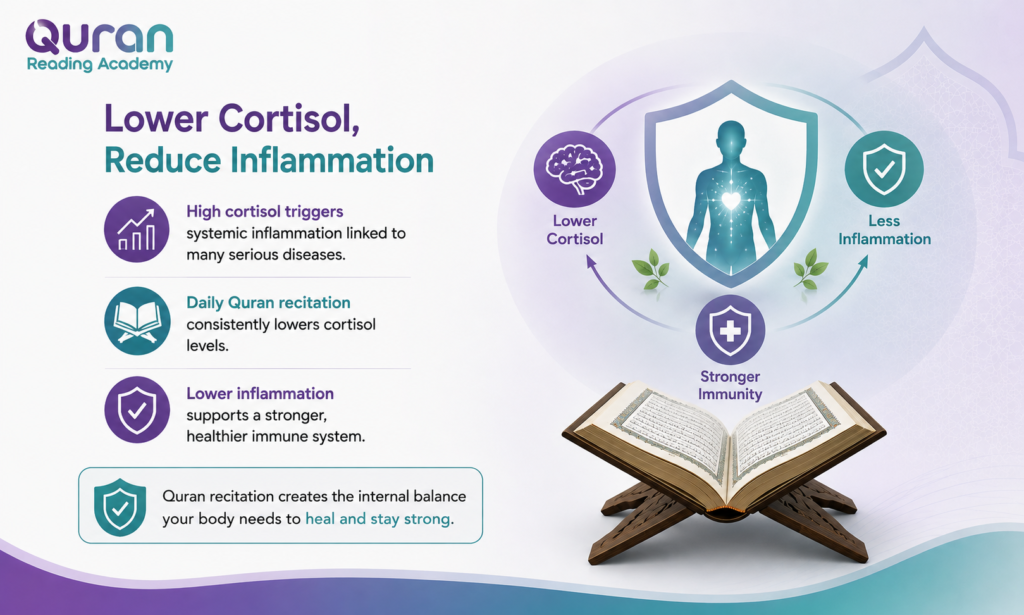
Daily Quran recitation, by consistently lowering cortisol, removes one of the primary drivers of chronic inflammation. This creates an internal environment where the immune system operates at full capacity.
Surah Al-Fatiha and the Prophetic Practice of Ruqyah
The Prophet Muhammad (peace be upon him) validated the use of Surah Al-Fatiha for physical healing. A companion recited it over a tribal leader who had been bitten by a venomous creature.
عَنْ أَبِي سَعِيدٍ الْخُدْرِيِّ أَنَّ نَاسًا مِنْ أَصْحَابِ النَّبِيِّ صلى الله عليه وسلم أَتَوْا عَلَى حَيٍّ مِنْ أَحْيَاءِ الْعَرَبِ فَلَمْ يَقْرُوهُمْ فَبَيْنَمَا هُمْ كَذَلِكَ إِذْ لُدِغَ سَيِّدُ أُولَئِكَ فَقَالُوا هَلْ مَعَكُمْ مِنْ دَوَاءٍ أَوْ رَاقٍ فَقَالُوا إِنَّكُمْ لَمْ تَقْرُونَا وَلاَ نَفْعَلُ حَتَّى تَجْعَلُوا لَنَا جُعْلاً
(An Abī Sa’īd al-Khudriyyi anna nāsan min aṣḥābin-Nabiyyi ṣallallāhu ‘alayhi wa sallam ataw ‘alā ḥayyin min aḥyā’il-‘Arab falam yaqrūhum, fabaynahum kadhālika idh ludigha sayyidu ulā’ika faqālū hal ma’akum min dawā’in aw rāqin…)
(“Some companions of the Prophet came upon an Arab tribe that did not host them. The chief of that tribe was stung, so they asked: Do you have any medicine or someone who can perform Ruqyah?”)
The companion recited Al-Fatiha and the chief recovered completely. The Prophet (peace be upon him) confirmed this practice as valid.
This hadith establishes Quran recitation as a legitimate healing modality within the prophetic medical tradition, not a replacement for professional care but a powerful complement to it.
Quran Reading Academy offers a dedicated Quran Recitation Course focused on Tarteel methodology that builds both spiritual connection and proper vocal technique.
Perfect your recitation with one-on-one expert guidance
7. Nightly Quran Recitation Can Support Better Sleep
Poor sleep accelerates nearly every chronic health condition. Quran reading before bed addresses both the physiological and psychological barriers to restful sleep.
a. Building a Calming Pre-Sleep Quran Recitation Routine
The Prophet Muhammad (peace be upon him) recommended specific surahs before sleep, including Surah Al-Mulk and the last two verses of Surah Al-Baqarah.
This prophetic practice creates a structured wind-down ritual. The rhythmic Arabic phonemes reduce mental chatter while the content shifts focus away from daily anxieties toward divine trust.
Clinicians who treat insomnia recognize that a consistent pre-sleep routine is the single most effective behavioral intervention. Quranic recitation fulfills this role with an added spiritual dimension.
b. Quran Recitation and Stress Before Sleep
Stress-related insomnia often involves cortisol spikes during the night that disrupt deep sleep cycles. Regular reciters experience lower baseline cortisol levels, which translates to fewer nighttime awakenings.
The cumulative effect over weeks and months is profound. Better sleep quality improves daytime cognitive function, emotional regulation, and immune recovery during rest.
Read also: Benefits of Reading Quran in the Morning
8. Group Quran Recitation Supports Social and Spiritual Well-Being
Reading Quran in congregation produces health benefits that solitary reading cannot replicate. The Prophet (peace be upon him) described this communal dimension explicitly.
Hadith on Gathering for Quran Study
مَا اجْتَمَعَ قَوْمٌ فِي بَيْتٍ مِنْ بُيُوتِ اللَّهِ يَتْلُونَ كِتَابَ اللَّهِ وَيَتَدَارَسُونَهُ بَيْنَهُمْ إِلاَّ نَزَلَتْ عَلَيْهِمُ السَّكِينَةُ وَغَشِيَتْهُمُ الرَّحْمَةُ وَحَفَّتْهُمُ الْمَلاَئِكَةُ وَذَكَرَهُمُ اللَّهُ فِيمَنْ عِنْدَهُ
(Mā ijtama’a qawmun fī baytin min buyūtillāhi yatlūna kitāballāhi wa yatadārasūnahu baynahum illā nazalat ‘alayhimus-sakīnatu wa ghashiyat-humur-raḥmatu wa ḥaffat-humul-malā’ikatu wa dhakarahumullāhu fīman ‘indah)
(“No people gather in one of the houses of Allah, reciting the Book of Allah and studying it together, except that tranquility descends upon them, mercy covers them, angels surround them, and Allah mentions them to those near Him.”)
The word “sakīnah” describes a tangible tranquility that descends on the group. Social connection combined with shared spiritual practice reduces isolation, which is itself a major risk factor for cardiovascular disease and depression.
Group recitation circles also create accountability structures that maintain consistent reading habits over years rather than weeks.
Read also: Spiritual Benefits of Reading Quran
9. Building a Daily Recitation Routine for Maximum Benefit
Knowing the benefits matters less than implementing a sustainable daily practice. The health gains described above require consistency, not marathon reading sessions.
a. Make Quran Reading Part of Your Post-Fajr Routine
The period immediately after Fajr prayer offers the optimal window for Quran reading. Cortisol naturally peaks in early morning, and recitation during this window channels that energy toward focused spiritual engagement.
Even one page daily after Fajr creates a compound effect over months. The key is regularity, not volume. A reader who completes one page every morning for a year finishes the entire Quran twice.
b. Build an Evening Quran Recitation Habit Before Sleep
Pairing a morning session with a brief evening recitation creates two daily cortisol-lowering interventions. Surah Al-Mulk and the last three surahs before bed take approximately ten minutes.
This dual-session approach mirrors the clinical recommendation of twice-daily relaxation practice for optimal stress management outcomes.
Inside Our Live Classroom
We believe in complete transparency. Take a look inside our virtual classrooms to experience our premium teaching tools and engaging learning environment firsthand.
Start Your Quran Learning Journey Today
Join Quran Reading Academy and begin structured, step-by-step Quran reading with expert guidance.
Try your first class for freeStart Your Free Trial Session Today
Every benefit described in this article begins with a single step toward consistent, correct recitation. Quran Reading Academy offers a free trial session where you experience personalized one-on-one instruction with a certified teacher.
During this session, your instructor assesses your current reading level and recommends the ideal course path. No commitment required after the session ends.
Whether you are a complete beginner learning Arabic letters or an intermediate reader refining Tajweed, this free session gives you a clear starting point.
Our Quran Courses
- Quran Reading Classes
- Quran Reading Classes for Kids
- Quran Reading Classes for Adults
- Quran Reading Classes for Female/Sisters
- Quran Reading Classes for New Muslims
- Quran Reading Course for Beginners
- Online Quran Reading Course with Tajweed
- Reading and Memorizing the Quran Course
- Noorani Qaida Course
- Quran Course for Beginners
- Quran Tajweed Course
- Quran Recitation Course
- Quran Hifz Course
- Online Quran Qirat Classes
Book Your Free Trial Session Now
Conclusion
Reading the Quran delivers a wide set of physical, mental, and emotional health gains that no single wellness practice can match. From cortisol reduction and cardiovascular protection to cognitive sharpening and depression relief, every benefit traces back to consistent engagement with Allah’s words.
The scientific evidence aligns with what the Quran itself declares. Allah sent this Book as healing and mercy, and modern research continues to confirm that promise across clinical settings worldwide.
The health benefits of reading Quran are not reserved for scholars or Huffadh alone. Every Muslim who picks up the Mushaf with sincere intention and reads even a single verse activates these protective mechanisms.
Frequently Asked Questions
Does reading the Quran actually reduce stress and anxiety?
Yes. Clinical research at the University of Salford demonstrated that Quran recitation lowers heart rate, blood pressure, and perceived stress levels. The rhythmic breathing patterns of Tajweed recitation activate the parasympathetic nervous system, producing a measurable calming response that secular Arabic reading does not replicate.
How many minutes of daily Quran reading provide health benefits?
Even ten to fifteen minutes of focused recitation daily produces noticeable results within weeks. The key factor is consistency rather than duration. A brief daily session after Fajr or before sleep builds cumulative cortisol reduction and cognitive benefits that irregular long sessions cannot match.
Can listening to Quran recitation offer the same benefits as reading?
Listening provides significant benefits, particularly for stress and anxiety reduction. However, active reading and vocal recitation engage additional brain regions including motor speech areas and the hippocampus. Combining both listening and personal recitation maximizes the full range of cognitive, emotional, and cardiovascular benefits.
Is there scientific evidence linking Quran memorization to lower disease risk?
A cross-sectional study of older Saudi men found that participants who memorized ten or more sections of the Quran were 64% less likely to have hypertension, 71% less likely to have diabetes, and 81% less likely to experience depression compared to those who memorized less than half a section.
What Quran surah is best for healing purposes?
Surah Al-Fatiha holds a special status in prophetic healing practice. The Prophet Muhammad (peace be upon him) confirmed its use as Ruqyah in Sahih al-Bukhari 5736. Surah Al-Isra verse 82 and Surah Yunus verse 57 also explicitly describe the Quran as a source of healing and mercy for believers.






Leave a Reply