 Quran
Quran
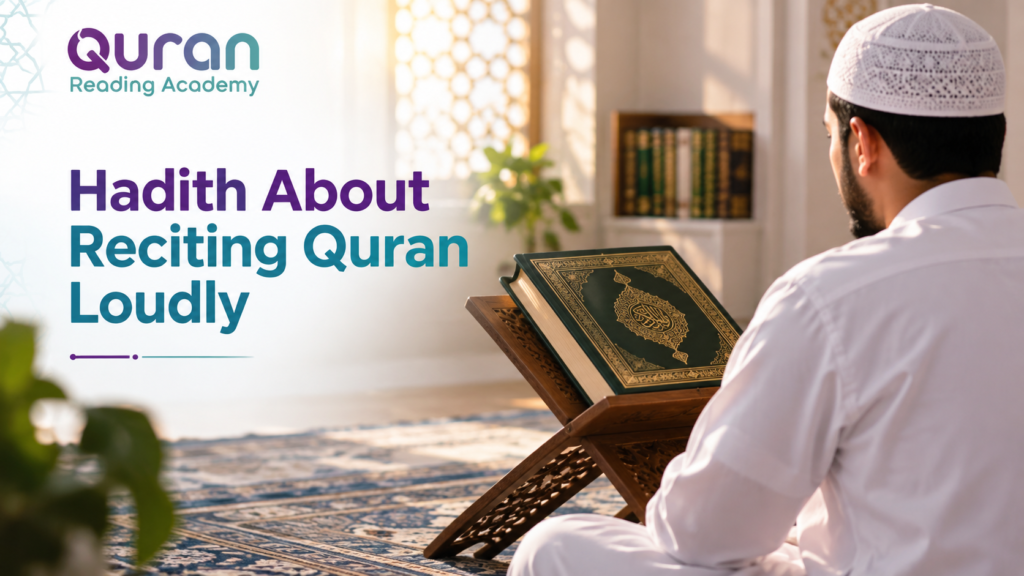
The Prophet Muhammad (peace be upon him) addressed the question of Quran recitation volume across multiple authentic narrations. Some hadiths encourage raising the voice to beautify recitation, while others instruct Muslims to lower it when others are praying nearby.
These narrations do not contradict each other. They address different situations with precise, applicable rulings.
The hadith about reciting Quran loudly forms a critical body of prophetic guidance that every Muslim needs to apply correctly.
The Sunnah provides a clear framework for when audible recitation earns greater reward and when silence becomes the better choice, from home recitation to mosque worship to tahajjud prayers.
1. Hadith Comparing Loud and Quiet Quran Recitation to Charity
The most direct hadith on this topic draws a comparison between recitation volume and the visibility of charitable giving.
This analogy carries significant weight because Islamic law generally favors private charity over public donation.
a. Uqbah ibn Amir’s Report on Loud and Silent Quran Recitation
Uqbah ibn Amir (may Allah be pleased with him) reported that the Prophet (peace be upon him) said:
الْجَاهِرُ بِالْقُرْآنِ كَالْجَاهِرِ بِالصَّدَقَةِ، وَالْمُسِرُّ بِالْقُرْآنِ كَالْمُسِرِّ بِالصَّدَقَةِ
(Al-jaahiru bil-Qur’aani kal-jaahiri bis-sadaqah, wal-musirru bil-Qur’aani kal-musirri bis-sadaqah)
“One who recites the Qur’an in a loud voice is like one who gives alms openly; and one who recites the Qur’an quietly is one who gives alms secretly.”
Since secret charity is considered more virtuous in Islamic jurisprudence because it avoids the risk of showing off, a surface reading might suggest silent recitation is always better. However, classical scholars did not read the hadith in isolation.
b. Imam Al-Nawawi on When Loud or Quiet Recitation Is Better
Imam al-Nawawi’s synthesis became the authoritative position in the Hanafi, Maliki, Shafi’i, and Hanbali schools.
He concluded that quiet recitation is specifically preferred when the person fears falling into riya (showing off) or when raising the voice would disturb worshippers, students, or sleepers nearby.
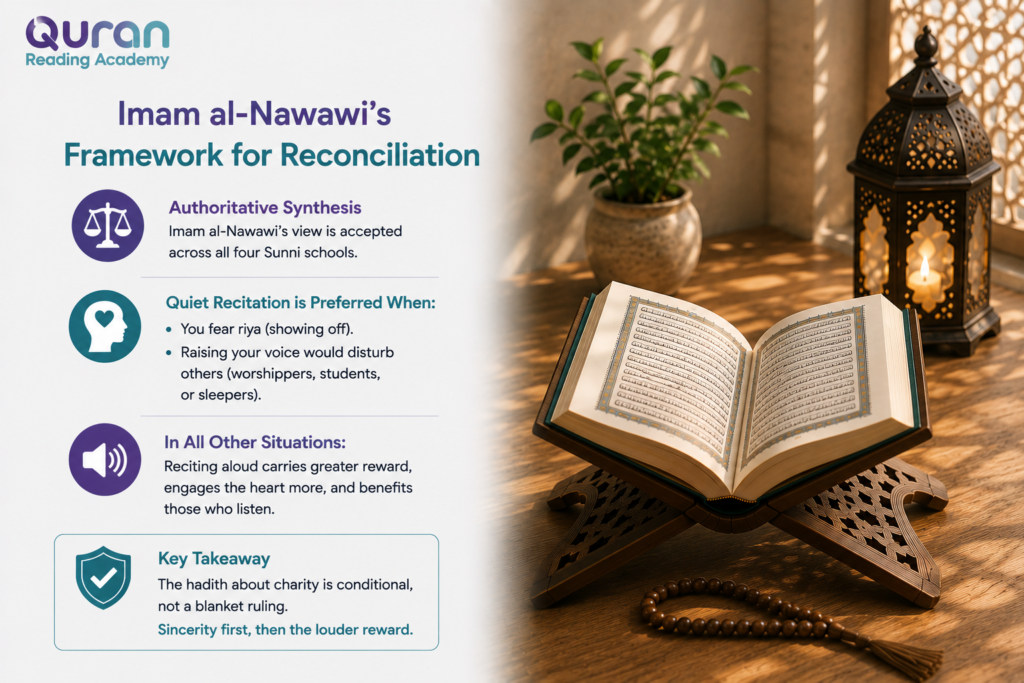
In every other situation, reciting aloud carries greater reward. The effort is greater, the heart becomes more engaged, and the benefit extends to others who listen. The hadith about charity is not a blanket ruling. it is a conditional comparison that applies when sincerity is at risk.
Read also: Hadith About Reading Quran
2. Hadith on Allah Listening to Beautiful Quran Recitation
A second stream of narrations actively encourages vocal, melodious recitation. These hadiths confirm that raising the voice with the Quran is encouraged and praised at the highest level.
Abu Hurairah’s Hadith on Beautiful Quran Recitation
Abu Hurairah (may Allah be pleased with him) reported that the Prophet (peace be upon him) said:
مَا أَذِنَ اللَّهُ لِشَىْءٍ مَا أَذِنَ لِلنَّبِيِّ أَنْ يَتَغَنَّى بِالْقُرْآنِ
(Maa adhina Allahu li-shay’in maa adhina lin-Nabiyyi an yataghanaa bil-Qur’aan)
“Allah does not listen to anything as He listens to a Prophet who recites the Qur’an in a pleasant tone.”
The word “adhina” here means listening carefully and with appreciation. Scholars understood this to show that Allah values a beautiful, raised voice when reciting the Quran. It also encourages us to raise our voices in worship, following the example of the Prophets.
The Prophet’s Command to Beautify the Quran With Your Voice
Al-Bara’ ibn ‘Azib (may Allah be pleased with him) reported that the Prophet (peace be upon him) said:
زَيِّنُوا الْقُرْآنَ بِأَصْوَاتِكُمْ
(Zayyinul-Qur’aana bi-aswaatikum)
Imam al-Khattabi explained that the command here is to make the voice itself beautiful during recitation. Imam al-Nawawi added that the purpose is to recite in a manner that draws people to listen attentively and benefit spiritually.
A voice that carries weight, sincerity, and proper tajweed articulation fulfills this prophetic instruction.
Quran Reading Academy offers a dedicated Quran Recitation Course that trains students to recite with the measured, rhythmic cadence of Tarteel while applying correct tajweed rules under live instructor guidance.
Start building your recitation skills with expert feedback
When Loud Quran Recitation Should Be Lowered to Avoid Disturbance
The governing principle of the entire topic appears in a single narration that sets the line between virtuous audible recitation and harmful disturbance.
This hadith is the key that prevents the encouragement of loud recitation from becoming a license to impose on others.
Abu Said Al-Khudri’s Hadith on Reciting Without Disturbing Others
Abu Sa’id al-Khudri (may Allah be pleased with him) reported that the Messenger of Allah (peace be upon him) was in itikaf in the mosque. He heard his companions reciting aloud. He removed the curtain and said:
أَلاَ إِنَّ كُلَّكُمْ مُنَاجٍ رَبَّهُ فَلاَ يُؤْذِيَنَّ بَعْضُكُمْ بَعْضًا، وَلاَ يَرْفَعْ بَعْضُكُمْ عَلَى بَعْضٍ فِي الْقِرَاءَةِ
(Alaa inna kullakum munaajin Rabbahu, falaa yu’dhiyanna ba’dukum ba’dan, wa laa yarfa’ ba’dukum ‘ala ba’din fil-qiraa’ah)
“Lo! Every one of you is calling his Lord quietly. One should not trouble the other and one should not raise the voice in recitation or in prayer over the voice of the other.”
This narration establishes the boundary with precision. Loud recitation is your right and privilege until it becomes a burden on someone else’s right to worship in peace.
The Prophet (peace be upon him) did not prohibit audible recitation entirely. He prohibited one person’s recitation from overpowering and disturbing another’s worship.
Applying the Hadith to Quran Recitation at Home and in the Mosque
When multiple people are praying or reciting in the same space, the Sunnah requires each person to keep the volume at a level that benefits their own concentration without intruding on others.
In a home setting where a family member is sleeping, the same principle applies. In a private room with no one to disturb, the full benefits of audible recitation are available without restriction.
The British Fatwa Council extended this ruling by analogy (qiyas) to public spaces in non-Muslim societies, noting that if loud recitation is restricted even in a mosque to protect other worshippers, it applies even more strongly on public transport or shared facilities where people have not consented to hear it.
Read also: Hadith About Reading Quran With Difficulty
Four Situations When Reciting the Quran Aloud Is Preferred
Classical scholars in all four madhhabs converged on specific conditions under which raising the voice is the preferred and more rewarded choice.
The following situations represent the scholarly consensus drawn from the combined hadith evidence.
1. Reciting Aloud When You Are Alone
When no one nearby can be affected, the full benefits of audible recitation are realized without cost to anyone.
The physical engagement of the tongue, lips, and vocal cords with each letter increases focus and prevents the mind from wandering during long recitation sessions.
2. Reciting Aloud When Others Benefit From Listening
When others are listening and gaining spiritual benefit from the recitation, the reward multiplies. The reciter earns the reward of their own worship plus the reward of everyone who benefits.
This applies to family gatherings, halaqat (study circles), and teaching environments where students learn proper pronunciation by listening.
3. Reciting Aloud to Improve Focus and Concentration
Audible recitation that prevents mental distraction serves the act of worship more effectively than silence that allows the mind to drift.
Many scholars recommended that a person who finds their attention fading during silent recitation should raise the voice enough to re-engage focus.
4. Reciting Aloud in Fajr, Maghrib, and Isha Prayers
Fajr, Maghrib, and Isha prayers call for audible recitation from the imam. This is an established Sunnah practice and a matter of scholarly consensus. not individual preference.
Quran Reading Academy provides structured Quran Tajweed Course sessions where certified instructors correct articulation points in real time, ensuring every letter meets the standard of authentic prophetic recitation.
Perfect your tajweed with certified instructors
Three Situations When Quiet Quran Recitation Is Preferred
The same scholarly framework that identifies when loud recitation is better also identifies when silence becomes the more virtuous. and sometimes obligatory. choice.
1. Avoiding Disturbance to Worshippers and Sleepers
When worshippers are praying in the same space and loud recitation would confuse their own reading, or when people are sleeping and a raised voice would wake them, silence becomes an act of mercy and an application of the Prophet’s direct command from the hadith of Abu Said al-Khudri.
2. Reciting Quietly to Protect Sincerity and Avoid Riya
When a person honestly recognizes that reciting aloud is feeding self-admiration or the desire to be praised, lowering the voice protects the sincerity of the act.
This is the specific condition where the hadith comparing loud recitation to public charity applies most directly.
3. Quiet Recitation During Voluntary Daytime Prayers
During voluntary daytime prayers, the classical position holds that recitation is quiet by default. The scholar Ibn Sirin established the practical minimum threshold: “In daytime recitation.
let yourself hear.” Your own ears catching the sound of your own voice is the baseline. Anything beyond that requires an honest assessment of whether the increased volume serves a legitimate purpose.
Read also: Hadith About Reading Quran in 3 Days
Minimum Requirement for Quran Recitation to Count
One of the most overlooked rulings in this topic concerns what actually counts as recitation. Many Muslims assume that reading the Quran silently in the mind, without moving the lips or tongue, qualifies as full recitation. The scholarly consensus says otherwise.
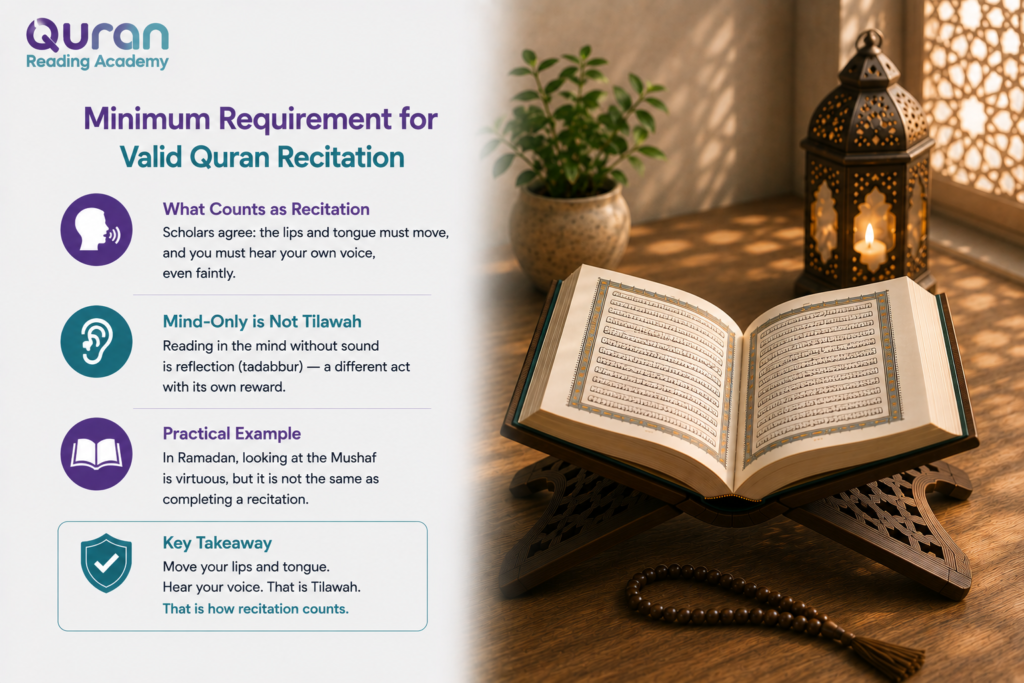
The majority of scholars in the four madhhabs hold that the lips and tongue must move and that the person should be able to hear their own voice, even faintly, for the act to count as tilawah (recitation).
Passing the Quran through the mind without producing any sound is a form of reflection (tadabbur), which carries its own reward, but it is a different act entirely.
This distinction matters practically during Ramadan, when many Muslims sit with an open Mushaf and let the text pass before their eyes without articulating the words.
The reward of looking at the Mushaf has its own virtue, but this is not the same as completing a recitation of the Quran.
Discover what a typical session looks like! Watch these brief highlights from our live, interactive classes to see how our instructors engage with students of all ages.
Start Your Quran Learning Journey Today
Join Quran Reading Academy and begin structured, step-by-step Quran reading with expert guidance.
Try your first class for freeThree Hadiths About the Rewards of Quran Recitation
The narrations about reward for Quran recitation are among the most motivating in the entire hadith corpus. Three in particular address distinct dimensions of reward that every regular reciter should keep in mind.
1. Earn Ten Good Deeds for Every Single Letter
Abdullah ibn Mas’ud (may Allah be pleased with him) reported that the Prophet (peace be upon him) said:
مَنْ قَرَأَ حَرْفًا مِنْ كِتَابِ اللَّهِ فَلَهُ بِهِ حَسَنَةٌ وَالْحَسَنَةُ بِعَشْرِ أَمْثَالِهَا لاَ أَقُولُ الم حَرْفٌ وَلَكِنْ أَلِفٌ حَرْفٌ وَلاَمٌ حَرْفٌ وَمِيمٌ حَرْفٌ
(Man qara’a harfan min Kitaab-Illaahi falahu bihi hasanah, wal-hasanatu bi-‘ashri amthaalihaa, laa aqoolu Alif-Laam-Meem harfun wa laakin Alifun harfun wa Laamun harfun wa Meemun harf)
“Whoever recites a letter from Allah’s Book, then he receives the reward from it, and the reward of ten the like of it. I do not say that Alif Lam Mim is a letter, but Alif is a letter, Lam is a letter and Mim is a letter.”
Jami at-Tirmidhi 2910 | Graded Hasan
A single short verse carries hundreds of individually counted rewards. The arithmetic of daily recitation is far more generous than most Muslims ever stop to calculate.
2. Rise Through the Ranks of Paradise Through Quran Recitation
Abdullah ibn Amr (may Allah be pleased with him) reported that the Prophet (peace be upon him) said:
يُقَالُ لِصَاحِبِ الْقُرْآنِ اقْرَأْ وَارْتَقِ وَرَتِّلْ كَمَا كُنْتَ تُرَتِّلُ فِي الدُّنْيَا فَإِنَّ مَنْزِلَكَ عِنْدَ آخِرِ آيَةٍ تَقْرَؤُهَا
(Yuqaalu li-saahib-il-Qur’aani iqra’ warta qi wa rattil kamaa kunta turattilu fid-dunyaa fa inna manzilaka ‘inda aakhiri aayatin taqra’uhaa)
“It will be said to the companion of the Quran: Recite and ascend, and recite carefully as you used to recite carefully in the world, for your station will be at the last verse you recite.”
Sunan Abi Dawud 1464 | Graded Hasan Sahih by Al-Albani
This hadith links consistent recitation and memorization to elevation in Paradise. a station determined entirely by how much a person engaged with the Book during this life.
3. Earn Double Reward When Quran Recitation Is Difficult
Aisha (may Allah be pleased with her) reported that the Prophet (peace be upon him) said:
الْمَاهِرُ بِالْقُرْآنِ مَعَ السَّفَرَةِ الْكِرَامِ الْبَرَرَةِ وَالَّذِي يَقْرَأُ الْقُرْآنَ وَيَتَتَعْتَعُ فِيهِ وَهُوَ عَلَيْهِ شَاقٌّ لَهُ أَجْرَانِ
(Al-maahiru bil-Qur’aani ma’as-safaratil-kiraamil-bararah, walladhi yaqra’ul-Qur’aana wa yata-ta’ta’u feehi wa huwa ‘alayhi shaqqun lahu ajraan)
“The one who is proficient with the Quran will be with the noble, upright, recording angels; and the one who recites the Quran and struggles with it, finding it difficult, will have two rewards.”
Difficulty is not a signal to stop or feel discouraged. It is confirmation that the effort itself is being counted as a separate act of worship.
The person who stumbles, corrects, and pushes through earns more than the one for whom recitation comes naturally.
Quran Reading Academy runs dedicated Quran Reading Classes for Beginners that take students from the first Arabic letter to confident, tajweed-correct recitation. building real skill, not just familiarity with shapes on a page.
Begin your recitation journey with structured guidance
Essential Etiquette Scholars for Quran Recitation
Beyond the question of volume, the prophetic tradition established a complete set of practices that separate conscious worship from mechanical reading.
Prepare Yourself and Your Space Before Reciting the Quran
Performing wudu before recitation is strongly recommended because the Quran is the highest form of remembrance.
Choosing a clean, quiet space establishes the right spiritual frame. Sitting with composure and facing the qiblah mirrors how the Companions approached the act.
Seeking Refuge in Allah and Reflect on the Verses You Recite
Reciting the ta’awwudh (seeking refuge from Shaytan) before recitation is explicitly recommended in the Quran itself. When passing a verse that mentions Paradise, the Sunnah is to pause and ask Allah for it.
When passing a verse that mentions the Fire, the practice is to pause and seek refuge from it. These pauses turn recitation from passive reading into a direct conversation with the text.
Read also: Hadith About Reading Quran with Tajweed
Build a Consistent Daily Quran Recitation Habit
The Companions maintained daily recitation schedules, often dividing the Quran into fixed portions (ahzab) spread across a week or a month.
Modern research supports what they practiced instinctively. short, consistent daily sessions produce better retention and deeper engagement than occasional marathon readings.
Inside Our Live Classroom
We believe in complete transparency. Take a look inside our virtual classrooms to experience our premium teaching tools and engaging learning environment firsthand.
Start Your Quran Learning Journey Today
Join Quran Reading Academy and begin structured, step-by-step Quran reading with expert guidance.
Try your first class for freeStart Your Structured Quran Recitation With a Free Trial Session
Every hadith discussed in this article points toward the same conclusion: recitation done correctly, consistently, and with proper guidance carries immense spiritual weight. A complete beginner who has never read Arabic and an intermediate reciter refining tajweed both benefit from qualified instruction. It makes the difference between building a lasting habit and struggling alone.
Quran Reading Academy offers a Free Trial Class with a certified instructor who assesses your current level and designs a personalized learning path. No commitment required. Just one session with a real instructor who meets you where you are.
Our Quran Courses
- Quran Reading Classes
- Quran Reading Classes for Kids
- Quran Reading Classes for Adults
- Quran Reading Classes for Female/Sisters
- Quran Reading Classes for New Muslims
- Quran Reading Course for Beginners
- Online Quran Reading Course with Tajweed
- Reading and Memorizing the Quran Course
- Noorani Qaida Course
- Quran Course for Beginners
- Quran Tajweed Course
- Quran Recitation Course
- Quran Hifz Course
- Online Quran Qirat Classes
Book your free trial class now and start reciting with confidence
Conclusion
The hadiths about reciting Quran loudly form a coherent prophetic framework, not a set of conflicting instructions. The Prophet (peace be upon him) praised beautiful audible recitation in one narration, instructed companions during itikaf to protect each other’s worship in another, and guaranteed double reward to every struggling reciter in a third. These three truths hold together without contradiction.
Raise the voice when alone, when others benefit, and when sincerity is intact. Lower it when others are praying, when people are resting, and when the ego begins to intrude. Move the tongue and lips at minimum so the recitation counts. And remember that every single letter. loud or quiet. earns ten good deeds that no other act of worship matches letter for letter.
The path forward is clear: learn the correct pronunciation, apply the prophetic etiquette, and recite consistently. One articulated letter at a time, the reward accumulates in ways that only become fully visible on the Day of Judgment.
Frequently Asked Questions
Is it better to recite the Quran loudly or silently?
Neither is categorically better in every situation. Silent recitation is preferred when there is a genuine risk of showing off or when a raised voice would disturb others praying or sleeping nearby. In all other situations. particularly when alone, when others benefit from listening, or when audible recitation strengthens personal focus. raising the voice carries greater reward according to the majority of classical scholars.
What is the minimum requirement for Quran recitation to count?
The lips and tongue must move and the person must be able to hear their own voice, even faintly. This is the threshold established by the majority of scholars in the four madhhabs. Reading the Quran silently in the mind without producing any sound is considered reflection (tadabbur), which has its own reward, but it does not fulfill the specific worship category of tilawah (recitation).
Does someone who struggles with Quran recitation earn reward?
The person who struggles earns double the reward of the proficient reciter. The Prophet (peace be upon him) confirmed this in the hadith narrated by Aisha in Sahih Muslim. The difficulty and effort involved in recitation count as an additional act of worship on top of the recitation itself. Struggling is not a reason to stop. it is a guarantee of extra reward.
Can loud Quran recitation in a mosque disturb other worshippers?
The Prophet (peace be upon him) addressed this directly in the hadith of Abu Sa’id al-Khudri reported in Sunan Abi Dawud. He instructed companions not to raise their voices over each other during recitation in the mosque. The practical guideline is to keep the volume at a level that serves your own recitation without becoming a burden on anyone else praying or reciting in the same space.
How many good deeds does a person earn for each letter of the Quran?
Each letter of the Quran earns a minimum of ten good deeds. The Prophet (peace be upon him) specified in the hadith narrated by Ibn Mas’ud that “Alif Lam Mim” is not counted as a single letter but as three separate letters. Alif, Lam, and Mim. each earning its own tenfold reward. This means even the shortest verses carry dozens of individually counted rewards.
What does the hadith comparing loud recitation to public charity actually mean?
The hadith narrated by Uqbah ibn Amir in Sunan Abi Dawud draws a parallel: loud recitation is like public charity, and quiet recitation is like private charity. Since private charity is generally more virtuous due to greater sincerity, this hadith indicates that quiet recitation is better specifically when sincerity is at risk. Imam al-Nawawi clarified that when the fear of showing off is absent and no one is disturbed, loud recitation is the more rewarded choice.







Leave a Reply