 Quran
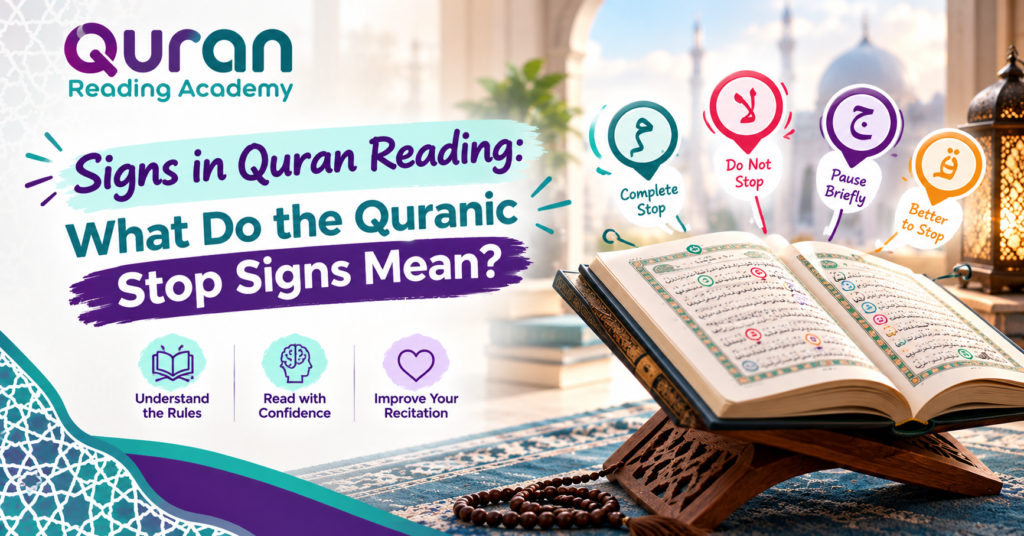
The signs in Quran reading are symbols placed in the Mushaf to guide readers on when to stop, continue, or pause during Quran recitation. These symbols, commonly known as Waqf signs, help readers maintain the intended meaning of the verses and recite the Quran more accurately.
Understanding these signs is especially important for beginners learning Tajweed and Quran recitation, as each symbol gives a specific instruction about how to proceed while reading. In this guide, we’ll explain the most common Quran stop signs, what they mean, and how to apply them correctly during recitation.
What Are the Signs in Quran Reading?
The signs in Quran reading are small symbols placed in the Mushaf to guide readers on when to stop, continue, or briefly pause during Quran recitation. These symbols are commonly known as Waqf signs, with Waqf referring to stopping or pausing while reading.
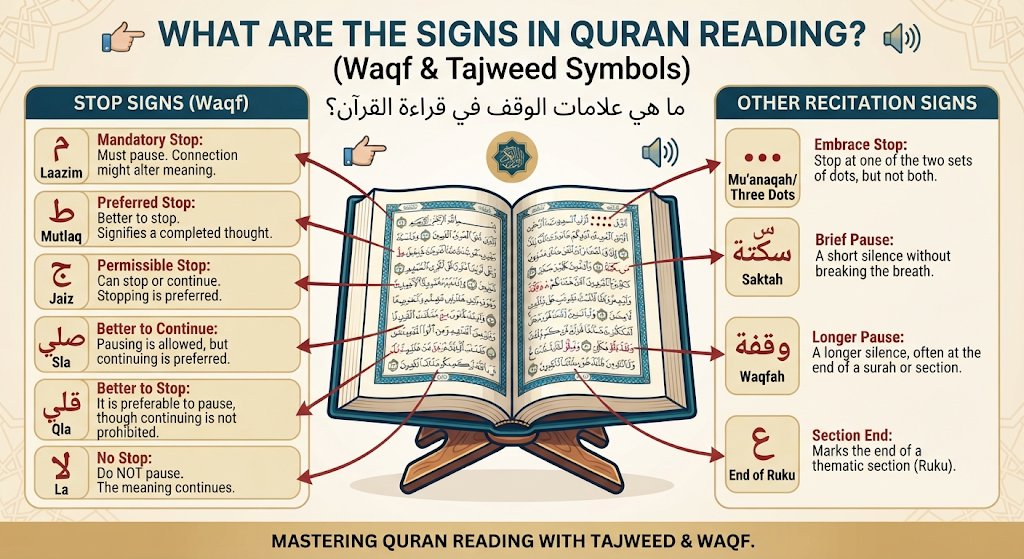
For beginners, the easiest way to understand these signs is to group them according to what they tell you to do:
- م – Mandatory stop: Indicates a place where stopping is strongly required to avoid affecting the meaning.
- لا – Do not stop: Indicates that stopping at this point should generally be avoided.
- ج – Permissible stop: You may stop or continue, depending on your recitation.
- قلى – Stopping is preferred: It is better to stop at this point.
- صلى – Continuing is preferred: It is better to continue reading rather than stop.
- س – Brief pause: Indicates a short pause without taking a full breath.
These categories make Quran stop signs easier to understand without requiring beginners to memorize every symbol immediately. As you learn more about Waqf signs, you can become familiar with each symbol and apply it naturally during Quran recitation Tajweed.
Understanding these signs is an important part of learning Tajweed, because knowing where to stop or continue can help preserve the meaning and flow of Quranic verses.
Waqf and Ibtida: Knowing Where to Stop and Where to Start
Learning the signs in Quran reading is not only about knowing where to stop. A complete understanding of Quran recitation also includes knowing where to begin again after a stop.
What Is Waqf?
Waqf means stopping the recitation at a particular word or place. The Waqf signs in the Mushaf help indicate whether stopping is required, preferred, permissible, or should be avoided.
What Is Ibtida?
Ibtida means beginning or resuming Quran recitation after a stop. When you resume, it is important to choose a starting point that keeps the meaning of the verse clear and connected.
Why Do Waqf and Ibtida Matter?
Imagine that you stop because you run out of breath at a place that is not an ideal stopping point. Simply continuing from the next word may sometimes leave the meaning incomplete. Instead, you may need to go back slightly and restart from a more suitable point.
This is why good Quran recitation involves two related skills:
- Waqf: Knowing where to stop.
- Ibtida: Knowing where to start again.
For beginners, the goal is not to memorize every rule immediately. Start by learning the common Quran stop signs, then practice stopping and restarting with a qualified Quran teacher.
What Do the Different Quran Stop Signs Mean?
Understanding the most common Quran stop signs makes it easier to know when to pause or continue during recitation. While symbol conventions can vary between Mushafs, the following signs are commonly encountered:
1. م – Mandatory Stop
The م sign indicates a strong stop. It is generally placed where continuing without stopping could affect or obscure the intended meaning. When you see م, stop before continuing with the next part of the verse.
2. لا – Do Not Stop
The لا sign indicates that stopping at that point should be avoided. Continuing is preferred because stopping there may leave the meaning incomplete or unclear.
3. ج – Permissible Stop
The ج sign means that stopping or continuing is permissible. Beginners can choose either option based on their breath and recitation, while still considering the meaning of the verse.
4. قلى – Stopping Is Preferred
The قلى sign indicates that stopping is preferable. You may continue when necessary, but stopping at this location is generally considered the better choice.
5. صلى – Continuing Is Preferred
The صلى sign indicates that continuing the recitation is preferable. Although stopping may be possible, maintaining the connection between the words is generally better.
6. س – Brief Pause
The س sign indicates a brief pause during recitation. It is not treated like an ordinary stop where the reader takes a full breath before continuing.
Learning these Quran reading signs gradually is more effective than trying to memorize them all at once. Start with the most common symbols, understand what each one asks you to do, and then practice applying them while reading from the Mushaf.
How to Decide Whether to Stop or Continue
Knowing the meaning of each Quran stop sign is the first step. The next step is learning how to apply that information naturally while reading.
When you encounter a Waqf symbol, use this simple process:
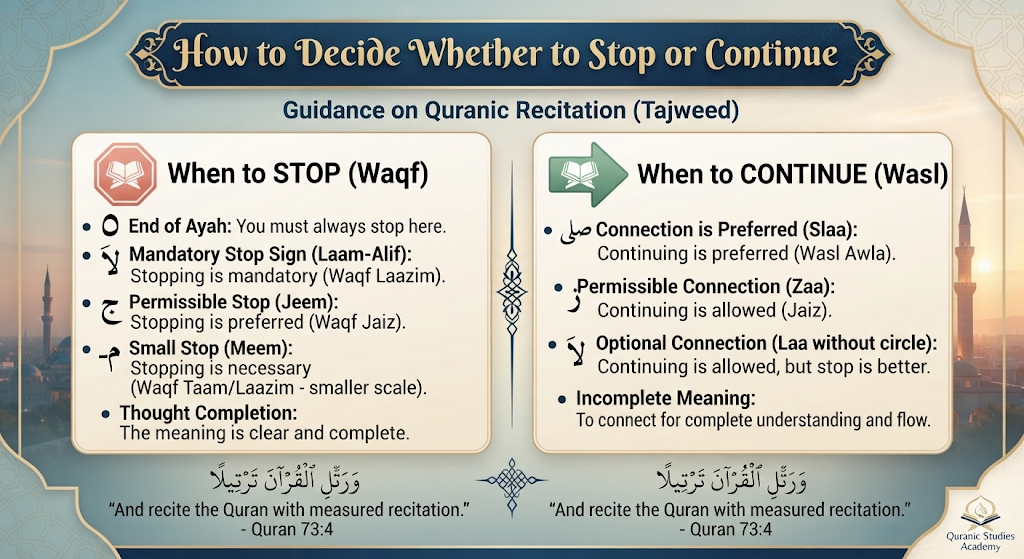
- Identify the symbol – Check whether it indicates stopping, continuing, or that either choice is permissible.
- Follow its guidance – Do not treat every pause as optional.
- Consider the meaning – Avoid stopping in a way that separates words or phrases whose meanings are closely connected.
- Consider your breath – If you need to breathe, choose the most suitable stopping point available.
- Resume carefully – If you had to stop at an unsuitable place, consider restarting from a point that makes the meaning clear.
Read the Quran With Deliberation
The verse “And recite the Quran with measured recitation” (Surah Al-Muzzammil 73:4) refers to Tarteel, the practice of reciting the Quran slowly, clearly, and deliberately rather than rushing.:
وَرَتِّلِ الْقُرْآنَ تَرْتِيلًا
“And recite the Quran with measured recitation.”
This verse highlights the importance of reading the Quran with care and deliberation. Following Waqf signs is one practical part of developing that careful approach to Quran recitation.
For beginners, remember one simple rule: do not focus only on where you can stop; also learn why you should stop there and where you should begin again.
What Is the Difference Between Waqf Signs and Tajweed Rules?
Waqf signs and Tajweed rules both help you read the Quran correctly, but they focus on different aspects of recitation. Waqf signs tell you where and how to stop or continue while reading. They help you maintain the correct meaning and flow of the Quranic verses. Symbols such as م, لا, ج, قلى, and صلى guide stopping and continuing.
Tajweed rules, on the other hand, explain how to pronounce the Quranic letters and words correctly. They cover areas such as the pronunciation of letters, elongation (Madd), Ghunna, Idgham, Ikhfa, and other rules of Quran recitation.
A Simple Way to Remember the Difference
Think of it this way:
- Waqf signs: Where should I stop or continue?
- Tajweed rules: How should I pronounce what I am reading?
You need both skills for accurate Quran recitation. Learning Waqf signs helps you manage pauses and stops, while Tajweed helps you pronounce the words correctly. Together, they make your reading more accurate and help you preserve the meaning and beauty of the Quran.
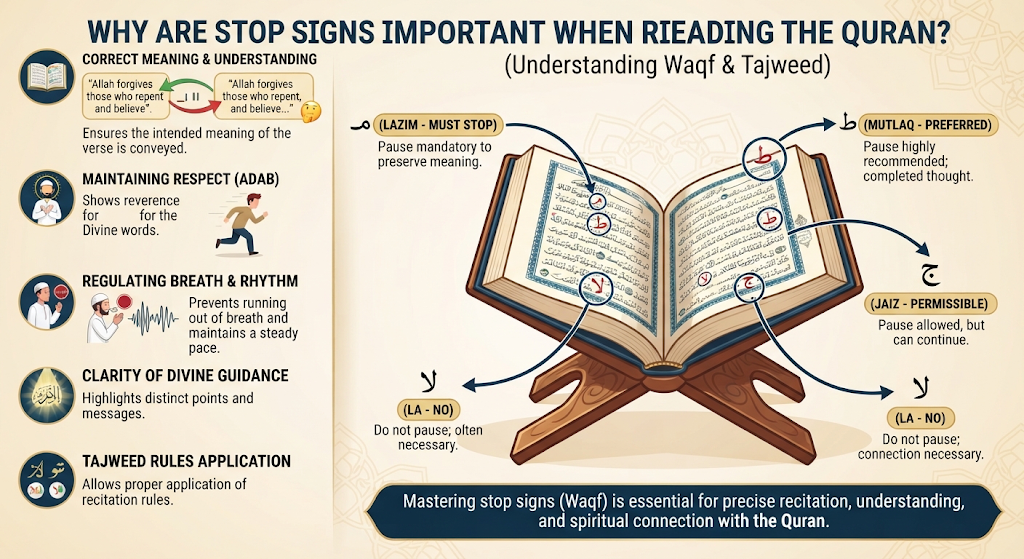
Why Are Stop Signs Important When Reading the Quran?
Quran stop signs are more than visual symbols in the Mushaf. They help readers know where a pause or stop is appropriate so that the meaning and flow of the Quranic verses are not unintentionally disrupted.
For beginners, understanding these signs can make recitation more confident and organized. Instead of stopping randomly whenever you need to breathe, you can learn to look for suitable stopping points and follow the guidance provided by the Mushaf.
1. They Help Preserve Meaning
Stopping at an unsuitable place can sometimes separate words or phrases that are closely connected in meaning. Following Waqf signs helps you avoid unnecessary interruptions and maintain the intended meaning of the verse.
2. They Improve Quran Recitation
Knowing when to stop and continue makes your recitation smoother. It also works alongside Tajweed, helping you develop better control over your reading rather than focusing only on pronunciation.
3. They Help Beginners Read With Confidence
You do not need to memorize every Waqf rule immediately. Start by recognizing the most common symbols and understanding what action each one suggests. With regular practice, these Quran reading signs become easier to recognize and apply naturally.
What Should You Do If You Need to Stop Because You Run Out of Breath?
Ideally, Quran recitation should follow appropriate Waqf signs, but you may sometimes need to stop because you have run out of breath. In this situation, do not force yourself to continue reading simply to reach the next stop sign.
If you must stop at an unsuitable place, take a breath and then resume from an appropriate point that preserves the meaning, rather than simply continuing from the exact word where you stopped.
What Should Beginners Do?
When you feel your breath getting short:
- Look ahead for a suitable stopping point if possible.
- Stop at an appropriate place rather than forcing the recitation.
- Take a comfortable breath.
- When you resume, consider repeating a suitable part of the phrase or verse so the meaning remains connected.
- With practice, learn to control your breathing and recognize natural stopping points.
The goal is not to hold your breath for as long as possible. Good Quran recitation combines proper Waqf, correct pronunciation, and comfortable breathing.
A qualified Quran teacher can also help you practice where to stop and where to restart, especially when a verse contains several connected meanings.
Start Your Quran Learning Journey Today
Join Quran Reading Academy and begin structured, step-by-step Quran reading with expert guidance.
Try your first class for freeWhat If You Have to Stop at an Unsuitable Place?
Sometimes a reader may need to stop before reaching a suitable Waqf sign because of shortness of breath, coughing, forgetting a word, or another interruption. In such situations, do not force yourself to continue reading when you cannot comfortably do so.
After stopping, take a breath and look at the words you have just read. When you resume, avoid starting from a point that could make the meaning incomplete or confusing. If necessary, repeat part of the previous phrase before continuing.
A Simple Example for Beginners
If you had to stop in the middle of a connected phrase:
Stop → Breathe → Review the meaning → Restart from a suitable point → Continue
This is where understanding Ibtida becomes especially useful. The goal is not simply to restart from the exact word where you stopped, but to begin from a point that keeps the meaning connected.
What If You Make a Mistake?
Do not become anxious if you occasionally stop in the wrong place. Quran reading is a learning process. With regular practice and guidance from a qualified Quran teacher, you can gradually improve your understanding of Waqf signs, Ibtida, and Tajweed.
The Prophet ﷺ said:
«الْمَاهِرُ بِالْقُرْآنِ مَعَ السَّفَرَةِ الْكِرَامِ الْبَرَرَةِ، وَالَّذِي يَقْرَأُ الْقُرْآنَ وَيَتَتَعْتَعُ فِيهِ وَهُوَ عَلَيْهِ شَاقٌّ لَهُ أَجْرَانِ».
“The one who is proficient in the Quran is with the noble and obedient scribes.” [Sahih al-Bukhari & Sahih Muslim]
The Prophet ﷺ also taught that the person who recites the Quran with difficulty receives a special reward. This can encourage beginners to continue learning even when recitation is challenging.
What matters is to keep practicing, seek proper guidance, and approach the Quran with care and respect.
Shots Videos from Our Courses
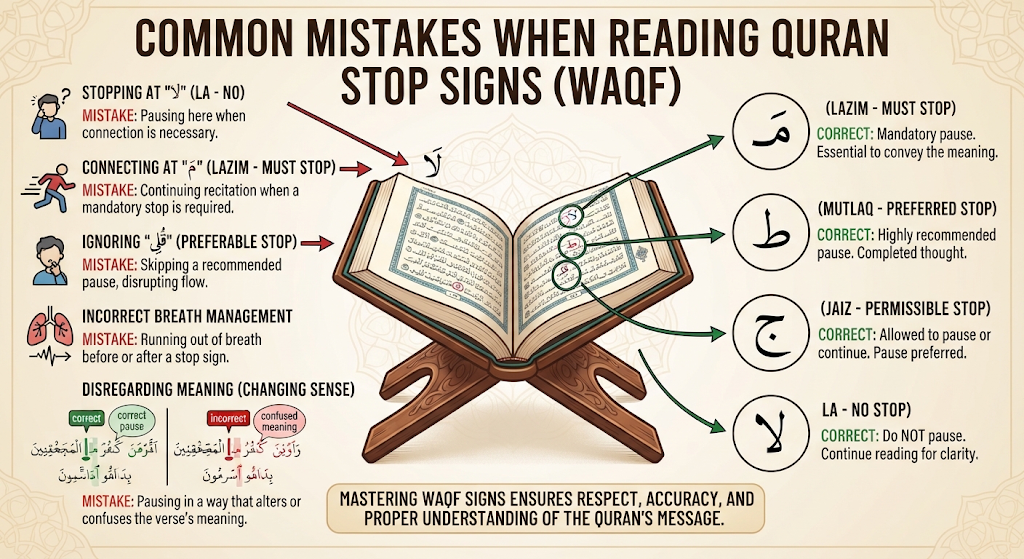
Common Mistakes When Reading Quran Stop Signs
Learning Quran stop signs takes practice. Beginners often make a few simple mistakes when they are still becoming familiar with Waqf signs.
1. Stopping Whenever You Need to Breathe
Breathing is important, but stopping anywhere can sometimes interrupt the meaning. When possible, look ahead and choose a suitable stopping point before your breath runs out.
2. Ignoring the Meaning of the Verse
A reader may focus only on the symbol without considering how the words are connected. Understanding the basic meaning of the verse can make it easier to recognize why a particular stopping point is recommended or discouraged.
3. Treating Every Symbol the Same Way
Not every Quran reading sign means “stop.” Some signs recommend continuing, some allow either choice, and others indicate a brief pause. Learning the basic categories first can prevent confusion.
4. Trying to Memorize Everything at Once
Beginners do not need to learn every Waqf symbol in one lesson. Start with the most common signs, practice them while reading, and gradually add more as your Quran recitation improves.
With regular practice and guidance from a qualified Quran teacher, these signs become much easier to recognize and apply naturally.
Are Quran Stop Signs the Same in Every Mushaf?
The basic purpose of Waqf signs is the same: they guide the reader on where stopping or continuing is appropriate. However, you may notice differences in the symbols or their placement when comparing different Mushafs.
This is because different editions and traditions of Quran printing may use different systems for marking Waqf. Some Mushafs may include more signs, while others may use different symbols or place them at slightly different locations.
Should Beginners Be Concerned?
Not necessarily. If you are learning from a particular Mushaf, focus first on understanding the Quran reading signs used in that copy rather than comparing every symbol with another edition.
If you notice that two Mushafs have different Waqf markings, this does not mean that the Quran itself is different. The difference is generally related to the system used to indicate stopping and continuation.
A qualified Quran teacher can help you understand the signs in the Mushaf you regularly use and explain how to apply them correctly during recitation.
Are Quran Stop Signs the Same as the Seven Qira’at?
No. Quran stop signs and the Seven Qira’at are two different concepts. Waqf signs are symbols found in the Mushaf that guide the reader on where to stop, continue, or pause during Quran recitation. They relate to how a reader manages pauses and stopping points within verses.
The Seven Qira’at, on the other hand, refer to recognized canonical modes of Quranic recitation transmitted through established chains of reciters. They involve differences in aspects of recitation, such as pronunciation and certain linguistic features, rather than simply telling you where to stop.
A Simple Way to Remember the Difference
- Waqf signs: Tell you where to stop or continue.
- Qira’at: Refer to recognized modes of Quran recitation.
So, if you are searching for signs in Quran reading, you are most likely asking about Waqf signs, not the Seven Qira’at. Understanding this distinction can help beginners focus on the right skills when learning Quran reading and Tajweed.
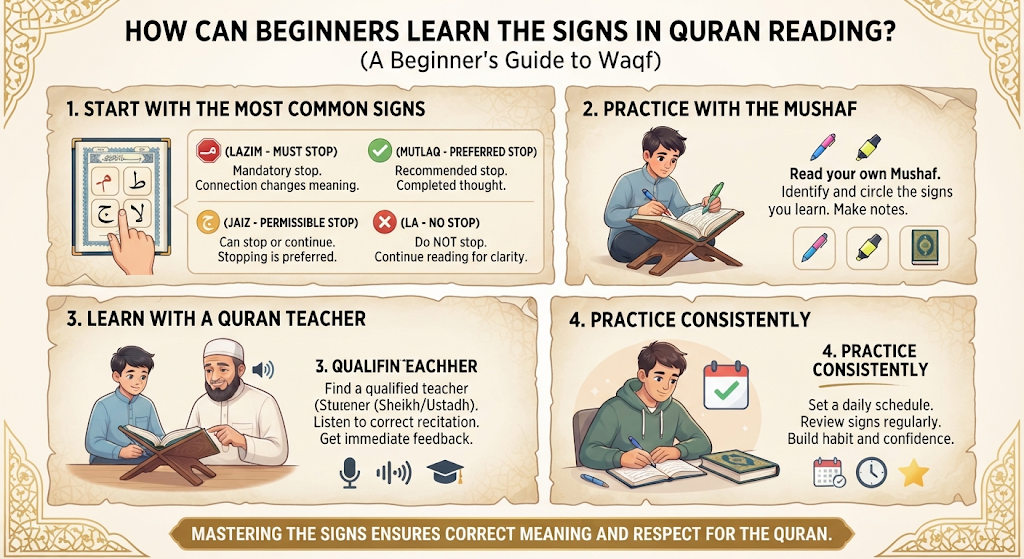
How Can Beginners Learn the Signs in Quran Reading?
Beginners do not need to memorize every Waqf sign before they can start applying them. The best approach is to learn the most common symbols gradually and practice them during regular Quran reading.
1. Start With the Most Common Signs
Begin with symbols such as م, لا, ج, قلى, and صلى. Learn what each symbol means and, most importantly, what action you should take when you see it.
2. Practice With the Mushaf
Choose a short Surah and read it slowly. Whenever you encounter a Quran stop sign, pause and identify what the symbol is telling you to do. This helps connect the rule with actual Quran recitation.
3. Learn With a Quran Teacher
A qualified Quran teacher can correct your stopping and help you understand why a particular place is suitable or unsuitable for Waqf. This is especially helpful when the meaning of a verse affects where you should stop.
4. Practice Consistently
A few minutes of focused practice each day can make the signs much easier to recognize. Over time, you will begin to notice stopping points naturally instead of having to think about every symbol.
Learning signs in Quran reading is not about memorizing symbols alone. It is about understanding their purpose and applying them correctly while reciting the Quran.
Learn Quran Reading and Tajweed With Quran Reading Academy
Understanding signs in Quran reading becomes much easier when you learn them through guided practice. At Quran Reading Academy, students can learn Quran reading, Tajweed, pronunciation, and Waqf rules with qualified Quran teachers in a structured online learning environment.
Instead of simply memorizing the meanings of symbols, you can practice applying Quran stop signs while reading actual verses. Your teacher can also help you improve pronunciation, identify appropriate stopping points, and correct mistakes as you recite.
Whether you are a beginner or looking to improve your existing Quran reading skills, personalized lessons can help you build greater confidence and consistency.
Start Learning Quran Reading Today
Ready to improve your Quran recitation and understand Waqf signs with proper guidance? Join Quran Reading Academy and learn with a qualified teacher who can support you step by step.
Book your free trial class today and start improving your Quran reading with confidence.
Start Your Quran Learning Journey Today
Join Quran Reading Academy and begin structured, step-by-step Quran reading with expert guidance.
Try your first class for freeConclusion
The signs in Quran reading, especially Waqf signs, help readers understand when to stop, continue, or briefly pause during Quran recitation. Learning common symbols such as م, لا, ج, قلى, and صلى can make your reading more accurate and confident.
You do not need to memorize every sign at once. Start with the most common symbols, practice them while reading the Mushaf, and learn with a qualified teacher who can explain how to apply them correctly.
With regular practice and proper guidance, understanding Quran stop signs can become a natural part of your recitation. Quran Reading Academy can help you develop your Quran reading and Tajweed skills through personalized online lessons.
FAQs
What does م mean in the Quran?
The م symbol generally indicates a strong or necessary stop. It helps prevent the reader from continuing in a way that could affect the intended meaning.
What does لا mean in the Quran?
The لا symbol indicates that stopping at that location should generally be avoided. Continuing is preferred so that the meaning remains connected.
What does ج mean in the Quran?
The ج symbol indicates a permissible stop. You may stop or continue, depending on the context and your recitation.
What does قلى mean in the Quran?
The قلى symbol indicates that stopping is preferred, although continuing may still be possible.
What does صلى mean in the Quran?
The صلى symbol indicates that continuing is preferred. It suggests maintaining the connection with what follows.
Why are stop signs important when reading the Quran?
They help readers make appropriate stopping and continuation choices, supporting accurate Quran recitation and helping preserve the meaning and flow of the verses.
Do I need to memorize all Waqf signs?
No. Beginners can start with the most common signs and learn additional symbols gradually through regular practice and guidance from a qualified Quran teacher.



Leave a Reply