 How to read Quran
Many Muslims struggle with reading Quranic Arabic despite their deep desire to connect with the Quran directly. Learning to read Quranic Arabic opens the door to proper recitation, meaningful prayer, and spiritual fulfillment.
Reading Quranic Arabic rests on a structured progression: mastering the alphabet, internalizing vowel marks, recognizing silent letters, lengthening sounds correctly, and applying essential Tajweed rules. With disciplined practice and qualified guidance, non-Arabic speakers can develop accurate, confident recitation rooted in authentic methodology.
1. Begin Learning to Read Quranic Arabic with the Arabic Alphabet
To read Quranic Arabic, you must first master all 28 Arabic letters with their correct shapes and sounds. The Arabic alphabet forms the foundation of Quranic reading.
Unlike English, Arabic letters change shape based on their position in a word. Each letter has up to four forms: isolated, initial, medial, and final.
Start by learning five letters daily. Practice writing each form while pronouncing it correctly. This prevents confusion later when reading connected text.
Master Individual Letter Pronunciation
Each Arabic letter has a specific articulation point called a Makhraj. Your tongue, lips, throat, and nasal cavity create different sounds.
For example, the letter ح (Haa) comes from the middle of the throat. The letter ق (Qaaf) originates from the deepest part of the tongue base.
Listen to a certified Qari demonstrate each letter. Record yourself and compare. Incorrect pronunciation from the start creates lasting mistakes that are difficult to correct later.
The Quran Reading Academy’s Noorani Qaida Course provides one-on-one instruction where certified tutors correct your pronunciation in real-time during live sessions.
Start Reading the Quran Today with Our Noorani Qaida Course

2. Learn to Read Quranic Arabic Harakat Correctly
Harakat are the vowel marks that determine how you pronounce Arabic letters. Without mastering Harakat, you cannot read Quranic Arabic accurately.
There are three primary short vowels: Fatha (َ), Kasra (ِ), and Damma (ُ). Each produces a distinct sound that changes the word’s meaning completely.
Fatha makes an “a” sound as in “cat.” Kasra produces an “i” sound like “sit.” Damma creates an “u” sound similar to “put.”
Practice Reading Letters with Harakat
Combine each letter you learned with all three Harakat. For example, practice بَ (ba), بِ (bi), بُ (bu) repeatedly.
This exercise builds muscle memory for your tongue and lips. Your mouth learns to transition smoothly between different vowel sounds.
Example from Surah Al-Fatihah:
بِسْمِ ٱللَّهِ ٱلرَّحْمَـٰنِ ٱلرَّحِيمِ
Bismillahir-Rahmanir-Raheem
“In the name of Allah, the Entirely Merciful, the Especially Merciful.” (Al-Fatihah 1:1)
Notice how Kasra under ب creates the “Bi” sound in Bismillah.
3. Understand How to Read Quranic Arabic with Sukoon
Sukoon (ْ) is the absence of a vowel, creating a stopped or silent sound. It appears as a small circle above the letter.
When a letter carries Sukoon, you pronounce the letter without adding any vowel sound. This creates syllable boundaries in Arabic words.
Reading Sukoon correctly prevents adding extra vowels that distort Quranic pronunciation. Many beginners struggle because they unconsciously add vowel sounds where Sukoon appears.
Recognize Sukoon in Connected Words
In the word “Bismillah,” the letter م carries Sukoon after “Bis.” This stops the sound before continuing with “mil.”
Practice reading two-letter combinations where the second letter has Sukoon. Example: قُلْ (qul).
Start Your Quran Learning Journey Today
Join Quran Reading Academy and begin structured, step-by-step Quran reading with expert guidance.
Try your first class for free4. Master How to Read Quranic Arabic Long Vowels
Long vowels extend the sound for two counts. They use specific letter combinations called Huroof al-Madd.
The three long vowels are: Alif (ا) for long “aa,” Waaw (و) for long “oo,” and Yaa (ي) for long “ee.”
Long vowels change word meanings entirely. The difference between قَالَ (qaala – he said) and قُلْ (qul – say) demonstrates this perfectly.
Apply Long Vowel Rules When Reading
When you see Fatha followed by Alif, extend the “a” sound for two beats. Similarly, Damma before Waaw extends “u” sound.
Count silently “one-two” in your mind while sustaining the vowel. This ensures consistent lengthening across your recitation.
| Long Vowel Type | Letter Combination | Sound | Example |
| Alif Madd | Fatha + ا | aa (2 counts) | قَالَ (qaala) |
| Waaw Madd | Damma + و | oo (2 counts) | نُوحٌ (Nooh) |
| Yaa Madd | Kasra + ي | ee (2 counts) | قِيلَ (qeela) |
5. Learn to Read Quranic Arabic Double Letters
Shaddah (ّ) doubles a letter’s sound, creating emphasis and changing meaning. It appears as a small “w” shape above the letter.
When you see Shaddah, pronounce the letter twice with firmness. The first pronunciation carries Sukoon, the second carries the vowel mark.
For example, in the word رَبِّ (Rabbi), the ب is doubled. Pronounce it as “Rab-bi” with clear emphasis on the doubled letter.
Practice Shaddah with Different Harakat in Quranic Arabic
Shaddah combines with Fatha, Kasra, or Damma. The vowel mark appears above or below the Shaddah symbol.
Read these examples slowly: مُحَمَّدٌ (Muhammad), صَلَّىٰ (salla), حَجَّ (hajja). Notice the emphasis on doubled letters.
Incorrect Shaddah pronunciation is among the most common mistakes in Quranic recitation. Many beginners skip the doubling entirely, which changes word meanings.
6. Understand How to Read Quranic Arabic Tanween Sounds
Tanween adds a nasal “n” sound to the end of words. It appears as double Harakat: double Fatha (ً), double Kasra (ٍ), or double Damma (ٌ).
Tanween occurs only at word endings. It creates three sounds: “an” with double Fatha, “in” with double Kasra, “un” with double Damma.
When you see Tanween, pronounce the vowel followed by “n.” For example, كِتَابًا (kitaaban), عَلِيمٍ (aleemim), غَفُورٌ (ghafoorun).
Apply Tanween Rules During Quran Reading
Tanween with Fatha (ً) on Alif is written as ـًا. Read it as “an” for two counts due to the Alif.
Without Alif, Tanween Fatha is still pronounced “an” but for one count only. Example: شَيْءٍ (shay’an).
7. Practice Quranic Arabic Letter Connections
Arabic letters connect to each other in flowing script. Understanding connection rules is essential for reading Quranic Arabic fluently.
Most letters connect from both sides. Six letters never connect to the following letter: ا، د، ذ، ر، ز، و.
When these six letters appear, they break the connection. The next letter starts fresh as if beginning a new word.
Recognize Letter Forms in Connected Text
Practice identifying letters in their different forms within words. The letter ع looks completely different when isolated versus connected.
Start with simple three-letter words. Gradually progress to longer words. This builds visual recognition of letter shapes in context.
Example from Surah Al-Ikhlas:
قُلْ هُوَ ٱللَّهُ أَحَدٌ
Qul huwa Allahu ahad
“Say, He is Allah, [who is] One,” (Al-Ikhlas 112:1)
Observe how ل connects to ه in “الله” but أ breaks the connection before ح in “أحد.”
8. Study How to Read Quranic Arabic with Basic Tajweed
Tajweed means “to improve” or “to make better.” It refers to the rules governing proper Quranic pronunciation and recitation.
Basic Tajweed includes rules for Ghunnah (nasal sound), Qalqalah (echoing sound), and Idgham (merging sounds). These rules beautify recitation and preserve meaning.
You cannot read Quranic Arabic correctly without applying fundamental Tajweed rules. They protect the Quran’s precise pronunciation as revealed.
Apply Ghunnah in Noon and Meem Sounds
Ghunnah is a two-count nasal sound produced from the nose. It occurs with Noon Mushaddad (نّ) and Meem Mushaddad (مّ).
When you see these doubled letters, hold the nasal sound for two beats. The sound resonates in your nasal cavity.
Example:
إِنَّ (inna) – Hold the “nn” sound nasally for two counts.
ثُمَّ (thumma) – Hold the “mm” sound nasally for two counts.
The Quran Tajweed Course covers all Tanween applications with practical recitation exercises from actual Quranic verses.
Join Our Quran Tajweed Course with a Free Trial

9. Learn How to Read Quranic Arabic Qalqalah Letters
Qalqalah creates a slight bouncing echo when pronouncing specific letters with Sukoon. Five letters require Qalqalah: ق، ط، ب، ج، د.
When these letters carry Sukoon or appear at word endings with stopping, produce a subtle echoing sound. This echo comes from slight vibration.
The echo is stronger at verse endings (Qalqalah Kubra) and softer mid-word (Qalqalah Sughra). Both preserve the letter’s clarity without adding a vowel.
Identify Qalqalah During Quran Reading Practice
Look for the five Qalqalah letters with Sukoon. Practice each one individually before attempting full verses.
Example from Surah Al-Falaq:
قُلْ أَعُوذُ بِرَبِّ ٱلْفَلَقِ
Qul a’udhu bi-rabbi al-falaq
“Say, I seek refuge in the Lord of daybreak,” (Al-Falaq 113:1)
| Qalqalah Letter | Arabic | Example Word |
| Qaaf | ق | خَلَقَ |
| Taa | ط | فِطْرَةِ |
| Baa | ب | ٱكْتُبْ |
| Jeem | ج | ٱلْحَجِّ |
| Daal | د | أَحَد |
10. Develop Reading Quranic Arabic Through Daily Practice
Consistency transforms theoretical knowledge into practical reading ability. Daily practice, even for fifteen minutes, surpasses sporadic lengthy sessions.
Create a structured practice schedule. Dedicate specific times for letter review, Harakat reading, Tajweed application, and full verse recitation.
Record your recitation regularly. Listen back to identify mistakes. Compare with a certified Qari’s recitation of the same verses.
Follow a Progressive Reading Methodology
Start with short Surahs from Juz Amma. These contain simpler vocabulary and shorter verses perfect for beginners.
Once comfortable, gradually move to longer Surahs. This progressive approach builds confidence while expanding your recognition of Quranic patterns.
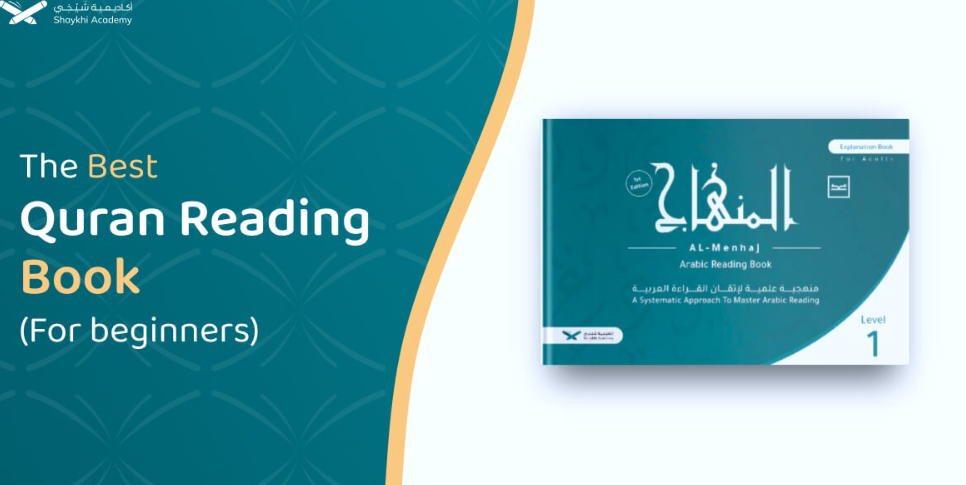
The Quran Reading Academy offers the Al-Menhaj Book, specifically designed for step-by-step Quranic Arabic reading development with a proven systematic approach.
Explore The Best Quran Reading Book
11. Read Quranic Arabic with Qualified Instruction
Self-study has limits when learning Quranic Arabic. Live instruction from certified Quran tutors catches errors you cannot identify yourself.
A qualified instructor corrects your Makhraj mistakes immediately. They ensure your tongue placement, lip movement, and throat sounds match proper articulation.
Group learning or video tutorials cannot replace one-on-one feedback. Each student has unique pronunciation challenges requiring personalized correction.
Choose Structured Learning with Expert Guidance
Enroll in a comprehensive program that covers alphabet mastery through advanced Tajweed application. Ensure instructors hold recognized Ijazah certification.
The Quran Recitation Course provides systematic progression with certified instructors who monitor your development and adjust teaching methods to your learning pace.
Join Our Quran Recitation Course with a Free Trial
Live classes create accountability. Scheduled sessions with a dedicated tutor prevent procrastination and maintain consistent progress toward reading fluency.
Start Your Quran Learning Journey Today
Join Quran Reading Academy and begin structured, step-by-step Quran reading with expert guidance.
Try your first class for freeStart Your Quran Reading Journey with The Quran Reading Academy
Learning to read Quranic Arabic transforms your relationship with the Quran from reliance on translation to direct engagement with Allah’s words. Following this structured approach establishes proper foundations.
The Quran Reading Academy offers comprehensive courses designed specifically for non-Arabic speakers:
- Certified instructors with Ijazah holding 9+ years teaching experience
- One-on-one live sessions with personalized pronunciation correction
- Flexible scheduling accommodating all time zones
- Structured curriculum from alphabet basics through advanced Tajweed
- Al-Menhaj Book methodology for systematic reading development
Experience expert instruction that makes reading Quranic Arabic achievable, regardless of your current level. Insha’Allah, begin your transformation into a confident Quran reader.
Check out our top courses to help you read the Quran with confidence:
- Quran Reading Course With Tajweed
- Noorani Qaida Course
- Quran Reading Course for Beginners
- Quran Reading Classes for Adults
- Quran Reading Classes for Sisters
- Quran Reading Classes for Kids
- Quran Hifz Course
- Arabic Reading Practice Course
- Quranic Arabic Course
Book your free class today—it’s the perfect start to learning the Quran

Conclusion
Fluency in Quranic Arabic grows from firm foundations. Correct letter articulation, Harakat awareness, Sukoon control, and long-vowel precision protect the meaning of Allah’s words and ensure that recitation reflects the form in which the Quran was revealed.
Consistency turns knowledge into skill. Short, daily practice sessions, gradual progression through connected text, and continuous self-review refine pronunciation while strengthening familiarity with Quranic patterns, making reading smoother and more intuitive over time.
Qualified instruction remains the defining factor. Certified teachers correct subtle errors, apply Tajweed practically, and guide learners step by step, allowing the Quran to be read with clarity, confidence, and reverence—directly, consciously, and as it was meant to be recited.
Related Articles
How to read Quran
Leave a Reply