 Arabic

Arabic script carries a rhythm and elegance that captivates new learners, yet many beginners feel overwhelmed the moment they face its right-to-left flow and unfamiliar sounds. Progress becomes possible when learning follows a clear path—one that builds confidence letter by letter, word by word.
Mastery begins with the 28-letter alphabet, positional forms, and connection rules, then expands to Harakat, long vowels, and essential pronunciation points. From structured handwriting practice and grammar foundations to graded reading texts and Quranic vocabulary, each step strengthens fluency through consistent, guided application.
1. Start with the Arabic Alphabet to Read and Write Arabic Effectively
The Arabic alphabet contains 28 letters, each with distinct shapes depending on position within words. Unlike English, Arabic reads from right to left, requiring your eyes to adjust to this directional flow.
Each letter has four positional forms: isolated, initial, medial, and final. For instance, the letter ب (Ba) appears differently when standing alone versus connecting with other letters. Beginners must memorize these variations systematically.
Start by learning five letters weekly through consistent daily practice. Write each letter repeatedly while pronouncing it aloud to build muscle memory and phonetic recognition simultaneously. This dual approach accelerates mastery significantly.
Arabic Letter Connection Rules
Arabic letters connect horizontally, creating flowing words. However, six letters never connect to following letters: ا (Alif), د (Dal), ذ (Dhal), ر (Ra), ز (Zay), و (Waw).
Understanding connection patterns prevents common writing errors. Practice connecting compatible letters before attempting full words. This foundational skill ensures readable, properly structured Arabic script.
Pronunciation with Arabic Letter Forms
Each letter carries a specific sound originating from precise articulation points in your mouth and throat. The letter ع (Ayn), for example, produces a deep pharyngeal sound unfamiliar to English speakers.
Listen to certified native Arabic tutors pronouncing each letter correctly. Record yourself and compare your pronunciation against authentic models. Self-correction through audio feedback dramatically improves accuracy.
Meet ourcertified native Arabic tutors
2. Master Arabic Vowel Marks to Read Arabic Correctly
Arabic uses three short vowel marks called Harakat: Fatha (َ), Kasra (ِ), and Damma (ُ). These diacritical marks appear above or below letters, indicating how to vocalize each consonant properly.
Fatha produces an “a” sound, Kasra produces an “i” sound, and Damma produces an “u” sound. Without these marks, readers rely on context and memorization to pronounce words correctly.
Beginners should practice reading texts with full Harakat before attempting unmarked Arabic. This progression builds confidence and prevents mispronunciation habits that become difficult to correct later.
Long Vowels in Arabic Script to Write and Read Arabic Correctly
Long vowels extend short vowel sounds using specific letters. Fatha followed by ا creates “aa,” Kasra followed by ي creates “ee,” and Damma followed by و creates “oo.”
The word كِتَاب (Kitaab, meaning “book”) demonstrates this pattern. The Kasra on ك produces “Ki,” while the Fatha followed by Alif extends to “taab.” Practice identifying these patterns in simple vocabulary.
Sukoon and Shaddah Marks to Write and Read Arabic Correctly
Sukoon (ْ) indicates consonants without vowels, creating brief pauses in pronunciation. Shaddah (ّ) doubles consonant sounds, adding emphasis and changing word meanings entirely.
The word مُحَمَّد (Muhammad) contains Shaddah over the letter م, requiring you to hold the “m” sound briefly. Recognizing these marks prevents confusion between similar-looking words.
Start Your Quran Learning Journey Today
Join Quran Reading Academy and begin structured, step-by-step Quran reading with expert guidance.
Try your first class for free3. Practice Writing Arabic Letters in Proper Sequence
Arabic letters must follow precise stroke sequences for proper formation and natural flow. Beginning each letter from the correct starting point ensures legible, aesthetically pleasing handwriting.
Purchase lined notebooks designed for Arabic script practice. These provide guidance for letter heights and positioning, crucial for maintaining consistency across your writing.
Dedicate fifteen minutes daily to copying simple Arabic words from authentic sources. Quality trumps quantity—ten perfectly formed letters surpass fifty rushed, incorrect ones.
Practice Right-to-Left Writing Direction
Your hand moves from right to left across pages, opposite to English writing direction. Position your paper slightly angled to facilitate this rightward-to-leftward movement comfortably.
Practice writing horizontal lines from right to left without letters initially. This exercise trains your hand muscles for the directional shift, making letter writing smoother afterward.
Practice Arabic Letter Size and Proportion
Arabic letters vary in vertical space usage. Letters like ل (Lam) extend upward, while letters like ي (Ya) extend downward. Maintaining proper proportions creates balanced, readable text.
Study calligraphy samples to observe professional letter proportions. Even basic handwriting benefits from understanding these aesthetic principles rooted in centuries of Arabic scribal tradition.
4. Learn Common Arabic Words to Read Arabic Fluently
Begin vocabulary acquisition with frequently occurring words in Arabic texts. Words like هذا (hatha, meaning “this”) and ذلك (thalika, meaning “that”) appear repeatedly across various contexts.
Create flashcards pairing Arabic script with transliterations and English translations. Review these daily, gradually removing transliterations as your reading confidence grows stronger.
The Arabic Reading Practice Course at The Quran Reading Academy provides structured vocabulary lessons progressing from basic nouns to complex sentence structures under certified instructor guidance.
Join Arabic Reading Practice Course With a Free Trial
Functional Arabic Vocabulary Categories
Group words thematically: family terms, common verbs, everyday objects, and question words. This categorical approach helps memory retention through associated learning rather than random memorization.
Practice writing complete sentences using new vocabulary immediately after learning it. Application cements retention far more effectively than passive review alone.
Learn Quranic Vocabulary Foundation
Many Arabic learners specifically want Quranic literacy. Begin with frequently repeated Quranic terms like رَبّ (Rabb, meaning “Lord”) and رَحْمَة (Rahmah, meaning “mercy”).
The opening chapter, Surah Al-Fatihah, provides excellent foundational vocabulary:
بِسْمِ ٱللَّهِ ٱلرَّحْمَـٰنِ ٱلرَّحِيمِ
Bismillahir-Rahmanir-Raheem
“In the name of Allah, the Entirely Merciful, the Especially Merciful.” (Al-Fatihah 1:1)
Memorize this verse while understanding each word’s meaning and grammatical function. This approach combines reading skill with comprehension depth.
Start Your Quran Learning Journey Today
Join Quran Reading Academy and begin structured, step-by-step Quran reading with expert guidance.
Try your first class for free5. Understand Arabic Grammar Rules to Write and Read Arabic Properly
Arabic follows grammatical patterns different from English structure. Sentences typically begin with verbs, followed by subjects and objects—a Verb-Subject-Object order.
Nouns and adjectives must agree in gender, number, and definiteness. The definite article ال (al) prefixes nouns, equivalent to English “the” but attached directly without spacing.
Learn Masculine and Feminine Forms to Write and Read Arabic Properly
Arabic assigns grammatical gender to all nouns. Feminine nouns typically end with ة (Ta Marbuta), though exceptions exist. Adjectives must match noun gender precisely.
The word مُعَلِّم (mu’allim) means “male teacher,” while مُعَلِّمَة (mu’allima) means “female teacher.” This gender distinction pervades Arabic grammar systematically.
Learn Plural Formation Patterns to Write and Read Arabic Properly
Arabic creates plurals through sound patterns or broken plural forms. Sound plurals add standard endings, while broken plurals change internal vowel patterns unpredictably.
The word كِتَاب (kitaab, “book”) becomes كُتُب (kutub, “books”) through internal modification. These irregular patterns require memorization through exposure and practice.
6. Read Simple Arabic Texts to Build Reading Confidence
Begin with children’s books written for native Arabic speakers learning to read. These texts use simple vocabulary, full Harakat, and repetitive sentence structures supporting comprehension.
Read aloud daily, even if pronunciation feels uncertain initially. Vocalization activates additional memory pathways, strengthening both reading recognition and speaking ability simultaneously.
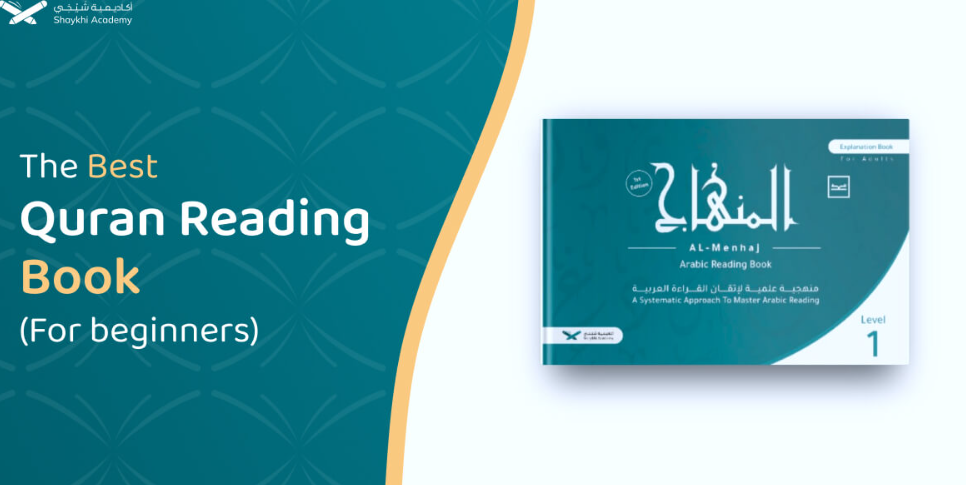
Al-Menhaj Book offers structured reading exercises specifically designed for beginners, progressing gradually from isolated letters to complete paragraphs with certified tutor support.
Explore The Best Quran Reading Book
Graded Arabic Reading Materials
Progress through increasingly complex texts systematically. Start with single sentences, advance to short paragraphs, then longer passages as confidence develops naturally.
Track unfamiliar words in a dedicated notebook. Review these regularly, watching your known vocabulary expand week by week—a motivating progress indicator.
Arabic Reading Speed Development
Initial reading will feel slow and laborious. Accept this reality without frustration; speed develops naturally through consistent practice over months.
Time yourself reading the same passage weekly. You’ll notice gradual improvement, reinforcing that persistent effort produces measurable results.
Start Your Quran Learning Journey Today
Join Quran Reading Academy and begin structured, step-by-step Quran reading with expert guidance.
Try your first class for free7. Practice Arabic Handwriting Through Daily Writing Exercises
Consistent writing practice transforms recognition into production ability. Copy Arabic texts manually rather than typing—handwriting engages deeper cognitive processing pathways.
Begin with individual letters, progress to words, then complete sentences. This graduated approach prevents overwhelming yourself while building genuine competence.
Maintaining Writing Consistency
Arabic’s connected script requires smooth, flowing movements. Practice writing letters without lifting your pen between connected characters, creating seamless word formations.
Notice how experienced Arabic writers maintain consistent slant angles and letter spacing. Emulate these qualities by studying authentic handwritten Arabic samples regularly.
Common Writing Mistakes
Beginners often reverse letter connection directions or misplace diacritical marks. Review your writing critically, identifying recurring errors requiring focused correction.
Start Your Quran Learning Journey Today
Join Quran Reading Academy and begin structured, step-by-step Quran reading with expert guidance.
Try your first class for freeStart Your Arabic Learning Journey with The Quran Reading Academy
You now understand the essential steps to write and read Arabic effectively through systematic practice and proper guidance.
The Quran Reading Academy offers comprehensive courses taught by certified native Arabic instructors with proven track records helping Western learners achieve reading fluency. Our structured methodology includes:
- Personalized one-on-one lessons fitting your schedule
- Noorani Qaida Course for systematic alphabet and reading rules
- Arabic Reading Practice Course developing vocabulary and fluency
- Al-Menhaj Book providing structured exercises for beginners
- Native pronunciation modeling from experienced teachers
- Progress tracking with regular feedback and corrections
Take the first step today by booking your free trial lesson. Experience professional Arabic instruction that transforms confusion into confident reading and writing ability.
Check out our top courses to help you read the Quran with confidence:
- Quran Reading Course With Tajweed
- Noorani Qaida Course
- Quran Reading Course for Beginners
- Quran Reading Classes for Adults
- Quran Reading Classes for Sisters
- Quran Reading Classes for Kids
- Quran Hifz Course
- Arabic Reading Practice Course
- Quranic Arabic Course
Book your free class today—it’s the perfect start to learning the Quran

Conclusion
Confident Arabic reading and writing grow from disciplined fundamentals—alphabet mastery, vowel recognition, correct pronunciation, and accurate letter formation. When these building blocks are practiced daily, they transform scattered effort into steady, measurable improvement.
Fluency deepens through vocabulary expansion, grammar awareness, and gradual exposure to simple texts. Reading aloud, tracking progress, and correcting recurring mistakes ensure that comprehension and speed develop naturally over time.
Structured guidance from qualified instructors accelerates this journey. With systematic courses, personalized feedback, and consistent handwriting and reading exercises, learners move from hesitation to clarity—building the skills needed for accurate Arabic literacy and confident Quran reading.


Leave a Reply