 Fatawa
| Key Takeaways |
| Passing wind (breaking wudu) while reading Quran from the Mushaf requires stopping and renewing wudu before continuing. |
| Reading Quran from memory after breaking wudu is permissible, as minor impurity does not invalidate recitation by heart. |
| Touching the physical Mushaf without wudu is prohibited according to the majority of Islamic scholars. |
A question many students bring to class — often hesitantly — is one that matters deeply for their daily recitation practice: what actually happens, from an Islamic ruling perspective, if you break your wudu while reading Quran? It is a practical concern, not an embarrassing one, and it deserves a clear, grounded answer.
The ruling depends on one key distinction: are you reading from the physical Mushaf, or reciting from memory? If you are holding the Mushaf when wudu breaks, you must stop and renew your wudu before continuing.
If you are reciting by heart, scholars of the majority view permit you to continue, since minor impurity does not prohibit recitation from memory.
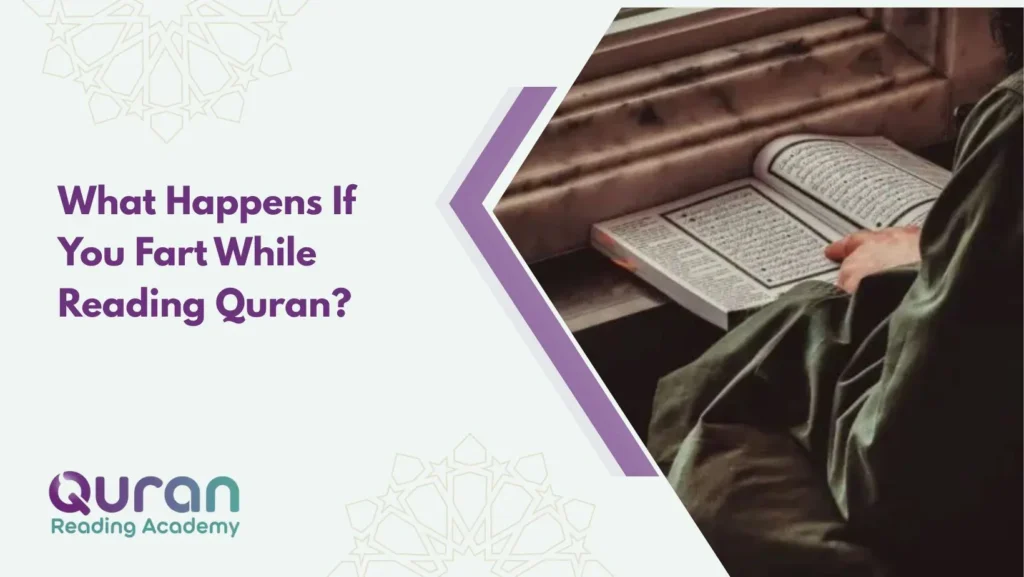
What Happens If You Fart While Reading Quran from the Mushaf?
Breaking wudu while holding the Mushaf requires you to stop your recitation immediately, set the Mushaf down, and renew your wudu before resuming. The majority of Islamic scholars hold that touching the Mushaf is only permitted in a state of ritual purity (taharah), based on established scholarly consensus.
Your recitation itself is not “invalidated” retroactively — you simply cannot continue touching the Mushaf until purified.
What to Do with the Mushaf While You Renew Wudu?
Place the Mushaf on a clean, elevated surface before leaving. Do not leave it face-down or on the floor. This is part of the broader etiquette of Quran reading that The Quran Reading Academy emphasizes from the very first lesson. Reverential handling of the Mushaf is not optional — it is part of the act of recitation itself.
Shots Videos from Our Courses
Start Your Quran Learning Journey Today
Join Quran Reading Academy and begin structured, step-by-step Quran reading with expert guidance.
Try your first class for freeWhy the Ruling Centers on Touching, Not on Speaking
The prohibition is specifically tied to physical contact with the Mushaf. Your tongue, your voice, and your heart are not rendered impure by minor hadath. This is why recitation from memory remains permissible. The scholarly distinction is precise and important, and understanding it removes unnecessary anxiety about your reading practice.
If you are working toward reading fluently from the Mushaf, our Quran Reading Classes for Adults include practical guidance on recitation etiquette alongside the technical reading skills — so you build correct habits from the start.
Book your FREE trial class to start reading Quran

What Happens If You Fart While Reading Quran from Memory?
Reciting the Quran from memory after passing wind is permissible according to the majority of scholars. Minor ritual impurity (hadath asghar) does not prohibit recitation of Quran from the heart. The person reciting from memory may continue his recitation, because being free of minor impurity is not a condition for recitation.
This is a significant ruling that many students do not know. You are not required to hold wudu in order to say the words of Quran.
The condition of purity for recitation applies only to those in a state of major impurity (janabah) — and, according to the majority view among scholars, to women in a state of menstruation (hayd).
What is the Difference Between Minor and Major Impurity?
| Type of Impurity | Arabic Term | Effect on Quran Recitation from Memory | Effect on Touching Mushaf |
| Minor impurity (e.g., passing wind) | Hadath Asghar | Permissible to continue | Must renew wudu first |
| Major impurity (e.g., after marital relations) | Hadath Akbar / Janabah | Not permissible | Not permissible |
| Menstruation (majority scholarly view) | Hayd | Not permissible (majority view) | Not permissible |
Understanding this table helps students navigate their daily recitation without unnecessary interruption. When minor impurity occurs, only the Mushaf interaction pauses — not the relationship between you and Allah’s words.
Read Also: Is Reading the Quran on Water Islamically Permissible?
The Scholar’s Counsel on Reverence Beyond the Ruling
Even where recitation from memory remains technically permissible, one should not take lightly the matter of passing wind while holding the Mushaf or during recitation. This is about inward reverence — tawqeer — for the speech of Allah. The ruling permits continuation; wisdom and adab encourage mindfulness of one’s state before and during reading.
Our Quran Reading Course for Beginners incorporates Islamic etiquette and rulings on recitation as part of foundational training — because correct practice cannot be separated from correct understanding.
Enroll in Our Quran Reading Course for Beginners with a Free Trial
Read Also: Why Do I Cry When I Read the Quran?
Start Learning Quran with Proper Guidance at The Quran Reading Academy
Understanding the rulings around Quran recitation is one part of becoming a confident, correct reader. The other part is developing real reading skill — letter recognition, Tajweed application, and fluent recitation.
The Quran Reading Academy offers:
- Certified, experienced teachers with up to 25 years of instruction experience
- Structured courses for beginners, adults, kids, and new Muslims
- Al-Menhaj Book — the foundational Arabic reading course for non-Arabic speakers
- Quran Reading Classes with Tajweed for recitation accuracy
- Flexible online scheduling for students worldwide
Book your free trial lesson today and begin building your recitation on the correct foundation — Insha’Allah.
Conclusion
The ruling on what happens when you break wudu during Quran reading is precise and, once understood, removes unnecessary anxiety from your practice. If you are reading from the Mushaf, stop and renew wudu.
If you are reciting from memory, the majority scholarly view permits you to continue. Major impurity is a separate category that requires ghusl before any recitation resumes.
What stays constant across all scenarios is the principle of reverence. The technical rulings are there to protect the sanctity of Allah’s speech — not to create barriers between you and the Quran.
Approach your recitation with maintained purity, proper intention, and consistent practice, and your relationship with the Quran will grow stronger with every session.
Our Students Reviews
Start Your Quran Learning Journey Today
Join Quran Reading Academy and begin structured, step-by-step Quran reading with expert guidance.
Try your first class for freeRead Also: Can a Non-Muslim Read the Quran?
Frequently Asked Questions About Wudu and Quran Recitation
Does Breaking Wudu Invalidate the Quran You Already Recited?
No. Breaking wudu does not retroactively invalidate recitation already completed. The recitation you performed in a state of purity remains valid. The ruling only applies to what comes after — specifically, whether you may continue touching the Mushaf or reciting, depending on whether you are reading from the Mushaf or from memory.
Can You Read Quran on Your Phone Without Wudu?
Yes. The majority position among contemporary scholars is that digital screens do not carry the same ruling as the physical Mushaf, since the Quran is not “contained” in the device itself. However, maintaining wudu when reading Quran digitally remains the more cautious and reverent approach.
Is It Sinful to Accidentally Break Wudu While Reading Quran?
No. Accidentally breaking wudu during recitation is not sinful. The ruling is practical — stop touching the Mushaf and renew your wudu — not punitive. Islam does not hold a person accountable for involuntary bodily functions. What matters is how you respond: calmly, correctly, and with continued reverence.
Can a Child Read Quran Without Wudu?
Young children who have not yet reached the age of religious accountability (bulugh) are generally afforded more flexibility by scholars. However, teaching children to maintain wudu before handling the Mushaf from an early age builds correct habits. Our Quran Reading Classes for Kids incorporate these foundational etiquettes as part of structured learning.







Leave a Reply