 Fatawa
| Key Takeaways |
| Ayatul Kursi (Al-Baqarah 2:255) is permissible to recite in Salah according to the scholarly consensus. |
| Ayatul Kursi may be recited during the optional portions of Salah after Al-Fatihah in any rak’ah — not as a replacement for it. |
| Reciting Ayatul Kursi in Salah carries immense reward, as it is the greatest single verse in the entire Quran. |
| Proper Tajweed application is required when reciting any Quran in Salah, including Ayatul Kursi, to preserve its meaning. |
Many Muslims memorize Ayatul Kursi early in their learning — and rightfully so. Its virtues are unmatched.
But a question that comes up regularly among students, especially those newer to formal prayer, is whether this beloved verse has a place inside their Salah.
Can You Read Ayatul Kursi in Salah?
Yes, you can read Ayatul Kursi in Salah. Reciting Ayatul Kursi in Salah is fully permissible according to scholarly consensus.
Ayatul Kursi, being a complete and self-contained verse, is among the finest choices one can make for that recitation.
The obligation in Salah is to recite Al-Fatihah. Beyond that, the worshipper has wide latitude in choosing additional Quranic content. Ayatul Kursi (Al-Baqarah 2:255) qualifies perfectly.
Where Exactly in Salah Can Ayatul Kursi Be Recited?
Ayatul Kursi is recited after Surah Al-Fatihah, in the standing position (Qiyam), during the first two rak’ahs of any Fard prayer or any rak’ah of Nafl prayer.
Ayatul Kursi does not replace Al-Fatihah under any circumstance — Al-Fatihah remains a pillar of Salah. After Al-Fatihah, reciting Ayatul Kursi alone suffices as the additional Quranic portion.
Shots Videos from Our Courses
Start Your Quran Learning Journey Today
Join Quran Reading Academy and begin structured, step-by-step Quran reading with expert guidance.
Try your first class for freeAyatul Kursi in Arabic, Transliteration and Translation
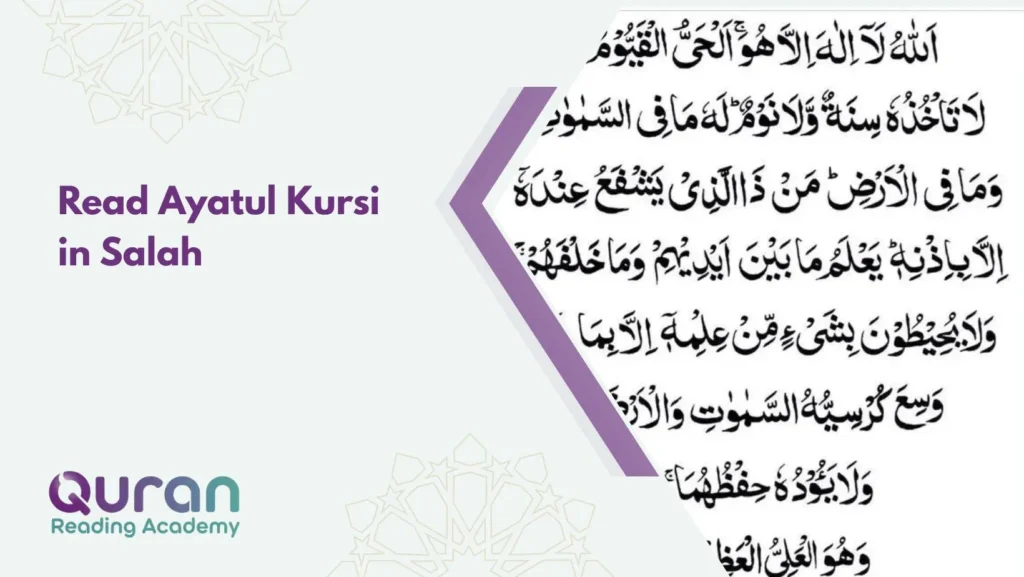
ٱللَّهُ لَآ إِلَٰهَ إِلَّا هُوَ ٱلْحَىُّ ٱلْقَيُّومُ ۚ لَا تَأْخُذُهُۥ سِنَةٌ وَلَا نَوْمٌ ۚ لَّهُۥ مَا فِى ٱلسَّمَٰوَٰتِ وَمَا فِى ٱلْأَرْضِ ۗ مَن ذَا ٱلَّذِى يَشْفَعُ عِندَهُۥٓ إِلَّا بِإِذْنِهِۦ ۚ يَعْلَمُ مَا بَيْنَ أَيْدِيهِمْ وَمَا خَلْفَهُمْ ۖ وَلَا يُحِيطُونَ بِشَىْءٍ مِّنْ عِلْمِهِۦٓ إِلَّا بِمَا شَآءَ ۚ وَسِعَ كُرْسِيُّهُ ٱلسَّمَٰوَٰتِ وَٱلْأَرْضَ ۖ وَلَا يَـُٔودُهُۥ حِفْظُهُمَا ۚ وَهُوَ ٱلْعَلِىُّ ٱلْعَظِيمُ ﴿٢٥٥﴾
Allahu la ilaha illa huwa alhayyu alqayyoomu la takhuthuhu sinatun wala nawmun lahu ma fee alssamawati wama fee alardi man tha allathee yashfaAAu AAindahu illa biithnihi yaAAlamu ma bayna aydeehim wama khalfahum wala yuheetoona bishayin min AAilmihi illa bima shaa wasiAAa kursiyyuhu alssamawati waalarda wala yaooduhu hifthuhuma wahuwa alAAaliyyu alAAatheemu (255)
“Allah – there is no deity except Him, the Ever-Living, the Sustainer of [all] existence. Neither drowsiness overtakes Him nor sleep. To Him belongs whatever is in the heavens and whatever is on the earth. Who is it that can intercede with Him except by His permission? He knows what is [presently] before them and what will be after them, and they encompass not a thing of His knowledge except for what He wills. His Kursi extends over the heavens and the earth, and their preservation tires Him not. And He is the Most High, the Most Great. (255)” (Al-Baqarah 2:255)
If you want to recite it correctly in Salah — with the pronunciation it deserves — our Online Quran Reading Course with Tajweed trains students specifically in applying Tajweed rules to longer, more complex verses like this one.
Start Reading the Quran with Tajweed with a FREE Trial Today

Why Is Ayatul Kursi the Greatest Verse to Recite in Salah?
Ayatul Kursi holds a status no other single verse in the Quran shares. Understanding its virtue helps a Muslim appreciate the weight of including it in their Salah — not merely as a habit, but as a conscious act of worship.
The Prophet ﷺ confirmed its unparalleled rank. As narrated in Sahih Muslim, Ubayy ibn Ka’b (رضي الله عنه) was asked by the Prophet ﷺ which verse of the Quran was the greatest. He answered: Ayatul Kursi. The Prophet ﷺ affirmed this, praising him and saying that knowledge would always be easy for him.
This verse affirms Tawhid — the absolute Oneness of Allah — in the most concentrated, linguistically powerful form found in the Quran.
When you stand before Allah in Salah and recite these words with understanding and correct pronunciation, the act becomes both an act of worship and a declaration of faith simultaneously.
Proper application of these rules is not optional. As scholars of Tajweed state, recitation errors that alter meaning are sinful, not merely imperfect.
If you are uncertain about your pronunciation, our Quran Reading Classes for Adults are specifically designed to audit and correct recitation errors in memorized verses like Ayatul Kursi.
Book your FREE trial class to start reading Quran

Common Mistakes Muslims Make When Reciting Ayatul Kursi in Salah
Many Muslims have Ayatul Kursi memorized but have never had their recitation formally evaluated. In my experience teaching non-Arabic speakers specifically, the errors are predictable — and correctable.
1. Rushing Through the Verse Without Observing Madd
Ayatul Kursi contains multiple Madd (elongation) positions. Students who memorized it through rapid repetition frequently compress these elongations, reducing 4–5 count Madd positions to 1–2 counts. In Salah, this disrupts both Tajweed and the meditative weight of the recitation.
2. Mispronouncing the Letter ع in “Al-‘Aliyy”
The word الْعَلِيُّ (Al-‘Aliyy — “The Most High”) ends Ayatul Kursi. The letter ع (‘Ayn) is one of the most commonly mispronounced letters among non-Arabic speakers. It is produced from the middle of the throat (Halq) — not from the lips or tongue tip.
Pronouncing it as a simple ‘A’ sound removes a theologically significant Divine Name from its correct form.
For students struggling specifically with Makharij al-Huruf (articulation points of letters), ourfoundational Quran reading program for beginners addresses each articulation point systematically before any memorized content is reviewed.
Enroll in Our Quran Reading Course for Beginners with a Free Trial
Read Also: Do You Have to Read the Quran in Arabic?
3. Connecting Words Incorrectly at Phrase Boundaries
Ayatul Kursi contains natural pausing positions (Waqf). Many students, not knowing where these pause markers fall, either stop mid-phrase or connect where they should pause — altering the meaning.
Learning to read Quran word by word helps students understand phrase boundaries before attempting fluent connected recitation.
Read Also: Can You Read the Quran in English?
Our Students Reviews
Start Your Quran Learning Journey Today
Join Quran Reading Academy and begin structured, step-by-step Quran reading with expert guidance.
Try your first class for freeRead Also: Listen to the Quran Instead of Reading It
Start Reciting Ayatul Kursi in Salah with Confidence at The Quran Reading Academy
Knowing the ruling is one step. Reciting it correctly is another. The Quran Reading Academy helps non-Arabic speakers close that gap.
What we offer:
- One-to-one sessions with certified Quran reading instructors trained in Tajweed
- Specialized Quran Reading Classes for Adults and beginners
- The Al-Menhaj Book — our structured foundational reading curriculum for non-Arabic speakers
- Flexible scheduling for Western Muslims across all time zones
- Free trial lesson — no commitment required
Check out our top courses to help you read the Quran with confidence:
- Quran Reading Course With Tajweed
- Noorani Qaida Course
- Quran Reading Course for Beginners
- Quran Reading Classes for Adults
- Quran Reading Classes for Sisters
- Quran Reading Classes for Kids
- Quran Hifz Course
- Arabic Reading Practice Course
- Quranic Arabic Course
Book your free class today—it’s the perfect start to learning the Quran

Conclusion
Ayatul Kursi belongs in your Salah. It is permissible, it is rewarded, and it is — according to the Prophet ﷺ himself — the greatest verse in the Book of Allah. The question was never whether you can recite it in prayer. The real question is whether you are reciting it as it deserves to be recited.
Correct pronunciation, proper Tajweed, and genuine understanding transform Ayatul Kursi from a memorized habit into an act of living worship.
If your recitation has never been formally evaluated, there is no better time than now to ensure the words you carry into your Salah are as sound as your intention. Insha’Allah, every rak’ah you stand in becomes stronger for it.
Start Your Quran Learning Journey Today
Join Quran Reading Academy and begin structured, step-by-step Quran reading with expert guidance.
Try your first class for freeRead Also: What is the Punishment of Not Reading Quran?
Frequently Asked Questions About Reciting Ayatul Kursi in Salah
Is It Obligatory to Recite a Full Surah After Al-Fatihah in Salah?
No, reciting a complete Surah after Al-Fatihah is not obligatory. What is recommended (Sunnah) is to recite any portion of the Quran after Al-Fatihah in the first two rak’ahs of Fard prayer. A single long verse like Ayatul Kursi fully satisfies this Sunnah and is considered a rewarding choice by scholars.
Can You Recite Ayatul Kursi in All Five Daily Prayers?
Yes, Ayatul Kursi may be recited in any of the five daily prayers — Fajr, Dhuhr, Asr, Maghrib, or Isha — after Al-Fatihah in the standing position. There is no scholarly restriction limiting it to a particular prayer.
Does Mispronouncing Ayatul Kursi in Salah Invalidate the Prayer?
Minor pronunciation errors that do not alter meaning do not invalidate Salah according to most scholars. However, errors that significantly change the meaning of a Divine attribute — such as mispronouncing Allah’s Names — are treated more seriously. This is precisely why learning correct Tajweed before incorporating longer verses into Salah matters practically, not just spiritually.
Can Children Recite Ayatul Kursi in Salah?
Yes, children who have memorized Ayatul Kursi correctly may recite it in Salah. However, parents and instructors should ensure their pronunciation is verified before regular in-Salah use. Our Quran Reading Classes for Kids include dedicated Tajweed review of memorized content to ensure what children recite in prayer is accurate.







Leave a Reply