 Fatawa
| Key Takeaways |
| The Quran is read from right to left on each page, and the book itself opens from right to left as well. |
| Muslims are encouraged to read the Quran in the order of the Mushaf, starting with Al-Fatihah and ending with An-Nas. |
| Reading the Quran out of Mushaf order is permitted and not sinful, but it contradicts the preferred and established practice. |
| Reversing individual verses within a surah is forbidden according to scholars, as it removes the miraculous arrangement of the text. |
| Beginners are sometimes taught from shorter surahs at the back first — this is a teaching method, not a reversal of the reading direction. |
New Muslims and non-Arabic speaking learners often pick up a Quran for the first time and feel genuinely confused. The book opens differently, the text flows in an unfamiliar direction, and the whole experience feels unlike any other reading they have done. That first moment of disorientation is completely normal.
The Quran is read from right to left on each line, and the Mushaf itself opens from the right side — the opposite of English books. However, the question of whether you read it “back to front” depends entirely on what you mean.
The direction of Arabic script, the order of surahs, and beginner teaching sequences are three separate matters, and understanding each one will remove any confusion you may have.
Do You Read the Quran From Back to Front?
No, you do not read the Quran from back to front. The Quran opens from what English readers would recognize as the back cover, because Arabic is written and read from right to left. What appears to be the “back” of the book to an English speaker is actually the front of the Mushaf — where Al-Fatihah, the opening surah, is located. You begin there and move forward through the pages.
This is one of the common points of confusion for beginners, and it dissolves the moment you hold a Mushaf and understand that Arabic script simply flows in the opposite direction from English.
The structure of the Quran is entirely logical — it has a clear beginning, a defined order, and a recognized conclusion.
The Physical Direction of Arabic Reading
Every line of Quranic Arabic begins on the right side of the page and ends on the left. This is not unique to the Quran — all Arabic text follows this pattern. When you finish a line, your eye moves to the beginning of the next line, again on the right.
Pages in the Mushaf are turned from left to right, which means you progress through the book in the opposite physical direction from an English novel. Once this clicks into place, the Mushaf feels entirely natural to navigate.
Start Your Quran Learning Journey Today
Join Quran Reading Academy and begin structured, step-by-step Quran reading with expert guidance.
Try your first class for freeWhere You Actually Begin in the Quran
The Quran begins with Surah Al-Fatihah, the seven-verse opening chapter, on the first page of the Mushaf. It ends with Surah An-Nas, the 114th chapter. A complete reading of the Quran follows this exact sequence from Al-Fatihah to An-Nas.
If you are just starting out, our Quran Reading Classes for Beginners will walk you through holding and navigating the Mushaf correctly from your very first lesson.
Enroll in Our Quran Reading Course for Beginners with a Free Trial
Do You Read the Quran From Right to Left?
Yes — Arabic is read from right to left, and this applies fully to Quranic recitation. Every word, every letter, and every line follows this direction. This is the natural writing direction of the Arabic language, which has remained consistent for over fourteen centuries.
For non-Arabic speakers, this is often the single largest adjustment in the early stages of learning. Students accustomed to left-to-right scripts need deliberate practice before the right-to-left flow feels automatic.
At The Quran Reading Academy, our certified instructors spend focused time in early lessons helping students track text correctly before introducing letter sounds.
Meet our Quran teachers and find the perfect match for your trial session
How Does Right-to-Left Reading Affect Page Layout?
In a standard Mushaf printed for the Hafs ‘an ‘Asim recitation — the most widely used version globally — the page layout is designed entirely around right-to-left reading. Surah headers appear at the top, the bismillah opens each surah, and the ayah markers flow continuously from right to left across each line.
Understanding this layout visually, before even reading a single letter, saves beginners significant confusion in their first lessons.
A Practical Starting Point for Non-Arabic Speakers
The most effective foundation for right-to-left Quranic reading is a structured introduction to the Arabic script itself.
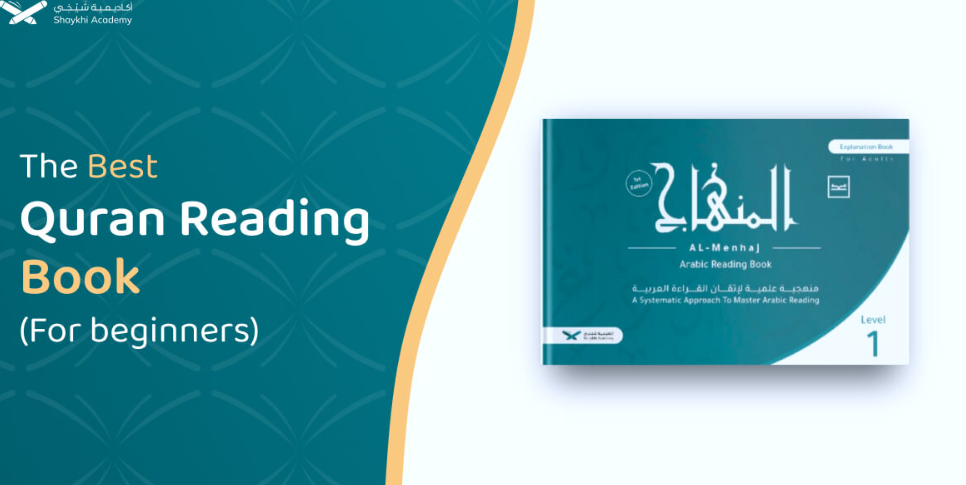
The Al-Menhaj Book, developed by experienced instructors at The Quran Reading Academy, introduces Arabic letters and their positions in a sequence specifically designed for non-native speakers — building reading direction confidence from the very first lesson.
Explore The Best Quran Reading Book for FREE
Do You Have to Read the Quran in Order?
The established scholarly position is that reading the Quran in Mushaf order — beginning with Al-Fatihah and proceeding surah by surah to An-Nas — is the preferred practice. It is not, however, an obligatory condition.
A Muslim who reads surahs out of Mushaf sequence is not sinning, but they are departing from what scholars consider the better approach.
Imam An-Nawawi, in At-Tibyan fi Adab Hamalat Al-Qur’an, stated that scholars choose reading according to Mushaf order, whether in prayer or outside it, because the ordering of the Mushaf was established with wisdom — and that wisdom is best preserved by following it. This position represents the mainstream scholarly view across the major madhabs.
What Do Scholars Say About Reading Out of Order?
Sheikh Ibn Baz, when asked about this matter, confirmed that reading out of Mushaf order carries no sin, but that the better and more established practice is to follow the sequence of the Mushaf — as the Companions did when they organized their complete readings.
He noted that beginning with Al-Fatihah and descending through the surahs reflects the practice of the Ahl As-Sunnah.
This distinction — between what is permitted and what is preferred — is important for any student to understand. You will not be corrected harshly for reading Surah Al-Kahf before Surah Al-A’raf, but you should know the scholarly preference and work toward it.
What is The Ruling on Reversing Verses Within a Surah?
This is a stricter matter. Scholars of the Shafi’i school, as recorded in Asna Al-Matalib, ruled that reversing the order of individual ayat within a surah is forbidden — because it removes the miraculous arrangement of the Quran and eliminates the wisdom embedded in the ordering of verses.
This ruling is based on the understanding that the ayah sequence within each surah is divinely arranged and must be preserved.
Reversing surah order in a khatmah (complete reading) is disliked but not forbidden. Reversing ayah order within a surah is a separate, more serious matter entirely.
| Practice | Ruling | Reason |
| Reading surahs in Mushaf order | Preferred (Mustahabb) | Follows Companions’ practice and Mushaf wisdom |
| Reading surahs out of Mushaf order | Permitted, not sinful | No fundamental harm, but contra the preferred |
| Reversing ayat within a surah | Forbidden | Destroys miraculous arrangement of the text |
| Teaching shorter surahs first | Permitted | Recognized scholarly exception for learning ease |
For a deeper look at the etiquette surrounding Quran reading, our guide on Quran reading etiquettes and manners covers these principles in full practical detail.
Shots Videos from Our Courses
Start Your Quran Learning Journey Today
Join Quran Reading Academy and begin structured, step-by-step Quran reading with expert guidance.
Try your first class for freeWhat Happens If You Read the Quran Backwards?
Reading the Quran “backwards” can mean different things, and the ruling differs significantly depending on what is actually happening. Three scenarios are worth distinguishing clearly.
If someone reads the Quran beginning from Surah An-Nas and moving toward Al-Fatihah — completing the surahs in reverse Mushaf sequence — this is disliked according to scholars, because it contradicts the established order. It is not, however, forbidden or sinful based on the evidence and scholarly positions cited above.
1. What is the Ruling of Reversing Ayat?
If someone recites the ayat within a surah in reverse order — reading the last ayah of Al-Baqarah before the first, for example — this is forbidden according to scholars, as it destroys the deliberate arrangement of Allah’s words.
The miraculous nature of the Quran (i’jaz) is embedded in its precise ordering, and reversing that ordering removes what the text was structured to convey.
This ruling applies to recitation as a standalone practice. In teaching contexts, scholars permitted some flexibility, acknowledging that instruction sometimes requires presenting material in non-sequential form for ease of learning.
2. The Teaching Exception Scholars Acknowledged
Scholars explicitly recognized that teaching often requires presenting Quranic content in a non-standard sequence. A teacher drilling a student on the letter pronunciation in Surah Al-Ikhlas before moving to longer surahs is not violating any ruling.
Asna Al-Matalib notes that the dislike of out-of-order reading does not apply to teaching, “because it occurs in a scattered manner, and because it is easier for learning.”
In almost every beginner course at The Quran Reading Academy, instructors introduce students to the shorter surahs of Juz’ ‘Amma — the 30th section of the Quran — before building toward longer passages. This is a teaching sequence, not a doctrinal reversal. Students learn to read correctly; the sequence is adjusted for their current ability level.
If you are an adult beginning this process now, our Quran Reading Classes for Adults are structured around exactly this principle — starting where you are, building correctly, and moving forward with confidence.
Book your FREE trial class to start reading Quran

Why Do Beginners Often Start With the Shorter Surahs at the End?
Most non-Arabic speaking beginners first encounter Quranic surahs like Al-Ikhlas, Al-Falaq, and An-Nas — surahs located at the very end of the Mushaf. This leads many learners to assume the Quran is read from back to front. In reality, these surahs are taught first because they are short, phonetically accessible, and commonly used in daily prayer.
This is purely a pedagogical choice, not a reversal of reading direction or Mushaf order. The same logic applies in every language-learning context: you begin with manageable material and build toward complexity.
Read Also: Can You Read Quran in Your Head?
How This Connects to Structured Quran Learning
Our Noorani Qaida Course follows a structured sequence that introduces letter sounds, vowel marks (harakat), and basic reading rules before a student ever attempts full surah recitation.
Start Reading the Quran Today with a FREE Trial in Our Noorani Qaida Course

Once foundational reading skills are in place, students then begin working through the Quran in proper Mushaf order — which is both the scholarly preference and the most coherent long-term reading habit.
For those ready to build a sustainable reading practice, our daily Quran reading plan offers a realistic, structured schedule suited to different commitment levels.
Our Students Reviews
Start Your Quran Learning Journey Today
Join Quran Reading Academy and begin structured, step-by-step Quran reading with expert guidance.
Try your first class for freeRead Also: Can You Read Quran on Behalf of Someone Dead?
Start Reading the Quran the Right Way With The Quran Reading Academy
Understanding direction, order, and sequence in Quran reading is the foundation everything else is built on.
The Quran Reading Academy offers:
- Certified instructors with up to 25 years of experience
- Courses for kids, adults, and new Muslims
- Beginner-friendly structure using the Al-Menhaj Book
- Online Quran Reading Course with Tajweed for proper recitation
- Flexible scheduling for all time zones
Book your free trial today and begin with clarity, structure, and expert guidance from lesson one.
Conclusion
The question of whether you read the Quran from back to front is really three separate questions in one: about the direction of Arabic script, about the preferred order of surahs, and about how beginners are typically introduced to Quranic reading. Each has a clear, grounded answer rooted in both linguistics and established scholarly guidance.
Arabic reads right to left, the Mushaf opens from what English readers call the back, and scholars unanimously prefer that a complete reading follows the order from Al-Fatihah to An-Nas. None of this is arbitrary — it reflects the wisdom embedded in how the Quran was arranged and preserved.
Beginning this practice correctly, with a qualified teacher and a clear understanding of how to approach the text, makes every subsequent step more secure and more rewarding. Insha’Allah, may your reading be sound, consistent, and filled with barakah.
Start Your Quran Learning Journey Today
Join Quran Reading Academy and begin structured, step-by-step Quran reading with expert guidance.
Try your first class for freeRead Also: Can I Read from the Quran While Praying?
Frequently Asked Questions About Reading the Quran in Order
Is the Quran Read From Right to Left or Left to Right?
The Quran is read from right to left on every line, following the natural direction of the Arabic language. The Mushaf also opens from the right side, which is the front of the book. Each page is read right to left, and pages are turned in the opposite direction from English books, moving from left to right as you progress.
Do You Have to Read the Quran in Order From Beginning to End?
Reading the Quran in Mushaf order — from Al-Fatihah to An-Nas — is the scholarly preferred practice, described by Imam An-Nawawi and affirmed by scholars including Ibn Baz. It is not obligatory, and reading surahs out of sequence carries no sin. However, reversing individual ayat within a surah is considered forbidden by scholars.
Why Do Beginners Learn the Short Surahs at the End First?
Shorter surahs located in Juz’ ‘Amma — the final section of the Quran — are taught first because they are brief, phonetically manageable, and used in daily prayer. This is a teaching sequence designed for accessibility, not a statement about reading direction. Once foundational skills are established, students move through the Quran in proper Mushaf order.
What Happens If You Accidentally Read Surahs Out of Order?
Reading surahs out of their Mushaf sequence is permitted and does not invalidate your recitation or constitute a sin. Scholars consider it contrary to the preferred practice, but not forbidden. The stricter ruling applies to reversing the order of individual ayat within a single surah, which scholars have ruled is not permissible.
Can New Muslims Start Reading the Quran Without Knowing Arabic?
Yes — with proper structured instruction. New Muslims can begin with transliteration-assisted recitation while simultaneously building Arabic reading skills through a course like the Noorani Qaida Course or using the Al-Menhaj Book. Our Quran Reading Classes for New Muslims are specifically designed for exactly this starting point.





Leave a Reply