 Quran
Quran
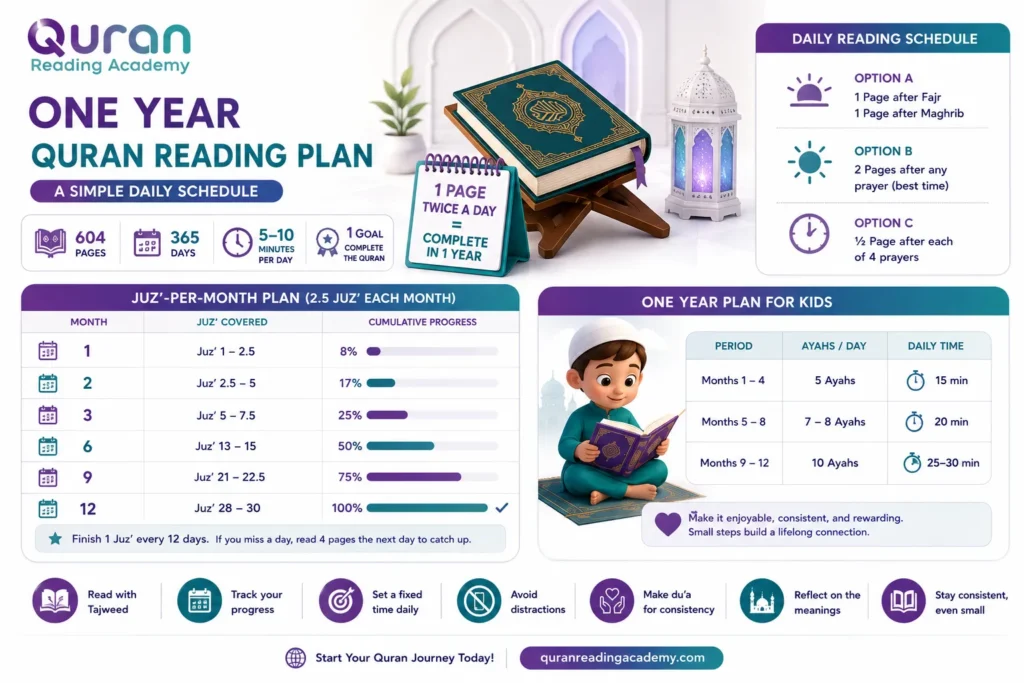
Every Muslim dreams of completing the Quran — cover to cover — but the idea of reading all 604 pages can feel overwhelming. The truth is, a one year Quran reading plan only asks for about 2 pages a day, roughly 5 to 10 minutes of your time.
That small daily commitment, spread across 365 days, carries you through all 30 Juz’ without pressure or burnout.
This guide from Quran Reading Academy breaks down exactly how to read the Quran in a year, whether you’re an adult building a new habit or a parent helping your child start their journey.
If you’ve been searching for a realistic way to read the Quran in a year plan that fits into a busy schedule, this is it. You’ll find a concrete daily schedule, practical tips for staying consistent, and a special plan adapted for children’s attention spans.
How To Read The Quran In One Year?
Before diving into strategies, it helps to see the actual numbers. When you understand how little daily effort a full Khatmah requires, the goal stops feeling distant and starts feeling doable.
The Quran contains 604 pages across 30 Juz’. Divide 604 by 365 days and you get approximately 1.65 pages per day — round that up to 2 pages (one physical sheet, sometimes called a “wird”).
At an average reading pace, 2 pages of Arabic text takes between 5 and 10 minutes, depending on your fluency and whether you pause for reflection.
That means a complete Khatmah in one year costs you less time than a single social media scroll session.
1. A Prayer-Based Daily Reading Schedule
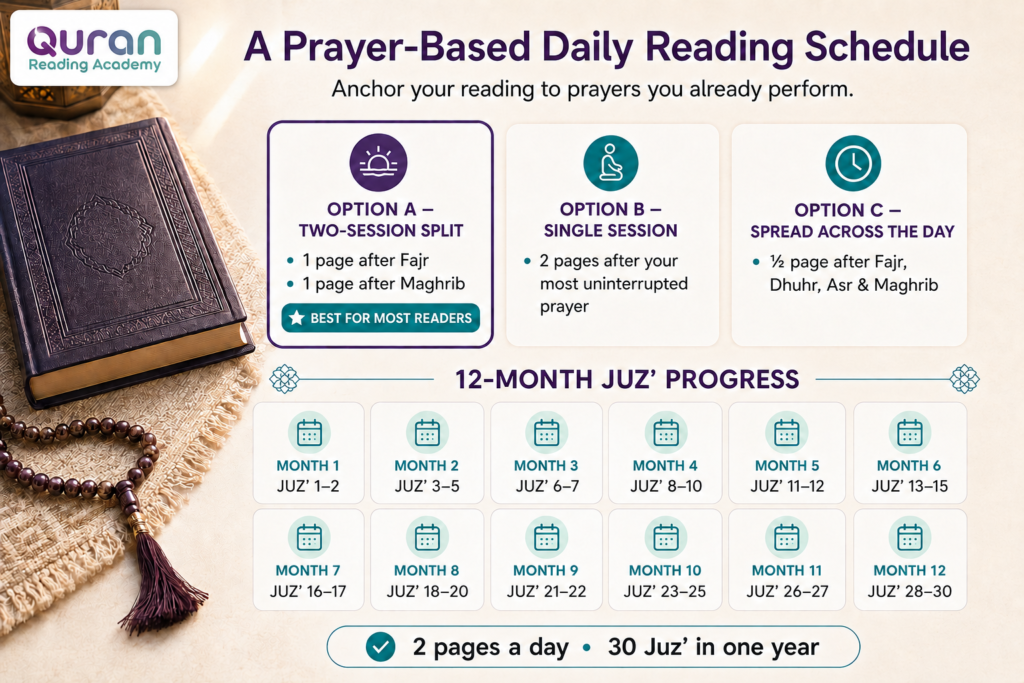
The most effective way to read the Quran in one year is to anchor your reading to prayers you already perform. This removes the need for willpower — the prayer itself becomes your reminder.
Option A — Two-session split:
- Read 1 page after Fajr
- Read 1 page after Maghrib
Option B — Single session:
- Read 2 pages after any prayer where you have the most uninterrupted time
Option C — Spread across the day:
- Read half a page after each of four prayers (Fajr, Dhuhr, Asr, Maghrib)
The two-session split works best for most readers because Fajr and Maghrib are natural transition points in the day — the mind is either fresh or winding down, both ideal states for focused reading.
Read Also: 30 Day Ramadan Quran Reading Schedule
2. The Juz’-Per-Month Framework
Here is a practical way to track your progress without overcomplicating it. Quran Reading Academy recommends what we call the “2.5 Juz’ Month” approach:
| Month | Juz’ Covered | Cumulative Progress |
| 1 | Juz’ 1–2.5 | 8% complete |
| 2 | Juz’ 2.5–5 | 17% complete |
| 3 | Juz’ 5–7.5 | 25% complete |
| 6 | Juz’ 13–15 | 50% — halfway |
| 9 | Juz’ 21–22.5 | 75% complete |
| 12 | Juz’ 28–30 | 100% — Khatmah |
Each month covers roughly 2.5 Juz’, which means finishing one Juz’ every 12 days. If you miss a day, you only need to read 4 pages the next day to catch up — a gap that’s easy to close before it snowballs.
Read Also: Quran Reading Tracker
One Year Quran Reading Plan for Kids
Children can absolutely complete a Khatmah in one year, but their plan needs to look different from an adult’s. Shorter attention spans, developing Tajweed skills, and the need for positive associations with the Quran all call for a gentler pace.
Instead of measuring by pages, a kids’ one year Quran reading plan works better when measured by Ayahs.
Reading 5 to 10 Ayahs per day — which takes about 15 to 30 minutes including Tajweed practice — keeps sessions short enough to hold a child’s focus while still covering the full Quran within the year.
| Period | Ayahs Per Day | Daily Time |
| Months 1–4 | 5 Ayahs | 15 minutes |
| Months 5–8 | 7–8 Ayahs | 20 minutes |
| Months 9–12 | 10 Ayahs | 25–30 minutes |
The gradual increase matters. Starting at 10 Ayahs on day one often leads to resistance by week three. Starting at 5 and building up lets the habit solidify before the volume grows.
What Makes A Kids’ Plan Actually Work?
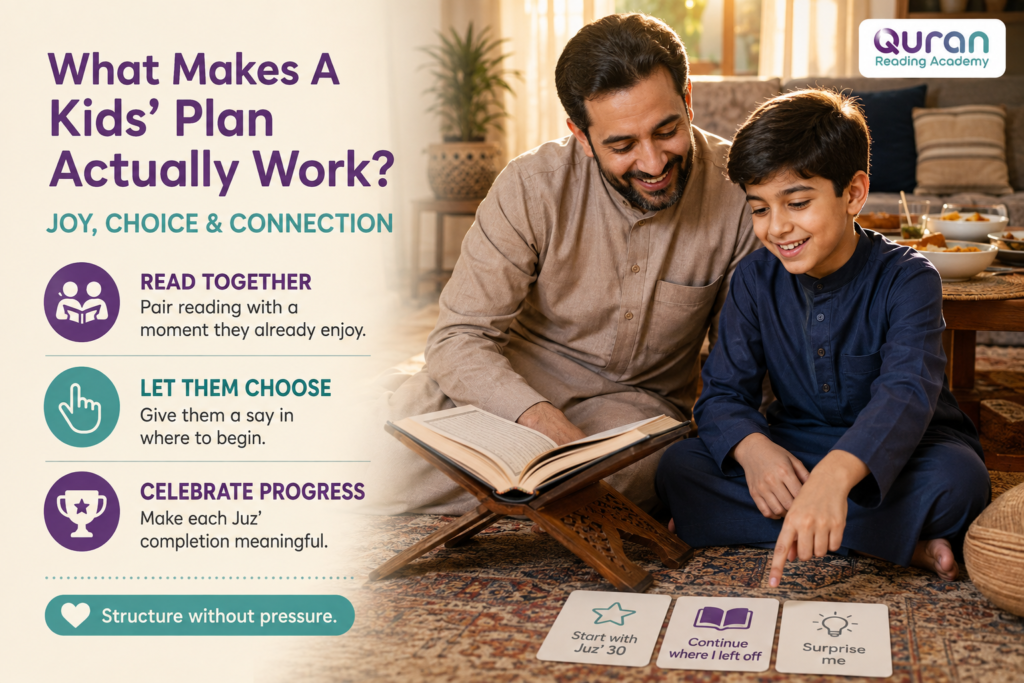
A common mistake parents make is treating a child’s Quran reading schedule like a homework assignment — rigid, timed, and consequence-driven. Children who associate Quran reading with punishment or pressure tend to abandon it the moment parental oversight relaxes.
What works instead: pair reading with something the child already enjoys. Read together after a favourite meal.
Let them choose which Surah to start with each week. Celebrate Juz’ completions with something meaningful — a family outing, a small gift, or simply verbal recognition in front of relatives.
Quran Reading Academy’s Quran Reading Classes for Kids give children a structured environment with qualified teachers who understand how to keep young learners engaged without turning sessions into chores.
Rules And Etiquette Of Quran Reading
Following proper etiquette during your daily reading isn’t just tradition — it shapes how deeply the words affect you. The physical and mental preparation creates a state of focus that turns routine reading into genuine spiritual engagement.
1. Preparing Yourself Before You Begin
Most scholars recommend performing Wudu (ablution) before touching the Mushaf, though listening to a digital recitation without Wudu is generally considered permissible.
Beginning with “Bismillah ir-Rahman ir-Raheem” sets your intention and marks the transition from daily activity to sacred engagement.
Choose a clean, quiet space. Reading the Quran in noisy or inappropriate environments — during a party, in a cluttered room with distractions — diminishes the reflective quality that makes the practice meaningful.
2. Reading with Proper Tajweed
Tajweed — the rules governing pronunciation, elongation, and stops — ensures you’re reciting the Quran as it was revealed. Common errors like shortening a Madd (elongation) or skipping a Ghunnah (nasal sound) can change the meaning of a word entirely.
If your Tajweed needs strengthening, don’t let that stop your one year Quran reading plan. Start reading at your current level and improve your pronunciation in parallel.
Quran Reading Classes for Adults at Quran Reading Academy pair daily reading progress with Tajweed correction from native Arabic-speaking instructors.
See Our Academy in Action
Discover what a typical session looks like! Watch these brief highlights from our live, interactive classes to see how our instructors engage with students of all ages.
Start Your Quran Learning Journey Today
Join Quran Reading Academy and begin structured, step-by-step Quran reading with expert guidance.
Try your first class for free3. Reflecting On Meaning, Not Just Pronunciation
Reading the Quran in Arabic carries spiritual weight, but reading without understanding leaves much of the benefit untapped.
Keep a reliable English translation nearby — Sahih International or Dr. Mustafa Khattab’s “The Clear Quran” are both accessible for daily use. Read the Arabic first, then glance at the translation for the same passage.
This dual approach takes only 2 to 3 extra minutes per session but transforms the experience from phonetic exercise into genuine connection with the text.
If you’re a new Muslim or someone returning to the Quran after time away, Quran Reading Academy offers Quran Reading Classes for New Muslims designed to build both reading fluency and comprehension from the ground up.
Read also: How To Read The Whole Quran In 10 Days?
Tips For Building A Daily Quran Reading Routine That Lasts
Starting a one year Quran reading plan is easy. The real challenge is day 47, or day 112 — the stretches where motivation fades and life gets busy. These strategies address that specific problem.
1. Prioritize Understanding Over Speed
Rushing through 2 pages to check a box defeats the purpose. A reader who takes 10 minutes to read 2 pages with reflection retains more — spiritually and intellectually — than one who races through 4 pages in 5 minutes.
Set a specific daily time that allows genuine focus: early morning after Fajr, before bed after Isha, or during a lunch break.
2. Start Small And Build Gradually
If 2 pages feels like too much on day one, start with half a page. Consistency matters more than volume in the first two weeks. Once the habit is automatic — meaning you feel something is missing when you skip — increase to the full 2 pages.
Habit research consistently shows that reducing friction in the early days leads to higher long-term adherence.
3. Use Audio Recitations As A Companion
Listen to a skilled Qari reciting the same passage you read that day. This serves three purposes: it corrects your pronunciation passively, it deepens your emotional connection to the Surah, and it counts as additional engagement with the Quran during commutes or household tasks.
Mishary Rashid Alafasy and Abdul Rahman Al-Sudais are widely recommended for clear, measured recitation.
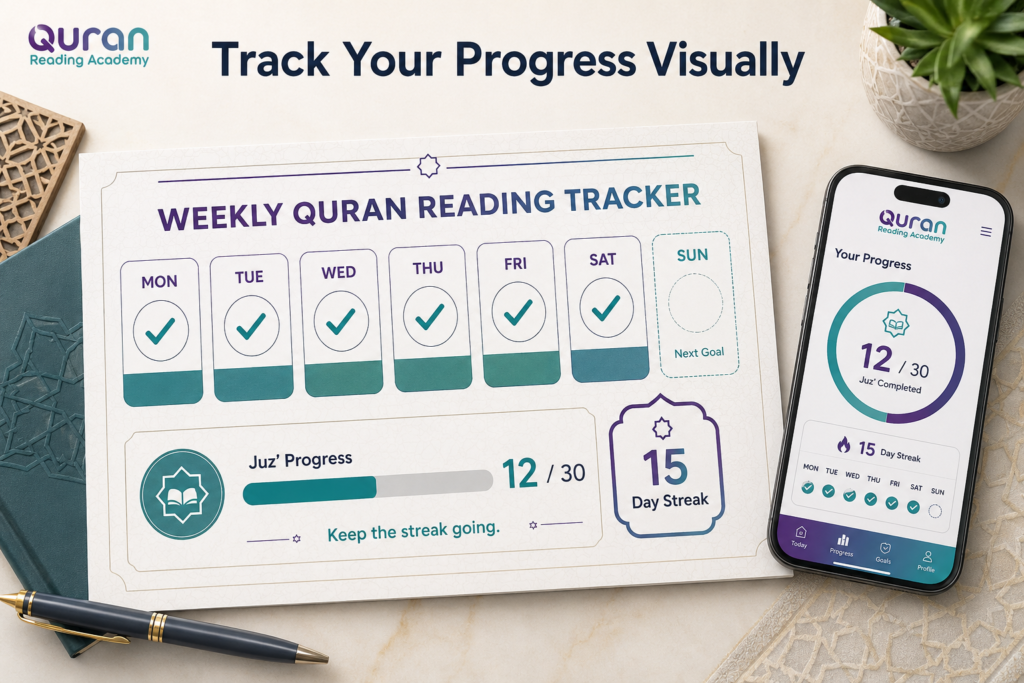
4. Track Your Progress Visually
A simple chart on your wall or a Quran tracking app showing completed Juz’ creates a visual streak you won’t want to break.
The psychology is straightforward — once you’ve filled in 15 consecutive days, skipping day 16 feels like a loss. Quran Reading Academy provides progress tracking within its structured Quran Reading Classes so students and teachers both monitor consistency.
5. Have An Accountability Partner Or Join A Course
Solo reading plans have a significantly higher dropout rate than group-based ones. When someone else expects you to show up — a study partner, a teacher, a family member reading alongside you — the social commitment fills the gap when personal motivation dips.
Quran Reading Academy’s structured courses pair you with a dedicated instructor who tracks your reading schedule, corrects your recitation in real time, and adjusts the pace to your life.
Whether you’re a working professional, a stay-at-home parent, or a student, the flexibility of online sessions with Quran Reading Classes for Female/Sisters or mixed classes means the plan adapts to you — not the other way around.
Common Mistakes That Derail A One Year Quran Reading Plan
Knowing what causes failure is as valuable as knowing the plan itself. These are the three patterns Quran Reading Academy instructors see most often.
A. Trying To Make Up Too Many Missed Days At Once
Missing one day means reading 4 pages the next — manageable. Missing a full week and then trying to read 14 pages in a single sitting leads to fatigue, frustration, and often quitting entirely.
The better approach: cap your makeup at double the daily amount (4 pages) and accept that the timeline may shift by a few days. Finishing in 370 days is still a Khatmah.
B. Reading Without Any Comprehension Support
Readers who spend months pronouncing Arabic words they don’t understand often report feeling disconnected and question why they’re continuing. Even a brief glance at a translation after each page maintains the sense of purpose that fuels long-term commitment.
C. Isolating The Practice From Daily Life
The Quran is referenced across most of the five pillars of Islam — in Salah, during Ramadan fasting, throughout Hajj. Readers who treat their daily reading as separate from these practices miss the natural reinforcement.
When you read a passage about patience in the morning and then face a difficult situation at work, the connection strengthens both the habit and its impact.
Read Also: How To Read Quran In 2 Months
Inside Our Live Classroom
We believe in complete transparency. Take a look inside our virtual classrooms to experience our premium teaching tools and engaging learning environment firsthand.
Start Your Quran Learning Journey Today
Join Quran Reading Academy and begin structured, step-by-step Quran reading with expert guidance.
Try your first class for freeStart Your One Year Quran Reading Plan with Quran Reading Academy
You now have the schedule, the strategies, and the awareness of what to avoid. The only thing between you and a complete Khatmah is the decision to begin — and the right support to keep going.
Quran Reading Academy offers one-on-one online classes with qualified, native Arabic-speaking instructors who guide your daily reading, correct your Tajweed in real time, and keep you accountable across all 30 Juz’.
Whether you’re starting fresh or restarting after a break, a structured course removes the guesswork and replaces it with a clear, supported path.
Our Quran Courses:
- Quran Reading Classes
- Quran Reading Classes for Kids
- Quran Reading Classes for Adults
- Quran Reading Classes for Female/Sisters
- Quran Reading Classes for New Muslims
- Quran Reading Course for Beginners
- Online Quran Reading Course with Tajweed
- Reading and Memorizing the Quran Course
- Noorani Qaida Course
- Quran Course for Beginners
- Quran Tajweed Course
- Quran Recitation Course
- Quran Hifz Course
- Online Quran Qirat Classes
- Quranic Arabic Course
- Arabic Reading Practice Course
Start Your Quran Learning Journey Today
Join Quran Reading Academy and begin structured, step-by-step Quran reading with expert guidance.
Try your first class for freeConclusion
A one year Quran reading plan is one of the most accessible spiritual commitments a Muslim can make — 2 pages a day, 5 to 10 minutes, anchored to prayers you already perform.
The key is not speed or volume but consistency: showing up daily, reading with intention, and having a support system that catches you when motivation drops.
For children, the same principle applies at a gentler pace — 5 to 10 Ayahs daily, building gradually, with positive reinforcement replacing pressure.
Whether you follow a read of the Quran in a year plan alone with a translation by your side or join a structured course with Quran Reading Academy, the path to Khatmah is simpler than most people assume.
The Quran was revealed over 23 years — reading it in one year is already a focused pace. Give yourself grace on difficult days, celebrate each completed Juz’, and remember that the goal is not just to finish the book but to let it change how you live.
Frequently Asked Questions
Below are the most common questions readers ask when planning to read the Quran in one year. Each answer gives you a direct, practical response you can apply immediately.
1. How many pages of the Quran should I read per day to finish in one year?
You need to read approximately 2 pages per day to complete all 604 pages within 365 days. At a moderate pace, this takes 5 to 10 minutes depending on your familiarity with Arabic and whether you pause for reflection.
2. Can I listen to the Quran instead of reading it for my daily plan?
Listening counts as engagement with the Quran and carries its own spiritual rewards, but it does not replace the act of reading from the Mushaf for most scholarly opinions. The most effective approach is to combine both — read your 2 daily pages and listen to the same passage during commutes or downtime to reinforce retention.
3. What if I miss several days in my one year Quran reading plan?
Cap your daily makeup at 4 pages (double the normal amount) rather than trying to cover an entire missed week in one sitting. If you fall behind by more than a week, adjust your completion target to 13 months instead of abandoning the plan. A Khatmah completed in 380 days is still a Khatmah.
4. Is a one year Quran reading plan suitable for beginners who read Arabic slowly?
Yes. Beginners may need 15 to 20 minutes for 2 pages instead of 5 to 10, but the plan remains realistic. Pairing your daily reading with a structured course — like those offered at Quran Reading Academy — accelerates your reading speed while keeping you on schedule.
5. How do I keep my child motivated throughout a full year of Quran reading?
Start with just 5 Ayahs per day and increase gradually. Celebrate Juz’ milestones, read alongside your child rather than assigning it as a solo task, and avoid linking Quran reading to punishment. Enrolling in a kids-focused class with an engaging instructor provides external motivation that supplements what you do at home.
6. What is the difference between reading the Quran in one year and memorizing it in one year?
Reading (Khatmah) requires about 2 pages per day at 5 to 10 minutes — a light daily commitment. Memorizing (Hifz) the entire Quran in one year requires memorizing roughly 2 pages per day, 6 days a week, with 1.5 to 3 hours of daily effort including revision. The two goals demand very different levels of time and focus.






Leave a Reply