 Quran
Quran
You can read the Quran online for free using trusted platforms like Tanzil.net, Quran.com, and QuranExplorer.
These websites provide the full Quran in Arabic with translations, transliteration, and audio recitation at zero cost. Every Muslim with internet access can start reading today without downloading software or creating an account.
Reading the Quran strengthens your connection with Allah and brings spiritual clarity to daily life. Free online Quran tools have removed financial and geographic barriers that once limited access to proper Quranic text.
This guide walks you through six practical steps to start reading the Quran online for free, from choosing the right platform to applying Tajweed rules and knowing when to seek guided instruction.
1. Choose a Reliable Free Quran Reading Platform
Several trustworthy websites allow you to read Quran online for free with full Arabic text and multiple translations. Selecting the right platform depends on your reading level and preferred features.
a. Tanzil.net for Verse-by-Verse Navigation
Tanzil.net displays the Quran in clean Uthmani script with verse-by-verse navigation. Readers can select from over 40 translations in dozens of languages. The interface loads quickly and works on mobile browsers without any app installation.
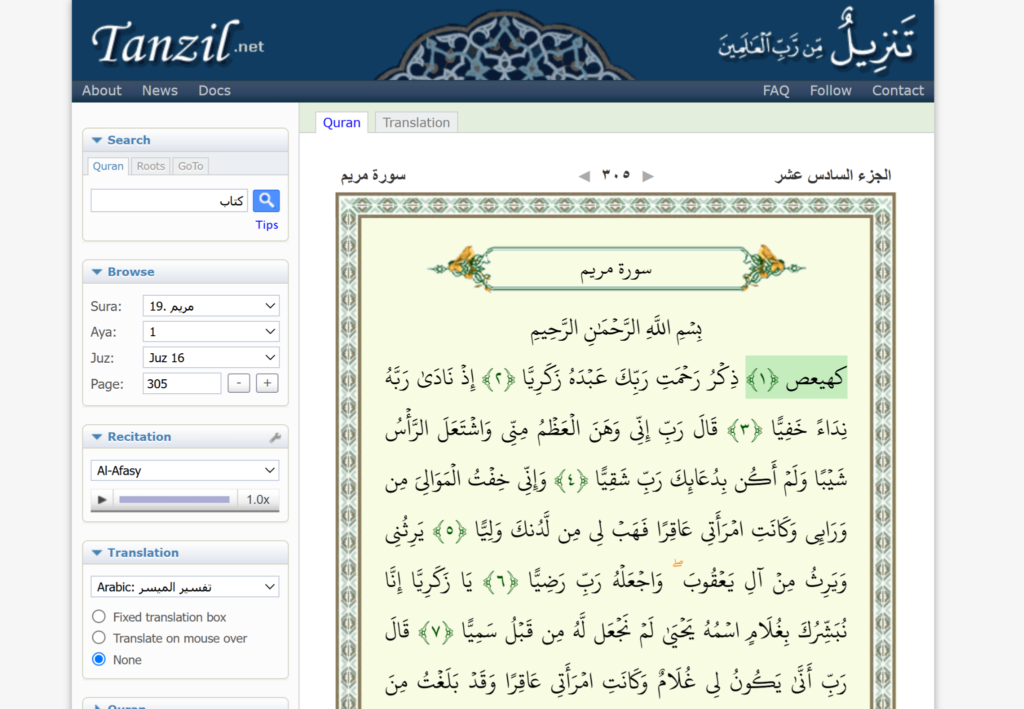
A key advantage of Tanzil is its transliteration option. Beginners who cannot read Arabic script yet can follow the romanized pronunciation alongside the original text. This bridges the gap between wanting to recite and not knowing the alphabet.
Tanzil also offers a search function that locates specific words or phrases in any of the 114 Surahs. This feature helps readers find verses they heard in a lecture or Khutbah.
Read Also: Quran Reading Plan for Beginners
b. Quran.com for Audio and Translation Access
Quran.com pairs every verse with audio recitation from renowned Qaris like Mishary Rashid Alafasy and Abdul Basit. Readers can listen while following the Arabic text, which trains the ear and eye simultaneously.
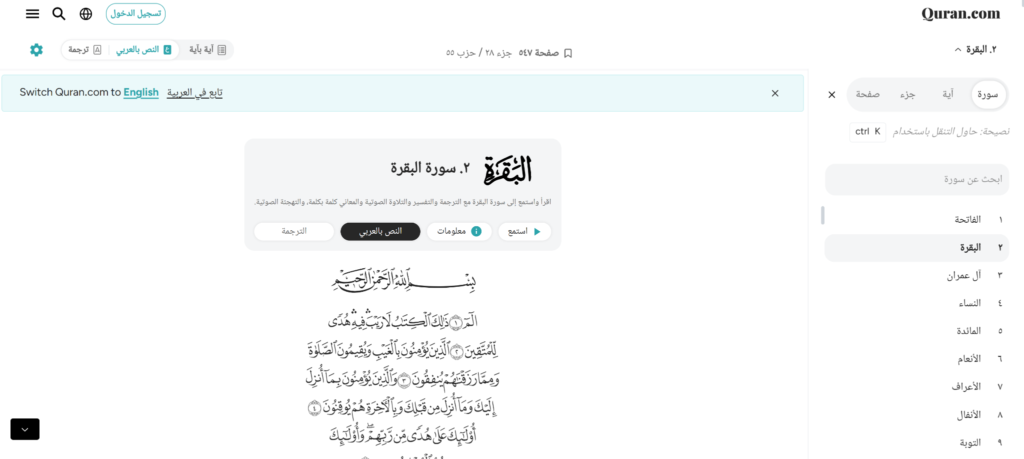
The platform supports word-by-word translation and morphological breakdown. Each Arabic word displays its English meaning when hovered or tapped. This granular approach helps learners absorb Quranic vocabulary naturally.
Quran.com also allows bookmarking and progress tracking. Readers who commit to finishing one Juz per week can monitor their pace without external tools.
c. QuranExplorer for Mushaf-Style Reading
QuranExplorer presents the Quran in a visual format resembling the printed Mushaf. Readers who prefer the traditional page layout find this interface familiar and comfortable.
The platform includes synchronized audio that highlights each verse during playback. This visual-audio pairing reinforces correct pronunciation and helps readers identify where each verse begins and ends on the page.
d. Free Quran Platform Comparison
The table below compares popular free Quran platforms based on the features that matter most for online reading and study, including Arabic script, transliteration, audio recitation, word-by-word translation, and Mushaf-style layout.
Use it to quickly identify which platform best matches the way you prefer to read, listen to, or study the Quran online.
| Platform | Arabic Script | Transliteration | Audio Recitation | Word-by-Word Translation | Mushaf Layout |
| Tanzil.net | Yes (Uthmani) | Yes | No | No | No |
| Quran.com | Yes (Uthmani) | Yes | Yes (20+ Qaris) | Yes | No |
| QuranExplorer | Yes (Uthmani) | Limited | Yes | No | Yes |
Read Also: Benefits of Reading Quran
2. Learn Arabic Letters and Their Different Forms Before Reading Quranic Text
Reading the Quran accurately requires recognizing all 28 Arabic letters in their isolated, initial, medial, and final forms. Free resources can teach this foundational skill effectively.
a. Use Noorani Qaida to Build Basic Quran Reading Skills
Noorani Qaida is the most widely used primer for Quran reading beginners. Free PDF versions are available on multiple Islamic education websites.
The book introduces letters individually, then combines them with short vowels before progressing to full words.
Many YouTube channels offer complete Noorani Qaida courses at no cost. Channels dedicated to Quranic education walk through every topic with audio examples and repetition drills. Learners can pause, rewind, and repeat until each sound feels natural.
A common beginner mistake is rushing past letter recognition to start reading Surahs. Skipping this foundation causes persistent pronunciation errors that become harder to correct later. Spend two to four weeks on letters alone before moving forward.
Quran Reading Academy offers a structured Noorani Qaida Course that teaches Arabic letter recognition, Harakat, Sukoon, Tanween, and basic Tajweed principles through one-on-one live sessions with certified instructors.
Build your Arabic foundation with expert Noorani Qaida instruction
b. Learn Arabic Vowels and Diacritics for Accurate Quran Reading
Arabic diacritics determine how each letter sounds in context. Fatha produces an “ah” sound, Kasra produces an “ee” sound, and Damma produces an “oo” sound.
Without recognizing these marks, a reader cannot distinguish between words that share the same letters.
Tanween doubles the vowel sound at the end of a word. Sukoon indicates a consonant stop with no vowel. Shaddah doubles the letter itself. Each mark changes meaning, so accuracy matters greatly.
Practice reading simple three-letter words with different vowel combinations. Repeat each word aloud five times before moving to the next. This repetition builds muscle memory in the tongue and mouth.
| Diacritical Mark | Arabic Example | Sound Produced | Example Effect |
| Fatha | بَ (ba) | “ah” as in “cat” | Changes base letter to “ba”, “ta”, “tha” |
| Kasra | بِ (bi) | “ee” as in “bit” | Changes base letter to “bi”, “ti”, “thi” |
| Damma | بُ (bu) | “oo” as in “put” | Changes base letter to “bu”, “tu”, “thu” |
| Sukoon | بْ (b) | Consonant stop | Halts the letter with no vowel |
| Shaddah | بّ (bb) | Doubled letter | Emphasizes and doubles the consonant |
| Tanween | بً (ban) بٍ (bin) بٌ (bun) | Double vowel ending | Adds “an”, “in”, or “un” at word end |
Inside Our Live Classroom
We believe in complete transparency. Take a look inside our virtual classrooms to experience our premium teaching tools and engaging learning environment firsthand.
Start Your Quran Learning Journey Today
Join Quran Reading Academy and begin structured, step-by-step Quran reading with expert guidance.
Try your first class for free3. Practice Quran Recitation Daily with Audio Support
Consistent daily practice separates successful Quran readers from those who stall after initial enthusiasm. Even 15 minutes of focused reading each day produces noticeable improvement within weeks.
a. Use the Listen-and-Repeat Method with Expert Quran Reciters
Select a Qari who recites at a slow, deliberate pace. Sheikh Mahmoud Khalil Al-Husary recorded the entire Quran in a Murattal style specifically designed for learners. His clear articulation makes each letter and vowel distinguishable.
Play one verse, pause the audio, and repeat the verse aloud. Compare your pronunciation to the recording. Repeat until your version closely matches the original. This active imitation method trains both listening comprehension and vocal production.
Record yourself reciting a short passage weekly. Listening to your own recordings reveals errors your ear misses during live recitation. Track improvement by comparing recordings from different weeks.
Read Also: How to Get Better at Reading Quran?
b. Build a Consistent 15-Minute Daily Quran Reading Routine
Choose a specific time each day for Quran reading. After Fajr prayer is ideal because the mind is fresh and distractions are minimal. Allah highlights the special status of dawn recitation in the Quran:
وَقُرْءَانَ ٱلْفَجْرِ ۖ إِنَّ قُرْءَانَ ٱلْفَجْرِ كَانَ مَشْهُودًا
(Wa qur’ānal-fajr, inna qur’ānal-fajri kāna mashhūdā)
(“And the Quran at dawn. Indeed, the recitation of dawn is witnessed.”)
Angels witness the Fajr recitation, adding spiritual weight to early morning reading. Setting a fixed schedule removes the daily decision of when to practice and turns reading into an automatic habit.
Start each session by reviewing yesterday’s passage before adding new material. Revision strengthens retention and prevents the common pattern of always reading new text while forgetting previous sections.
Quran Reading Academy offers a structured Online Quran Reading Course with Tajweed that pairs learners with certified tutors for personalized pronunciation correction during live sessions.
Start your Tajweed journey with expert guidance
4. Apply Basic Tajweed Rules for Accurate Quran Reading
Tajweed governs the precise pronunciation of every Quran letter. Learning basic rules early prevents habits that become difficult to break later. Free resources introduce foundational Tajweed concepts effectively.
a. Learn Noon Sakinah and Tanween Rules for Correct Pronunciation
Noon Sakinah occurs when the letter Noon carries a Sukoon. Four rules govern its pronunciation depending on the letter that follows:
- Izhar (clear pronunciation).
- Idgham (merging).
- Iqlab (conversion).
- Ikhfa (concealment).
Each rule changes how the nasal sound behaves. Izhar requires full clarity when followed by throat letters like Ha or Ain. Idgham merges the Noon into the next letter when followed by Ya, Ra, Meem, Lam, Waw, or Noon.
Iqlab converts the Noon sound into a Meem when followed by the letter Ba. Ikhfa produces a partial nasal sound before 15 specific letters. Beginners should learn Izhar and Idgham first, then add Iqlab and Ikhfa gradually.
Allah commands clear, measured recitation in the Quran:
وَرَتِّلِ ٱلْقُرْءَانَ تَرْتِيلًا
(Wa rattilil-Qur’āna tartīlā)
This command establishes that Tajweed is not optional for those who can learn it. Measured recitation (Tarteel) requires applying pronunciation rules deliberately and carefully.
b. Practice Madd and Makharij for Accurate Letter Articulation
Madd rules dictate how long a vowel sound extends. Natural Madd (Madd Tabii) stretches for exactly two counts. Secondary Madd types extend to four or six counts depending on the context.
Articulation points (Makharij) define exactly where each letter originates in the mouth or throat. The letter Qaf originates from the deepest part of the tongue touching the soft palate. The letter Tha originates from the tip of the tongue touching the upper front teeth.
Confusing Makharij is the most frequent error among self-taught readers. Letters like Seen and Saad sound similar to untrained ears but originate from different tongue positions. A certified teacher can identify these errors instantly, which free tools cannot.
Quran Reading Academy provides a dedicated Quran Tajweed Course where Al-Azhar graduates correct articulation errors in real-time one-on-one sessions.
Perfect your Makharij with certified Al-Azhar tutors
5. Progress from Short Surahs to Full Quran Pages
Gradual progression builds confidence and prevents overwhelm. Starting with manageable portions and expanding systematically leads to fluent Quran reading.
a. Start with Juz Amma to Build Quran Reading Confidence
Juz Amma (the 30th Juz) contains the shortest Surahs in the Quran. Many of these chapters are only three to six verses long. Their brevity makes them ideal for beginners practicing newly learned skills.
Begin with Surah Al-Fatiha because every Muslim needs it for Salah. Then move to Surah Al-Ikhlas, Al-Falaq, and An-Nas. These three Surahs appear frequently in daily prayers and protective supplications.
Read each Surah slowly with full attention to vowel marks and letter connections. Accuracy matters more than speed at this stage. One correctly recited verse holds more value than ten rushed verses with errors.
b. Use a Self-Assessment Checklist to Track Your Reading Progress
Track your development using concrete milestones. The following timeline helps beginners measure steady improvement:
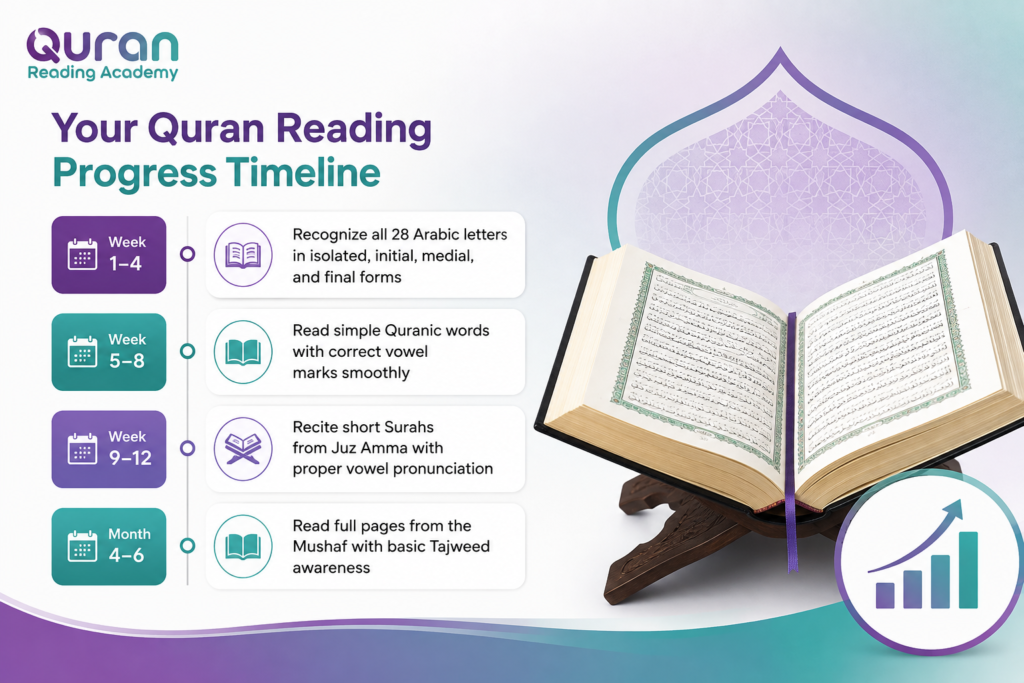
- Week 1 to 4: Recognize all 28 Arabic letters in isolated, initial, medial, and final forms
- Week 5 to 8: Read simple Quranic words with correct vowel marks smoothly
- Week 9 to 12: Recite short Surahs from Juz Amma with proper vowel pronunciation
- Month 4 to 6: Read full pages from the Mushaf with basic Tajweed awareness
If progress stalls at any checkpoint, the issue likely traces back to a weak foundation in letter recognition or vowel marks. Return to Noorani Qaida lessons for that specific gap.
6. Move from Free Quran Tools to Guided Teacher Instruction
Free platforms serve as excellent starting points, but they cannot replace live human feedback. Recognizing when to seek structured guidance accelerates progress dramatically.
a. Avoid Common Tajweed and Pronunciation Mistakes in Self-Study
Self-taught readers often develop pronunciation habits that feel correct but violate Tajweed rules. The tongue placement for heavy letters (Mufakhkham) versus light letters (Muraqqaq) requires external correction that no app can provide.
Another frequent issue is incorrect Madd timing. Readers may elongate vowels inconsistently or skip elongation entirely. Without a teacher measuring their counts, these errors become ingrained patterns.
Free tools also lack accountability. Many learners start enthusiastically but abandon their routine within weeks. A scheduled class with a live teacher creates commitment that self-study cannot replicate.
Read Also: Daily Quran Reading Plan And Schedule
b. Know When Free Quran Resources Are No Longer Enough
Free resources effectively teach letter recognition, basic vowel reading, and listening skills. They fall short when precise articulation correction, advanced Tajweed application, and personalized pacing become necessary.
The transition point usually arrives when a reader can decode Arabic text slowly but cannot recite it smoothly or beautifully. At this stage, expert instruction turns mechanical reading into genuine Tarteel recitation.
Prophet Muhammad (peace be upon him) emphasized beautifying Quran recitation:
زَيِّنُوا الْقُرْآنَ بِأَصْوَاتِكُمْ
(Zayyinul-Qur’āna bi-aṣwātikum)
(“Adorn the Quran with your voices”)
This Hadith shows that recitation quality is not optional but a Prophetic instruction. Achieving beautiful recitation requires guided training with a qualified teacher.
Quran Reading Academy offers a Quran Reading Course for Beginners that takes students from zero Arabic knowledge to fluent Mushaf reading through a structured Noorani Qaida curriculum.
Begin your guided Quran reading journey today
7. Spiritual Rewards of Learning and Reading the Quran Consistently
Reading the Quran carries immense reward regardless of the reader’s skill level. Allah acknowledges effort alongside proficiency, encouraging every Muslim to engage with the Quran.
The Prophet Muhammad (peace be upon him) said:
الْمَاهِرُ بِالْقُرْآنِ مَعَ السَّفَرَةِ الْكِرَامِ الْبَرَرَةِ وَالَّذِي يَقْرَؤُهُ وَيَتَتَعْتَعُ فِيهِ وَهُوَ عَلَيْهِ شَاقٌّ لَهُ أَجْرَانِ
(“The one who is proficient in reciting the Quran will be with the honourable and righteous scribes (angels), and the one who reads the Quran and stumbles over it, finding it difficult, will have double rewards.”)
This Hadith directly addresses beginners who struggle with pronunciation. The difficulty itself earns additional reward, meaning no effort spent learning to read the Quran goes unrewarded.
Consistent engagement with the Quran also brings tranquility. Allah describes the Quran as a source of healing and mercy for believers:
وَنُنَزِّلُ مِنَ ٱلْقُرْءَانِ مَا هُوَ شِفَآءٌ وَرَحْمَةٌ لِّلْمُؤْمِنِينَ
(Wa nunazzilu minal-Qur’āni mā huwa shifā’un wa raḥmatun lil-mu’minīn)
(“And We send down of the Quran that which is a healing and a mercy for the believers.”)
Reading even a few verses daily maintains this spiritual connection. The key is consistency, not quantity. A reader who recites half a page daily for a year accomplishes far more than someone who reads intensely for one week and then stops.
Quran Reading Academy offers a Quran Recitation Course focused on the art of Tarteel, teaching students to recite with the measured, rhythmic cadence the Prophet (peace be upon him) commanded.
Recite the Quran beautifully with certified guidance
See Our Academy in Action
Discover what a typical session looks like! Watch these brief highlights from our live, interactive classes to see how our instructors engage with students of all ages.
Start Your Quran Learning Journey Today
Join Quran Reading Academy and begin structured, step-by-step Quran reading with expert guidance.
Try your first class for freeStart a Free Trial Session with Quran Reading Academy
Every new student receives a free trial session to evaluate the teaching style, platform quality, and tutor expertise before making any financial commitment. Sessions are one-on-one with certified Al-Azhar graduates who adapt lessons to the student’s current level.
If you are a complete beginner, an adult returning to Quran study, or a parent seeking classes for your child, Quran Reading Academy matches you with the right instructor and curriculum.
Our Quran Courses
- Quran Reading Classes
- Quran Reading Classes for Kids
- Quran Reading Classes for Adults
- Quran Reading Classes for Female/Sisters
- Quran Reading Classes for New Muslims
- Quran Reading Course for Beginners
- Online Quran Reading Course with Tajweed
- Reading and Memorizing the Quran Course
- Noorani Qaida Course
- Quran Course for Beginners
- Quran Tajweed Course
- Quran Recitation Course
- Quran Hifz Course
- Online Quran Qirat Classes
Reserve your complimentary trial session now and start reading the Quran with confidence
Conclusion
Reading the Quran online for free is fully achievable through platforms like Tanzil.net, Quran.com, and QuranExplorer. These tools provide authentic Arabic text, translations, transliteration, and audio recitation without any cost.
Building a strong foundation starts with learning Arabic letters through Noorani Qaida, practicing daily with audio support, and applying basic Tajweed rules progressively. Short Surahs from Juz Amma offer the ideal starting point for beginners.
Free resources serve as a powerful launchpad, but live instruction from certified tutors accelerates progress and corrects errors that self-study cannot detect. The combination of free daily practice and structured guidance produces confident, accurate Quran readers who maintain a lifelong relationship with Allah’s Book.
Frequently Asked Questions
Can I Read Quran Online for Free Without Knowing Arabic?
Yes. Platforms like Quran.com and Tanzil.net offer transliteration alongside Arabic text. Transliteration displays Arabic sounds in English letters, allowing non-Arabic readers to follow the recitation phonetically while learning the original script gradually.
Which Free Platform Offers Audio Recitation with English Translation?
Quran.com provides synchronized audio from over 20 renowned Qaris with English translations displayed verse by verse. Readers can select their preferred reciter and translation author. The platform works on desktop browsers and mobile devices without requiring an app download.
How Long Does It Take to Read Quran Fluently Through Free Online Resources?
Most dedicated beginners achieve basic reading fluency within three to six months of daily 15-minute practice. This timeline assumes consistent effort using Noorani Qaida for the first month, followed by gradual Surah reading. Progress accelerates significantly when supplemented with live instruction from a qualified tutor.
Do Free Quran Reading Websites Include Tajweed Guidance?
Some platforms display basic Tajweed color coding that highlights different pronunciation rules within the text. Quran.com offers a Tajweed mode that visually marks Ghunnah, Ikhfa, Idgham, and other rules. However, applying these rules correctly requires practice with a teacher who can hear and correct your specific errors.
Is Reading Quran from a Screen Equal in Reward to Reading from a Mushaf?
Islamic scholars confirm that reading the Quran from any medium carries spiritual reward. The reward applies when reading from a printed Mushaf, a screen, or from memory. The essential factor is sincere intention and respectful engagement with the text, not the physical format.


Leave a Reply