 Quran
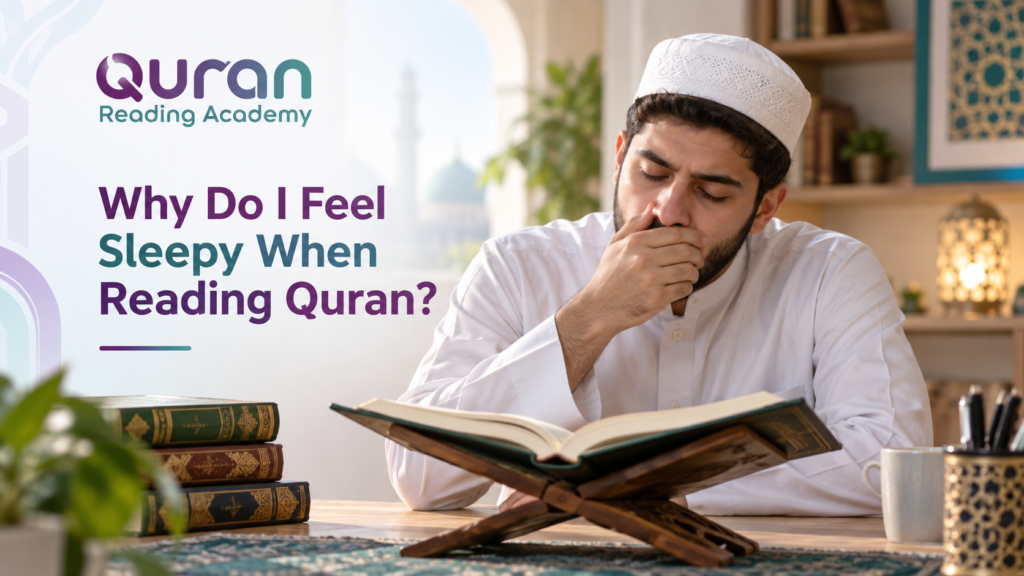
Millions of Muslims begin reading the Quran with sincere intention, only to feel their eyes grow heavy and their focus fade within minutes. Yawning during recitation is not a sign of weak faith, failure, or lack of love for the Quran. It is a common experience with clear physical, mental, and spiritual causes.
Sleepiness during Quran reading can depend on your reading time, sleep routine, Arabic understanding, and preparation before reciting. This article explains the main causes, what the Quran and authentic Sunnah say about drowsiness in worship, and practical ways to stay alert during recitation.
What Causes Sleepiness When Reading Quran?
Sleepiness while reading the Quran usually comes from fatigue, mental effort, environmental conditions, or reduced engagement with the meaning, rather than a lack of faith. Identifying the main cause makes it easier to choose a practical response, such as changing the reading time, posture, or level of engagement.
The table below summarizes common causes of drowsiness during Quran reading and a practical response to each one:
| Cause | Core Mechanism | Immediate Correction |
| Physical exhaustion | Reading when the body is in natural sleep descent | Shift sessions to morning hours |
| Mental overload from Arabic | Processing sound without comprehension depletes cognitive reserves | Read translation alongside each verse |
| Poor posture and environment | Reclining position and warm rooms send sleep signals to the brain | Sit upright, improve ventilation |
| Spiritual interference | Shaytan exploits existing fatigue during acts of worship | Recite ta’awwudh sincerely before every session |
| Passive recitation | No semantic engagement gives the brain no reward signal | Set comprehension targets alongside page goals |
Physical Exhaustion Causes Drowsiness During Quran Reading
The human body operates on a 24-hour internal clock that governs alertness and sleep at different points in the day.
Most Muslims who struggle with drowsiness during Quran reading choose late-night sessions, after Isha prayer or before bed, when the body is already well into its natural descent toward rest. Any low-stimulation activity at that hour, including recitation, will accelerate that descent, not interrupt it.
The Quran’s measured cadence and the quiet of a late-night setting can make a tired reader feel even more ready for rest.
These conditions resemble an environment that encourages sleep. When a person is already tired, the body may respond to a peaceful Quran session much as it responds to preparation for rest.
Read also: Do You Get Reward for Reading Quran on Phone
Poor Sleep Reduces Focus During Quran Recitation
Consistently getting too little sleep can reduce the ability to sustain attention during a low-movement task.
Quran recitation requires visual tracking, phonetic processing, and mental retention simultaneously. When the brain is already running on a sleep deficit, these combined demands exhaust its remaining reserves within minutes.
Quran Reading Academy offers a Quran Recitation Course that structures sessions to be active and engagement-driven, helping students build the mental stamina for consistent, alert recitation instead of the passive fatigue that unstructured self-study sessions routinely produce.
Start Your Quran Recitation Training with a Free Trial
Why Reading Quran at Night Can Make You Feel Sleepy
Melatonin, the hormone responsible for sleepiness, begins rising in the early evening and peaks in the middle of the night.
Any relaxing activity during this hormonal window accelerates melatonin’s effect instead of offsetting it.
Reading the Quran at night is thus working directly against the body’s chemistry, not because the Quran itself causes sleep, but because the timing places recitation inside a physiological window that promotes it.
Read also: Can You Read Quran in State of Janaba
Why Reading Arabic Can Cause Mental Fatigue
For a reader still developing fluency in Arabic, reciting the Quran demands significant cognitive effort on every single line. Letter recognition, vowel reading, Tajweed rule application, and pronunciation monitoring all occur simultaneously.
For the brain, this is not passive reading; it can feel like completing repeated pattern-recognition tasks without much rest between them.
This cognitive load is already high in a fully rested reader. In a tired reader, it becomes exhausting within minutes. The brain signals fatigue, attention narrows, and the eyes grow heavy.
This form of fatigue is not simply a matter of motivation. When mental processing reserves are low, taking a break or simplifying the task can be more helpful than forcing continued focus.
How Reading Without Translation Can Reduce Engagement
A reader who recites purely in Arabic without checking any translation engages only the sound layer of the Quran. The meaning layer remains dormant.
The brain naturally disengages from sustained phonetic effort that carries no semantic payoff.
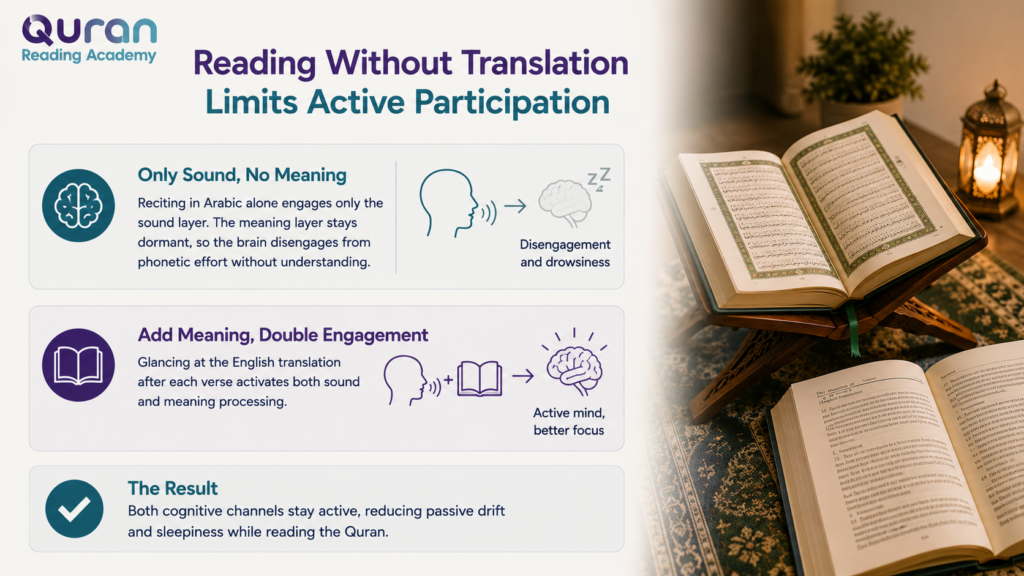
Comprehension creates a reward signal that sustains mental engagement; phonetic repetition without meaning creates a processing loop that exhausts without satisfying.
Introducing even a brief glance at the English translation after each verse adds a second layer of engagement to every passage.
Sound processing and meaning processing work together, keeping both cognitive channels active and reducing the passive drift that leads to sleepiness when reading Quran.
Read also: Can You Read Quran from Phone While Praying
Why Quran Recitation Feels More Tiring Without Understanding
In our experience at Quran Reading Academy, students who recite phonetically for extended sessions without engaging with meaning report falling asleep during reading within 10 to 15 minutes.
Students who pause to read the translation often find that meaning helps them remain engaged for longer. Comprehension may slow the pace of recitation, but it can anchor attention in a way that phonetic reading alone may not.
See Our Academy in Action
Discover what a typical session looks like! Watch these brief highlights from our live, interactive classes to see how our instructors engage with students of all ages.
Start Your Quran Learning Journey Today
Join Quran Reading Academy and begin structured, step-by-step Quran reading with expert guidance.
Try your first class for freeEnvironmental Conditions Can Affect Quran Reading Alertness
Your reading environment directly affects your physiological state during recitation. A warm, poorly ventilated room can make a reader feel less alert and more likely to yawn.
Yawning can occur when a person is tired or less alert, and a warm or stuffy room may make that feeling more noticeable.
Seating posture works in the same direction. Reading while lying on a bed, reclining against cushions, or sitting in a deeply padded chair places the body in positions the brain associates with rest.
Neck, back, and jaw muscles relax in reclining postures, sending rest signals to the brainstem even while you consciously attempt to remain alert.
How Upright Posture Helps You Stay Alert While Reading Quran
Sitting on a chair or directly on the floor with a straight back and the Quran on a stand can support alert recitation. Avoid the bed, the couch, or any reclined position during reading sessions.
Upright posture supports comfortable breathing and keeps the body more active than reclining. These physical cues can help a reader remain alert during a session.
Quran Reading Academy offers Quran Reading Classes for Adults with live, one-on-one sessions where a certified instructor maintains session momentum, preventing the drift and disconnection that unstructured solo study regularly allows to develop.
Book Your Free Adult Quran Reading Trial
Read also: Can You Read Quran While Praying Taraweeh?
Why You Should Seek Allah’s Protection Before Quran Recitation
Islamic teaching encourages believers to prepare spiritually before Quran recitation by seeking refuge in Allah from Shaytan. This spiritual preparation can accompany practical steps such as sufficient rest, an alert reading time, and attentive posture.
Allah instructs believers directly on what to do before every recitation:
فَإِذَا قَرَأْتَ الْقُرْآنَ فَاسْتَعِذْ بِاللَّهِ مِنَ الشَّيْطَانِ الرَّجِيمِ
(Fa-idhā qara’ta l-Qurāna fasta’idh billāhi mina sh-shayṭāni r-rajīm)
(“So when you recite the Quran, seek refuge with Allah from Satan, the expelled [from His mercy].”)
This command gives the reader a clear practice to begin with before recitation: seek refuge in Allah and approach the Quran with attention and intention.
The Prophet Muhammad (peace be upon him) also established the immeasurable reward of every letter recited from the Book of Allah:
مَنْ قَرَأَ حَرْفًا مِنْ كِتَابِ اللَّهِ فَلَهُ بِهِ حَسَنَةٌ وَالْحَسَنَةُ بِعَشْرِ أَمْثَالِهَا لَا أَقُولُ الم حَرْفٌ وَلَكِنْ أَلِفٌ حَرْفٌ وَلَامٌ حَرْفٌ وَمِيمٌ حَرْفٌ
(Man qara’a ḥarfan min kitābillāhi falahu bihi ḥasanatun, wal-ḥasanatu bi’ashri amthālihā, lā aqulu Alif Lam Mim ḥarfun, walakin alifun ḥarfun wa lāmun ḥarfun wa mīmun ḥarfun)
(“Whoever recites a letter from the Book of Allah will have a reward, and that reward will be multiplied by ten. I am not saying Alif Lam Mim is one letter, Alif is a letter, Lam is a letter, and Mim is a letter.”)
Remembering the reward of Quran recitation can strengthen a reader’s intention and encourage attentive engagement throughout the session.
Shaytan Can Exploit Tiredness During Worship
Classical scholars of Islamic spirituality describe Shaytan as exploiting existing weakness and distraction during worship.
A tired believer who sits down to read is in a spiritually vulnerable state, and Shaytan works to deepen that tiredness into full drowsiness during the session. Spiritual preparation before recitation, beginning with sincere intention, reciting the ta’awwudh, and choosing an alert time, removes much of the vulnerability Shaytan seeks to exploit.
Recite Ta’awwudh Before Quran Reading
Reciting “A’udhu billahi min ash-shaytan ir-rajim” before beginning functions as both spiritual protection and a psychological reset. It signals clearly to the heart and mind that what follows is sacred and demands full presence.
Reciting the ta’awwudh slowly and deliberately can help a reader begin the session with a clearer intention and greater attention.
Read also: Can You Read Quran for a Dead Person?
How Understanding Quran Can Help You Stay Focused
Allah commands believers not only to recite the Quran but to reflect upon it. This distinction is central to understanding why so many readers fall asleep during their sessions.
أَفَلَا يَتَدَبَّرُونَ الْقُرْآنَ أَمْ عَلَىٰ قُلُوبٍ أَقْفَالُهَا
(Afalā yatadabbarūna l-Qurāna am ‘alā qulūbin aqfāluhā)
(“Do they not reflect upon the Quran, or are there locks upon their hearts?”)
A reader who focuses only on finishing pages, especially when tired, may find it harder to remain engaged with the Quran. Reflection adds meaning to recitation and can help sustain attention throughout the session.
Connect Quran Recitation With Meaning to Maintain Attention
Setting a page target without a comprehension target creates a reading mode that bypasses meaning entirely. The brain receives no semantic reward from this pattern, no moments of recognition, understanding, or connection that maintain cognitive interest.
Without those signals, mental engagement may decline and make a reader more likely to drift toward sleep.
Quran Reading Academy’s Noorani Qaida Course builds phonetic fluency from the ground up so that articulation becomes smooth and effortless over time. When pronunciation no longer demands conscious effort, mental bandwidth is freed for meaning and reflection, two factors that can help a reader remain attentive throughout a session.
Begin Your Quran Fluency Journey with a Free Trial
Read also: Can You Read Quran for Someone Else?
Practical Ways to Avoid Sleepiness During Quran Reading
Overcoming drowsiness during recitation often depends on changing the conditions around the session, not simply relying on willpower. Each of the following changes addresses one of the specific causes identified above.
Applying several of these changes consistently can help make sleepiness during Quran reading less frequent over time.
The most impactful changes are those that shift your reading session away from the conditions your body associates with sleep and toward the conditions it associates with alert cognitive activity.
1. Read Quran During Your Most Alert Morning Hours
Morning hours, particularly the period after Fajr prayer and before the day’s demands begin, can be a helpful time for Quran recitation because many readers feel more rested and focused then.
Many people feel clearer and more attentive in the early morning after adequate rest. Islamic scholars have also recommended this time for Quran study and memorization.
2. Sit Upright to Stay Alert During Quran Recitation
Sitting on a chair or directly on the floor with a straight back and the Quran on a stand is the foundational posture for alert recitation. Avoid the bed, the couch, or any reclining surface during reading sessions.
Upright posture supports comfortable breathing and keeps the body active, which can make it easier to resist the drowsiness associated with reclining.
3. Read Translation Alongside Each Arabic Verse
After reciting each verse in Arabic, read its English translation before moving forward. Sound processing and meaning processing working simultaneously sustain alertness far longer than phonetic recitation alone.
Readers who adopt this practice consistently report that sessions become more engaging, not just longer. The Quran’s meanings are compelling enough on their own to keep a rested mind fully absorbed.
4. Recite Quran Aloud to Maintain Focus
Reciting aloud adds speech and self-monitoring to the reading process, which can make the session feel more active than silent reading.
This added activity may help some readers stay more engaged and less likely to drift into drowsiness than when they read silently.
5. Set a Realistic Daily Recitation Goal
Overambitious page targets create pressure that paradoxically reduces engagement quality. A reader who commits to 15 focused minutes of reflective recitation with comprehension absorbs far more than one who races through multiple pages without understanding any of them.
Setting a time-based goal instead of a page-count target shifts the focus from completion to quality, and quality engagement sustains alertness inherently.
Quran Reading Academy’s The Best Quran Reading Classes provide structured, time-efficient sessions with qualified instructors who guide students through recitation at a pace that builds real comprehension, not exhausted page completion.
Try Your First Quran Reading Class Free Today
Read also: Can You Read Quran If You Are Impure?
6. Keep the Room Cool and Well Ventilated
A comfortably cool room, often around 65°F to 68°F (18°C to 20°C), may help some readers feel more alert. A warm room can make drowsiness more noticeable.
Opening a window, running a fan, or moving to a cooler area of the home before beginning a session produces a noticeable improvement in alertness. Even a brief walk outside for fresh air immediately before reading effectively resets the body’s arousal level.
7. Take Short Breaks During Longer Quran Sessions
Reading multiple surahs in a single uninterrupted block creates cumulative cognitive load that eventually overwhelms alertness. Between surahs, stand up, stretch for 30 seconds, take two or three deep breaths, and then return to the session.
Short breaks reset attention without interrupting the overall recitation; they can reduce the gradual fatigue that may lead to falling asleep while reading the Quran.
Inside Our Live Classroom
We believe in complete transparency. Take a look inside our virtual classrooms to experience our premium teaching tools and engaging learning environment firsthand.
Start Your Quran Learning Journey Today
Join Quran Reading Academy and begin structured, step-by-step Quran reading with expert guidance.
Try your first class for freeLearn Quran With Quran Reading Academy’s Expert Instructors
Structured, instructor-led classes can provide accountability and active feedback for readers who find it difficult to stay engaged during independent Quran sessions.
When a live certified instructor follows a student’s recitation, corrects Tajweed, and guides the session, the student has more accountability and active participation. This structure can help reduce the drift that may occur in solo study.
Quran Reading Academy offers:
- All instructors hold Ijazah certification, meaning their recitation authority traces back to the Prophet Muhammad (PBUH) through an unbroken, verified chain of transmission
- Sessions are one-on-one and fully live, ensuring every student receives personalized attention and direct correction, with no pre-recorded lessons substituting for live instruction
- Flexible scheduling allows students to book sessions during their naturally alert morning hours so students avoid forcing Quran study into exhausting evening time slots
Our Quran Courses
- Quran Reading Classes
- Quran Reading Classes for Kids
- Quran Reading Classes for Adults
- Quran Reading Classes for Female/Sisters
- Quran Reading Classes for New Muslims
- Quran Reading Course for Beginners
- Online Quran Reading Course with Tajweed
- Reading and Memorizing the Quran Course
- Noorani Qaida Course
- Quran Course for Beginners
- Quran Tajweed Course
- Quran Recitation Course
- Quran Hifz Course
- Online Quran Qirat Classes
Conclusion
Feeling sleepy when reading the Quran is not necessarily a sign of spiritual weakness. It often results from exhaustion, poor timing, a drowsy environment, limited engagement with the meaning, or lack of preparation. These conditions can be adjusted, often with quick and noticeable results.
Islamic tradition recognizes both physical fatigue and Shaytan’s efforts to distract believers during worship. Seeking refuge before recitation and approaching worship with intention help readers respect their body’s needs while honoring the Quran.
Yawning does not mean you lack love for the Quran; it means your reading conditions need adjustment. With the right changes, recitation can become one of the most alert, focused, and spiritually present parts of your day.
Read also: Can You Read Quran at the Graveyard?
Frequently Asked Questions About Feeling Sleepy When Reading Quran
Why Do I Feel Sleepy Only When Reading Quran but Not During Other Activities?
You may feel sleepier during Quran reading because it often takes place in a quiet, low-stimulation setting, sometimes late at night after a full day. Other activities may involve more movement, conversation, or visual variety, which can make drowsiness less noticeable.
Is Yawning When Reading Quran a Sign of Shaytan’s Interference?
Not necessarily. Islamic scholars recognize that Shaytan may exploit existing fatigue during worship, while ordinary physical tiredness and reading conditions can also cause yawning. The prescribed response is to recite “A’udhu billahi min ash-shaytan ir-rajim” before beginning and to ensure physical alertness through proper timing, posture, and sufficient rest.
What Is the Best Time of Day to Read Quran Without Feeling Sleepy?
For many readers, morning hours after Fajr prayer are a helpful time to read Quran because they feel more rested and focused. The best time is ultimately the time when you are consistently awake, attentive, and able to reflect on what you recite.
Does Not Understanding Arabic Make Drowsiness Worse During Quran Recitation?
Yes, it can. Reciting without understanding the meaning may make it harder for some readers to stay engaged, while reading a translation alongside the Arabic adds a layer of meaning that can support attention.
What Should I Do If I Fall Asleep While Reading Quran?
There is no sin in falling asleep from genuine fatigue during recitation. Place the Quran respectfully, rest, and resume when you are alert. Adjusting the reading time, posture, and level of engagement can help reduce future drowsiness.
How Long Should a Quran Recitation Session Be to Avoid Drowsiness?
A focused session of 15 to 20 minutes is a useful starting point for many readers. Begin with a shorter, engaged session and extend it gradually as your stamina and Arabic fluency develop.








Leave a Reply