 Fatawa
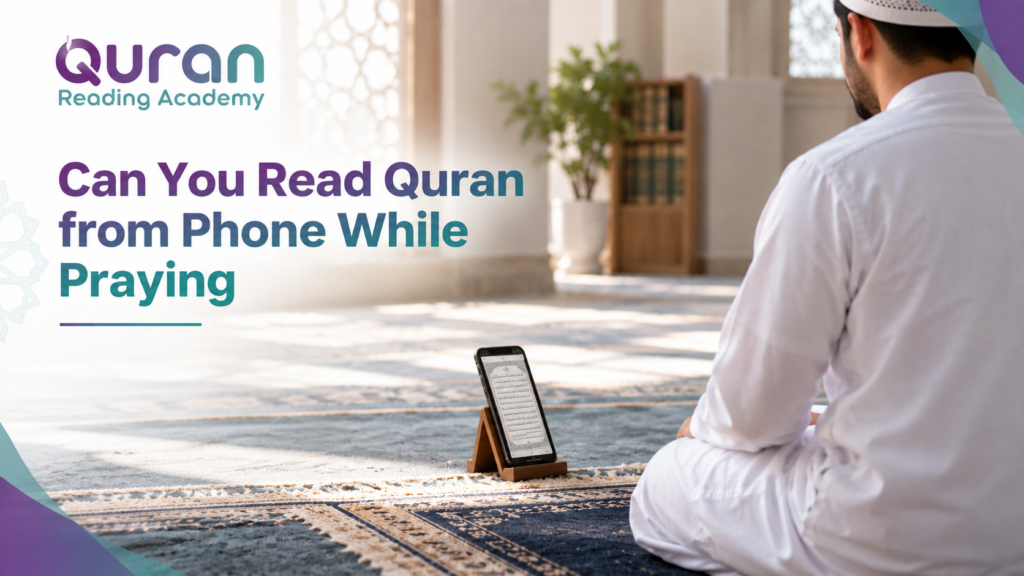
Reading Quran from a phone screen during prayer is not outright prohibited. The Shafi’i and Hanbali schools permit this in both obligatory and voluntary prayers, while other schools carry varying degrees of disapproval ranging from disliked to invalidating.
Knowing whether you can read Quran from phone while praying helps millions of Muslims still building their memorization. It lets you worship with clarity and sound intention, rather than unnecessary doubt, while you continue developing your recitation over time.
What You Will Learn in This Article
- Whether phone reading invalidates Fard or Nawafil prayer
- The specific ruling of each major madhab on this practice
- Correct conditions for phone use in Salah
- Historical evidence supporting the permitted position
- A clear path from phone reading to full Quran memorization
Can You Read Quran from Phone While Praying?
Yes, according to the Shafi‘i and Hanbali schools, it is permissible to read the Quran from a phone while praying, whether you are praying alone or leading others, and this applies to both voluntary and, according to some scholars within these schools, obligatory prayers.
Reading from a phone is generally given the same ruling as reading from a physical Mushaf in this regard.
This position rests on a well-documented historical practice. Imam al-Bayhaqi recorded in his Sunan al-Kubra that ‘Aisha (may Allah be pleased with her) was led in Ramadan prayer by her freed slave Dhakwan, who recited from a written Mus-haf throughout the Tarawih prayers, and no scholarly objection was raised against this.
Scholarly Ruling on Phone Recitation in Salah
Imam al-Nawawi stated in al-Majmu’ (4/27): “The prayer of one who reads from a written Mus-haf is valid, whether or not they have memorized anything.
Turning a page from time to time does not invalidate the prayer.” This ruling applies directly to phone screens under the same governing principle.
The Egyptian Dar al-Ifta has issued formal guidance confirming that a smartphone is not legally classified as a Mus-haf. Its letters are electronic signals rather than physical ink on parchment. This distinction affects purity requirements but confirms that reciting from a phone screen during Salah falls squarely within the permitted scholarly framework.
Phone Screen Classification in Islamic Law
Scholars at Al-Azhar and the Egyptian Dar al-Ifta agree that a smartphone is not a Mus-haf in the jurisprudential sense. Two practical outcomes follow from this classification.
- First, you do not need wudu to physically touch or hold the phone.
- Second, using it during prayer does not exceed the permitted scope of reading from a written source.
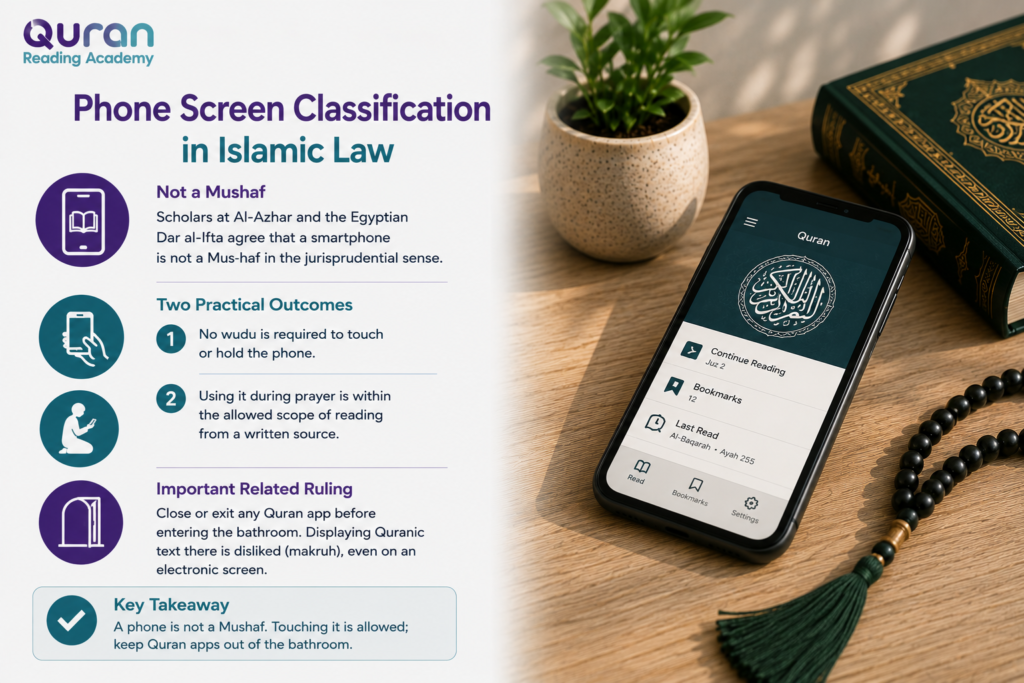
One important related ruling applies here: you should close or exit any Quran application before entering the bathroom.
Displaying Quranic text in that space is considered disliked (makruh) by the majority of scholars, even when the medium is an electronic screen rather than a physical page.
Read also: Can You Read Quran on Phone Without Wudu?
Madhab Positions on Reading Quran During Prayer
Each of the four major schools of Islamic law carries a distinct ruling on reading Quran from a written source in Salah. Knowing your madhab’s position removes unnecessary doubt and allows you to worship with settled confidence and correct intention.
The positions range from full permission in the Shafi’i and Hanbali schools to disliked in the Maliki view, with the Hanafi school holding it as invalidating under Imam Abu Hanifa’s founding opinion.
| Madhab | Fard Prayer | Nawafil Prayer |
| Shafi’i | Permitted | Permitted |
| Hanbali | Permitted | Permitted |
| Maliki | Disliked (makruh) | Permitted from the start |
| Hanafi | Invalidates prayer (Abu Hanifa) | Disliked (Abu Yusuf and al-Shaybani) |
Shafi’i and Hanbali Position on Salah Phone Reading
Imam al-Nawawi’s ruling in al-Majmu’ is the cornerstone of the Shafi’i position. Reading from a written copy is valid for any person, whether imam or individual, whether the content is memorized or not.
Turning a page or swiping a screen counts as a minor movement that does not invalidate Salah under this school’s principles.
Imam Ahmad bin Hanbal, when asked about an imam reading from a written Mus-haf during Tarawih, stated there is no harm in it. The Hanbali scholar al-Buhuti confirmed in Kashf al-Qina’ (1/384) that this permission applies equally to Fard and Nawafil prayers for both leaders and individuals.
Read also: Can You Read Quran in State of Janaba
Hanafi Ruling on Phone Use in Prayer
Imam Abu Hanifa held that reading from any written source during prayer invalidates it. He cited two reasons.
- First, carrying and swiping a device involves excessive movement.
- Second, a person being prompted by written text resembles someone receiving instruction from another, which disrupts the self-contained, independent nature of Salah.
Abu Yusuf and Muhammad al-Shaybani, his two most prominent students, disagreed. They considered it disliked (makruh) but not invalidating. Ibn Nujaym recorded in al-Bahr al-Ra’iq (2/11) that the concern of unintentionally imitating other religious traditions does not apply when there is no deliberate intent behind the act.
If you follow the Hanafi madhab, the clearest resolution is memorizing Al-Fatihah and a few short surahs. This removes all scholarly disagreement around phone use in Salah entirely, making the question moot.
Quran Reading Academy offers structured Quran Reading Classes for all levels, guiding students from basic Arabic letter recognition to full surah recitation with correct Tajweed and confident pronunciation under certified instruction.

Start building your Salah recitation today
Read also: Do You Get Reward for Reading Quran on Phone
Maliki View on Phone Reading in Fard and Nawafil
The Maliki school draws a clear line between obligatory and voluntary prayer. Reading from a phone or Mus-haf in Fard Salah is considered makruh (disliked) from the moment of recitation.
In Nawafil, it is permitted without disapproval when the person begins reading from the device at the very start of the surah and maintains that from the beginning.
This position reflects the Maliki emphasis on preserving concentration (khushu’) in obligatory prayer. The Maliki allowance for Nawafil acknowledges that many Muslims have not yet fully memorized the Quran and need access to longer surahs during Tarawih and other recommended night prayers throughout the year.
Conditions for Valid Phone Reading in Salah
Phone reading during prayer is permitted under the majority position, but specific conditions protect both the validity and the spiritual quality of Salah. Observing these guidelines also reduces any risk of crossing into makruh territory even under the more lenient positions.
These practical conditions come directly from the principles classical scholars applied when analyzing written-source reading in Salah, particularly regarding movement and the direction of the gaze.
Maintain Proper Prayer Posture and Minimize Changes to the Gaze
The recommended gaze in Salah is fixed at the place of prostration (sujud). Holding a phone shifts the gaze upward toward the screen, which departs from the mustahabb (recommended) form of prayer, though it does not invalidate Salah under the Shafi’i and Hanbali rulings.
To preserve both posture and gaze more fully, place the phone on a stand or rest it on a surface at eye level before beginning prayer. This allows reading without altering hand placement during Qiyam and avoids disrupting arm extension during ruku and sujud, preserving as much of the complete prayer form as possible.
Keep Phone Taps and Swipes to a Minimum
A single swipe or tap on the phone screen counts as a minor movement (amal qalil). Al-Nawawi’s clarification in al-Majmu’ confirms that turning a page from time to time does not invalidate Salah, since it does not constitute the excessive, aimless movement that scholars defined as a prayer-breaking action.
Repeated swiping, repositioning the phone mid-rak’ah, or adjusting the device angle multiple times risks crossing into excessive movement. Securing the phone properly and opening the correct surah before beginning Salah removes this concern before prayer even starts.

Quran Reading Academy offers a dedicated Quran Tajweed Course where Ijazah-certified teachers develop the articulation precision students need to recite every verse in Salah with authentic, rule-bound accuracy from every makhraj.
Perfect your Tajweed for prayer with certified instruction
Read also: Can You Read Quran While Praying Taraweeh?
Quranic Basis for Measured Recitation in Salah
Allah’s command in the Quran establishes the standard for how recitation should be performed, whether from memory or from a written source. This verse applies to every act of Quranic recitation in Salah, regardless of the medium used to access the words.
Allah says in Surah Al-Muzammil:
وَرَتِّلِ الْقُرْآنَ تَرْتِيلًا
(Wa rattilil-Qur’āna tartīlā)
“And recite the Quran with measured recitation.” (Surah Al-Muzammil 73:4) https://tanzil.net/#73:4
This command applies equally to phone-based recitation and memory-based recitation. The obligation to read with proper Tajweed and deliberate, measured pacing is not reduced because a screen is used instead of memory.
Every recitation in Salah must honor the manner Allah specified, and phone use does not exempt a worshiper from this standard.
See Our Academy in Action
Discover what a typical session looks like! Watch these brief highlights from our live, interactive classes to see how our instructors engage with students of all ages.
Start Your Quran Learning Journey Today
Join Quran Reading Academy and begin structured, step-by-step Quran reading with expert guidance.
Try your first class for freeWhy Memorizing Quran Is Better Than Reading from a Phone in Salah
Scholars across all four madhabs agree that reciting from memory in prayer is superior to reading from any written or digital source. Phone reading is a valid solution during the memorization period, not the permanent standard any Muslim should settle for.
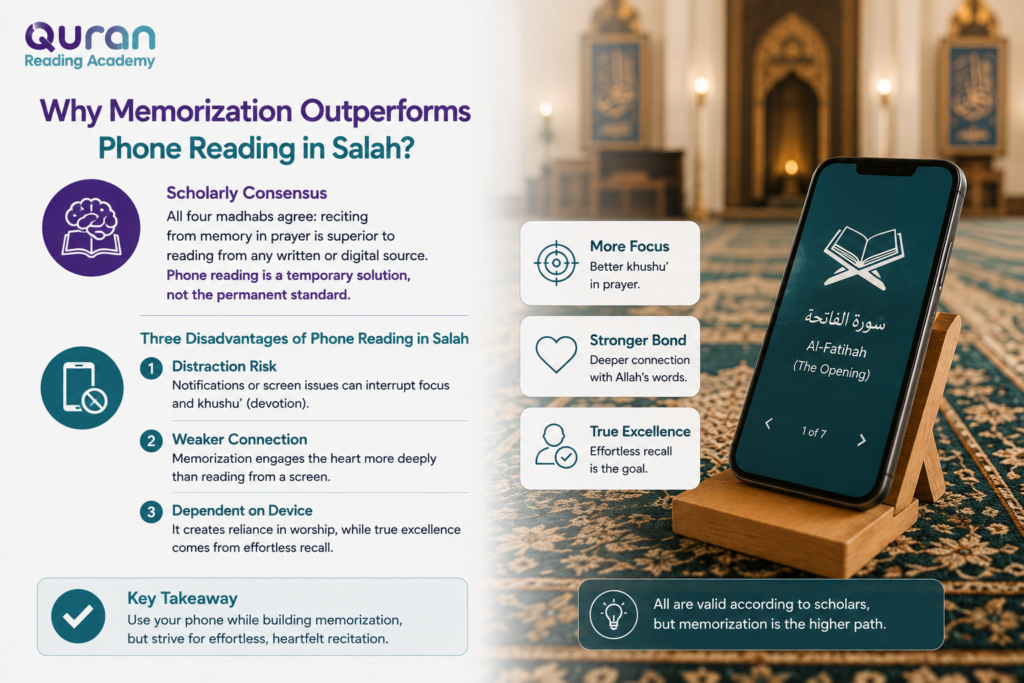
Three specific disadvantages apply when relying on a phone in Salah. None of them affect prayer validity under the majority position, but all of them reduce the completeness and spiritual depth of worship.
1. Memorization Helps Preserve the Natural Posture of Salah
Holding or facing a phone during Qiyam changes both the direction of the gaze and the placement of the hands.
Sheikh Salih al-Fawzan noted in al-Muntaqa (2/35, Q.16) that reading from any medium in Salah causes the worshiper to miss the correct placement of the right hand over the left on the chest, and may affect full arm extension during ruku and sujud.
These are not prayer-invalidating factors under the Shafi’i and Hanbali positions. However, they represent a less complete form of worship. Memorizing even a few additional surahs eliminates all of these posture-related concerns immediately and without compromise.
2. Memorization Encourages a Stronger Long-Term Connection with the Quran
Scholars and contemporary fatwa bodies have noted a consistent pattern across students: when a person knows they can open a screen during prayer, urgency to memorize naturally decreases.
The Standing Committee for Islamic Rulings (al-Lajnah al-Da’imah) confirmed that phone or Mus-haf reading in Salah weakens the desire and enthusiasm for memorizing the Quran over the long term.
The correct approach is to treat phone reading as a temporary bridge, not a permanent practice. Use it to fulfill the obligation of Salah while actively working to memorize the surahs you need for daily prayer without any screen.

Quran Reading Academy offers a structured Quran Hifz Course where qualified teachers guide students through systematic memorization techniques, building Ayah-by-Ayah retention with long-term review systems built into every scheduled session.
Begin your Hifz journey with qualified teachers
Read also: Can You Read Quran for a Dead Person?
Reading Quran from a Phone During Tarawih and Other Nawafil Prayers
Tarawih is a voluntary (Nawafil) prayer performed throughout Ramadan. Scholars across all madhabs apply more lenient rulings to Nawafil categories than to Fard prayer.
The majority explicitly permits phone or Mus-haf reading during Tarawih without reservation, disapproval, or any condition of prior memorization.
This leniency reflects the central purpose of Tarawih, which is completing the full Quran over the month of Ramadan.
The historical evidence for reading from a written source in Nawafil prayer is among the strongest available for this entire question, drawing from both scholarly narrations and early Muslim practice.
Classical Evidence for Reading from a Mushaf in Voluntary Prayer
Imam al-Zuhri, one of the leading scholars of the Tabi’in generation, was asked about a man reading from a Mus-haf during Ramadan prayer. He responded: “The best among us used to read from the Mus-haf.”
This statement is recorded in al-Mudawwana al-Kubra (1/228-289) and in Ibn Qudama’s al-Mughni (1/335).
The Dar al-Ifta of Egypt cited this Zuhri narration directly in its formal ruling on reading from a written copy during Salah. That ruling confirms the same permission extends to phone screens, making the contemporary scholarly consensus on Nawafil phone reading well-grounded in classical sources.
How to Use a Phone During Tarawih with Minimal Distraction
If you lead Tarawih and your memorization does not yet cover the full Quran, place your phone on a stand at eye level before the prayer begins.
This preserves hand placement during Qiyam and allows clean transitions into ruku and sujud without needing to handle or reposition the device between prayer positions.
If you pray behind an imam reading from a phone in Tarawih, your prayer is fully valid. The imam’s practice is either permitted or at most disliked, not invalidating, under the Shafi’i and Hanbali positions that most Muslim communities around the world follow today for Tarawih.

Quran Reading Academy offers a focused Quran Recitation Course designed to build the fluency, confidence, and Tarteel needed to recite Quranic surahs in Salah without relying on any screen or written source, taught by Ijazah-certified instructors with verified chains of transmission.
Build Salah recitation confidence with expert guidance
Read also: Can You Read Quran for Someone Else?
Inside Our Live Classroom
We believe in complete transparency. Take a look inside our virtual classrooms to experience our premium teaching tools and engaging learning environment firsthand.
Start Your Quran Learning Journey Today
Join Quran Reading Academy and begin structured, step-by-step Quran reading with expert guidance.
Try your first class for freeRead also: Can You Read Quran If You Are Impure?
Learn to Recite and Memorize Quran with Quran Reading Academy
Moving beyond phone reading in prayer begins with structured, consistent learning under qualified instruction.
Quran Reading Academy provides personalized, one-on-one online classes for students at every level, from complete beginners to those refining Tajweed and progressing toward full Quran memorization.
Begin today with a free trial session and discover how expert teaching transforms your recitation, in Salah and in every moment of worship throughout your day.
Our Quran Courses
- Quran Reading Classes
- Quran Reading Classes for Kids
- Quran Reading Classes for Adults
- Quran Reading Classes for Female/Sisters
- Quran Reading Classes for New Muslims
- Quran Reading Course for Beginners
- Online Quran Reading Course with Tajweed
- Reading and Memorizing the Quran Course
- Noorani Qaida Course
- Quran Course for Beginners
- Quran Tajweed Course
- Quran Recitation Course
- Quran Hifz Course
- Online Quran Qirat Classes

Book Your Free Trial Session Today
Conclusion
Reading Quran from a phone during prayer is permitted under the Shafi’i and Hanbali schools in both Fard and Nawafil Salah. The Maliki school considers it disliked in obligatory prayer but permits it in Nawafil.
The Hanafi school under Imam Abu Hanifa holds it invalidates prayer, though his students Abu Yusuf and al-Shaybani considered it only disliked and not prayer-breaking.
All scholars agree that recitation from memory is the ideal. A phone screen is a valid bridge for those still learning, not the permanent standard any Muslim works toward. Each surah memorized removes another layer of scholarly disagreement, brings Salah closer to its most complete form, and deepens the connection between the worshiper and the words of Allah.
Read also: Why Do I Feel Sleepy When Reading Quran?
Frequently Asked Questions
Does Reading Quran from Phone During Prayer Invalidate Salah?
It does not invalidate prayer according to the Shafi’i and Hanbali madhabs, which hold the majority scholarly position. The Hanafi school under Imam Abu Hanifa considers it invalidating, while his students Abu Yusuf and al-Shaybani held it is disliked but not invalid. Apply the ruling of your own madhab when making this decision for your Salah.
Is Phone Reading Different in Fard Prayer vs Nawafil Prayer?
Yes, scholars draw a clear distinction between the two. Nawafil prayer carries more lenient rulings across all four madhabs. The Maliki school permits phone reading in Nawafil without disapproval when started from the beginning of a surah, while considering it makruh in Fard. The Shafi’i and Hanbali schools permit it in both categories without distinction.
Can an Imam Lead Tarawih Prayer Reading from a Phone?
Yes. The Shafi’i and Hanbali positions explicitly permit an imam to read from a Mus-haf or phone during Tarawih. The precedent of ‘Aisha’s servant Dhakwan leading her in Ramadan prayer from a written Mus-haf, recorded in al-Bayhaqi’s Sunan al-Kubra, is the direct historical basis that most scholars cite for granting this permission.
Does Touching a Phone with a Quran App Require Wudu?
No. The Egyptian Dar al-Ifta and the majority of contemporary scholars confirm that a phone is not legally classified as a Mus-haf. Its text consists of electronic signals, not physical ink. You do not need wudu to touch or hold a phone, even when the Quran application is open and the text is visible on screen.
Is Reciting from Memory Always Better Than Using a Phone in Salah?
Yes. Memorization is unanimously preferred by classical scholars across all four madhabs. It removes all scholarly disagreement, preserves the correct prayer posture and gaze toward sujud, maintains deeper khushu’, and fulfills the ideal of complete self-contained worship. Phone reading is a valid option during memorization, but recitation from memory remains the target every Muslim should actively work toward.
Can a Woman Read Quran from a Phone During Prayer While in Haidh?
A woman in haidh (menstruation) may not perform Salah, so phone use during prayer does not apply in this state. Outside of Salah, the majority of contemporary scholars, including those at Al-Azhar, permit a woman to read Quran from her phone during haidh for personal revision and dhikr. This recitation carries its full reward and helps preserve memorized portions during the monthly period.









Leave a Reply