 Fatawa
| Key Takeaways |
| Reading Quran on a phone without wudu is permissible according to the majority of contemporary scholars. |
| A phone or digital device is not classified as a Mus-haf, so the ruling on touching the Mus-haf does not apply. |
| Wudu remains highly recommended when reading Quran digitally, as it reflects proper Islamic etiquette and reverence. |
| Memorized recitation without wudu is also permissible, though purity is always the preferred state for worship. |
Many Muslims learning Quran today rely on phones and apps as their primary reading tool. Whether you’re commuting, practicing between classes, or fitting recitation into a busy schedule, the question of wudu and digital devices comes up constantly — and it deserves a clear, grounded answer.
Can You Read Quran on Phone Without Wudu?
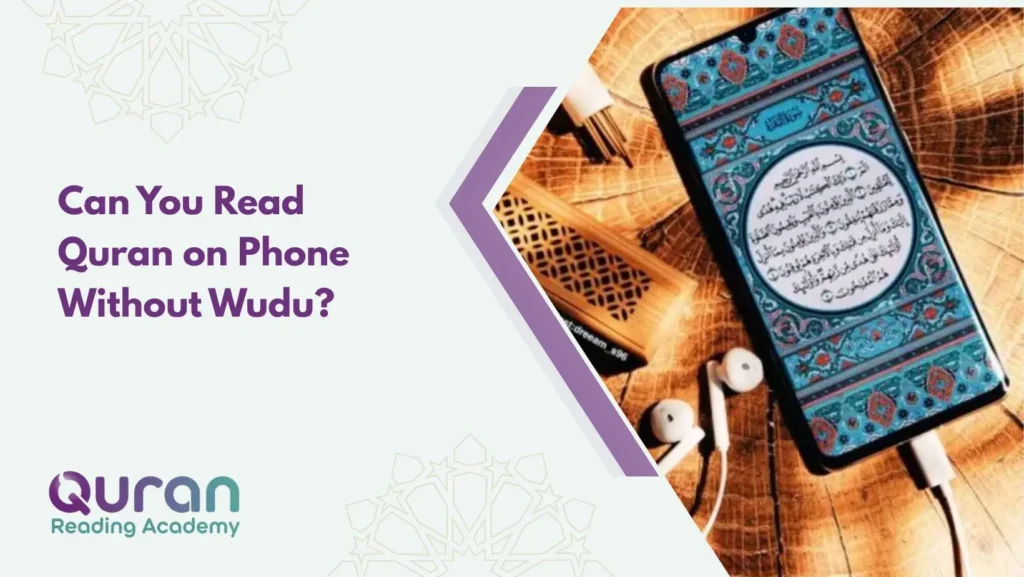
Yes, you can read Quran on your phone without wudu. Reading Quran on a phone without wudu is permissible. A phone is not a Mus-haf — it does not store Quranic text in a fixed, inscribed form.
The letters appear on screen only when called up, then disappear when you navigate away. This distinction is central to the scholarly ruling: the legal prohibition on touching the Mus-haf without wudu applies to the physical scripture, not to digital representations of it.
Sheikh Abd al-Rahman ibn Nasir al-Barrak explained this precisely: the Quranic text on a phone exists as digital signals that form letters when displayed, then vanish upon navigation. This is fundamentally different from the permanently inscribed text of a physical Mus-haf.
This ruling does not encourage carelessness toward the Quran. It simply applies the correct legal framework to a modern tool.
Shots Videos from Our Courses
Start Your Quran Learning Journey Today
Join Quran Reading Academy and begin structured, step-by-step Quran reading with expert guidance.
Try your first class for freeWhy Does the Mus-haf Ruling Not Apply to Phones?
The prohibition on touching the Mus-haf without wudu is based on the verse:
لَّا يَمَسُّهُۥٓ إِلَّا ٱلْمُطَهَّرُونَ
Lā yamassuhū illā al-muṭahharūn
“None touch it except the purified.” (Al-Waqi’ah 56:79)
Scholars who apply this verse to physical contact with the Mus-haf do so because the Mus-haf is a permanently inscribed, dedicated scripture. A phone, by contrast, serves dozens of functions beyond Quran display. Its Quranic content is not permanently fixed — it is rendered temporarily on a screen. This is why the majority of contemporary scholars treat phones differently.
What About Reading Aloud from Memory Without Wudu?
Reciting Quran from memory without wudu is permissible according to the majority of scholars. The hadith in which the Prophet ﷺ would remember Allah in all states — narrated by Aisha (may Allah be pleased with her) — supports this position.
‘A’isha said:
The Apostle of Allah (ﷺ) used to remember Allah at all moments. (Sahih Muslim)
Wudu is not a condition for verbal recitation from memory; it is a condition for touching the physical Mus-haf.
Our Quran Reading Course for Beginners and the Noorani Qaida Course are structured so students can supplement every class with phone-based practice between sessions. Knowing this ruling frees you to do exactly that — consistently, confidently, and correctly.
Enroll in Our Quran Reading Course for Beginners with a Free Trial

Is There a Difference Between Reading and Touching the Physical Mus-haf?
There is a meaningful distinction between reading the Quran aloud and physically touching the Mus-haf, and understanding this distinction matters practically for every student of Quran. The ruling on touching the Mus-haf without wudu is stricter than the ruling on verbal recitation.
Touching the physical Mus-haf without wudu is prohibited according to the majority of scholars (Hanafi, Maliki, Shafi’i, and Hanbali schools all hold this position with some variation in detail). This is based on Al-Waqi’ah 56:79 and is well-established in classical fiqh.
Verbal recitation from memory without wudu is permitted by the majority. A person in a state of minor ritual impurity may recite Quran from memory without restriction.
Reading from a phone without wudu falls under a third category — permissible, as established above.
| Situation | Physical Mus-haf | Phone/Digital Device |
| Minor impurity (no wudu) | Not permitted (majority view) | Permitted |
| Major impurity (janabah) | Not permitted | Not permitted |
| Menstruation | Not permitted | Permitted |
| Purified state | Permitted | Permitted |
If you want to understand more about proper etiquette during Quran reading, the guide on Quran reading etiquettes and manners covers this with depth and clarity.
Read Also: Can You Read Quran Without Ghusl on Phone?
Our Students Reviews
Start Your Quran Learning Journey Today
Join Quran Reading Academy and begin structured, step-by-step Quran reading with expert guidance.
Try your first class for freeShould You Still Make Wudu Before Reading Quran on Your Phone?
Permissibility and best practice are two different things, and every experienced Quran instructor will tell you — always strive for wudu before engaging with the Quran, even digitally. While it is not legally required when reading from a phone, wudu elevates the quality of your engagement with Allah’s words.
Reading Quran is an act of worship. Approaching it in a state of purity sharpens focus, invites barakah, and reflects genuine reverence.
At The Quran Reading Academy, our certified instructors consistently advise students to treat their phone recitation sessions with the same spiritual preparation they would bring to reading from a physical Mus-haf.
Make wudu a habit, not an obligation. Students who build this habit early tend to develop stronger consistency and deeper connection with their recitation — something I’ve observed repeatedly over years of teaching beginners.
This is especially relevant for students following structured learning — if you’re working through our Quran Reading Classes for Adults or using the Al-Menhaj Book to build foundational reading skills, starting each session with wudu helps condition your mind and body toward focused, reverent learning.
Book your FREE trial class to start reading Quran

Read Also: Can I Read Quran Without Wudu?
Start Your Quran Reading Journey with The Quran Reading Academy
You now have clarity on the ruling. The next step is building actual skill in recitation. The Quran Reading Academy offers:
- Expert certified instructors with years of hands-on teaching experience
- Structured courses for all levels — beginners, kids, adults, and new Muslims
- The Al-Menhaj Book — the foundational reading resource for non-Arabic speakers
- Online Quran Reading Course with Tajweed for those ready to perfect their recitation
- Free trial lesson — no commitment, no pressure
Book your free trial today and take your first real step toward confident Quran reading.
Check out our top courses to help you read the Quran with confidence:
- Quran Reading Course With Tajweed
- Noorani Qaida Course
- Quran Reading Course for Beginners
- Quran Reading Classes for Adults
- Quran Reading Classes for Sisters
- Quran Reading Classes for Kids
- Quran Hifz Course
- Arabic Reading Practice Course
- Quranic Arabic Course
Book your free class today—it’s the perfect start to learning the Quran

Conclusion
Reading Quran on your phone without wudu is permissible — and this isn’t a modern concession, it’s a well-reasoned application of classical Islamic legal principles to contemporary tools. Phones are not Mus-hafs. The text is not permanently inscribed. The prohibition does not apply.
What remains unchanged is the spirit behind the ruling: approach the Quran with reverence. Make wudu when you can. Bring your full presence to every recitation. And never let ritual uncertainty become a barrier between you and Allah’s words. You have both the permission and the responsibility to read — so begin.
Start Your Quran Learning Journey Today
Join Quran Reading Academy and begin structured, step-by-step Quran reading with expert guidance.
Try your first class for freeRead Also: Is It Fard to Read Quran?
Frequently Asked Questions About Reading Quran on Phone Without Wudu
Can you read Quran on phone without wudu according to all scholars?
The permissibility of reading Quran on a phone without wudu is the position of the majority of contemporary scholars. The reasoning is consistent: a phone is not a Mus-haf in the classical legal sense. Its Quranic text appears temporarily on a screen and is not permanently inscribed, so the prohibition on touching the Mus-haf does not apply.
Is it disrespectful to read Quran on phone without wudu?
It is not disrespectful from a legal standpoint, but wudu is always encouraged as the ideal state for engaging with the Quran. The scholars who permit phone reading without wudu do not suggest abandoning respect for the Quran — they simply clarify that the specific legal ruling on the Mus-haf does not extend to digital devices.
Can you Read Quran on tablets and computers displaying Quran without Wudu?
Yes. The same scholarly reasoning applies to tablets, laptops, and any digital screen displaying Quranic text. None of these are classified as a Mus-haf. You may touch them and read from them without wudu, regardless of the size of the screen or the clarity of the display.








Leave a Reply