 Quran
| Key Takeaways |
| Scholars differ over whether Quran recitation reward can be gifted to another person. |
| Hanafi and Hanbali scholars permit dedicating the reward, while early Shafi’i scholars restrict it. |
| Dua and sadaqah for the living and deceased are established acts of worship. |
Can You Read Quran for Someone Else? This question often arises after completing a Surah and wanting to share its spiritual reward with a mother, spouse, or dear friend.
This article explains the scholarly views on dedicating Quran recitation reward, the Quranic and prophetic evidence cited for each view, and the established deeds that benefit both the living and the deceased.
Does Quran Recitation Benefit Someone Else?
Yes, according to Hanafi and Hanbali scholars, you may recite Quran and ask Allah to grant its reward to another Muslim, whether that person is living or deceased. Early Shafi’i scholars took a stricter view and held that the reward remains with the reciter because Quran recitation is a personal bodily act of worship.
If you follow the permissive view, recite sincerely and make dua afterward for the named person; if you want an act accepted without disagreement, make dua or give sadaqah on their behalf.
This does not mean you recite instead of the other person or that reward moves automatically. Under the permissive position, you complete the recitation yourself, then ask Allah to convey its reward to the person you intend. No fixed wording is required, and the recitation should remain a personal act of worship, not a paid service or a formal ceremony.
Read also: Do You Get Reward for Reading Quran on Phone
Scholarly Views on Gifting Quran Recitation Reward for Others
Two primary groups emerged across Islamic legal history on this issue. The first group, which includes many early Shafi’i scholars, held that Quran recitation is a physical act of worship.
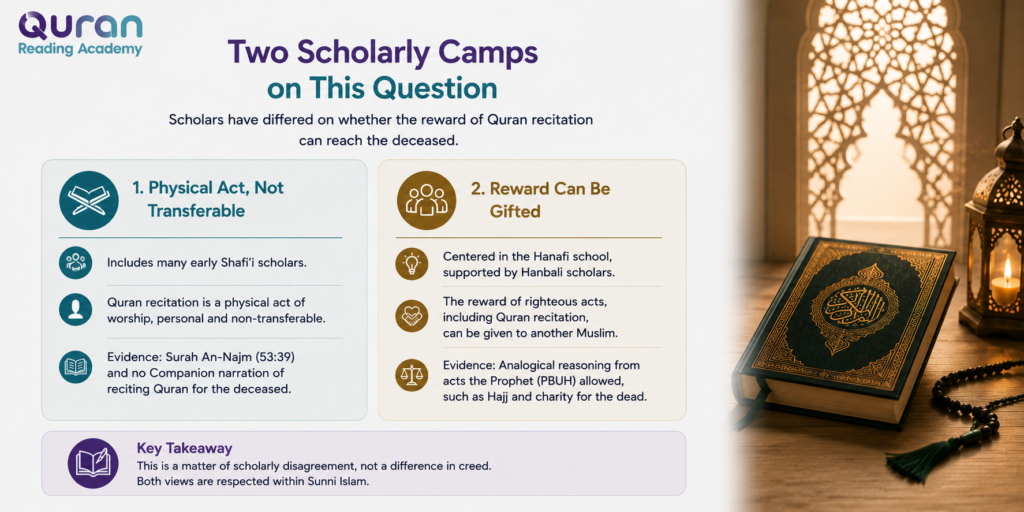
They argued that physical worship is personal and cannot be transferred to another person. Their evidence was Surah An-Najm verse 39 and the absence of any prophetic narration showing the companions reciting Quran specifically for their deceased.
The second group, centered in the Hanafi school and supported by Hanbali scholars, held that the reward of any righteous act, including Quran recitation, can be gifted to another Muslim.
Their position draws on analogical reasoning from acts the Prophet (PBUH) explicitly permitted, such as Hajj and charity on behalf of the deceased.
Why the Scholarly Disagreement Matters to Muslims
Muslims in every generation feel the deep human impulse to do something spiritually meaningful for people they love. A child who has lost a parent naturally asks what can still be done for them.
Knowing the scholarly debate helps Muslims act with knowledge rather than assumption. Both the permissive and restrictive positions are valid scholarly opinions within mainstream Sunni Islam, each resting on serious textual evidence and offering practical guidance.
Read also: Can You Read Quran in State of Janaba
Islamic Schools View Quran Recitation for Someone Else
Each major legal school developed a distinct position on whether you can recite Quran on behalf of someone else. These are the result of rigorous legal reasoning and evidence evaluation across generations of qualified scholars.
a. Hanafi View on Gifting Quran Recitation Reward to Others
Hanafi jurists clearly permit dedicating the reward of Quran recitation to another Muslim, living or deceased. They argue that Allah’s generosity is unrestricted, and He may convey the benefit of an act to whoever is intended.
Ibn Nujaym, a foundational Hanafi scholar, stated explicitly that if a person recites the Quran, fasts, prays, or gives charity and dedicates the reward to another, that reward reaches them. This is established according to Ahl al-Sunnah wa al-Jama’ah.
The Hanafi method is straightforward. Complete your recitation personally and sincerely, then make dua to Allah asking Him to convey the reward to the named person. The gift lies in the sincerity of that supplication, not only in the act itself.
b. Shafi’i View on Gifting Quran Recitation Reward to Others
Early Shafi’i scholars, including Ibn Hajar al-Haytami, maintained that recitation reward belongs to the reciter alone. Their reasoning was that physical acts of worship, unlike charity or Hajj, were not explicitly authorized by the Prophet (PBUH) as transferable.
However, later Shafi’i scholars, including Ibn al-Rif’a, moved toward permitting recitation for the deceased based on additional detailed evidence from prophetic practice and scholarly tradition. Within the Shafi’i school itself, a Muslim has scholarly support for either choice.
If you want the reward of your recitation to carry proper weight, learning to recite with correct Tajweed is essential. The Quran Recitation Course at Quran Reading Academy teaches the art of Tarteel, with qualified instructors guiding your voice toward precision and devotion.
Enroll in the Quran Recitation Course today
Read also: Can You Read Quran from Phone While Praying
Quranic Evidence About Gifting Quran Recitation Reward to Others
The Quran provides the scriptural foundation for this entire debate. Two verses are cited most frequently: one supporting the idea that reward is strictly personal, the other indicating that believers can benefit from one another’s righteousness.
Surah An-Najm 53:39 and the Principle of Personal Effort
Scholars who restrict transferring recitation reward anchor their position in this verse. Allah says in Surah An-Najm:
وَأَن لَّيْسَ لِلْإِنسَانِ إِلَّا مَا سَعَىٰ
(Wa-an laysa lil-insāni illā mā saʿā)
(“And that there is not for man except that [good] for which he strives”)
Hanafi scholars offered multiple responses to this verse. Some argued it was revealed specifically about the legislation of previous prophets and does not bind this ummah universally. Others argued it is abrogated in scope by Surah At-Tur 52:21.
A third Hanafi reading takes the preposition to mean that a person is only accountable for his own deeds, but may still receive benefit from what others gift him. These responses reflect serious scholarly engagement, not dismissal of the verse.
Surah At-Tur 52:21 and the Benefit of Family Righteousness
Hanafi and Hanbali scholars cite Surah At-Tur as evidence that one person’s righteousness can benefit another. Allah says:
وَالَّذِينَ آمَنُوا وَاتَّبَعَتْهُمْ ذُرِّيَّتُهُم بِإِيمَانٍ أَلْحَقْنَا بِهِمْ ذُرِّيَّتَهُمْ وَمَا أَلَتْنَاهُم مِّنْ عَمَلِهِم مِّن شَيْءٍ
(Wa-lladhīna āmanū wa-ttabaʿat-hum dhurriyyatuhum bi-īmānin alḥaqnā bihim dhurriyyatahum wa-mā alatnahum min ʿamalihim min shayʾin)
(“And those who believed and whose descendants followed them in faith, We will join with them their descendants, and We will not deprive them of anything of their deeds.”)
This verse shows descendants elevated in Paradise based on their parents’ righteousness. If the faith and deeds of parents benefit their descendants, scholars argue, there is a consistent Quranic principle that one believer’s righteous acts can carry spiritual benefit to another.
Correct Tajweed helps keep every verse you recite correctly pronounced, whether for yourself or for those you love. The Quran Tajweed Course at Quran Reading Academy covers the full science of articulation and pronunciation rules authenticated from the Prophet (PBUH) himself.
Start the Quran Tajweed Course and recite with precision
Read also: Can You Read Quran While Praying Taraweeh?
Deeds That Benefit the Living and the Deceased
While scholars debate Quran recitation for others, two categories of worship enjoy complete unanimous agreement across all schools: charity given on behalf of another person, and supplication made for them. These are established by clear, direct prophetic evidence with no scholarly dispute.
Giving Sadaqah and Ongoing Charity on Behalf of Others
Allah instructs believers to pray for their parents with humility and mercy. He says in Surah Al-Isra:
وَاخْفِضْ لَهُمَا جَنَاحَ الذُّلِّ مِنَ الرَّحْمَةِ وَقُل رَّبِّ ارْحَمْهُمَا كَمَا رَبَّيَانِي صَغِيرًا
(Wakhfiḍ lahumā janāḥa dh-dhulli mina r-raḥmati wa-qul Rabbi rḥamhumā kamā rabbayānī ṣaghīrā)
(“And lower to them the wing of humility out of mercy and say: My Lord, have mercy upon them as they brought me up [when I was] small.”)
Scholars note that this dua instruction applies even after a parent’s death. Giving sadaqah, funding a water source, supporting a masjid, or sponsoring Islamic education on behalf of a parent are forms of lasting charity that continue delivering reward long after the donor and recipient have both passed.
Read also: Can You Read Quran for a Dead Person?
Making Dua for the Living and the Deceased
Supplication for others, living and deceased alike, is universally accepted and directly established by prophetic narration. The Prophet Muhammad (PBUH) said:
إِذَا مَاتَ الْإِنْسَانُ انْقَطَعَ عَنْهُ عَمَلُهُ إِلَّا مِنْ ثَلَاثَةٍ: إِلَّا مِنْ صَدَقَةٍ جَارِيَةٍ، أَوْ عِلْمٍ يُنْتَفَعُ بِهِ، أَوْ وَلَدٍ صَالِحٍ يَدْعُو لَهُ
(Idhā māta l-insānu inqaṭaʿa ʿanhu ʿamaluhū illā min thalāthin: ṣadaqatin jāriyatin, aw ʿilmin yuntafeʿu bihi, aw waladin ṣāliḥin yadʿū lahu)
(“When a person dies, all his deeds come to an end except for three: ongoing charity, beneficial knowledge, or a righteous child who prays for him.”)
Notice the Prophet (PBUH) specifically mentioned a “righteous child who prays for him,” not one who recites Quran on his behalf. This is the direct textual basis for why dua remains the most authenticated act benefiting the deceased.
See Our Academy in Action
Discover what a typical session looks like! Watch these brief highlights from our live, interactive classes to see how our instructors engage with students of all ages.
Start Your Quran Learning Journey Today
Join Quran Reading Academy and begin structured, step-by-step Quran reading with expert guidance.
Try your first class for freeRead also: Can You Read Quran If You Are Impure?
Method for Dedicating Quran Recitation Reward to Someone Else
For Muslims who follow the permissive scholarly position, from either the Hanafi school or the later Shafi’i scholars, the method of practice matters. Doing it correctly aligns the act with what authenticated scholarship has prescribed.
a. Set Sincere Intention Before Quran Recitation
Begin with a sincere, clear intention. You may intend in your heart before starting that this recitation is being performed for the benefit of a specific named person. Alternatively, you may read for yourself first and then dedicate the reward to another afterward.
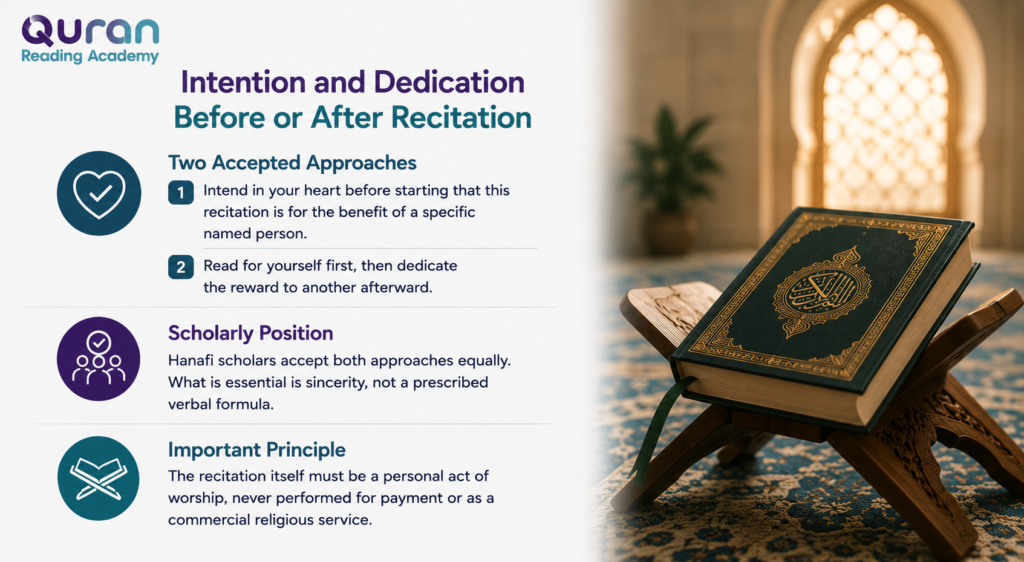
Hanafi scholars accept both approaches equally. What is essential is sincerity, not a prescribed verbal formula. The recitation itself must be a personal act of worship, never performed for payment or as a commercial religious service.
b. Make Dua After Quran Recitation
After completing your recitation, make a sincere dua to Allah. Ask Him directly to convey the reward of what you have just read to the person you intend.
A simple supplication such as “O Allah, grant the reward of this recitation to [name]” fully captures what scholars have prescribed.
The reward rests entirely with Allah’s will and generosity. This is a request directed to Allah, not a mechanical transfer of credits. A sincere request from a sincere heart is what brings the act its spiritual meaning.
For those looking to memorize the Quran and build a deeper personal connection with it, the Quran Hifz Course at Quran Reading Academy offers structured memorization with certified instructors and proven long-term retention techniques.
Enroll in the Quran Hifz Course and begin your memorization journey
Read also: Why Do I Feel Sleepy When Reading Quran?
Quran Recitation Reward for Deceased Parents
Reciting Quran on behalf of deceased parents is the most emotionally significant application of this question. Children who have lost parents naturally search for every way to continue serving them in the next life.
Ibn Taymiyyah’s View on Quran Recitation for the Deceased
Sheikh al-Islam Ibn Taymiyyah, from the Hanbali school, held that dedicating the reward of recitation to the deceased is permissible.
However, he consistently reminded Muslims that the established Sunnah of the Prophet (PBUH) and his companions was specifically dua for the deceased, not Quran recitation.
His position offers a meaningful nuance. A Muslim who recites Quran and dedicates its reward to a deceased parent is doing something permissible.
A Muslim who focuses primarily on dua and ongoing charity is following the most directly authenticated prophetic practice. Both are valid; one is more established.
Why Paid Quran Recitation and Fixed Ceremonies Should Be Avoided
Even scholars who permit this practice draw firm lines around certain customs. Hiring someone to recite Quran for monetary payment on behalf of the deceased is prohibited by all schools, since worship performed for money loses its spiritual character and validity.
Organizing regular communal gatherings at fixed intervals after a death specifically for group Quran recitation as a ceremony is considered an innovation (bid’ah) by many scholars, even those who otherwise permit individual recitation for others.
The practice, when followed, must remain personal, sincere, and free from any public ritual structure.
For structured Quran learning with qualified live instructors from anywhere, the Online Quran Reading Course with Tajweed at Quran Reading Academy provides a complete curriculum from letter recognition through full recitation with authenticated Tajweed rules.
Join the Online Quran Reading Course with Tajweed
Read also: Can You Read Quran at the Graveyard?
Inside Our Live Classroom
We believe in complete transparency. Take a look inside our virtual classrooms to experience our premium teaching tools and engaging learning environment firsthand.
Start Your Quran Learning Journey Today
Join Quran Reading Academy and begin structured, step-by-step Quran reading with expert guidance.
Try your first class for freeStart a Free Trial With Quran Reading Academy
Whether you are starting from the basics, refining your Tajweed, memorizing, or deepening your knowledge of the Quran, Quran Reading Academy provides live online classes for students at every level. Book a free trial class today and experience the instruction firsthand.
Our Quran Courses
- Quran Reading Classes
- Quran Reading Classes for Kids
- Quran Reading Classes for Adults
- Quran Reading Classes for Female/Sisters
- Quran Reading Classes for New Muslims
- Quran Reading Course for Beginners
- Online Quran Reading Course with Tajweed
- Reading and Memorizing the Quran Course
- Noorani Qaida Course
- Quran Course for Beginners
- Quran Tajweed Course
- Quran Recitation Course
- Quran Hifz Course
- Online Quran Qirat Classes
Book Your Free Trial Session at Quran Reading Academy
Conclusion
The question of whether you can read Quran for someone else has no single universally accepted answer across all Islamic schools. Hanafi scholars and later Shafi’i authorities permit it and prescribe a clear method: recite with sincere intention, then make dua asking Allah to convey the reward.
Early Shafi’i scholars restricted it, citing Surah An-Najm 53:39 and the absence of direct prophetic precedent for this specific practice.
What all scholars agree on is that dua and sadaqah on behalf of both the living and deceased are fully authenticated and reward-bearing acts. If you choose to recite Quran for someone else, do so sincerely, without payment or ceremony, and follow it with heartfelt supplication.
If you choose not to, dua and ongoing charity remain equally powerful, unanimously accepted acts of love and spiritual generosity. In either case, your sincerity and your own righteousness are what Allah values most.
Frequently Asked Questions
Can you read Quran for someone else who is alive?
Yes. Hanafi scholars and many others permit you to recite Quran and dedicate its reward to a living Muslim. Complete the recitation sincerely, then make dua asking Allah to convey its reward to them. This is a permissible act of spiritual generosity toward people you love.
Can you read Quran on behalf of your deceased parents?
Hanafi scholars and the Hanbali school permit this. Recite the Quran sincerely and personally, then make dua asking Allah to send the reward to your deceased parent. Early Shafi’i scholars differed on this question, though later Shafi’i authorities moved toward permitting it based on additional scholarly evidence.
Does the reward of Quran recitation reach the deceased?
Scholars differ. Hanafi jurists and Hanbali scholars say the reward reaches the deceased when it is followed by sincere dua to Allah. Early Shafi’i scholars disagree because no direct prophetic precedent establishes it. Both views are ijtihadi and hold scholarly weight.
What is the correct way to recite Quran for someone else?
Set your intention before or at the time of recitation, complete the reading personally without payment, then make dua to Allah asking Him to convey the reward to the named person. Avoid turning this into a formal ceremony or hiring others to perform the recitation on your behalf.
Is it permissible to hire someone to recite Quran for the deceased?
No. Even scholars who permit reciting Quran for the deceased explicitly prohibit paying someone to perform that recitation as a service. Worship performed for monetary compensation loses its spiritual validity. The recitation must be a sincere, personal, unpaid act of worship directed to Allah.
What other acts benefit the deceased besides Quran recitation?
Sadaqah jaariyah (ongoing charity), dua, beneficial knowledge they left behind during their lifetime, Hajj on their behalf if they were unable to perform it, and a righteous child who prays for them all definitively benefit the deceased. These are established by direct, unambiguous prophetic narration with unanimous scholarly agreement.






Leave a Reply