 Quran

| Key Takeaways |
| Islamic law divides ritual impurity into two categories: minor impurity (hadath asghar), which requires wudu for prayer, and major impurity (hadath akbar), which requires ghusl. Each state has different rulings for Quran recitation and touching the Mushaf. |
| Reciting the Quran from memory without wudu is permitted by scholarly consensus; touching the physical Mushaf without wudu is prohibited by the majority of scholars across all four major schools of Islamic law. |
| A person in a state of major impurity (janabah) may not recite the Quran in any form, neither from memory nor from the Mushaf, until ghusl is completed. Listening to recitation, however, remains permitted. |
| Reading the Quran from a phone or digital screen does not carry the same ruling as touching the physical Mushaf, making digital recitation permissible without wudu according to the majority of contemporary scholars. |
Ritual purity affects how and when Muslims may engage with the Quran. Questions often arise after a state requiring ghusl, before wudu, or when reading from a phone outside the home.
This article explains the scholarly rulings on Quran recitation in different states of impurity. It covers minor and major impurity, touching the physical Mushaf, and reading from digital devices.
Can You Read Quran in Minor or Major Impurity?
Yes, you may recite the Quran from memory in minor impurity without wudu, but you may not touch the physical Mushaf; during janabah, active Quran recitation is not permitted until ghusl is completed. The ruling changes according to whether the impurity is minor or major and whether the engagement is recitation or physical contact with the Mushaf.
Minor Impurity and Quran Recitation
Minor ritual impurity, known as hadath asghar, is any state that requires wudu before performing prayer. Passing gas, using the restroom, and similar acts place a person in this state.
In this state, the scholarly consensus across all four major schools is clear: reciting the Quran from memory is permitted. Touching the physical Mushaf without wudu is not.
The evidence for permitting recitation in minor impurity comes from narrations confirming that the Prophet (PBUH) recited Quranic text after waking from sleep and before making wudu.
Imam al-Nawawi explicitly stated that the permissibility of Quran recitation without wudu represents the consensus of the scholars.
The prohibition on touching the Mushaf, by contrast, is established by the Quran itself and by prophetic narrations that clearly restrict physical contact with the written text to those in a state of purity.
Read also: Do You Get Reward for Reading Quran on Phone
Major Impurity and Quran Recitation
Major ritual impurity, known as hadath akbar or janabah, is entered through sexual intercourse, seminal emission, menstruation, or postpartum bleeding. This state requires full ghusl before the person may return to prayer or Quran recitation.
In a state of major impurity, the prohibition extends beyond touching the Mushaf. Reciting from memory is also not permitted, and reading from any printed copy of the Quran is similarly forbidden.
The majority of scholars across the Hanafi, Maliki, Shafi’i, and Hanbali schools all agree on this ruling. Ghusl must be completed before any form of Quran recitation resumes.
Quran Reading Academy offers a Quran Recitation Course that teaches students the complete etiquette of Quran engagement, including when and how to recite correctly, through structured one-on-one sessions with certified instructors.

Start Your Quran Recitation Journey with Expert Instructors
Read also: Can You Read Quran in State of Janaba
What the Quran Says About Touching the Mushaf Without Wudu
The Quran addresses the matter of who may touch the sacred text directly. The verse cited most consistently by scholars in this discussion appears in Surah Al-Waqi’ah:
إِنَّهُ لَقُرْآنٌ كَرِيمٌ فِي كِتَابٍ مَّكْنُونٍ لَّا يَمَسُّهُ إِلَّا الْمُطَهَّرُونَ
(Innahu la-Qur’anun karimun, fi kitabin maknunin, la yamassuhu illa al-mutahharun)
(“Indeed, it is a noble Quran, in a well-guarded Book. None shall touch it except the purified.”)
Commentators have offered two primary interpretations of this verse. The first holds that the “purified ones” refers to the angels who guard the Preserved Tablet, making this a statement about the heavenly realm.
The second interpretation, preferred by scholars including Imam Qurtubi and the Hanafi jurists, holds that the verse applies equally to physical copies of the Quran and that “the purified ones” includes human beings in a state of ritual purity.
Even scholars who were cautious about using this verse alone as the legal foundation for the prohibition agreed that the ruling is firmly established by prophetic narrations.
The most widely cited is the letter of the Prophet (PBUH) to Amr ibn Hazm, recorded in the Muwatta of Imam Malik, which contained the instruction that the Quran should not be touched except by one who is pure.
This prophetic instruction is the primary basis cited by scholars of all four schools. Scholars including Ali ibn Abi Talib (RA), Ibn Masud (RA), and Saad ibn Abi Waqqas (RA) acted on this ruling, and the four major imams all built their prohibitions on this combined evidence.
Read also: Can You Read Quran from Phone While Praying
Can You Read Quran on a Phone Without Wudu?
Yes, a person in minor impurity may read the Quran on a phone, tablet, computer, or e-reader without wudu because a digital device is not treated as a physical Mushaf. This permission concerns touching the device and does not permit active recitation during janabah.
The ruling requiring wudu to touch the Mushaf applies specifically to the bound, physical Arabic copy of the Quran. A digital screen, even when Quranic verses are displayed on it, is not a Mushaf in the traditional legal sense.
On the basis of this distinction, the majority of contemporary scholars, including those of major Islamic jurisprudence bodies, have affirmed that reading the Quran from a digital device does not require wudu. The person is not making physical contact with the written Arabic text of a bound Mushaf.
This ruling applies equally to phones, tablets, computers, and e-readers. If a Quran application is open and verses appear on the screen, the person in minor impurity may read from it freely.
If a person is in major impurity (janabah), the prohibition on recitation still applies regardless of the device used.
Quran Reading Academy offers a Noorani Qaida Course that builds the phonetic foundation students need for accurate Quran recitation, for reading from a screen or a Mushaf, with a certified instructor guiding pronunciation from the first session.

Book Your Free Lesson and Begin Building Your Foundation
Read also: Can You Read Quran While Praying Taraweeh?
How the Four Madhabs View Quran Recitation Without Wudu
All four major schools permit Quran recitation from memory without wudu when a person is in minor impurity. Performing wudu remains recommended as an act of respect, but it is not a condition for recitation.
The Shafi’i, Hanafi, Maliki, and Hanbali schools all permit it, with minor internal variations on the recommended versus obligatory status of wudu for recitation.
Some scholars within the Hanbali tradition prefer that a person in minor impurity perform wudu before reciting, treating it as a strong recommended practice. The dominant ruling across all four schools, however, is clear: recitation from memory without wudu is permitted.
The practical wisdom behind this position is significant. A Muslim engages with the Quran throughout the day, in supplication, in reflection, in dhikr, and in formal recitation.
Requiring wudu for every instance of recitation from memory would place an undue burden on the worshipper and finds no firm textual evidence to support it.
Read also: Can You Read Quran for a Dead Person?
Touching the Mushaf vs. Reciting Quran Without Wudu
The distinction between touching the written text and engaging in recitation is grounded in classical jurisprudence, not modern convenience.
Touching the Mushaf is an act that involves the physical sanctity of the written word of Allah. The scholars treat this as requiring the highest level of ritual respect, based on both the Quranic verse and the prophetic narrations.
Reciting from memory is an act of the heart and the tongue. The scholars understood that the Quran was preserved and transmitted orally across generations, and that access to its recitation must remain open even when formal conditions for Mushaf contact are not met.
This distinction was observed and taught by the Companions of the Prophet (PBUH). Ali ibn Abi Talib (RA) and Ibn Abbas (RA) both distinguished between the two acts in their reported positions on ritual purity and Quran engagement.
See Our Academy in Action
Discover what a typical session looks like! Watch these brief highlights from our live, interactive classes to see how our instructors engage with students of all ages.
Start Your Quran Learning Journey Today
Join Quran Reading Academy and begin structured, step-by-step Quran reading with expert guidance.
Try your first class for freeCan You Recite Quran During Janabah?
No, a person in janabah may not actively recite the Quran from memory, a physical Mushaf, or a digital source until ghusl is completed. Listening to Quran recitation remains permitted as long as the listener does not move the lips or tongue to recite along.
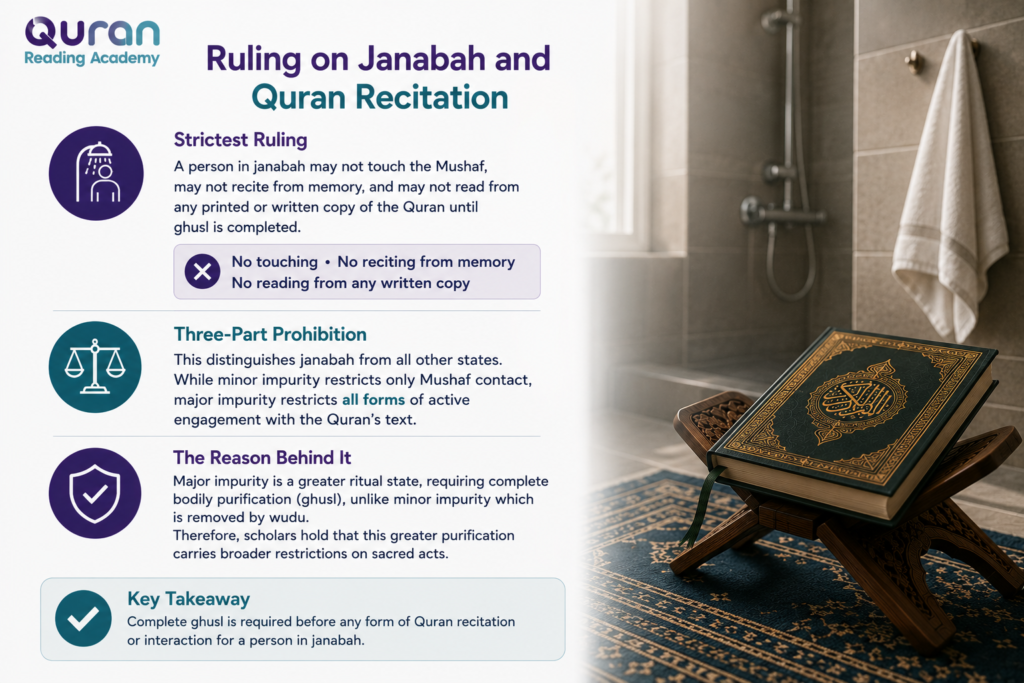
This three-part prohibition distinguishes janabah from all other states in Islamic law regarding the Quran. While minor impurity restricts only Mushaf contact, major impurity restricts all forms of active engagement with the Quran’s text.
The reasoning behind this heightened restriction relates to the nature of major impurity as a more significant ritual state. Unlike minor impurity, which is removed by a few minutes of wudu, major impurity requires a complete bodily purification. The scholars reason that this more complete purification requirement also carries broader restrictions on sacred acts.
Read also: Can You Read Quran for Someone Else?
Listening to Quran During Janabah
A person in janabah may listen to Quran recitation without restriction, provided they do not actively recite along. The prohibition concerns forming Quranic words with the lips and tongue, not listening to them.
Shaykh Ibn Baz (RA) addressed this explicitly: listening to the Quran while in janabah carries no prohibition. The prohibition targets active recitation, the movement of the lips and tongue to form Quranic words, not passive reception of the sound.
The condition scholars attach to this permission is that the listener must not move their lips or tongue to silently recite along with the audio. Ibn Rushd recorded from Imam Malik that “recitation is that in which a person moves their tongue.” Listening without silent mouthing of the words remains fully permitted.
Quran Reading Academy offers a Quran Tajweed Course that trains students in the complete science of Tajweed, ensuring that every session of recitation, once ritual purity is restored, is performed with the precision and reverence the Quran demands.

Start Your Tajweed Training with Certified Instructor
Read also: Why Do I Feel Sleepy When Reading Quran?
Can a Menstruating Woman Recite Quran?
The majority of scholars prohibit active Quran recitation during menstruation, while Ibn Taymiyyah and other scholars permit it because no specific authentic text prohibits it. Touching the physical Mushaf remains restricted without a barrier according to the majority view.
The majority position, held by the Hanafi, Shafi’i, and Hanbali schools, is that a menstruating woman may not recite the Quran during her period. Menstruation is a state requiring ghusl, and the prohibition on recitation that applies to janabah applies here as well.
The Maliki school holds a slightly different internal position on the extent of the prohibition, though it similarly maintains restrictions on touching the Mushaf.
Ibn Taymiyyah’s View on Quran Recitation During Menstruation
Shaykh al-Islam Ibn Taymiyyah (RA) presented a well-reasoned opposing position. He argued that no authentic, clear narration specifically prohibits a menstruating woman from reciting the Quran, and he distinguished her situation from that of a person in janabah on two firm grounds.
First, the person in janabah can end that state at any moment by performing ghusl, while a menstruating woman has no such option during her period. Second, the duration of menstruation commonly spans several days, whereas janabah is typically a temporary state resolved quickly due to the requirement of prayer.
Ibn Taymiyyah concluded that prolonged separation from Quran recitation without a clear, authentic textual prohibition constitutes an unwarranted hardship. This position was endorsed by a number of classical and contemporary scholars and is considered a valid scholarly opinion within Islamic jurisprudence.
How Hifz Students Can Maintain Memorization During Menstruation
Scholars who follow the majority prohibition have also provided practical accommodations for women who have memorized the Quran and fear they may lose portions of their memorization during their period.
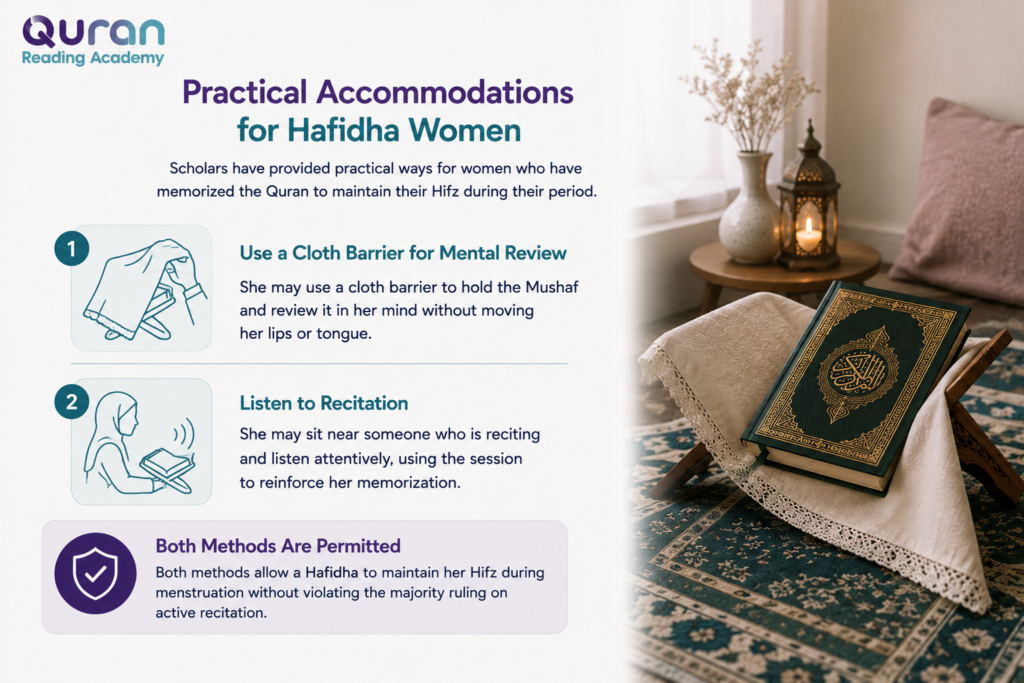
Two methods are specifically sanctioned:
- She may use a cloth barrier to hold the Mushaf and review it in her mind without moving her lips.
- She may sit near someone who is reciting and listen attentively, using the listening session to reinforce her memorization.
Both methods allow a memorizer to maintain her Hifz during menstruation without violating the majority ruling on active recitation.
Read also: Can You Read Quran at the Graveyard?
Can You Touch the Physical Mushaf Without Wudu?
No, direct contact with the physical Mushaf without wudu is not permitted according to the four major schools of Islamic law. Their agreement applies to the Arabic Quranic text and its pages, while some details differ regarding indirect handling with a separate barrier.
The Hanafi school permits carrying the Mushaf with a sleeve or cloth that is not permanently attached to it, relying on the principle that indirect contact does not constitute touching. Imam Abu Hanifah held this position.
Imams Malik and al-Shafi’i did not permit even this, holding that a person in minor impurity should not handle the Mushaf by any means until wudu is performed.
All four schools agree that direct, bare-handed contact with the pages of the Mushaf requires wudu. The blank margins carry the same ruling as the text itself, according to the position of Imam Shurunbulali and the majority of classical Hanafi jurists.
A book of Tafsir or Fiqh in which Quranic verses appear alongside commentary may be touched without wudu when the non-Quranic content exceeds the Quranic verses in length. When the Quranic portion is the majority of the content, the Mushaf ruling applies to the entire book.
Quran Reading Academy offers an Online Quran Reading Course with Tajweed that teaches students the compl
Inside Our Live Classroom
We believe in complete transparency. Take a look inside our virtual classrooms to experience our premium teaching tools and engaging learning environment firsthand.
Start Your Quran Learning Journey Today
Join Quran Reading Academy and begin structured, step-by-step Quran reading with expert guidance.
Try your first class for freeLearn Quran Recitation With Certified Instructors
Quran Reading Academy offers one-on-one live sessions with Ijazah-certified instructors who correct pronunciation, Tajweed application, and Quran recitation etiquette.
Each student follows a structured curriculum and progresses at a pace suited to their current level.
The program includes:
- Ijazah-certified instructors with verified chains of Quranic transmission.
- One-on-one live sessions providing personalized correction in real time.
- Structured curriculum covering both Tajweed rules and correct recitation etiquette.
Our Quran Courses
- Quran Reading Classes
- Quran Reading Classes for Kids
- Quran Reading Classes for Adults
- Quran Reading Classes for Female/Sisters
- Quran Reading Classes for New Muslims
- Quran Reading Course for Beginners
- Online Quran Reading Course with Tajweed
- Reading and Memorizing the Quran Course
- Noorani Qaida Course
- Quran Course for Beginners
- Quran Tajweed Course
- Quran Recitation Course
- Quran Hifz Course
- Online Quran Qirat Classes

Conclusion
Ritual purity and Quran recitation are connected through a clear, well-established framework in Islamic law. A person in minor impurity may recite from memory freely but may not touch the physical Mushaf without wudu.
A person in a state of major impurity may not recite the Quran in any form until ghusl is completed, though listening to recitation remains permitted in all states.
Can you read Quran when impure? The ruling depends on the type of impurity and the form of recitation. Reciting from memory in minor impurity is permitted. Touching the Mushaf without wudu is not.
Reciting the Quran in a state of impurity requiring ghusl is not permitted in any form. Reading from a phone or digital screen carries fewer restrictions than the physical Mushaf in minor impurity, though it does not change the ruling in major impurity.
Understanding these distinctions and building a regular recitation practice grounded in proper ritual preparation is a lifelong commitment. Quran Reading Academy’s certified instructors are available to guide every stage of that journey.
Frequently Asked Questions About Reading the Quran in a State of Impurity
Can you read Quran if you are impure from minor hadath without wudu?
Yes, reciting the Quran from memory without wudu is permitted in a state of minor impurity. The scholarly consensus across all four major schools allows this. The prohibition in minor impurity applies only to touching the physical Mushaf, not to verbal or mental recitation.
Can you recite Quran in a state of impurity caused by janabah?
No, reciting the Quran in any form, from memory or from the Mushaf, is not permitted during janabah. This is the position of the majority of scholars. Ghusl must be completed before recitation resumes. Listening to Quran recitation without moving the lips remains permitted.
Can you read Quran while impure using a phone or digital app?
Yes, reading from a phone or digital screen does not require wudu, according to the majority of contemporary scholars. The wudu requirement applies to physical contact with the bound Mushaf. A digital device is not legally a Mushaf, so the restriction on touching does not apply to it.
Can a menstruating woman read Quran in her state of impurity?
The majority of scholars prohibit recitation during menstruation, treating it similarly to janabah. Shaykh al-Islam Ibn Taymiyyah and some contemporary scholars permit it, citing the absence of a specific, authentic prohibition. A memorizer may review silently in her mind or listen to someone else reciting.
Does touching a Quran translation require wudu?
A translation-only copy with no Arabic Quranic text is generally not subject to the Mushaf ruling. A bilingual edition where Arabic Quranic text is the majority content carries the same ruling as the Mushaf. When non-Quranic content clearly exceeds the Quranic portion, wudu is not required to handle it.








Leave a Reply