 Fatawa
| Key Takeaways |
| Scholars across the Maliki, Shafi’i, and Hanbali schools permit reading from a physical Mushaf during Tahajjud, citing the authentic narration of Dhakwan leading Aisha (RA) in voluntary prayer while reading directly from the Quran. |
| Reading from the Quran in night prayer is spiritually valid and fully rewarded, making it a practical solution for Muslims who have not yet memorized large portions of the Quran. |
| Hanafi scholars consider Mushaf recitation in Salah generally disliked, but permit it during voluntary prayers such as Tahajjud when genuine need exists and no other option is available. |
| Surahs Al-Muzzammil, Al-Mulk, and the Mufassal section from Surah Qaf onward are most commonly recited in Tahajjud, and reading them from a Mushaf is fully valid at every stage of Quranic learning. |
Tahajjud has a special place among voluntary acts of worship, performed in the quiet of the night when the heart turns closely to Allah. Many Muslims wonder whether they may hold a Mushaf and read from it during night prayer if they have not memorized much Quran.
Classical scholars from all major legal schools addressed this question carefully. This article explains the ruling on reading from the Quran in Tahajjud, recommended surahs, and how to build a regular night-prayer recitation practice at any level.
Is Reading from a Mushaf Valid During Tahajjud?
Yes, the majority of classical scholars permit reading from a physical Mushaf during Tahajjud and other voluntary night prayers. This ruling is supported by an authentic narration preserved in Sahih Bukhari recording that Dhakwan, the freed servant of Aisha (RA), led her in voluntary prayer during Ramadan while reading directly from the Quran.
Scholars of the Maliki, Shafi’i, and Hanbali schools cited this narration as establishing clear permissibility for Mushaf recitation in night prayers, and none of the companions present objected to the practice.
Dhakwan’s Report on Reading from a Mushaf During Tahajjud
The report of Dhakwan provides the central evidence scholars cite for reading from a Mushaf during Tahajjud. Imam al-Bukhari preserved it in his Sahih in a mu’allaq (suspended chain) form within the chapter on leading prayer.
Dhakwan, freed servant of Aisha bint Abi Bakr (RA), used to lead her in prayer during Ramadan while reading from the Quran directly. This report circulated among the companions and their successors without any recorded objection.
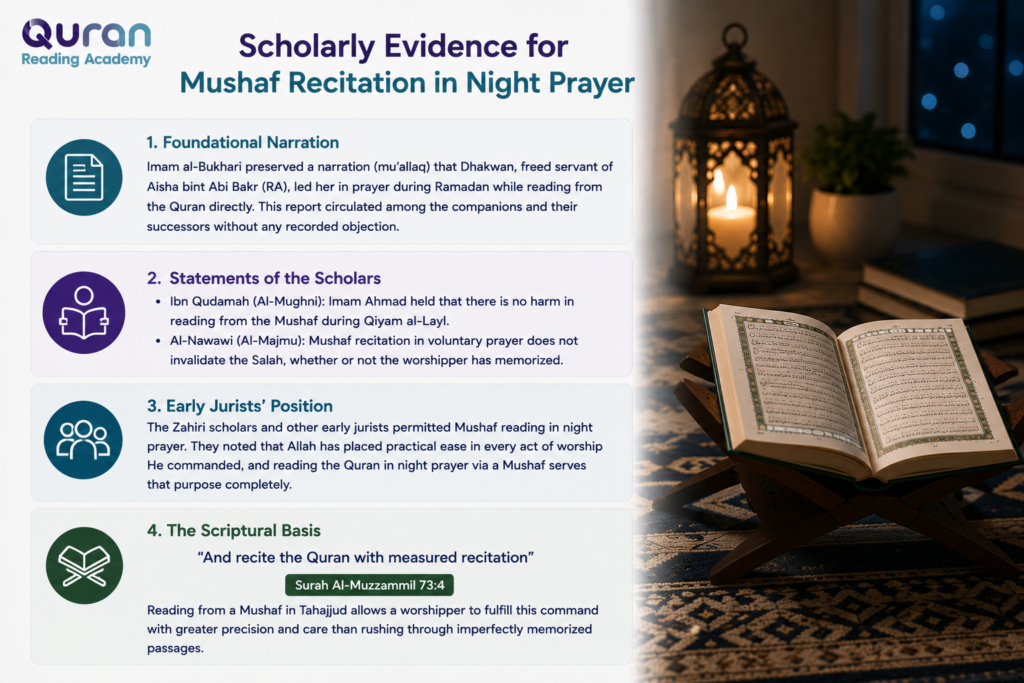
Ibn Qudamah in Al-Mughni records Imam Ahmad’s position clearly: no harm exists in a person reading from the Mushaf during Qiyam al-Layl. Al-Nawawi confirmed in Al-Majmu that Mushaf recitation in voluntary prayer does not invalidate the Salah, whether or not the worshipper has memorized the Quran.
The Zahiri scholars and other early jurists similarly permitted Mushaf reading in night prayer. They noted that Allah has placed practical ease in every act of worship He commanded, and reading the Quran in night prayer from a Mushaf serves that purpose completely. The Quran also instructs believers to recite with measured care:
وَرَتِّلِ الْقُرْآنَ تَرْتِيلًا
(Wa rattili al-Qur’ana tartila)
Reading from a Mushaf in Tahajjud allows a worshipper to fulfill this command with greater precision and care than rushing through imperfectly memorized passages.
Read also: Can You Listen to Quran While Reading Quran?
How the Four Madhhabs Rule on Reading from a Mushaf During Tahajjud
The four major legal schools examined this question from different angles, but the weight of the classical tradition falls clearly on the side of permissibility.
Three schools permit Mushaf recitation in Tahajjud outright, while the fourth allows it under conditions of genuine need. The positions below reflect each school’s reasoning and the evidence each relied on.
a. Maliki, Shafi’i, and Hanbali Views on Mushaf Recitation During Tahajjud
All three schools permit Mushaf recitation in Tahajjud without qualification. Al-Nawawi’s statement in Al-Majmu is definitive for the Shafi’i school: reading Surah Al-Fatiha and additional surahs from a Mushaf constitutes a fully valid prayer.
Turning pages during the prayer is also permitted under the Shafi’i analysis, as the action is directly connected to the recitation itself.
The Hanbali position documented by Ibn Qudamah is equally clear. Reading from the Quran in Tahajjud is permissible, particularly for those who have not memorized large portions or who wish to recite extended passages during Qiyam al-Layl. Imam Ahmad treated the Dhakwan narration as sufficient evidence to settle the question.
b. Hanafi View on Reading from a Mushaf During Tahajjud
The dominant Hanafi view holds that reading from a Mushaf during Salah is generally disliked (makruh).
Hanafi scholars reasoned that physically holding and reading from a book introduces an additional action into the prayer that can diminish the worshipper’s complete focus on the act of worship.
However, Hanafi jurists recognized that genuine need (hajah) changes this ruling. A person who has not memorized sufficient Quran for meaningful Tahajjud recitation may read from the Mushaf when no other option exists.
Those following the Hanafi school should consult a reliable scholar about their specific circumstances, as individual situations affect how this ruling applies.
Quran Reading Academy offers a Quran Recitation Course that trains students in the controlled Tajweed-accurate recitation required for night prayer, with Ijazah-certified instructors who provide real-time articulation correction in live one-on-one sessions.

Start Your Recitation Training Today
Read also: Can You Read Quran During Khutbah?
Surahs to Recite from a Mushaf During Tahajjud
No specific surah is obligatory for Tahajjud. The tradition recommends reciting from certain portions of the Quran based on the Prophetic practice and the narrations of companions, and a worshipper using a Mushaf can follow these recommendations directly during night prayer.
a. Recite Surah Al-Muzzammil for Tahajjud Reflection
Surah Al-Muzzammil (Chapter 73) carries particular significance for Tahajjud because it opens with a direct divine instruction to stand in night prayer and to recite the Quran with measured precision.
Many scholars recommend beginning Tahajjud sessions with Al-Muzzammil for this direct thematic connection to the act of night prayer recitation itself.
Surah Al-Mulk (Chapter 67) also appears prominently in narrations about night recitation. Reading it from a Mushaf in Tahajjud is a practice many Muslims maintain as part of a regular night prayer routine, and authentic narrations encourage its recitation during this time.
b. Choose Al-Mufassal Surahs for Tahajjud Recitation
Al-Mufassal refers to the section of the Quran from Surah Qaf (Chapter 50) to the end of the Quran. This portion appears consistently in classical accounts of the Prophet’s night prayers.
Longer surahs within this section, including Al-Waqiah (Chapter 56), Al-Hashr (Chapter 59), Al-Rahman (Chapter 55), and Al-Insan (Chapter 76), are particularly associated with Qiyam al-Layl.
| Surah | Chapter | Significance in Night Prayer |
| Al-Muzzammil | 73 | Direct divine instruction for night recitation with measured pace |
| Al-Mulk | 67 | Narrations specifically recommend it during night prayers |
| Al-Waqiah | 56 | Reported in accounts of Prophetic night prayer recitation |
| Al-Rahman | 55 | Prominent in classical Qiyam al-Layl accounts |
| Al-Insan | 76 | Authentic narrations mention it in Prophetic Tahajjud |
| Al-Baqarah 285-286 | 2 | Specifically recommended for night recitation in authentic narrations |
Read also: Can You Read Quran with Tayammum?
See Our Academy in Action
Discover what a typical session looks like! Watch these brief highlights from our live, interactive classes to see how our instructors engage with students of all ages.
Start Your Quran Learning Journey Today
Join Quran Reading Academy and begin structured, step-by-step Quran reading with expert guidance.
Try your first class for freeCan You Read from a Mushaf With Limited Quran Memorization?
Yes, a Muslim with limited Quran memorization may read from a Mushaf during Tahajjud according to the majority of scholars. Many Muslims avoid Tahajjud because they feel their memorization is too limited for a meaningful night prayer, but the Islamic tradition makes practical allowance for voluntary worship.
The narration of Dhakwan reading for Aisha (RA) demonstrates that physical Mushaf recitation in voluntary prayer was practiced in the Prophet’s companion households without objection.
Reading two pages from Al-Waqiah using a Mushaf allows a worshipper to include longer Quran passages in night prayer instead of repeating the same three short surahs in every rakah.
Reading from the Quran in Tahajjud also serves a practical memorization function over time. Regular exposure to longer passages during night prayer builds familiarity with the text that gradually supports committing those passages to memory.
وَمِنَ اللَّيْلِ فَتَهَجَّدْ بِهِ نَافِلَةً لَّكَ عَسَىٰ أَن يَبْعَثَكَ رَبُّكَ مَقَامًا مَّحْمُودًا
(Wa min al-layli fatahajjad bihi nafilatan laka ‘asa an yab’athaka rabbuka maqaman mahmuda)
(“And from [part of] the night, pray with it as additional [worship] for you; it is expected that your Lord will resurrect you to a praised station.”)
This command attaches no memorization requirement to the night prayer. Reading from the Quran in Tahajjud serves this divine command completely, regardless of how much a worshipper has committed to memory.
Quran Reading Academy offers a Quran Hifz Course that provides the systematic memorization techniques needed to gradually build the Quranic archive that reduces reliance on a Mushaf during Tahajjud as a student’s memorization grows.

Begin Your Hifz Journey with Expert Guidance
Reading Quran After Tahajjud
Reading the Quran after completing Tahajjud carries its own independent reward, separate from the reward of Salah itself.
The time immediately following Tahajjud, particularly in the final third of the night, is among the most blessed windows for supplication and Quranic recitation outside of prayer.
a. Continue Quran Recitation After Tahajjud
After completing the prayer portion of Tahajjud, many scholars recommend remaining in the same position and continuing with dhikr, Quranic recitation, and dua.
Every letter of the Quran recited in that state carries its own recorded reward. Night prayer creates a focused state of heart, and the words of the Quran carry more weight there than in most other settings.
b. Set a Quran Reading Time Before Fajr
No fixed time limit exists for Quran reading after Tahajjud. A worshipper may read until the time for Fajr approaches, at which point preparing for the obligatory prayer becomes the priority.
Many practitioners set aside 15 to 20 minutes after the prayer portion for Quranic recitation, treating it as part of the broader Tahajjud session.
As Fajr draws near, making dua and seeking forgiveness in the final moments is especially emphasized in the tradition. Quranic recitation fits fully within this pre-Fajr window, making post-Tahajjud Quran reading a valuable addition to any night worship routine.
Read also: Can You Read Quran Without Covering Awrah?
Building a Regular Tahajjud Quran Recitation Practice
A regular Tahajjud Quran recitation practice can be built by preparing the Mushaf, choosing the passage in advance, and keeping the routine manageable.
The following steps help a worshipper structure the session with focus:
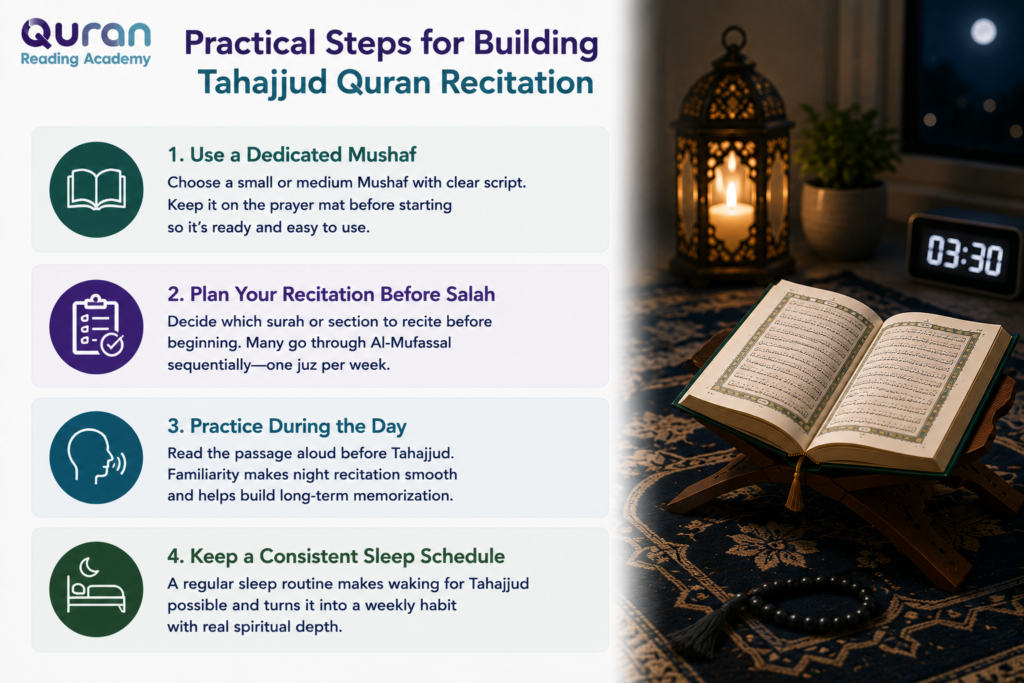
- Select a dedicated Mushaf specifically for Tahajjud. A small or medium-sized copy with clear script is easier to hold during prayer than a large desk copy. Keeping it on the prayer mat before beginning removes the need to search for it in the dark.
- Decide which surah or section to recite before beginning the prayer, not during it. Flipping through pages mid-Salah interrupts focus. Many worshippers work through Al-Mufassal sequentially across Tahajjud sessions, completing one juz across a full week.
- Practice reading the chosen passage aloud during the day. When the tongue has already moved through the text before night prayer, reciting it in Tahajjud feels natural and does not disrupt the flow of the Salah. This daily practice also gradually builds familiarity that can eventually support memorization.
- Maintain a consistent sleep schedule that makes waking for Tahajjud practical. A regular Tahajjud time turns an occasional effort into a weekly practice with real spiritual depth.
Inside Our Live Classroom
We believe in complete transparency. Take a look inside our virtual classrooms to experience our premium teaching tools and engaging learning environment firsthand.
Start Your Quran Learning Journey Today
Join Quran Reading Academy and begin structured, step-by-step Quran reading with expert guidance.
Try your first class for freeImprove Tahajjud Quran Recitation with Quran Reading Academy
Building a Tahajjud practice that includes correct Quranic recitation requires both a sound understanding of Tajweed and a clear path through Quranic learning.
Quran Reading Academy connects students with Ijazah-certified instructors in live one-on-one online sessions, providing the real-time correction and personal guidance needed to recite the Quran with Tajweed during night prayer, from wherever they are in the world.
Why Students Choose Quran Reading Academy
- Ijazah-certified instructors who correct articulation errors in real time during every session.
- One-on-one live lessons that adapt to each student’s memorization level and night prayer recitation goals.
- A structured curriculum that builds from foundational phonetics to full surah recitation used in Tahajjud.
Our Quran Courses
- Quran Reading Classes
- Quran Reading Classes for Kids
- Quran Reading Classes for Adults
- Quran Reading Classes for Female/Sisters
- Quran Reading Classes for New Muslims
- Quran Reading Course for Beginners
- Online Quran Reading Course with Tajweed
- Reading and Memorizing the Quran Course
- Noorani Qaida Course
- Quran Course for Beginners
- Quran Tajweed Course
- Quran Recitation Course
- Quran Hifz Course
- Online Quran Qirat Classes

Conclusion
Reading from the Quran during Tahajjud is permitted by most classical scholars. The authentic report of Dhakwan reading from the Mushaf for Aisha (RA) supports this practice.
The Maliki, Shafi‘i, and Hanbali schools permit it clearly, while the Hanafi school allows it when there is a genuine need.
Surahs Al-Muzzammil, Al-Mulk, and the Al-Mufassal section from Surah Qaf onward are especially suitable for Tahajjud. Reading Quran after night prayer is also encouraged during the blessed time before Fajr, while memorization remains a valuable long-term goal.
Frequently Asked Questions
Does reading from a Mushaf during Tahajjud make the prayer invalid?
No. According to the Maliki, Shafi’i, and Hanbali schools, Mushaf recitation during Tahajjud does not invalidate the prayer. Al-Nawawi stated explicitly in Al-Majmu that voluntary prayer remains fully valid when the worshipper reads from a physical Quran during recitation.
Can we read Quran in Tahajjud without understanding Arabic?
Yes. A worshipper may read Arabic from a Mushaf in Tahajjud even without understanding Arabic, as long as the Arabic text is recited aloud. A translation does not replace the recitation required in Salah, but Arabic recitation from a Mushaf is valid at any comprehension level.
What Surah Should Beginners Read in Tahajjud?
Beginners should start with shorter surahs from Al-Mufassal, such as Al-Mulk (Chapter 67), Al-A’la (Chapter 87), or Al-Ghashiyah (Chapter 88). Reading them from a Mushaf in Tahajjud is practical and rewarding, while repeated recitation gradually builds familiarity that may support memorization.
Is Recitation From Memory Better Than Mushaf Reading in Tahajjud?
Yes, recitation from memory is preferred when a worshipper has sufficient memorization because it can allow greater focus and khushu. However, reading from a Mushaf in Tahajjud is fully valid and may be more substantive than repeating the same short memorized surahs throughout the night.
Can I read Quran after Tahajjud and receive reward for it?
Yes. Quran recitation after completing Tahajjud carries independent reward and is recommended in the scholarly tradition. Every letter recited in that pre-Fajr window counts as an act of worship, making post-Tahajjud Quran reading a valuable and spiritually rich addition to any night prayer routine.









Leave a Reply