 Quran
| Key Takeaways |
| Tayammum (dry ablution using clean earth or stone) is a complete substitute for wudu and ghusl when water is unavailable or harmful, granting full ritual purity for all acts of worship including Quran reading. |
| A Muslim who performs valid tayammum may read from the Mushaf, recite the Quran aloud, and touch the Quran directly. The same permissions that wudu grants apply in full. |
| Tayammum becomes void the moment water becomes accessible and safe to use, requiring the person to perform wudu before continuing to read from the physical Mushaf. |
| A person in major impurity (janabah) must perform tayammum with the intention of replacing ghusl, not wudu, before reciting the Quran. This distinction matters for the ruling to apply correctly. |
Ritual purity is central to Islamic worship, especially when water cannot be used because of illness, travel, or emergency. The Shariah provides clear guidance that balances the obligation of worship with these physical limitations.
Tayammum is the Quranic substitute for water-based purification and a mercy granted to this ummah. This article explains whether it permits Quran recitation and handling, the evidence behind the ruling, and the conditions that make reading Quran with tayammum valid.
Does Tayammum Permit Quran Reading and Mushaf Handling?
Yes, a Muslim who has performed valid tayammum may read from the Mushaf, recite from memory, and touch the Quran directly.
Tayammum is not a reduced form of purification; it is a complete substitute that grants ritual purity for as long as the valid excuse that necessitated it remains.
Tayammum as a Substitute for Water-Based Purification
Valid tayammum replaces water-based purification when water is unavailable or harmful to use.
The Quran establishes tayammum as a legal replacement for water-based purification, not a temporary workaround for prayer. Allah says in Surah Al-Maidah:
وَإِن كُنتُم مَّرْضَىٰٓ أَوْ عَلَىٰ سَفَرٍ أَوْ جَآءَ أَحَدٌ مِّنكُم مِّنَ ٱلْغَائِطِ أَوْ لَٰمَسْتُمُ ٱلنِّسَآءَ فَلَمْ تَجِدُوا۟ مَآءً فَتَيَمَّمُوا۟ صَعِيدًا طَيِّبًا فَٱمْسَحُوا۟ بِوُجُوهِكُمْ وَأَيْدِيكُم مِّنْهُ
(Wa in kuntum mardaa aw ‘alaa safarin aw jaa’a ahadun minkum mina al-ghaa’iti aw laamastumu an-nisaa’a falam tajiduu maa’an fatayammamuu sa’eedan tayyiban famsahuu biwujoohikum wa aydeekum minhu)
(“And if you are ill or on a journey or one of you comes from the place of relieving himself or you have contacted women and find no water, then seek clean earth and wipe over your faces and your hands with it.”)
This verse places tayammum directly in the context of purification for worship. The command is unqualified: “seek clean earth.” It grants complete purity for prayer, Quran reading, and every other act that requires taharah (ritual purity).
a. Legal Status of Tayammum for Quran Reading
Classical scholars across all four madhabs are unanimous on this point. Tayammum is not a shortcut that carries asterisks or partial permissions.
Once a person performs tayammum with a valid excuse and correct method, the ritual purity it establishes is equivalent in legal status to the purity gained from wudu or ghusl. Everything that requires wudu, including reading and touching the Mushaf, becomes permissible without qualification.
Read also: Can You Listen to Quran While Reading Quran?
b. Renewing Purification When Water Becomes Accessible
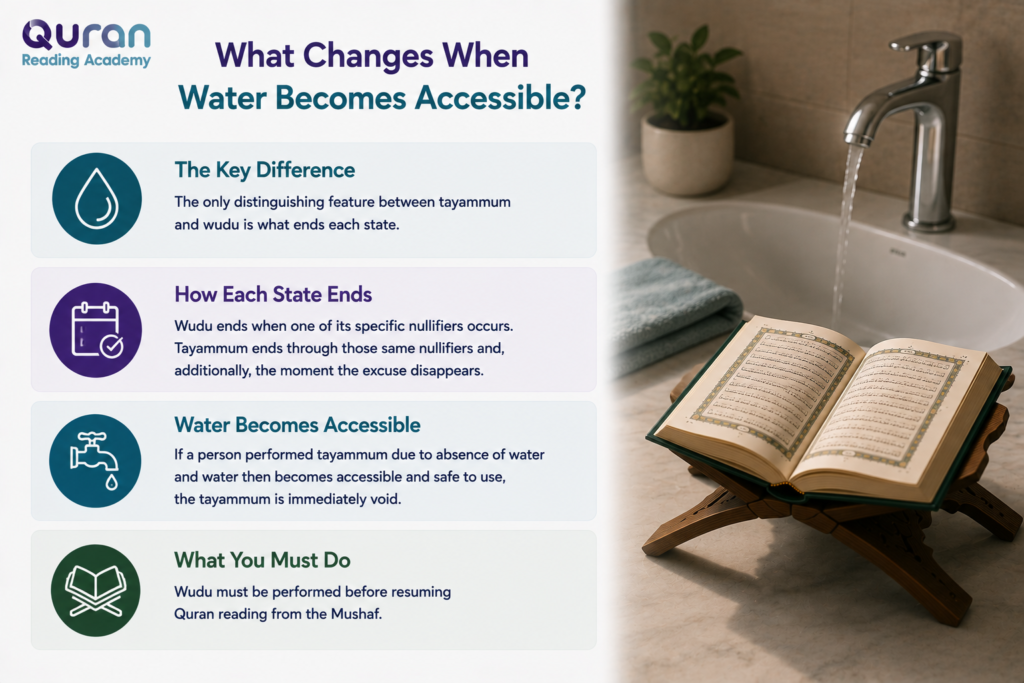
The only distinguishing feature between tayammum and wudu is what ends each state. Regular wudu ends when one of its specific nullifiers occurs. Tayammum ends through those same nullifiers and, additionally, the moment the excuse for performing it disappears.
If a person performed tayammum due to absence of water and water then becomes accessible and safe to use, the tayammum is immediately void. Wudu must be performed before resuming Quran reading from the Mushaf.
What Tayammum Permits for Quran Reading
Valid tayammum permits Quran reading, direct Mushaf handling, and Salah within the scope of the valid excuse. The table below summarizes the related permissions:
| Act of Worship | Permitted with Valid Tayammum? | Note |
| Reading Quran from the Mushaf | Yes | Full permission, same as wudu |
| Reciting Quran from memory | Yes | Full permission |
| Touching the Mushaf directly | Yes | Full permission |
| Performing Salah | Yes | Full permission |
| Making Dua | Yes | Permitted regardless of purity state |
| Acts that normally require ghusl | Yes | When water is unavailable, tayammum replaces ghusl too |
Quran Reading Academy offers a Quran Recitation Course that trains students to recite Allah’s words with Tarteel and certified Tajweed instruction, building a consistent practice that holds to correct standards in every prayer and personal recitation session.
Get Started with a Certified Quran Recitation Instructor
How the Four Madhhabs Address Quran Reading After Tayammum
The four major madhhabs treat valid tayammum as a legal substitute for purification when its conditions are met. Scholars of the Hanafi, Maliki, Shafi’i, and Hanbali madhhabs agree that tayammum grants permission for Quran recitation and Quran handling.
This consensus is grounded in the understanding that tayammum serves as a legal substitute, not a lesser option, for wudu and ghusl.
The Quran references the purity required to interact with the divine text:
لَّا يَمَسُّهُۥٓ إِلَّا ٱلْمُطَهَّرُونَ
(Laa yamassuhu illaa al-mutahharoon)
The word “al-mutahharoon” (the purified) applies to anyone who has achieved ritual purity, whether through wudu, ghusl, or the Shariah-sanctioned substitute of tayammum. A person who has performed valid tayammum is, in the legal sense of Islamic jurisprudence, among the purified.
Imam al-Nawawi, one of the most authoritative figures in Shafi’i jurisprudence, confirmed that tayammum lifts impurity in the same manner water does, for the duration that the excuse persists.
Ibn Qudamah of the Hanbali school similarly stated that tayammum grants full permission for everything wudu permits, without distinction.
The only scholars who ever expressed reservations did so about specific edge cases in complex ghusl situations, never about the basic permission for reading Quran with tayammum.
Minor and Major Impurity in Quran Recitation
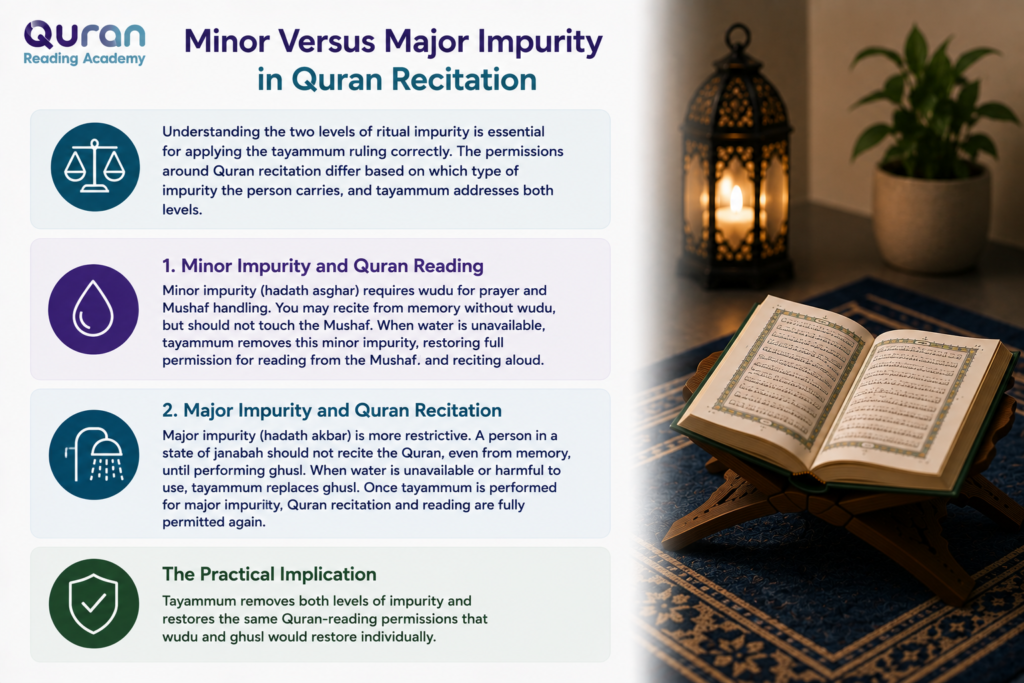
Tayammum can address both minor and major impurity when water is unavailable or harmful, but the relevant intention and ruling differ by state.
The permissions around Quran recitation therefore depend on which type of impurity the person carries.
a. Quran Reading in Minor Impurity
Minor impurity (hadath asghar), caused by urination, passing wind, using the restroom, or sleep, requires wudu for prayer and Mushaf handling. A person in minor impurity may recite the Quran from memory without wudu but should not touch the Mushaf.
When water is unavailable, tayammum removes this minor impurity entirely, restoring full permission for reading from the Mushaf and reciting aloud.
b. Quran Recitation in Major Impurity
Major impurity (hadath akbar), arising from sexual intercourse, seminal emission, menstruation, or post-natal bleeding, is more restrictive regarding the Quran. A person in a state of janabah (major ritual impurity) should not recite the Quran, even from memory, until performing ghusl.
When water is unavailable or genuinely harmful to use, tayammum replaces ghusl. Once tayammum is performed for a state of major impurity, Quran recitation and reading become fully permitted again.
The practical implication: tayammum removes both levels of impurity and restores the same Quran-reading permissions that wudu and ghusl would restore individually.
Quran Reading Academy offers an Online Quran Reading Course with Tajweed that helps students build accurate recitation habits through certified, one-on-one live sessions where instructors correct pronunciation and Tajweed in real time.
Book a Free Tajweed Session with a Certified Instructor
Read also: Can You Read Quran During Khutbah?
Valid Reasons for Performing Tayammum
Not every situation where a person prefers to avoid water qualifies as a valid excuse. The Shariah defines specific circumstances under which tayammum is permissible, and only tayammum performed under these conditions grants valid permission for Quran reading and prayer.
| Valid Reason | Description |
| Absence of water | No water is available within reasonable reach |
| Medical necessity | Using water would worsen illness, delay healing, or harm a wound |
| Extreme cold | Water is available but would cause genuine physical harm to use |
| Time constraint | Seeking water would cause the prayer time to expire entirely |
| Fear of harm | A person cannot safely travel to the water source |
Performing tayammum without a valid reason from the list above does not constitute valid purification. Quran reading or Salah performed under invalid tayammum must be repeated once a valid state of purity is achieved through wudu or ghusl.
Quran Reading Academy offers a Noorani Qaida Course that builds accurate letter recognition and Arabic phonetics before students progress to full Quran reading, so students build correct Arabic pronunciation before progressing to full Quran reading.
Learn Quran Foundations with a Certified Instructor
Performing Tayammum Before Reading Quran
Tayammum requires only a few deliberate steps, but each must be performed correctly for the purification to be valid. The surface used must come from the earth: clean soil, sand, natural stone, unpolished brick, or clay all qualify. Painted surfaces, metal, and glass do not qualify.
The correct method follows this sequence:
- Form the intention (niyyah) in the heart to purify oneself for the purpose of worship.
- Strike both palms lightly on the clean earthen surface.
- Wipe the face once, covering from the hairline to the chin and ear to ear.
- Strike the palms again on the surface.
- Wipe both arms from fingertips to the elbows, starting with the right arm.
Once complete, the person is in a valid state of ritual purity and may read the Quran, touch the Mushaf, and perform Salah. Visible physical dirt must be removed before tayammum, as tayammum addresses ritual purity, not physical cleanliness.
See Our Academy in Action
Discover what a typical session looks like! Watch these brief highlights from our live, interactive classes to see how our instructors engage with students of all ages.
Start Your Quran Learning Journey Today
Join Quran Reading Academy and begin structured, step-by-step Quran reading with expert guidance.
Try your first class for freeCan You Touch the Mushaf After Tayammum?
Yes, valid tayammum permits direct contact with the physical Mushaf according to the majority position. The condition for touching the Mushaf, established by the Quranic verse in Surah Al-Waqi’ah and supported by the scholarly tradition, is ritual purity.
A person in valid tayammum has achieved that purity and may carry the Mushaf, open it, turn its pages, and follow the text during recitation.
Read also: Can You Read Quran Without Covering Awrah?
Reading Quran on a Phone or Tablet After Tayammum
Reading Quranic text on a phone or tablet is permitted without wudu according to most contemporary scholars, and tayammum remains valid for it. Wudu is recommended but not legally obligatory because the screen does not constitute the Mushaf in the classical legal sense.
However, for recitation in the state of major impurity (janabah), tayammum or ghusl remains necessary regardless of whether the reader uses a physical Mushaf or a digital device, because the restriction in that case applies to the act of recitation itself, not solely to touching.
Quran Reading Academy offers Quran Reading Classes for Beginners that guide students from their first Arabic letters through to confident Mushaf reading, with one-on-one sessions and a structured curriculum designed for students at every starting point.
Book Your Free Beginner Trial Lesson Today
When Tayammum Becomes Void While Reading Quran
Tayammum becomes void when a wudu nullifier occurs or when the valid excuse for tayammum disappears. A person must renew purification before continuing to read from the Mushaf.
Events that break wudu also break tayammum:
- Urination or defecation
- Passing gas
- Deep sleep or loss of consciousness
Events specific to tayammum:
- Water becomes accessible and safe to use
- The valid excuse disappears (for example, recovery from the illness that made water harmful)
- Entering a state of major impurity when the original tayammum replaced only wudu
Once tayammum is void, the person must either renew tayammum, if the excuse still persists, or perform wudu, if water is now available, before resuming Quran reading from the Mushaf.
Recitation from memory remains permitted in states of minor impurity but ceases to be permitted in major impurity without valid purification.
Inside Our Live Classroom
We believe in complete transparency. Take a look inside our virtual classrooms to experience our premium teaching tools and engaging learning environment firsthand.
Start Your Quran Learning Journey Today
Join Quran Reading Academy and begin structured, step-by-step Quran reading with expert guidance.
Try your first class for freeBuild Accurate Quran Recitation with Quran Reading Academy
Building a strong Quran recitation practice requires more than knowing the rulings around purity. It requires regular, structured sessions with an instructor who can hear you recite, correct your pronunciation, and guide you through a curriculum designed to build lasting accuracy.
Why Students Choose Quran Reading Academy
- Certified, Ijazah-holding instructors who specialize in Tajweed-accurate recitation and correct Makhraj training.
- Fully flexible one-on-one live sessions scheduled around your availability, seven days a week.
- A structured curriculum that covers foundational Arabic phonetics through complete Quran reading with Tajweed.
Our Quran Courses
- Quran Reading Classes
- Quran Reading Classes for Kids
- Quran Reading Classes for Adults
- Quran Reading Classes for Female/Sisters
- Quran Reading Classes for New Muslims
- Quran Reading Course for Beginners
- Online Quran Reading Course with Tajweed
- Reading and Memorizing the Quran Course
- Noorani Qaida Course
- Quran Course for Beginners
- Quran Tajweed Course
- Quran Recitation Course
- Quran Hifz Course
- Online Quran Qirat Classes
Conclusion
Reading Quran with tayammum is fully valid. When performed correctly for a valid excuse, it permits recitation from memory, reading from the Mushaf, and touching it, just as wudu or ghusl would, until the tayammum is invalidated.
Tayammum replaces wudu for minor impurity and ghusl for major impurity when water is unavailable or unsafe to use. In both cases, Quran recitation is permitted. Water-based purification becomes obligatory again once water is accessible and safe to use.
Frequently Asked Questions
Can You Touch the Mushaf After Performing Tayammum?
Yes. A person who has performed valid tayammum may touch the physical Mushaf directly. Tayammum grants the same ritual purity as wudu, and touching the Quran requires only that the person be ritually pure, which tayammum provides for as long as the excuse persists.
Does Tayammum Replace Ghusl for Quran Recitation?
Yes, when water is genuinely unavailable or harmful to use. A person in a state of major impurity cannot recite the Quran until performing ghusl or, when water is absent, tayammum with the intention of replacing ghusl. Once performed correctly, Quran recitation is fully permitted.
How Long Does Tayammum Remain Valid for Reading Quran?
Tayammum remains valid until one of its nullifiers occurs, either an event that would break wudu, or the disappearance of the excuse that made tayammum necessary, most commonly water becoming available. While the excuse persists and no nullifier has occurred, tayammum remains active for Quran reading.
Can a Sick Person Use Tayammum to Read Quran?
Yes, illness is one of the primary valid reasons for tayammum. If a person cannot use water due to injury, surgery, or a condition where water causes harm, tayammum is not only permitted but required. Valid tayammum grants permission to read and touch the Quran for the duration of the medical condition.
Is Tayammum Valid for Quran Reading if Performed on Stone?
Yes. Natural stone is a valid surface for tayammum, alongside clean soil, sand, clay, and unpolished brick. The Quran specifies “sa’eedan tayyiban” (clean earth), and classical scholars agree this includes any natural material from the earth’s surface that carries traces of dust or soil.







Leave a Reply