 How to read Quran
Yes, can you read quran before Maghrib. There is no general prohibition on Quran recitation during the period between Asr and sunset, so you may use this time for Tilawah, reviewing memorized verses, or listening to the Quran.
The restrictions associated with certain times of the day primarily concern Salah, particularly voluntary prayers at specific times. They should not be confused with Quran recitation. Therefore, if you have free time before Maghrib, you can dedicate it to reading the Quran without waiting until after the Maghrib prayer.
For many Muslims, the period before Maghrib can also be a practical part of a daily Quran routine. You might read a few pages after Asr, complete a specific portion before sunset, or use this quiet period for reflection and recitation. The key is to choose a consistent time that allows you to maintain your connection with the Quran regularly.
Can You Read Quran at Maghrib Time?
Yes, you can read the Quran at Maghrib time. The arrival of Maghrib does not make Quran recitation prohibited. You can read the Quran before the Maghrib prayer, after completing the prayer, or later in the evening as part of your regular Tilawah routine.
However, when the Maghrib prayer begins, the obligatory Salah should take priority. Once you have performed the prayer, you can return to Quran reading whenever it suits your schedule. This makes Maghrib a flexible point in your daily routine rather than a time when Quran recitation must stop.
If you are trying to build a consistent Quran habit, you can choose a simple routine around Maghrib—for example, reading a few pages after Salah or setting aside a dedicated period later in the evening. Consistency is more important than choosing a single “perfect” time, as long as your routine allows you to read, reflect, and stay connected to the Quran regularly.

Can You Read Quran Between Asr and Maghrib?
Yes, you can read the Quran between Asr and Maghrib. This period can be used for Tilawah, memorization, revision, or listening to the Quran. The approach of avoiding Quran recitation simply because sunset is approaching is not necessary.
For example, if you have 15 or 20 minutes after Asr, you can use that time to complete part of your daily Quran reading. You can also review previously memorized Surahs or read a few verses with their translation and reflect on their meaning.
Is There Anything to Keep in Mind Before Maghrib?
The most important point is to keep Salah and Quran recitation distinct. When the time for Maghrib prayer arrives, give priority to the obligatory prayer and avoid allowing your reading routine to cause you to delay or miss Salah.
After completing Maghrib prayer, you can return to your Quran reading whenever you wish. Therefore, the period between Asr and Maghrib can be a practical and flexible opportunity to maintain a consistent Quran routine.
Start Your Quran Learning Journey Today
Join Quran Reading Academy and begin structured, step-by-step Quran reading with expert guidance.
Try your first class for freeDoes the Prohibition on Prayer Before Maghrib Apply to Quran Recitation?
No. The restrictions that apply to certain types of Salah at specific times should not be treated as a general prohibition on reading the Quran. Quran recitation is a separate act of worship, so Can You Read Quran before Maghrib? The fact that some voluntary prayers may be discouraged or restricted around certain times does not mean that you must stop reading the Quran.
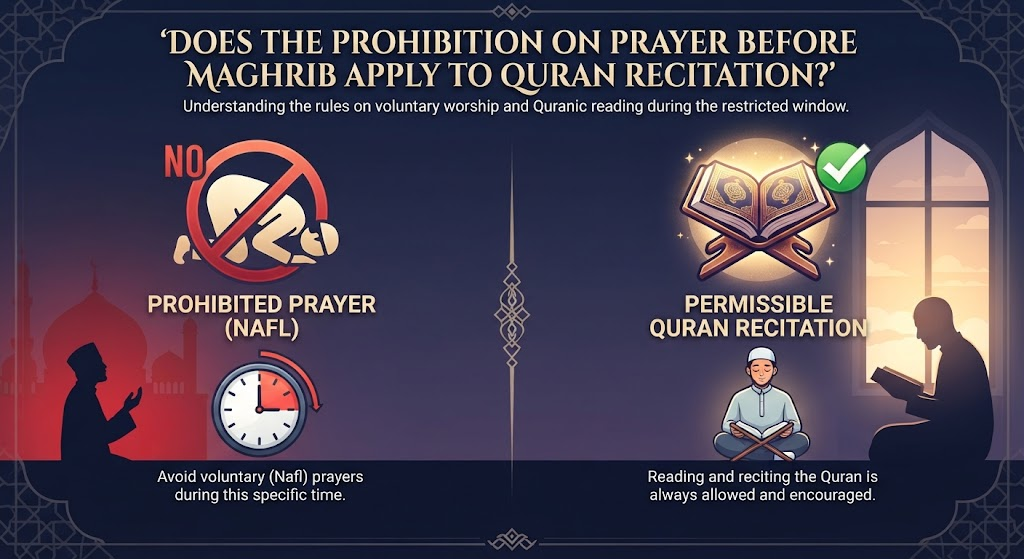
This distinction is especially important during the period between Asr and Maghrib. If you have set aside this time for Tilawah, you can continue reading the Quran rather than assuming that the prayer-related restrictions also apply to recitation.
You should still give priority to the obligatory Maghrib Salah when its time begins. Once the prayer is completed, you can continue your Quran reading afterward. Understanding this difference makes it easier to plan your daily Quran routine without confusing the rulings related to prayer with those related to recitation.
What Happens When the Maghrib Adhan Begins?
If the Maghrib Adhan begins while you are reading the Quran, you do not need to worry that your Quran recitation has suddenly become prohibited. Instead, the priority shifts to preparing for the obligatory Maghrib prayer.
If you are reading from a physical Mushaf, you can place it respectfully aside and prepare for Salah. If you are reading from a phone, you can close the Quran app and turn your attention to the prayer.
After completing Maghrib Salah, you can continue your Quran reading from where you stopped. You do not need to consider the unfinished portion lost or wait for another day to complete it.
A Simple Way to Manage the Transition
If you regularly read Quran before Maghrib, leave a few minutes at the end of your reading session to prepare for prayer. This allows you to complete your Tilawah without rushing and ensures that your Quran routine does not interfere with the timely performance of Maghrib Salah.
The key point is simple: Maghrib marks the beginning of the prayer time, not the end of the opportunity to read Quran.
What Does the Quran Say About Prayer Times and Quran Recitation?
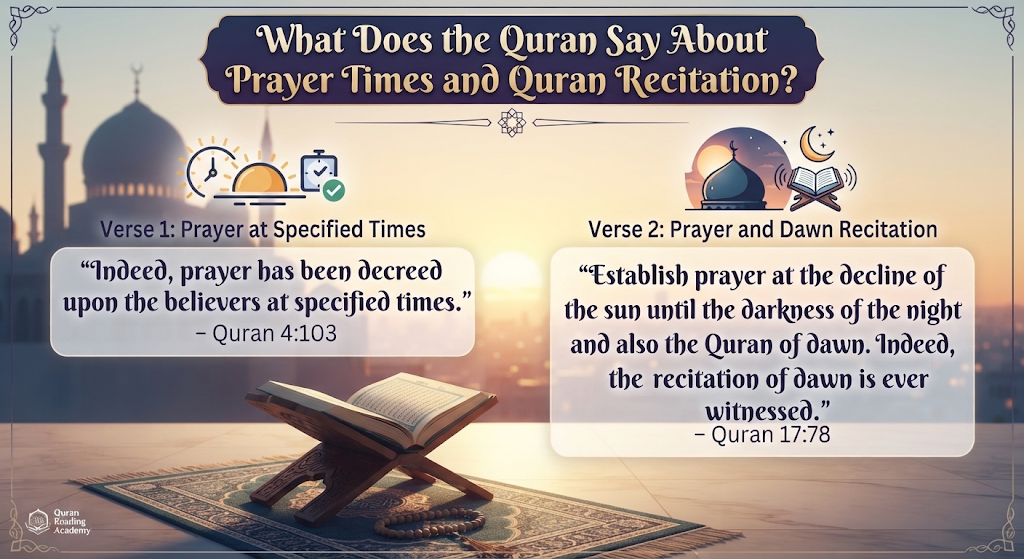
The Quran emphasizes that Salah has prescribed times, which is important when understanding what happens as the day moves from Asr toward Maghrib. Allah says:
Quran 4:103 (Surah An-Nisa) emphasizes that the five daily prayers (Salah) are a mandatory, time-bound obligation in Islam rather than optional or flexible rituals.
إِنَّ الصَّلَاةَ كَانَتْ عَلَى الْمُؤْمِنِينَ كِتَابًا مَوْقُوتًا
“Indeed, prayer has been decreed upon the believers at specified times.”
Core Teachings & Significance
- Mandatory Duty: Salah is a pillar of faith and a direct command from Allah that must be established consistently.
- Fixed Windows: Each of the five daily prayers (Fajr, Dhuhr, Asr, Maghrib, and Isha) has a defined beginning and ending time.
- Promptness in Worship: While praying anywhere within a prayer’s designated window is technically valid, Islamic teaching discourages delaying prayers until the very end of the time slot without a valid reason, as early prayer is most beloved to Allah.
- Mindfulness After Prayer: The first part of the same verse instructs believers to remember Allah continuously, standing, sitting, or lying down, once the formal prayer is completed.
Another relevant verse says:
Surah Al-Isra(Verse 17:78) outlines the schedule for the daily Islamic prayers and highlights the unique value of the dawn recitation.
“Establish prayer at the decline of the sun until the darkness of the night and also the Quran of dawn. Indeed, the recitation of dawn is ever witnessed.”
“أَقِمِ الصَّلَاةَ لِدُلُوكِ الشَّمْسِ إِلَى غَسَقِ اللَّيْلِ وَقُرْآنَ الْفَجْرِ إِنَّ قُرْآنَ الْفَجْرِ كَانَ مَشْهُودًا”
Breakdown of Prayer Times in the Verse
- Decline of the sun to the darkness of the night: Refers to the afternoon, evening, and night prayers, specifically Dhuhr and Asr starting from midday, followed by Maghrib and Isha as night falls.
- The Quran of dawn: Refers explicitly to the Fajr (morning) prayer and its recitation before sunrise.
Significance of the Dawn Recitation
- Witnessed by angels: Islamic tafsir (commentary) explains that the angels of the night shift and the angels of the day shift meet and attend the Fajr prayer together.
- Spiritual transition: It marks the quiet, focused hour separating the darkness of night from the start of the new day
Therefore, when reading Quran before Maghrib, the practical principle is to respect the prescribed time of Salah while continuing to maintain a regular relationship with the Quran. When Maghrib prayer arrives, prioritize the obligatory prayer, then return to Quran recitation afterward.
Is There a Forbidden Time to Read the Quran?
Generally, there is no specific time of day when Quran recitation with Tajweed itself is forbidden in the same way that certain prayers have restricted times. Can You Read Quran Before Maghrib or during the day or at night, after Maghrib, and after Asr?
This means you do not need to stop your Quran reading simply because the sun is approaching sunset. If the period before Maghrib is convenient for you, it can be used for Tilawah, memorization, revision, or reflection.
The important distinction is between reading the Quran and performing Salah. Some rulings concerning prayer are connected to particular times, but these should not automatically be applied to Quran recitation.
For your daily routine, choose a time when you can read with focus and consistency. Can You Read Quran before Maghrib, after Maghrib, after Fajr, or another suitable part of your day? Maintaining a regular connection with the Quran is the priority.
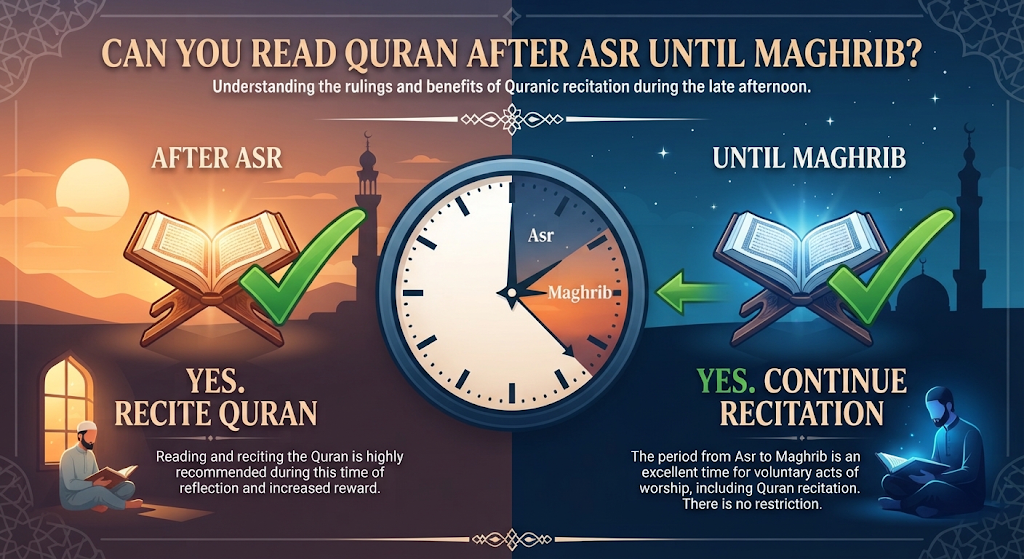
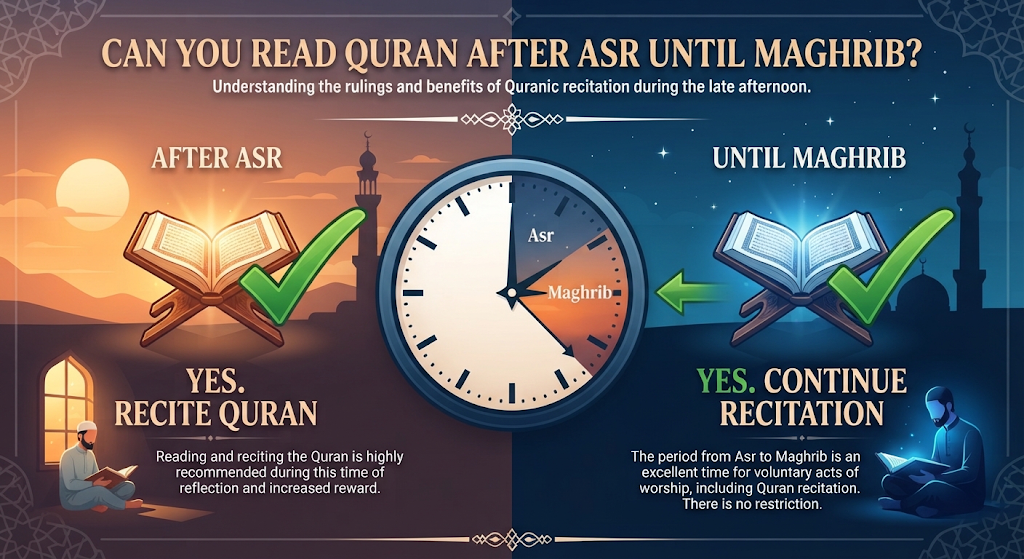
Can You Read Quran After Asr Until Maghrib?
Yes, you can read the Quran after Asr and before Maghrib. This period can be used for Quran recitation, memorization, revision, or listening to the Quran. There is no need to stop your Tilawah simply because sunset is approaching.
What Happens When Maghrib Begins?
The main change is that the Maghrib prayer time has entered. If you are reading the Quran when Maghrib begins, you should pause your recitation and prepare for the obligatory Maghrib Salah, particularly if the prayer is about to be performed in congregation or there is a concern about missing its prescribed time.
After completing Maghrib prayer, you can return to Quran reading. In other words, the transition from Asr to Maghrib does not turn Quran recitation into a forbidden activity. Rather, it marks the beginning of another obligatory prayer that should be given its proper priority.
This distinction makes it easier to plan your routine. Can You Read Quran Before Maghrib? Pause for Salah when its time arrives, and continue your Quran reading afterward if you have more time.
What About Wudu When Reading the Quran?
The guidance about Wudu can differ depending on how you are reading the Quran. If you are handling a physical Mushaf, many scholars hold that a person should have Wudu before touching it. This is the safest approach if you plan to read from a printed Quran before Maghrib.
If you are reciting the Quran from memory, you can recite without Wudu. Wudu is recommended as a state of purity and respect, but it is not a condition for simply reciting verses from memory.
Reading the Quran on a phone or digital device is also different from physically handling a Mushaf. Many scholars do not consider touching the phone screen while reading an app to be the same as touching the physical Mushaf, although maintaining Wudu remains a good practice.
So, if you can read the Quran before Maghrib, consider the method you are using:
- Physical Mushaf: Have Wudu before handling it according to the view of many scholars.
- From memory: You may recite without Wudu.
- Phone or digital device: Wudu is not generally treated the same way as touching a physical Mushaf.
Because scholars differ on some details, especially concerning the physical Mushaf and digital Quran apps, consult a qualified scholar if you need guidance for a specific situation.
Is Before Maghrib a Good Time to Read Quran?
Yes, Can You Read Quran before Maghrib, especially if this period fits naturally into your daily schedule. There is no need to wait for a particular hour to benefit from Quran recitation. What matters most is choosing a time when you can read consistently and with attention.
The time between Asr and Maghrib can work well for a short daily session. You might set a goal of reading a specific number of pages, revising memorized Surahs, or studying the meaning of a few verses before preparing for Maghrib Salah.
If your schedule is busy, even a short session can help you maintain consistency. You could begin with 10–15 minutes before Maghrib and gradually increase the time as your routine becomes established.
The best Quran-reading routine is therefore not necessarily about finding a universally “perfect” time. It is about choosing a practical time that you can maintain regularly and approach with focus and sincerity.
Build a Consistent Quran Reading Routine With Quran Reading Academy
Knowing that you can read the Quran before Maghrib gives you another practical opportunity to make Quran recitation part of your daily routine. The challenge for many learners is not finding a permissible time, but staying consistent and having the right guidance to improve their reading.
See Our Academy in Action
Discover what a typical session looks like! Watch these brief highlights from our live, interactive classes to see how our instructors engage with students of all ages.
At Quran Reading Academy, students can learn Quran online with qualified teachers and follow structured lessons designed around their learning needs. Whether you want to improve your Quran reading, strengthen your Tajweed, memorize Surahs, or help your child develop a regular Quran habit, online lessons can make it easier to maintain a consistent schedule.
You can choose a lesson time that fits naturally around your daily responsibilities, including a convenient period before or after Maghrib. With regular guidance and practice, your Quran journey can become a sustainable part of your routine rather than something you only do when you have extra time.
Ready to make Quran learning a consistent part of your day? Join Quran Reading Academy and start learning with a structured online Quran program designed around your needs.
Start Your Quran Learning Journey Today
Join Quran Reading Academy and begin structured, step-by-step Quran reading with expert guidance.
Try your first class for freeConclusion
So, can you read Quran before Maghrib? Yes. Quran recitation is permissible before Maghrib, including between Asr and sunset. The restrictions that apply to certain prayers should not be confused with a general prohibition on reading the Quran.
You can also continue your Quran reading after Maghrib, making either time a practical opportunity to maintain a consistent habit. The most important thing is to approach the Quran regularly, with proper respect and a commitment to learning and improving.
If you want guidance from qualified teachers and a structured way to stay consistent, Quran Reading Academy can help you make Quran learning a regular part of your daily life. Start your Quran journey today and choose a learning schedule that works for you.
FAQs
Can You Read Quran Before Maghrib?
Yes, you can read quran before Maghrib, including during the period between Asr and sunset. Quran recitation is not generally prohibited simply because Maghrib is approaching.
Can You Read Quran After Asr?
Yes, you can read Quran after Asr and before Maghrib. This can be a convenient time for Tilawah, memorization, revision, or reflection.
Can You Read Quran After Maghrib?
Yes. Quran recitation is permitted after Maghrib, and the evening can be a convenient time to continue your daily Quran routine.
Is There a Forbidden Time to Read Quran?
There is no general forbidden time for Quran recitation comparable to the specific restrictions that apply to certain prayers. However, particular circumstances can have their own rulings, so specific questions should be referred to a qualified scholar.
Can You Read Quran Without Wudu?
If you are reciting Quran from memory, you can recite without Wudu. For a physical Mushaf, many scholars require Wudu before touching it, while reading from a digital device is treated differently by many scholars. When in doubt, following the guidance of a qualified scholar is recommended.
Related Articles
How to read Quran








Leave a Reply