 Quran
Quran
Advanced Quran recitation with Tajweed rules means applying precise articulation, complete elongation systems, letter-merging laws, and rare phonetic rules consistently in every Surah, every session, and every pause.
Reaching this level deepens a reader’s connection to Allah’s words. Each rule refined brings the recitation closer to the authentic prophetic tradition, making every verse cleaner, more resonant, and spiritually alive. These seven steps map the complete path.
These seven steps cover every category a serious student must master before reaching Ijazah-standard recitation. Work through each one in order; precision builds on precision.
Step 1. Deepen Articulation Point Precision
Advancing past foundational Tajweed means moving from knowing where letters originate to controlling exactly how they sound in every context. Articulation refinement at this level is what separates proficient recitation from expert recitation.
Master the Different Degrees of Heavy Letters
Not all seven heavy letters carry equal weight. The gradation runs from Taa (ط) at maximum heaviness, through Daad (ض), Saad (ص), Dhaa (ظ), Qaaf (ق), Ghain (غ), and Khaa (خ) at the lightest.
Advanced students must feel and produce these distinctions instead of applying a single generic heaviness. Taa requires full tongue seal against the palate with maximum back-of-mouth resonance. Qaaf and Ghain are heavier than Khaa but lighter than the top four.
Apply Sifaat Correctly in Different Recitation Contexts
Each Arabic letter carries both permanent Sifaat (inherent characteristics) and conditional ones that surface in certain environments. A practitioner-level detail: the letter Saad (ص) is heavy because it carries both Isti’la (tongue-raising) and Itbaq (tongue-sealing).
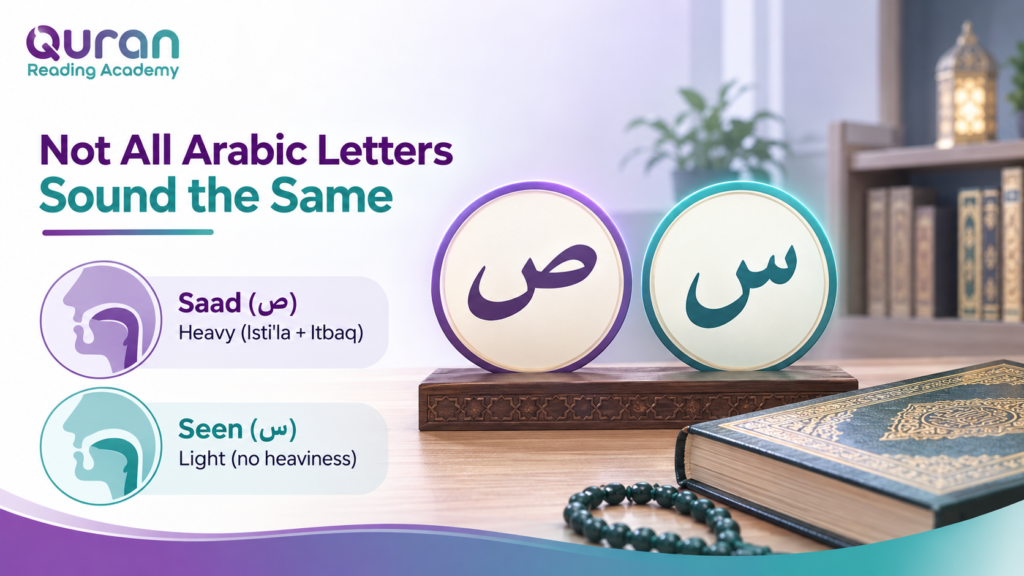
The letter Seen (س) exits from nearly the same position but carries neither. This is why Siraat sounds entirely different from a regular S. Drilling these distinctions makes the difference automatic instead of deliberate.
Read also: Reading the Quran Without Understanding
Step 2. Master Advanced Madd and Elongation Rules
The complete Madd system extends well beyond Natural Madd and Madd Wajib Muttasil. Advanced recitation requires mastering four additional types, each with its own triggering condition and count rule. Four types every advanced student must apply are laid out below:
Apply the Six-Count Madd Lazim Correctly
Madd Lazim is held for exactly six counts. the longest elongation in the entire Tajweed system. It is triggered when a Madd letter is followed by a letter with Shaddah or a permanent Sukoon.
The most recited example in the Quran appears in Al-Fatiha, which every Muslim repeats seventeen times daily in Salah:
وَلَا الضَّآلِّينَ
(Wa lad-daaalleen)
The Alif Madd followed by Shaddah on the Lam triggers Madd Lazim. The six-count hold must be exact. not four, not five, not seven.
Master Madd Arid Lis-Sukoon When Stopping
Madd Arid occurs when a Natural Madd letter sits near the end of a verse and the reciter pauses on it. Unlike Madd Lazim, the count is flexible: two, four, or six counts are all permissible.
The practitioner rule: whichever count a reciter chooses must be consistent throughout a single recitation session. Switching between lengths mid-recitation is considered an error in advanced Tajweed application.
Quran Reading Academy offers a structured path for reciting with these distinctions through the Quran Tajweed Course, where certified teachers correct elongation precision in live sessions.
Join the Quran Tajweed Course and recite with expert-level precision
Step 3. Master Tafkhim and Tarqiq in Quran Recitation
Heavy and light pronunciation rules run through every Surah in the Quran. At the advanced level, the goal is not just identifying which letters are heavy. it is producing the correct degree of heaviness for each letter in each context automatically.
Control the Different Degrees of Heavy Letters
The seven letters of Isti’la are all pronounced with Tafkhim, but they do not always carry the same degree of heaviness.
The table below provides a practical overview of their relative heaviness to help advanced learners refine their pronunciation.
| Letter | Transliteration | Heaviness Level |
| ط | Taa | Maximum |
| ض | Daad | Very High |
| ص | Saad | High |
| ظ | Dhaa | High |
| ق | Qaaf | Medium-High |
| غ | Ghain | Medium |
| خ | Khaa | Lower |
Recognizing this hierarchy develops the ear to hear and the tongue to produce subtle gradations that distinguish expert recitation.
See Our Academy in Action
Discover what a typical session looks like! Watch these brief highlights from our live, interactive classes to see how our instructors engage with students of all ages.
Start Your Quran Learning Journey Today
Join Quran Reading Academy and begin structured, step-by-step Quran reading with expert guidance.
Try your first class for freeApply the Heavy and Light Rules of Ra and Lam Al-Jalalah
Two letters require special mastery because they are neither permanently heavy nor permanently light. Ra (ر) is heavy in most contexts but light when: it carries a Kasra vowel, or when it carries Sukoon preceded by Kasra, or at a pause following a Kasra or Ya with Sukoon.
Lam Al-Jalalah in the word Allah (الله) is heavy when preceded by Fatha or Damma, and light when preceded by Kasra. This occurs dozens of times in the Quran:
بِسْمِ اللَّهِ الرَّحْمَٰنِ الرَّحِيمِ
(Bismillāhi ar-Raḥmāni ar-Raḥīm)
“In the name of Allah, the Most Gracious, the Most Merciful.”
In Bismillah, the Meem before Allah carries Kasra. so the Lam is light. In ‘Abdullah (عَبْدُ اللَّهِ), the Damma preceding Allah makes the Lam heavy.
Read Also: Quran Reading Plan for Beginners
Step 4. Master Advanced Idgham and Letter Merging Rules
The Idgham categories taught at beginner level cover Noon Sakinah and Tanween. Advanced recitation adds three distinct letter-merging types that appear throughout extended Quran reading. These rules activate whenever specific adjacent letter combinations occur.
Apply Idgham Al-Mutamatilain Between Identical Letters
When two identical letters appear adjacent and the first carries Sukoon, the first fully merges into the second. The result is a doubled letter with Shaddah. one strengthened consonant where two existed.
اضْرِب بِّعَصَاكَ الْحَجَرَ
(Iḍrib bi-‘aṣāka al-ḥajara)
The Ba with Sukoon in Iḍrib merges into the Ba that opens Bi’asaka. The two Ba letters become one doubled Ba with Shaddah. a complete merger.
Distinguish Idgham Al-Mutajanisain and Al-Mutaqaribain
Idgham Al-Mutajanisain merges two letters that share the same Makhraj but differ in Sifaat. A common example is the Taa (ت) with Sukoon merging into Taa (ط):
وَقَالَت طَّائِفَةٌ
(Wa qālat ṭā’ifatun)
The Taa with Sukoon merges into the Taa because they share the same articulation point. Idgham Al-Mutaqaribain merges letters with close but not identical points. the most common being Lam (ل) into Ra (ر).
Quran Reading Academy’s Quran Recitation Course trains students to apply all Idgham types naturally during extended Quran reading, not just in isolated drill exercises.
Enroll in the Quran Recitation Course and build fluent, rule-accurate recitation
Step 5. Master Sakt and Advanced Waqf Techniques
Beyond full stops and continuation, advanced recitation includes techniques for managing specific pauses in the Hafs ‘an ‘Asim narration. These rules are rare but obligatory when they appear. Mastering them signals a student’s readiness for Ijazah-level examination.
Learn the Four Sakt Positions in Hafs Recitation
Sakt is a brief, breathless pause. the sound is momentarily cut without the reciter taking a breath, and recitation resumes immediately. There are exactly four obligatory Sakt positions in the Hafs narration: Al-Kahf (18:1-2), Ya-Sin (36:52), Al-Qiyamah (75:27), and Al-Mutaffifin (83:14).
وَلَمْ يَجْعَل لَّهُ عِوَجًا ۜ قَيِّمًا
(Wa lam yaj’al lahu ‘iwajan. qayyimā)
“And has not made for it any deviance. [He has made it] straight.”
The brief, breathless pause falls on ‘iwajan before qayyimā. It is mandatory in the Hafs narration. not optional.
Apply Ar-Rawm and Al-Ishmam When Stopping
Ar-Rawm is the pronunciation of only a portion of the final vowel when stopping on a word. The sound is so soft it should only reach someone extremely close to the reciter.
Al-Ishmam is a purely visual cue. the lips circle as if to pronounce Dammah immediately after the final letter lands with Sukoon, indicating the original vowel.
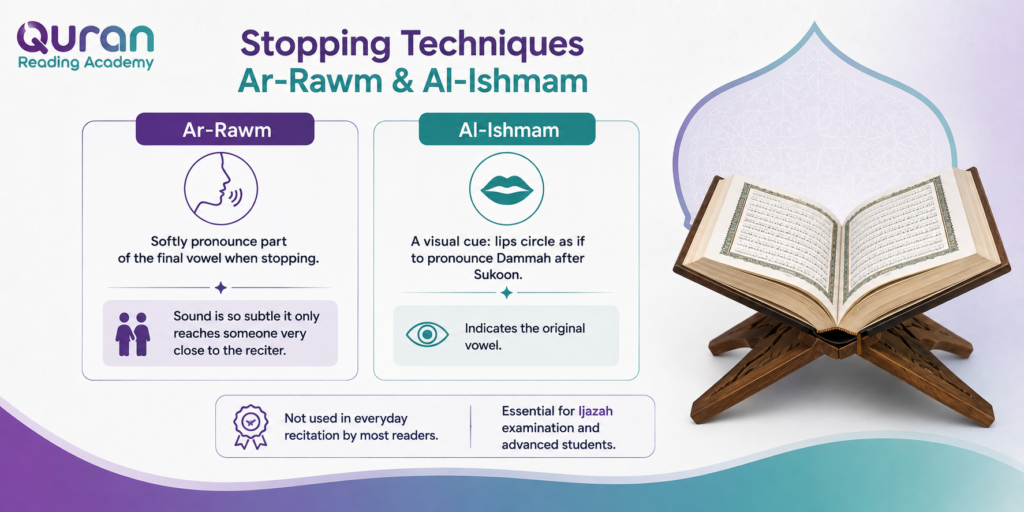
Neither technique is used in everyday recitation by most readers. Both are essential for Ijazah examination and for teaching advanced students.
Read Also: Benefits of Reading Quran
Step 6. Master Special Recitation Rules in Hafs
The Hafs ‘an ‘Asim narration contains a small number of unique words recited in ways that do not follow the standard rules.
These cases are entirely memorized. they cannot be derived from general principles. Advanced students must know each one by location, sound, and reason.
Learn the Unique Rules of Al-Imalah and At-Tashil
Al-Imalah is the “leaning” of a Fatha sound toward a Kasra. In the entire Quran under the Hafs narration, it occurs exactly once. on the word (مَجْر۪يهَا) in Surah Hud:
بِسْمِ اللَّهِ مَجْر۪يهَا وَمُرْسَاهَا
(Bismillāhi majrēhā wa mursāhā)
At-Tashil is the “facilitation” of a Hamzah. pronouncing it with a sound between a pure Hamzah and its corresponding Madd letter. This occurs only once in Hafs, on the word (ءَا۬عْجَمِيٌّ) in Surah Fussilat (41:44).
Apply Madd Al-Farq in Quranic Questions
Madd Al-Farq is a six-count elongation triggered when a Hamzah of questioning (hamzatul istifham) precedes a word beginning with Hamzatul Wasl. The elongation differentiates the verse as a question instead of a statement.
قُلْ آلذَّكَرَيْنِ حَرَّمَ أَمِ الْأُنثَيَيْنِ
(Qul āl-dhakarayni ḥarrama ami al-unthayayn)
“Say, ‘Is it the two males He has forbidden or the two females?'”
The elongation on (آلذَّكَرَيْنِ) signals a question. Without it, the verse would read as a statement. a meaning-altering error.
For students ready to practice these advanced cases with live correction, Quran Reading Academy’s Online Quran Qirat Classes cover narration-specific rules across multiple Qiraat styles under certified teachers.
Join the Online Quran Qirat Classes and master narration-specific recitation rules
Step 7. Pursue Ijazah Certification in Recitation
Every advanced Tajweed rule in this guide feeds directly into one goal: an Ijazah. This certification is the highest validation in Quranic recitation. and it requires every rule, from the most basic to the most advanced, to be applied perfectly under examination.
Understand Ijazah and the Chain of Transmission
An Ijazah is a formal certification issued by a qualified teacher whose chain of transmission (Sanad) connects. without interruption. back to the Prophet Muhammad (peace be upon him). It confirms that a student’s recitation is accurate and that they are authorized to teach others.
Earning an Ijazah requires reciting the entire Quran from memory to a certified teacher. Every Sakt position, every Imalah occurrence, every Madd Lazim count. all are verified.
Read Also: How to Get Better at Reading Quran?
Prepare for Ijazah Through Consistent Advanced Recitation
The expert approach to Ijazah preparation is recording and reviewing recitation regularly with a certified teacher. Most errors that appear in Ijazah examination are not new mistakes. they are deeply embedded habits from years of unmonitored practice.
Advanced students preparing for Ijazah should recite extended portions, not isolated verses. The examination environment requires consistent rule application across full Surahs and Juz, not just short drill passages.
Inside Our Live Classroom
We believe in complete transparency. Take a look inside our virtual classrooms to experience our premium teaching tools and engaging learning environment firsthand.
Start Your Quran Learning Journey Today
Join Quran Reading Academy and begin structured, step-by-step Quran reading with expert guidance.
Try your first class for freeAdvance Your Quran Recitation With Quran Reading Academy
Reciting the Quran with the level of precision this guide describes cannot be achieved alone. It requires a certified teacher, live correction, and consistent structured practice. Quran Reading Academy connects students with qualified Quran educators who guide advanced recitation from proficient to Ijazah-ready.
The Quran Hifz Course combines advanced rule application with structured memorization. ensuring every verse committed to memory is also recited with complete Tajweed accuracy, not just fluency.
Enroll in the Quran Hifz Course and memorize with rule-perfect recitation
Start Your Free Trial at Quran Reading Academy
Advanced Quran recitation requires a qualified teacher to hear what the student cannot hear alone. Every subtle elongation count, every Ra rule, every Sakt position. these require live oral feedback that no guide or recording can replace.
Quran Reading Academy offers a free trial session for students at every level. including advanced learners refining their recitation toward Ijazah preparation. Qualified teachers are available for one-on-one sessions with flexible scheduling.
Our Quran Courses
- Quran Reading Classes
- Quran Reading Classes for Kids
- Quran Reading Classes for Adults
- Quran Reading Classes for Female/Sisters
- Quran Reading Classes for New Muslims
- Quran Reading Course for Beginners
- Online Quran Reading Course with Tajweed
- Reading and Memorizing the Quran Course
- Noorani Qaida Course
- Quran Course for Beginners
- Quran Tajweed Course
- Quran Recitation Course
- Quran Hifz Course
- Online Quran Qirat Classes
Book your free trial session today → Start Free Trial
Conclusion
Advanced Quran recitation with Tajweed rules is built across seven areas of deepening precision: articulation refinement, complete Madd application, heavy and light letter gradation, advanced Idgham, Sakt and stopping techniques, Hafs narration special cases, and Ijazah preparation.
Each step tightens the recitation. Each rule mastered brings the voice closer to the prophetic tradition. The path ends not with a technique but with a chain. an Ijazah that connects the student’s voice to the voice of the Prophet (peace be upon him) through an unbroken line of scholars.
Frequently Asked Questions
What makes recitation “advanced” in Tajweed study?
Advanced recitation means applying the complete Madd system, all 17 Sifaat Al-Huruf, Ra and Lam Al-Jalalah variable rules, Waqf categories, Hamzah rules, and advanced Idgham types consistently. not just knowing them in isolation.
How long does it take to reach advanced Tajweed recitation level?
Most students who complete foundational Tajweed and study advanced rules two to three times weekly reach practical mastery in six to twelve months. Full fluency, where all rules apply automatically in extended recitation, typically develops over twelve to eighteen months of guided study.
Are advanced Tajweed rules required for daily Salah?
The seven foundational rules cover correct Salah recitation. Advanced Quran recitation with Tajweed rules becomes essential when reading longer portions of the Quran, leading congregational prayer, teaching, or preparing for Ijazah certification.
What is the hardest advanced Tajweed rule to apply correctly?
Madd Arid Lis-Sukoon is considered among the most nuanced because it gives the reciter a choice of length. two, four, or six counts. that must then remain consistent. Ra rules are equally challenging because they switch based on surrounding vowels, making automatic application difficult without extensive practice.
Can I prepare for Ijazah without a certified teacher?
No. Ijazah requires reciting the entire Quran to a teacher who holds their own Ijazah. The examination verifies live recitation. not recorded sessions or self-assessment. A certified teacher is not optional for Ijazah preparation; it is the process itself.





Leave a Reply