 How to read Quran
Many people ask the same question the moment they start reciting: what’s the point of reading Quran without understanding a single word? Some assume it’s meaningless. Others swing to the opposite extreme and refuse to open the Mus-haf until they’ve mastered Arabic first. Neither position reflects what Islamic scholarship actually teaches.
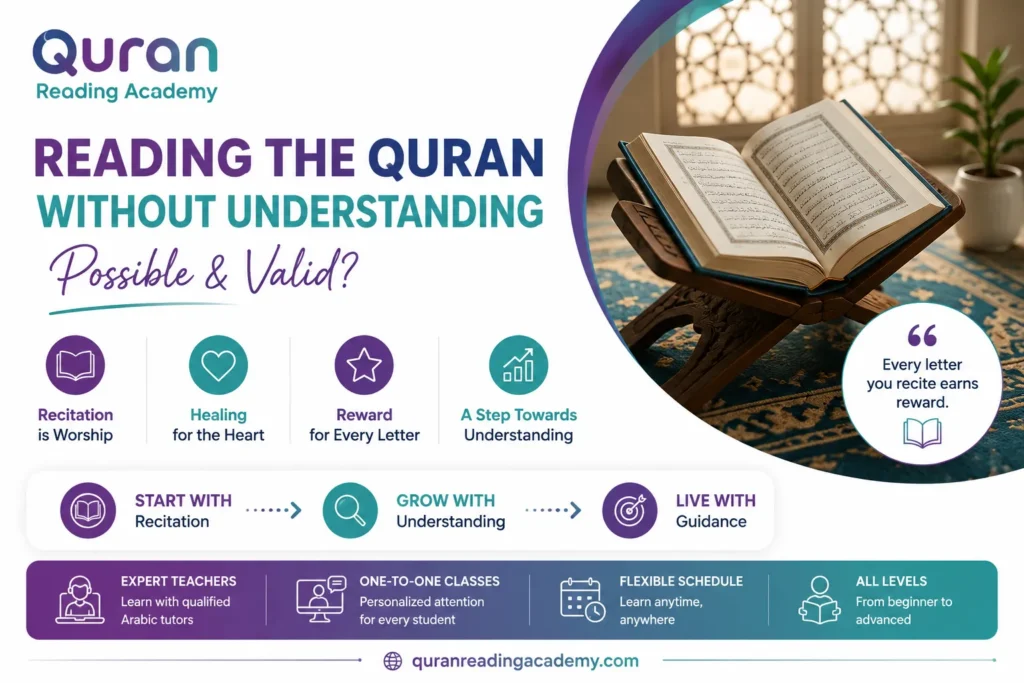
Reading Quran without understanding is valid, rewarded, and recommended as a starting point, but it isn’t meant to be the finish line. The Quran has two dimensions working together: the spiritual act of recitation itself, and the intellectual work of grasping its meaning. Treating them as competing choices misses how they were designed to function.
At Quran Reading Academy, this question comes up constantly from students who are just beginning their journey with the Quran. This article walks through what the evidence says, what scholars have ruled, and how to move from bare recitation toward genuine comprehension without stalling in the process.
What you’ll learn in this article
- Whether recitation without comprehension actually earns reward, according to the Quran and Hadith
- What the benefits of reciting Quran without understanding actually are, and where those benefits stop
- Why understanding still matters, and what scholars like Ibn Baz and Ibn Uthaymin said about it
- A practical way to move from recitation to reflection without becoming overwhelmed
- Common mistakes new reciters make when they try to skip straight to meaning
Is Reading the Quran Without Understanding Still Valid?
Islamic scholarship treats recitation as worship in its own right, independent of comprehension. The Prophet ﷺ said:
“[Whoever recites a letter] from Allah’s Book, then he receives the reward from it, and the reward of ten the like of it.I do not say that Alif Lam Mim is a letter, but Alif is a letter, Lam is a letter and Mim is a letter” [Tirmidhi].
The letters Alif Lam Mim carry a meaning known only to Allah, yet the Prophet ﷺ promised reward for reciting them anyway. That single hadith settles the core question: reward is tied to the act of recitation itself, not solely to comprehension of it.
Each letter recited from the Quran earns a stated reward, multiplied tenfold, regardless of whether the reciter has studied its meaning. This is why Muslims are encouraged to recite daily even during periods, like Ramadan, when they may be reading faster than they can reflect.
Why Do Scholars Confirm Recitation Alone Counts as Worship?
Shaykh Ibn Uthaymin was asked directly whether a person is rewarded for reading Quran without understanding its meanings.
He answered that a person “is enjoined to read it, whether he understands its meanings or not,” while adding that a believer who wants to act on the Quran should not stop at recitation alone. His answer holds both truths at once: recitation is valid worship, and understanding is still the goal a serious reader should work toward.
Quran Reading Academy builds its Quran reading classes around this same principle: correct recitation comes first, comprehension is layered in as the student progresses, so no one is stuck choosing between the two.
Read Also: How to Learn Quran Reading with Tajweed?
See Our Academy in Action
Discover what a typical session looks like! Watch these brief highlights from our live, interactive classes to see how our instructors engage with students of all ages.
Start Your Quran Learning Journey Today
Join Quran Reading Academy and begin structured, step-by-step Quran reading with expert guidance.
Try your first class for freeThe Benefits of Reciting Quran Without Understanding
The Quran is described as a healing for the heart independent of whether the reader grasps its meaning in the moment. Allah says:
“There has come to you instruction from your Lord and healing for what is in the breasts and guidance and mercy for the believers” [10:57]. The healing referenced here is attached to the recitation and hearing of the Quran, not gated behind fluency in Arabic.
Read also: How To Complete The Quran In 3 Days? (Plus 4 Day And 5 Day Khatm Plans)
1. Spiritual Steadiness Through Regular Recitation
Reciting even without full comprehension keeps a person in regular contact with revelation, which scholars describe as a source of guidance and calm distinct from academic study. The Prophet ﷺ said:
“Beware, in the body there is a piece of flesh; if it is sound, the whole body is sound and if it is corrupt the whole body is corrupt, and hearken it is the heart” [Sahih Muslim].
Consistent recitation is one of the practices scholars link to keeping that heart sound.
2. Building a Habit That Comprehension Can Later Attach To
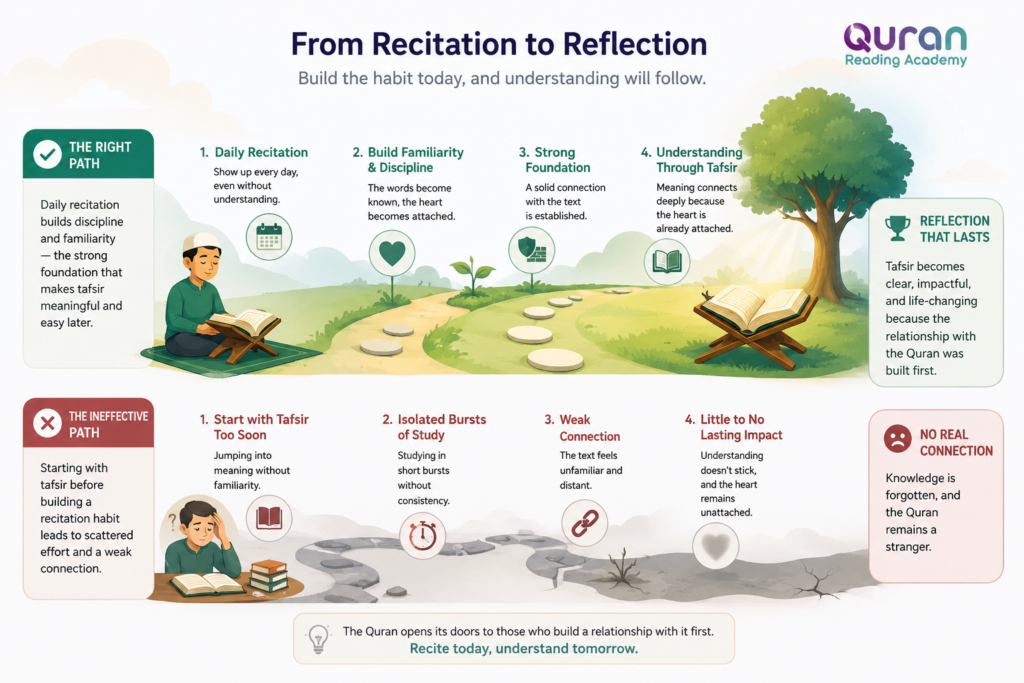
A reciter who reads daily, even without understanding, is building the discipline and familiarity with the text that makes tafsir study far easier later.
Trying to start with tafsir before any recitation habit exists usually produces the opposite result: students study meaning in isolated bursts and never build a relationship with the text itself.
Why Does Understanding the Quran Still Matters?
The Quran repeatedly states that it was revealed for a purpose beyond recitation: comprehension and reflection. Allah says:
“Indeed, We have sent it down as an Arabic Qur’an that you might understand” [12:2].
The verse ties the Arabic revelation directly to the goal of understanding, not simply reciting.
Allah describes the Quran as the Furqan, the distinguisher between right and wrong. A reader cannot apply that distinction to daily decisions without grasping what the verses actually instruct. Allah warns:
“Do they not then reflect upon the Qur’an, or are their hearts locked up?” [Muhammad 47:24], framing the absence of reflection as a spiritual deficiency, not a neutral state.
Read also: How To Read the Quran In 2 Weeks? A Complete Daily Plan
What Happens When Recitation Stays Surface-Level?
Ibn Uthaymin illustrated this with a comparison to studying medicine: a student who reads medical textbooks without understanding them cannot apply that knowledge, no matter how many pages they’ve covered.
He noted that the Companions “would not move on from ten verses until they had learned them and learned the knowledge they contained and how to act upon it,” treating recitation, knowledge, and action as one connected process rather than separate stages.
This is precisely where structured study helps. Adults returning to the Quran later in life,new Muslims building their foundation from scratch, and women learning in a dedicated class setting all benefit from a guided path rather than trying to piece meaning together alone.
How to Move From Recitation to Reflection?
Scholars consistently recommend a layered approach rather than an all-or-nothing switch. Shaykh As-Sa’di explained that the Quranic instruction to “listen to it, and be silent” [Al-A’raf 7:204] involves two connected steps: outward silence, and an inward listening that ponders meaning. Neither step is meant to wait for the other to be perfected first.
Read also: How To Read the Quran In 2 Months? A Complete 60-Day Plan
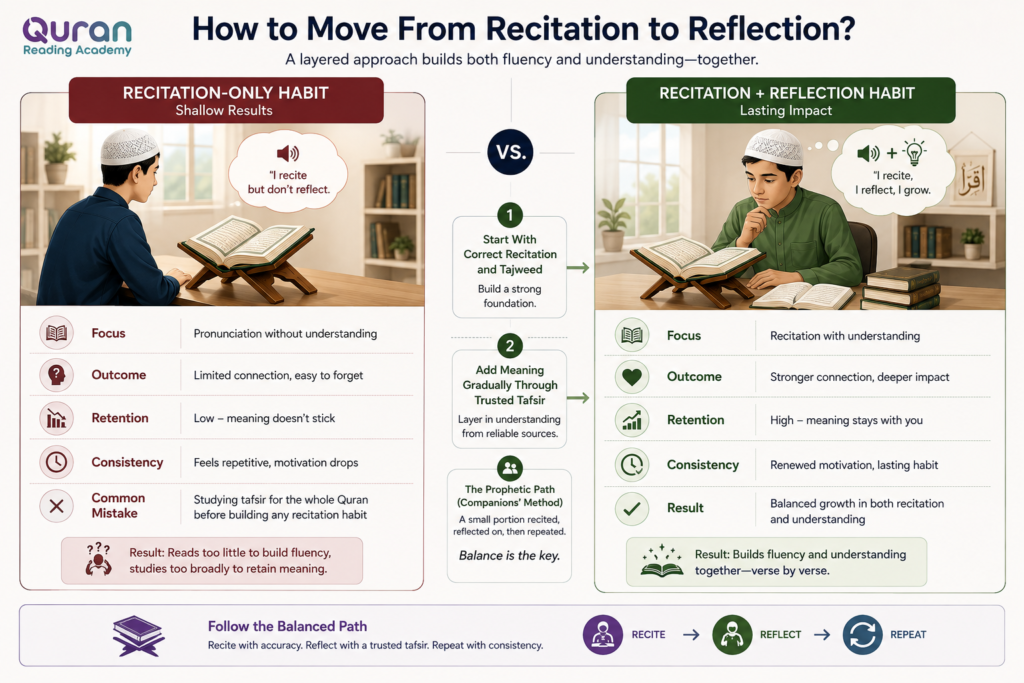
1.Start With Correct Recitation and Tajweed
Accurate pronunciation and tajweed rules come first, because reciting the Quran incorrectly can distort meaning even for words the reader does understand. This is the stage where a structured Quran reading course for beginners makes the biggest difference, since correcting pronunciation habits early prevents them from becoming permanent.
2. Add Meaning Gradually Through Trusted Tafsir
Once recitation is stable, layer in meaning using recognized tafsir sources rather than informal explanations. Reliable options include Tafsir Ibn Kathir, Tafsir At-Tabari, and Tafsir al-Muyassar, all of which draw on reports from the Companions and the generation after them rather than personal opinion.
The Common Mistake New Reciters Make
A frequent error is attempting to study tafsir for the entire Quran before building any recitation habit at all. This usually produces neither outcome: the reciter reads too little to build fluency, and studies too broadly to retain the meaning.
The more workable pattern is the one the Companions used, a small portion recited, then reflected on, then repeated, rather than either extreme on its own.
Read Also: How to Make Reading Quran More Interesting?
Inside Our Live Classroom
We believe in complete transparency. Take a look inside our virtual classrooms to experience our premium teaching tools and engaging learning environment firsthand.
Start Your Quran Learning Journey Today
Join Quran Reading Academy and begin structured, step-by-step Quran reading with expert guidance.
Try your first class for freeStart Learning To Recite And Understand The Quran Today
You don’t have to choose between reciting and understanding, and you don’t have to figure out the right order on your own.
A structured class with a qualified instructor builds both together, at a pace suited to your starting point, whether you’re a complete beginner, a parent enrolling your children, or a new Muslim taking your first steps with the Quran.
Book a class with Quran Reading Academy and start building a recitation habit that grows into real understanding, verse by verse.
Our Quran Courses:
- Quran Reading Classes
- Quran Reading Classes for Kids
- Quran Reading Classes for Adults
- Quran Reading Classes for Female/Sisters
- Quran Reading Classes for New Muslims
- Quran Reading Course for Beginners
- Online Quran Reading Course with Tajweed
- Reading and Memorizing the Quran Course
- Noorani Qaida Course
- Quran Course for Beginners
- Quran Tajweed Course
- Quran Recitation Course
- Quran Hifz Course
- Online Quran Qirat Classes
- Quranic Arabic Course
- Arabic Reading Practice Course
Start Your Quran Learning Journey Today
Join Quran Reading Academy and begin structured, step-by-step Quran reading with expert guidance.
Try your first class for freeConclusion
Reading Quran without understanding is not a lesser or invalid form of worship. The Prophet ﷺ promised reward for every letter recited, and scholars from Ibn Uthaymin to Ibn Baz have confirmed that recitation alone counts, even for someone with no knowledge of Arabic yet.
At the same time, the Quran was revealed to be understood and acted upon, not only recited, which is why every scholar who addressed this question paired the reward for recitation with an encouragement to keep learning its meaning.
The healthiest approach treats recitation as the entry point and reflection as the ongoing destination, exactly the model Quran Reading Classes is built around for learners at any stage.
Frequently Asked Questions
These are the questions students ask most often once they understand that recitation alone is valid but not meant to be the whole picture.
1. Will I be rewarded for reading Quran without understanding it?
Yes, a person is rewarded for reciting the Quran whether or not they understand its meaning, based on the hadith promising ten rewards for every letter recited. Scholars add that this reward should motivate further study of tafsir, not replace it.
2. Is it a sin to read Quran without knowing Arabic?
No, reading Quran without knowing Arabic is not sinful. It is, however, considered incomplete on its own, since the Quran instructs readers to reflect on its verses in addition to reciting them.
3. What are the benefits of reciting Quran without understanding?
The benefits of reciting Quran without understanding include the stated reward for every letter recited, the spiritual healing described in verses like [10:57], and building the recitation habit needed before deeper study becomes manageable.
4. Should I stop reciting until I learn tafsir first?
No, scholars recommend the opposite order. Build a steady recitation habit first, then add tafsir gradually, since trying to master meaning before establishing recitation usually stalls both.
5. How can I start understanding the Quran if I don’t speak Arabic?
Begin with trusted tafsir translations such as Tafsir Ibn Kathir or Tafsir al-Muyassar alongside your recitation, and consider structured classes that build recitation and comprehension together rather than treating them as separate projects.
Related Articles
How to read Quran



Leave a Reply