 Quran Reading Plans
A three-day Quran completion, or khatm, means reciting all 604 pages of the standard Mushaf across three days — roughly 201 pages, or 10 Juz’, every single day. It’s one of the most demanding recitation schedules in Islamic practice, and it only works with the right daily structure, honest self-assessment of your fluency, and a plan for maintaining Tajweed under time pressure.
At Quran Reading Academy, we’ve watched students attempt this pace both successfully and unsuccessfully, and the difference almost always comes down to preparation, not motivation.
This guide walks through the exact page targets for how to complete the Quran in 3 days, what Islamic scholarship says about this pace, and two slower alternatives — reading the Quran in 4 days and in 5 days — for reciters who need more breathing room without losing momentum.
How To Complete The Quran In 3 Days?
To complete the Quran in 3 days, you need to recite about 201 pages daily — 604 pages divided by 3 — which equals 10 Juz’ per day. Each Juz’ averages 20 pages, so the math has to be exact before you start, or the schedule collapses by Day 2.
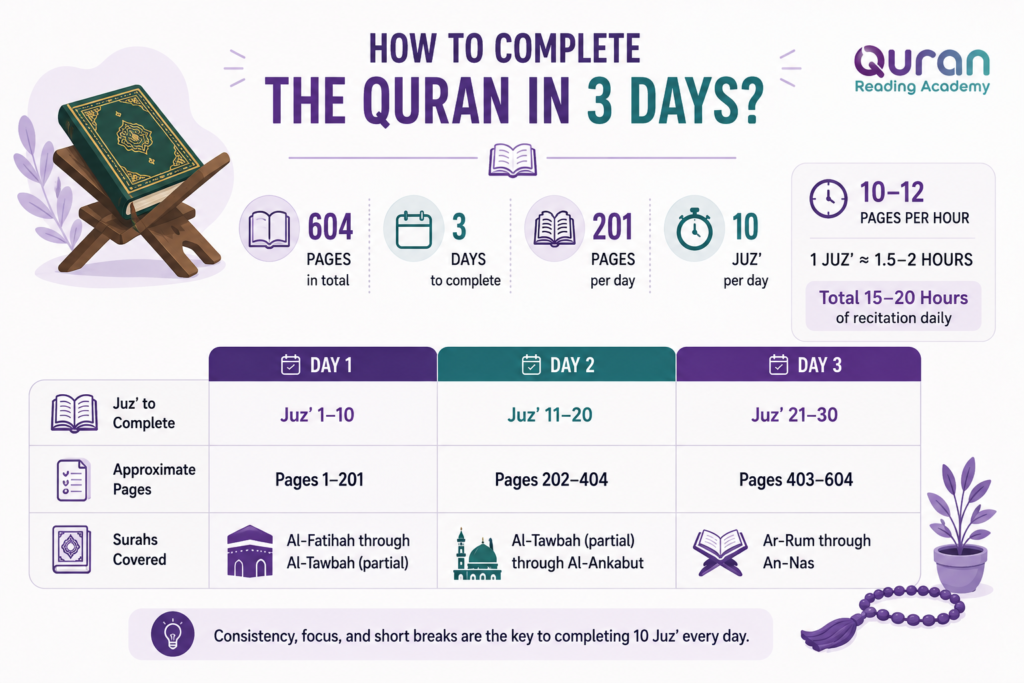
At a moderate recitation speed of 10–12 pages per hour, one Juz’ takes roughly 1.5 to 2 hours. Ten Juz’ per day therefore requires 15–20 total hours of recitation, spread across multiple sessions rather than one continuous sitting.
| Day | Juz’ to Complete | Approximate Pages | Surahs Covered |
| Day 1 | Juz’ 1–10 | Pages 1–201 | Al-Fatihah through Al-Tawbah (partial) |
| Day 2 | Juz’ 11–20 | Pages 202–404 | Al-Tawbah (partial) through Al-Ankabut |
| Day 3 | Juz’ 21–30 | Pages 403–604 | Ar-Rum through An-Nas |
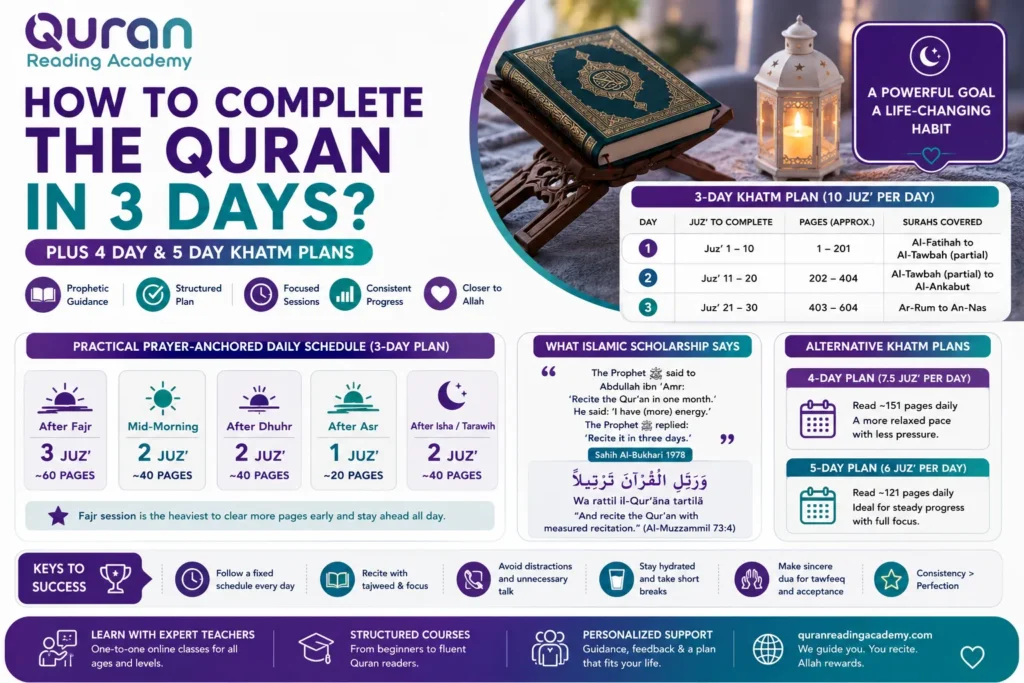
Splitting each day into five sessions anchored to prayer times keeps the pace sustainable. At Quran Reading Academy, students working through our Quran Reading Course for Beginners build this pacing skill long before attempting an intensive khatm — reciting fast without dropping accuracy is a trained ability, not a starting point.
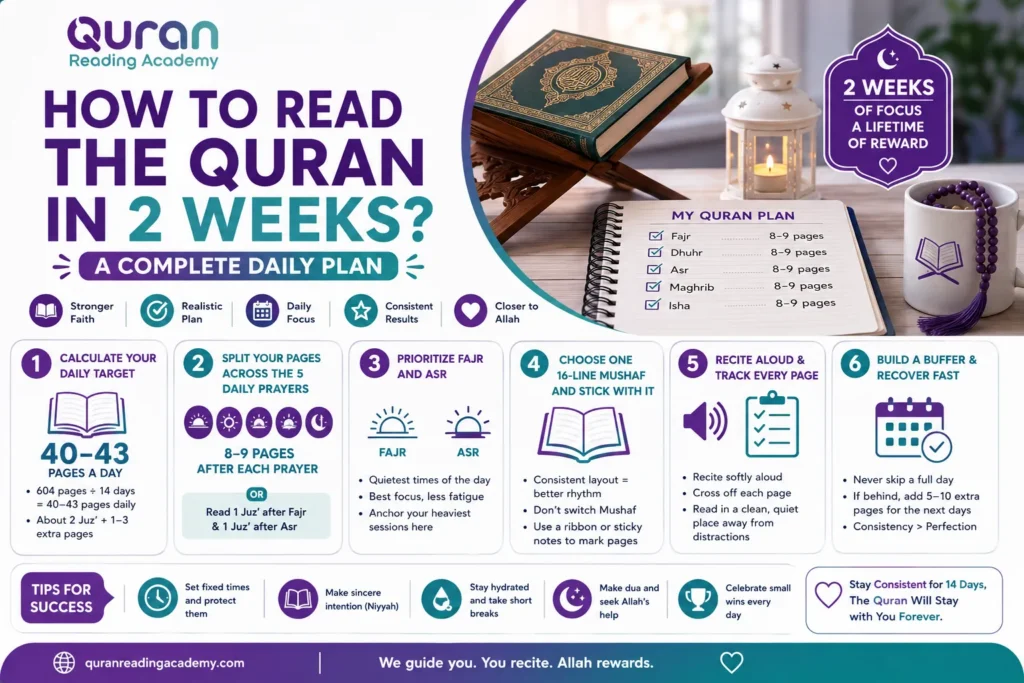
Read also: How To Read the Quran In 2 Weeks? A Complete Daily Plan
What Does a Practical Prayer-Anchored Schedule Look Like?
The most practical schedule distributes recitation across the five daily prayers, giving each session a fixed anchor point in your day. This prevents the mid-afternoon pile-up where hours of unread pages accumulate.
| Session | Timing | Target | Approx. Pages |
| Fajr Session | After Fajr prayer | 3 Juz’ | ~60 pages |
| Morning Session | Mid-morning | 2 Juz’ | ~40 pages |
| Dhuhr Session | After Dhuhr prayer | 2 Juz’ | ~40 pages |
| Asr Session | After Asr prayer | 1 Juz’ | ~20 pages |
| Isha Session | After Isha / Tarawih | 2 Juz’ | ~40 pages |
The Fajr session deliberately carries the heaviest load. Focus is sharpest right after Fajr, and clearing 3 Juz’ early removes pressure from the rest of the day.
Students who instead push heavy recitation to after Maghrib, without building up to it earlier in their day, tend to lose recitation quality by the second Juz’ of that block — the Fajr-heavy structure exists specifically to prevent that drop-off.
Read also: How To Read the Quran In 2 Months? A Complete 60-Day Plan
What Does Islamic Scholarship Say About Reciting The Quran In 3 Days?
Islamic scholarship treats three days as the minimum recommended period for a full Quran recitation, based on direct guidance from the Prophet ﷺ.
When Abdullah ibn ‘Amr told the Prophet ﷺ he had the energy to recite faster than one month, the Prophet ﷺ told him to recite it in three days — establishing this as the floor, not a suggestion to go lower.
‘Abd Allah b. ‘Amr reported that the Messenger of Allah (ﷺ) said to him: “Recite the Qur’an in one month.” He said: “I have (more) energy.” The Prophet ﷺ replied: “Recite it in three days.” This exchange is recorded in Sahih Al-Bukhari.
Is the reference point almost every scholar returns to when explaining how to complete the Quran in 3 days without violating the spirit of the practice.
The reasoning isn’t arbitrary. Reciting faster than this risks losing comprehension, correct articulation, and presence of heart — the qualities that give recitation its spiritual weight. This concern connects directly to a Quranic instruction on how recitation itself should sound:
وَرَتِّلِ ٱلْقُرْءَانَ تَرْتِيلًا
Wa rattil il-Qur’āna tartīlā
“And recite the Qur’an with measured recitation.” (Al-Muzzammil 73:4)
Tartīl here means precise, deliberate articulation — not slowness for its own sake, but clarity held together with presence of mind. A 3-day khatm sits right at the edge of permissible speed while still honoring this instruction, which is exactly why readiness matters so much before attempting it.
Is Completing The Quran In 3 Days Right For You?
Attempting a 3-day khatm without the right foundation produces rushed, error-laden recitation that works against the purpose of the act itself. This pace suits reciters who already read fluently, apply Tajweed rules without pausing to think, and have completed at least one full khatm previously.
Readiness Levels And Which One Matches You
Be honest rather than optimistic here — the table below maps four recitation levels to the schedule each one can realistically sustain, and misjudging your own level is the single biggest reason attempts at how to complete the Quran in 3 days break down by Day 2.
| Readiness Level | Description | Recommended Approach |
| Beginner | Still learning letter pronunciation and basic rules | Build fluency first; target a 30-day khatm |
| Intermediate | Fluent recitation with occasional rule errors | Attempt a 7-day khatm before trying 3 days |
| Advanced | Strong Tajweed, completed multiple khatm | A 3-day schedule is appropriate |
| Hafiz / Near-Hafiz | Memorized portions, strong recitation speed | Ideal candidate for 3-day completion |
If you recognize yourself as a beginner or intermediate reciter, that’s not a setback — it’s useful information. The Online Quran Memorization Course at Quran Reading Academy pairs students with a certified tutor who builds recitation fluency systematically, which is the exact foundation an intensive khatm demands.
New Muslims in particular benefit from this structured path — our Quran Reading Classes for New Muslims start from letter recognition and build toward the fluency a 3-day schedule requires, rather than assuming it.
Read also: How To Complete the Quran In 7 Days? A Structured Daily Plan
See Our Academy in Action
Discover what a typical session looks like! Watch these brief highlights from our live, interactive classes to see how our instructors engage with students of all ages.
How Do You Read the Quran in 4 Days?
Reading the Quran in 4 days sits between the 3-day and 5-day schedules, requiring about 151 pages daily — 604 pages divided by 4 — or roughly 7.5 Juz’ per day. This pace suits reciters who want a faster completion than 5 days but aren’t yet ready for the intensity of a 3-day khatm.
A practical way to structure it: split each day’s 7.5 Juz’ across five prayer-anchored sessions of roughly 30 pages each, the same session length used in the 5-day plan, just with one extra session added to the day.
This keeps individual sessions manageable while still compressing the total timeline. Because the daily target sits closer to the 3-day pace than the 5-day one, the same fluency benchmarks from the readiness table above apply — an intermediate reciter should still build up through a 7-day khatm first before trying 4 days.
How Do You Read The Quran In 5 Days Instead?
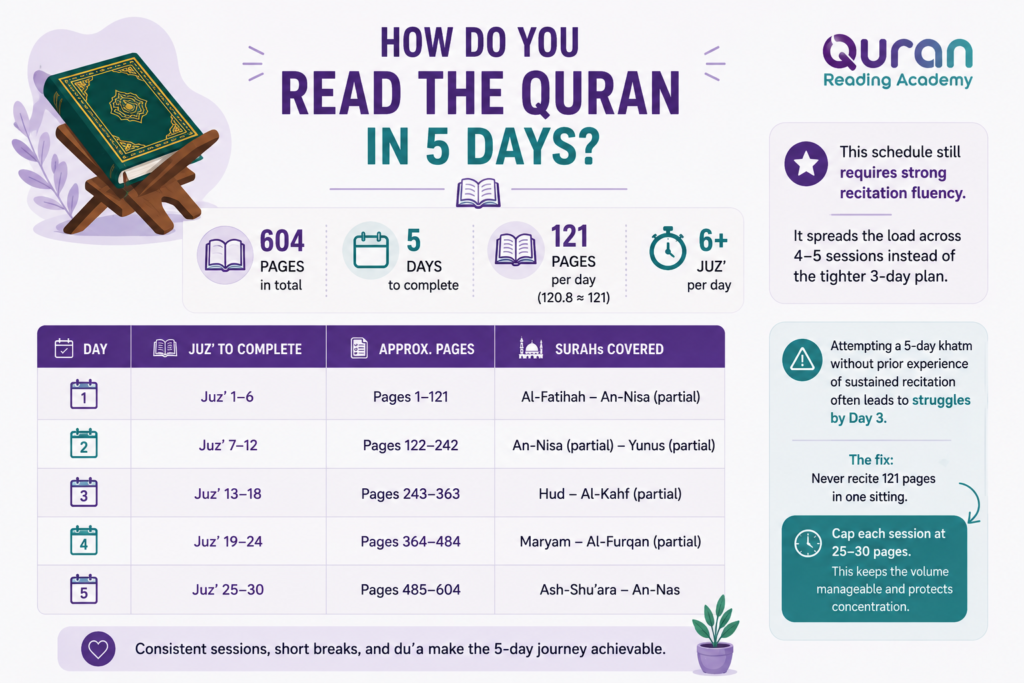
Reading the Quran in 5 days requires reciting about 121 pages daily — 604 pages divided by 5 equals 120.8 pages — which works out to just over 6 Juz’ per day.
This schedule still demands strong recitation fluency, but it spreads the load across four to five sessions instead of the tighter 3-day structure.
Students who attempt a 5-day khatm without prior experience of sustained recitation often struggle by Day 3. The fix is never reciting 121 pages in one sitting — capping each session at 25–30 pages keeps the volume manageable and protects concentration.
The Daily Page Breakdown for a 5-Day Khatm
The table below lays out each day’s Juz’ range, page count, and session split, so you can see the full 5-day path at a glance before committing to it.
| Day | Juz’ to Complete | Approximate Pages | Sessions (4 per day) |
| Day 1 | Juz’ 1–6 | Pages 1–121 | ~30 pages × 4 sessions |
| Day 2 | Juz’ 7–12 | Pages 122–242 | ~30 pages × 4 sessions |
| Day 3 | Juz’ 13–18 | Pages 243–363 | ~30 pages × 4 sessions |
| Day 4 | Juz’ 19–24 | Pages 364–484 | ~30 pages × 4 sessions |
| Day 5 | Juz’ 25–30 | Pages 485–604 | ~30 pages × 4 sessions |
Anchoring each session to a prayer time — Fajr, Dhuhr, Asr, and Isha — is the most reliable structure for a 5-day plan, since it ties recitation to a rhythm you’re already keeping. If a fifth session is needed on a given day, the window between Maghrib and Isha works well without competing with your main worship times.
How Do You Maintain Tajweed Quality While Reciting At Speed?
Maintaining Tajweed during rapid recitation requires that your rules already run on autopilot — they can’t depend on conscious effort mid-recitation. The three areas most commonly compromised at speed are Madd (elongation), Ghunnah (nasal resonance), and correct Waqf (stopping rules), and none of these are optional embellishments — they’re obligatory components of valid recitation.
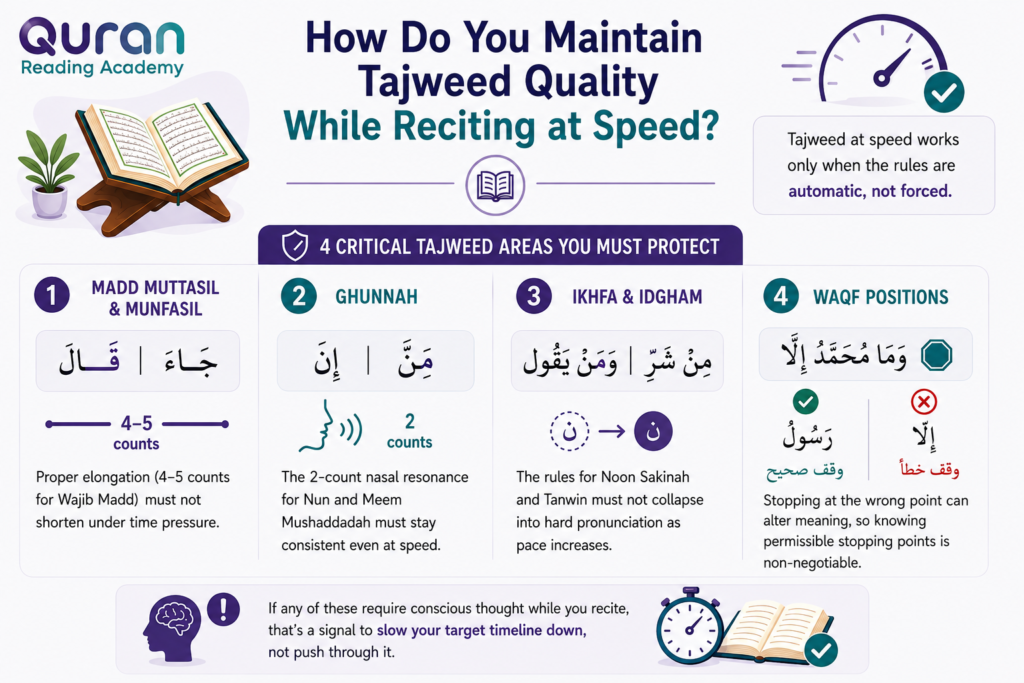
Before attempting any accelerated khatm, confirm you can execute these without mental interruption:
- Madd Muttasil and Munfasil — proper elongation counts, typically 4–5 counts for Wajib Madd, must not shorten under time pressure
- Ghunnah — the 2-count nasal resonance for Nun and Meem Mushaddadah must stay consistent even at speed
- Ikhfa and Idgham — the rules for Noon Sakinah and Tanwin must not collapse into hard pronunciation as pace increases
- Waqf positions — stopping at the wrong point can alter meaning, so knowing permissible stopping points is non-negotiable
If any of these require conscious thought while you recite, that’s a signal to slow your target timeline down, not push through it.
Our Online Quran Reading Course with Tajweed is built specifically around drilling these rules until they’re automatic — the exact prerequisite this schedule assumes you already have.
What Preparation Steps Should You Complete Before Day One?
Preparation in the days before an intensive khatm determines whether the schedule holds together or collapses halfway through. Complete these steps in the 3–5 days prior to beginning. This is also the part most guides skip when explaining how to complete the Quran in 3 days, even though it’s what determines whether Day 2 actually holds together.
Step 1 — Assess your recitation speed accurately. Time yourself reciting one Juz’. If it takes more than 2.5 hours, your current speed won’t sustain a 3-day or 4-day schedule — build fluency first.
Step 2 — Identify your weak Surahs in advance. Every reciter has portions read less frequently. Review Juz’ 7–10 and Juz’ 18–22 specifically, since these middle sections are where recitation pace most commonly drops.
Step 3 — Prepare your physical environment. Designate a fixed recitation space free from interruption, inform your household, and silence non-essential notifications for the full duration of your schedule. Sisters organizing a group khatm often find this easier to sustain together — our Quran Reading Classes for Female/Sisters build exactly this kind of accountable, structured recitation habit.
Step 4 — Plan your meals and rest strategically. Heavy meals before recitation sessions cause fatigue. Eat lightly and get 6–7 hours of sleep each night — physical depletion is the most common reason students abandon the schedule on Day 2.
Step 5 — Make sincere intention (Niyyah). This is an act of worship, not an endurance test. Begin with the genuine intention to draw closer to Allah ﷻ through His Book.
Ready to build the fluency this schedule requires? Explore Quran Reading Academy’s course options and start with the level that actually matches where you are today.
Read Also: How to Concentrate While Reading Quran?
Inside Our Live Classroom
We believe in complete transparency. Take a look inside our virtual classrooms to experience our premium teaching tools and engaging learning environment firsthand.
Start Your Quran Learning Journey Today
Join Quran Reading Academy and begin structured, step-by-step Quran reading with expert guidance.
Try your first class for freeStart Your Khatm Journey With Quran Reading Academy
Whatever pace you choose — 3 days, 4 days, or 5 — the outcome depends entirely on the fluency and Tajweed foundation you bring into it.
Quran Reading Academy builds that foundation through structured, one-on-one guided courses for every starting point, from children beginning their first Surahs to adults refining Tajweed before an intensive khatm attempt.
Our Quran Courses:
- Quran Reading Classes
- Quran Reading Classes for Kids
- Quran Reading Classes for Adults
- Quran Reading Classes for Female/Sisters
- Quran Reading Classes for New Muslims
- Quran Reading Course for Beginners
- Online Quran Reading Course with Tajweed
- Reading and Memorizing the Quran Course
- Noorani Qaida Course
- Quran Course for Beginners
- Quran Tajweed Course
- Quran Recitation Course
- Quran Hifz Course
- Online Quran Qirat Classes
- Quranic Arabic Course
- Arabic Reading Practice Course

Start Your Quran Learning Journey Today
Join Quran Reading Academy and begin structured, step-by-step Quran reading with expert guidance.
Try your first class for freeConclusion
Knowing how to complete the Quran in 3 days comes down to reciting 201 pages daily across five prayer-anchored sessions, and it’s the minimum period the Prophet ﷺ himself recommended — not an arbitrary personal challenge.
Reading the Quran in 4 days or 5 days offers the same structured, prayer-anchored approach at a more sustainable pace for reciters still building fluency. In every version of this schedule, the deciding factor isn’t willpower — it’s whether your Tajweed and recitation speed can hold up without conscious effort.
Assess your readiness honestly using the table above, prepare in the days beforehand, and choose the timeline that matches where your recitation actually stands today. Quran Reading Academy’s courses exist to move you up that readiness ladder, whichever schedule you’re aiming for next.

Frequently Asked Questions
Here are direct answers to the most common questions about completing the Quran within a few days, based on what students ask us most.
1. Is it permissible to complete the Quran in 3 days?
Yes, it is permissible, and the Prophet ﷺ specifically told a companion to recite it in three days rather than faster. Scholars support this practice when it’s done with proper Tajweed, genuine reflection, and sincere intention rather than as a speed challenge alone.
2. How many pages of the Quran must I read daily to finish it in 3 days?
You need to read approximately 201 pages per day to finish the Quran in 3 days, based on the standard 604-page Mushaf divided across three days. Splitting this into five prayer-anchored sessions of about 40 pages each keeps the pace manageable.
3. What is the best time of day to read large portions of the Quran during an intensive khatm?
The best times are right after Fajr and again after Isha, when focus is highest and distractions are lowest. Anchoring your heaviest sessions to these two prayers, as shown in the schedule above, prevents the mid-afternoon pile-up that derails most attempts.
4. Can a beginner attempt a 3-day Quran completion?
A beginner should not attempt a 3-day khatm directly, since the pace assumes recitation without hesitation and strong Tajweed already in place. Beginners should build fluency through a 30-day schedule first, then progress to 7 days before considering 3 or 4 days.
5. What’s the difference between reading the Quran in 4 days versus 5 days?
The 4-day schedule requires about 151 pages daily while the 5-day schedule requires about 121 pages daily, so 4 days demands roughly 30 more pages per day. Both use the same prayer-anchored session structure, just with slightly heavier daily loads on the 4-day plan.
6. What should I do if I make a mistake while reciting quickly?
Correct the mistake immediately only if it changes the meaning of the verse (Lahn Jalī); minor pronunciation imprecisions can be refined in a later recitation cycle without stopping. If you lose your place, quietly recite Ta’awwudh and continue rather than backtracking more than one ayah.
Related Articles
Quran Reading Plans







Leave a Reply