 How to read Quran
You sit down with the Mushaf, open to a familiar page — and within three lines your mind is somewhere else entirely. This is one of the most common struggles Muslims face, and it has nothing to do with weak faith or lack of desire. Learning how to concentrate while reading Quran is a skill that can be trained, not a character trait you either have or don’t.
The challenge is real and well-documented in Islamic scholarship. The Prophet ﷺ acknowledged the difficulty of sustained Quran engagement directly. What the classical scholars called Hudoor al-Qalb — the presence of the heart — is something that must be actively cultivated, not passively hoped for.
Step 1. Fix the Dopamine Problem Before You Open the Mushaf
This is the step that almost no article mentions, yet it explains why so many sincere Muslims sit down to read and still cannot focus.
Why Social Media Kills Quran Concentration?
The human attention system is calibrated by what it consumes most often. When you spend hours each day on short-form content — reels, notification loops, rapid scrolling — your brain’s dopamine system is trained to expect stimulation every few seconds.
Quran recitation does not deliver stimulation every few seconds. It delivers depth, weight, and gradual meaning — a completely different reward structure. The brain that has been conditioned on fast dopamine registers the Quran as “slow” and begins pulling toward its preferred rhythm.
The fix is not willpower. It is a brief digital pause before your session. Put the phone in another room at least 10 minutes before you begin. This single environmental change lowers the baseline arousal state and allows the attention system to reset enough to actually engage with the text.
Pre-Session Calm as a Concentration Investment
Performing wudu immediately before recitation is not only a spiritual act — it is a physical transition ritual that signals a state change to your nervous system. Use those two minutes of wudu as a deliberate shift: slow your movements, avoid rushing, and let the routine create mental separation from whatever you were doing before.
See Our Academy in Action
Discover what a typical session looks like! Watch these brief highlights from our live, interactive classes to see how our instructors engage with students of all ages.
Start Your Quran Learning Journey Today
Join Quran Reading Academy and begin structured, step-by-step Quran reading with expert guidance.
Try your first class for freeStep 2. Set a Clear Niyyah Tied to a Specific Verse Goal
Most readers sit down with a vague intention — “I’ll read some Quran now.” Vague intentions produce vague attention. A specific niyyah creates a cognitive anchor.
How a Specific Niyyah Sharpens Focus?
Before opening the Mushaf, state — aloud or in your heart — exactly what you intend to read and what you want to receive from it. “O Allah, I intend to read the first page of Surah Al-Baqarah and I ask You to open my heart to its meaning.” This is not ritualistic performance. It is directing your attention system toward a defined target.
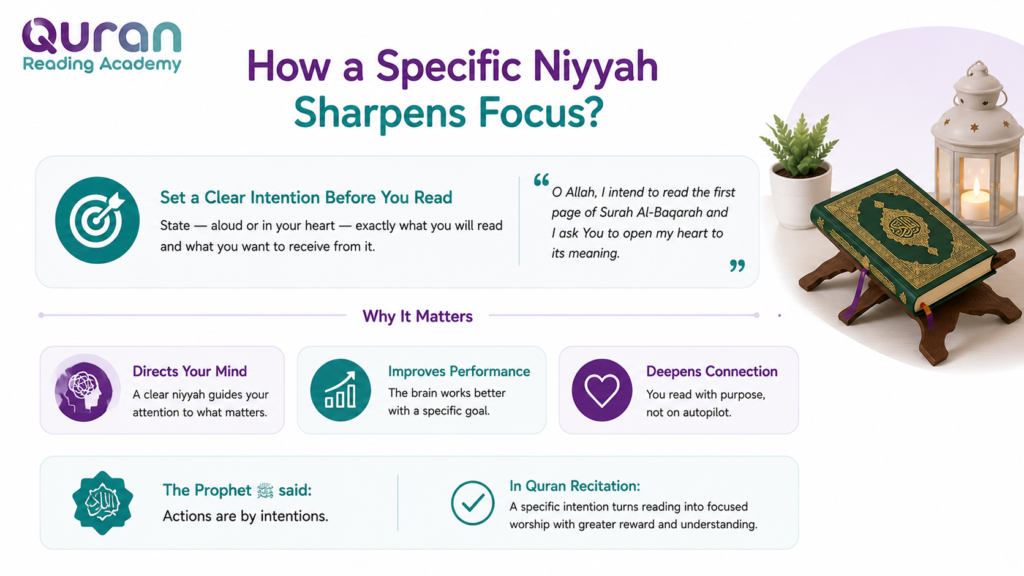
The Prophet ﷺ taught that actions are by intentions. In the context of Quran recitation, this has a practical cognitive dimension: the brain performs measurably better when it has a specific goal compared to an open-ended task.
Recommended Dua Before Recitation
Begin with Ta’awwudh (seeking refuge from Shaytan) and Basmala as commanded:
أَعُوذُ بِاللَّهِ مِنَ الشَّيْطَانِ الرَّجِيمِ
(A’ūdhu billāhi minash-shayṭānir-rajīm)
(“I seek refuge with Allah from the accursed devil”)
This recitation was commanded specifically before Quran reading. Its purpose is not formulaic — it is a declaration that frames what follows as a protected, intentional act of worship.
Quran Reading Academy’s Quran Tajweed Course trains you to articulate every letter from its correct point of origin — building the physical precision that keeps your attention anchored to every word you recite.
Recite with precision and full presence — Explore the Tajweed Course
Step 3. Use the Tadabbur-First Protocol to Anchor Attention
This is the information-gain insight that most competing articles miss entirely: read the meaning of your selected passage before you recite it, not after.
Why Meaning Before Recitation Changes Everything?
When you recite Arabic text whose meaning you haven’t engaged with yet, your mind has no semantic hook. Attention requires something to attach to. Reading a reliable translation of your three-to-five verse target — taking two minutes before you begin reciting — gives your attention system a framework to orient toward.
This is the Tadabbur-First Protocol: read the translation, pause for 30 seconds to let one idea from those verses land, then open your recitation. You will notice an immediate difference in how “present” you feel during the Arabic.
Allah explicitly commanded this approach:
كِتَابٌ أَنزَلْنَاهُ إِلَيْكَ مُبَارَكٌ لِّيَدَّبَّرُوا آيَاتِهِ
(Kitābun anzalnāhu ilayka mubārakun liyaddabbarū āyātih)
(“A blessed Book which We have revealed to you, that they might reflect upon its verses”) Sad 38:29
Start with Short Passages and Scale Up
Do not try to concentrate across an entire Juz’ in one session. Begin with five to seven verses. Read their meaning first, recite them attentively, then stop. Quality presence across five verses produces more spiritual benefit — and builds the concentration habit faster — than glazed-over reading of a full page.
Quran Reading Academy’s Quranic Arabic Course gives you the vocabulary tools to engage with verse meanings directly, without relying solely on translations. When you understand even 60% of the words you’re reciting, attention anchors naturally.
Start understanding what you recite — Explore the Quranic Arabic Course
Step 4. Apply Tajweed Rules as an Active Concentration Tool
This is a point that qualified Quran teachers know from direct experience but rarely explain to students: Tajweed forces concentration because it demands physical precision.
Why Tajweed Articulation Demands Full Attention?
Proper Makharij al-Huruf — articulating each letter from its correct point of articulation — requires active engagement of specific muscles of the tongue, lips, and throat. You cannot correctly produce the Dha (ظ), the ‘Ain (ع), or the Qaf (ق) on autopilot. The articulation demands that you be mentally present for every letter.
This is the practical mechanism: Tajweed rules raise the cognitive difficulty of each letter to a level where wandering attention becomes immediately obvious, because the sound you produce is immediately wrong. Your own ear becomes the concentration monitor.
The Ghunnah and Madd Method for Pulling Attention Back
When you notice your mind drifting mid-recitation, use a Tajweed rule as a re-engagement anchor. Return to the last verse you were focused on and recite it with exaggerated Ghunnah (nasal sound) on every Noon and Meem Mushaddad. The physical act of slowing down and heightening one rule snaps attention back into the text.
Step 5. Choose the Right Environment and Time Slot
Where and when you read directly shapes how well you can concentrate while reading Quran. Two variables — physical space and time of day — have an outsized effect on attention quality that most readers underestimate.
Physical Setup That Supports Quran Focus
Create a fixed recitation spot — the same corner, the same cushion, the same direction. Repetition of location trains the brain to associate that spot with a particular mental state. Over two to three weeks of consistent use, simply sitting in that spot begins producing the focused state automatically.
Remove visible distractions before sitting. A cluttered surface, a visible phone, a television in peripheral vision — each competes for attentional resources even when you’re not actively looking at them.
Best Time Slots for Quran Concentration
Fajr time carries the most barakah for recitation and is also — from a cognitive standpoint — the period when the prefrontal cortex is least fatigued and most capable of sustained attention. Students who build their primary recitation session around Fajr consistently report stronger presence compared to those who read late at night after a full day of work.
If Fajr is not feasible, the second most effective window is after Asr — the brief energy recovery period before the evening. Avoid reading during extreme fatigue; a five-minute session when mentally present outperforms thirty minutes of mechanical recitation.
Step 6. Handle Internal Distraction and Waswas Differently from External Noise
Not all distraction during recitation comes from the same source, and treating both types the same way is why most concentration advice fails. Identifying which type you’re dealing with determines which technique actually works.
Two Types of Distraction During Recitation
External distraction is noise, movement, notifications, or visual interruption from your environment. The solution is environmental: remove, silence, or relocate.
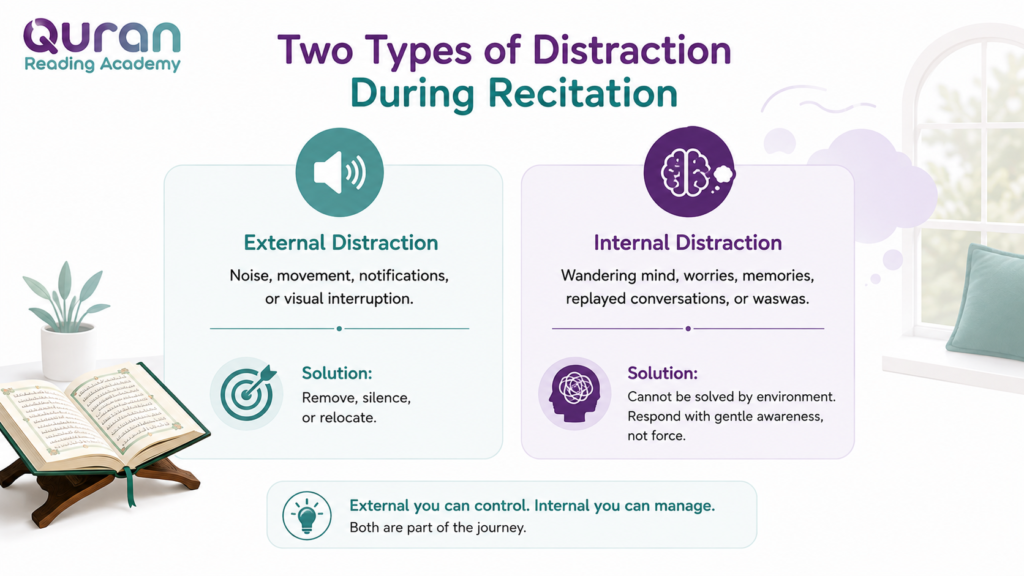
Internal distraction is the wandering mind — thoughts about work, replayed conversations, sudden memories, or the specific whispers the scholars called waswas. This type cannot be solved environmentally because it originates inside. Trying harder to suppress internal thoughts typically makes them louder.
The Classical Technique for Waswas During Recitation
Ibn Al-Qayyim described the optimal response to internal distraction during worship as returning without resistance — not fighting the thought, but gently re-directing attention back to the word you were on, without self-criticism. The moment you notice the mind has wandered, point your finger to the word on the page and return. No internal commentary about having wandered; just the act of returning.
Applied consistently, this conditions the attention to return faster and faster each time. The goal is not zero distraction — it is rapid, smooth recovery.
Read Also: How to Learn Noorani Qaida Online Step by Step
Step 7. Read Aloud Softly and Track Words with Your Finger
Reading silently allows the eye to race ahead while comprehension lags behind. Reading aloud at even a low volume synchronizes the visual, auditory, and motor systems — three channels of input simultaneously, which makes it structurally harder for attention to drift.
The Physical Tracking Method
Place your finger under each word as you recite. This is not a beginner’s technique — it is a focusing mechanism used by advanced students and teachers alike. The hand movement provides a motor anchor that keeps the body engaged in the act of reading.
When you reach the end of an ayah, pause before the next. Even a two-second pause creates a micro-moment of presence: the verse you just read has a fraction of a second to land before you move on. Over a full session, these pauses accumulate into a qualitatively different recitation experience.
Quran Reading Academy’s Quran Recitation Course teaches students to recite with Tarteel — the measured, present-tense cadence that the Prophet ﷺ commanded — which naturally incorporates both the pacing and physical presence needed for genuine focus.
Recite with Tarteel and real attention — Explore the Recitation Course
Read Also: How to Learn Quran Reading with Tajweed Juz 30
Step 8. Build Accountability and Track Your Progress Weekly
Concentration during Quran reading improves fastest when someone else hears you. Solitary recitation without external feedback creates invisible blind spots — both in pronunciation and in the consistency of your sessions.
Why a Qualified Teacher Accelerates Focus Building?
A qualified Quran teacher does two things that no app or self-study system can replicate. First, they provide immediate audio feedback when your attention lapses — a wandering mind produces a different sound, and a trained teacher catches it. Second, the scheduled session creates external accountability that prevents the “I’ll do it tomorrow” pattern that dissolves most solo habits.
Read Also: How to Start Reading Quran Daily in 7 Proven Steps
Session Length and Weekly Tracking
Keep daily sessions short enough to maintain quality throughout. Fifteen focused minutes produces stronger concentration habituation than forty-five unfocused minutes. Track your sessions — simply noting the date, passage read, and a one-word description of your focus level (sharp / moderate / difficult) — builds self-awareness about your patterns.
Over four to six weeks of tracked sessions, most students identify their two or three highest-focus time slots and can begin protecting those specifically for Quran.
Read Also: How to Learn to Read Quran Online for Kids Step by Step
Inside Our Live Classroom
We believe in complete transparency. Take a look inside our virtual classrooms to experience our premium teaching tools and engaging learning environment firsthand.
Start Your Quran Learning Journey Today
Join Quran Reading Academy and begin structured, step-by-step Quran reading with expert guidance.
Try your first class for freeStart Your Quran Journey with a Free Trial Session
If your sessions have been inconsistent or your focus keeps breaking down, the fastest reset is working with a qualified teacher who can identify exactly where your attention collapses and give you a personalized plan.
Quran Reading Academy offers a structured path from your very first session — expert instructors, Tajweed-grounded recitation, and a curriculum built around your schedule and current level.
Every student starts with a free trial session so you can experience the difference that guided, accountable recitation makes before committing to anything.
Our Quran Courses
- Quran Reading Classes
- Quran Reading Classes for Kids
- Quran Reading Classes for Adults
- Quran Reading Classes for Female/Sisters
- Quran Reading Classes for New Muslims
- Quran Reading Course for Beginners
- Online Quran Reading Course with Tajweed
- Reading and Memorizing the Quran Course
- Noorani Qaida Course
- Quran Course for Beginners
- Quran Tajweed Course
- Quran Recitation Course
- Quran Hifz Course
- Online Quran Qirat Classes
- Quranic Arabic Course
- Arabic Reading Practice Course

Book your FREE trial session today — and recite with presence from your very first class
Conclusion
Learning how to concentrate while reading Quran is not a mystery — it is a skill with identifiable components. Reduce cheap dopamine before you sit down. Set a specific intention tied to a defined passage. Prime your attention with the Tadabbur-First Protocol before you recite. Use Tajweed articulation as a concentration tool, not just a correctness standard. Distinguish between external distraction and internal waswas and apply a different response to each. Read aloud softly with a tracking finger. And build the weekly accountability that transforms occasional effort into a durable habit.
The students who achieve genuine Hudoor al-Qalb — heart presence during recitation — are not those who try harder. They are those who build better systems. Start with one technique from this article in your next session, observe what shifts, and add the next.
Frequently Asked Questions
Why do I keep losing focus while reading Quran even when I want to concentrate?
The most common cause is a mismatch between the attention system your brain has been conditioned to use and what Quran recitation actually requires. Frequent social media use trains the brain to expect rapid stimulation. Quran delivers depth and gradual meaning instead. A 10-minute digital pause before sitting down, combined with the Tadabbur-First Protocol, directly addresses this mismatch.
How long should a Quran reading session be for good concentration?
Fifteen to twenty focused minutes outperforms longer sessions done with poor attention. Start with a session length you can sustain with genuine presence throughout — even if that is only ten minutes. As your concentration capacity builds over weeks, extend gradually. Consistency of quality across short sessions is what develops lasting focus.
Does understanding Arabic help with concentration while reading Quran?
Yes — significantly. When you recognize even common Quranic words, your attention has semantic content to engage with rather than pure phonetic sounds. Learning 300 high-frequency Quranic root words accounts for roughly 70% of the Quran’s vocabulary. Even partial comprehension provides enough meaning-anchor to dramatically reduce mind-wandering.
What is the Islamic ruling on distractions during Quran recitation?
Scholars are consistent that reciting with presence of heart (Hudoor al-Qalb) is the ideal and that making effort toward it is obligatory. However, the Prophet ﷺ affirmed in an authentic hadith that the one who struggles with Quran recitation receives double reward. Distraction does not nullify the act of worship — it is a difficulty Allah recognizes and rewards the effort to overcome.
How do I stop my mind from wandering to other thoughts mid-recitation?
Do not attempt to suppress the thoughts. When you notice your mind has wandered, point your finger to the word you were on and return there — no self-criticism, no internal commentary. Ibn Al-Qayyim described this as returning without resistance. Consistent gentle return trains the attention to recover faster each time.
Can reciting Quran aloud help me concentrate better?
Yes. Soft-voice recitation engages visual, auditory, and motor channels simultaneously, making it structurally harder for attention to drift compared to silent reading. It also activates the same mechanisms Tajweed rules rely on — requiring physical precision that keeps your mind present. If your environment allows it, recite aloud rather than silently as a default practice.
Related Articles
How to read Quran








Leave a Reply