 How to read Quran

Starting to read Quran daily means choosing a consistent time, setting a realistic minimum target, and anchoring that target to an existing routine so it happens automatically. Even five minutes after Fajr counts as a daily Quran reading habit when repeated without interruption.
Most people who want to build this practice do not fail because of laziness — they fail because their starting goal is too ambitious. This guide gives you the exact framework to start reading Quran daily in a way that sticks, backed by prophetic guidance and practical habit science.
Step 1. Set a Clear Sincere Intention Before You Begin
Every lasting act of worship in Islam is anchored in a deliberate intention. Before you open the Mushaf, the first practical move is to clarify why you are doing this — not as a mental exercise, but as a sincere address to Allah.
Intention as a Habit Anchor
Your niyyah (intention) is not a one-time step. Renew it every single day before you sit down to read. This 10-second act psychologically separates Quran time from everything else on your schedule and signals to your brain that something meaningful is about to happen.
Reading for Connection Not Completion
The most common reason daily Quran reading collapses in week two is that the person is mentally tracking a quota — pages finished, checkboxes ticked — rather than time spent with Allah’s words. Frame your intention around connection, not completion. That shift changes how you experience even a slow two-minute session on a difficult day.
قال الله تعالى:
إِنَّا نَحْنُ نَزَّلْنَا عَلَيْكَ الْقُرْآنَ تَنزِيلًا
(Innā naḥnu nazzalnā ʿalayka al-Qurʾāna tanzīlā)
(“Indeed, it is We who have sent down to you the Quran progressively”)
This verse is a direct reminder that the Quran was sent for you — not as a performance requirement but as a gift given in stages.
See Our Academy in Action
Discover what a typical session looks like! Watch these brief highlights from our live, interactive classes to see how our instructors engage with students of all ages.
See Our Academy in Action
Discover what a typical session looks like! Watch these brief highlights from our live, interactive classes to see how our instructors engage with students of all ages.
Start Your Quran Learning Journey Today
Join Quran Reading Academy and begin structured, step-by-step Quran reading with expert guidance.
Try your first class for freeStep 2. Choose Your Minimum Daily Quran Reading Target
The single most effective decision you will make when you start reading Quran daily is choosing a target so small it feels almost too easy. This is not spiritual laziness — it is precision engineering for a lifetime habit.
Three Proven Starting Models
Different personalities require different entry points. Pick the one that fits your life right now, not the one that sounds most impressive.
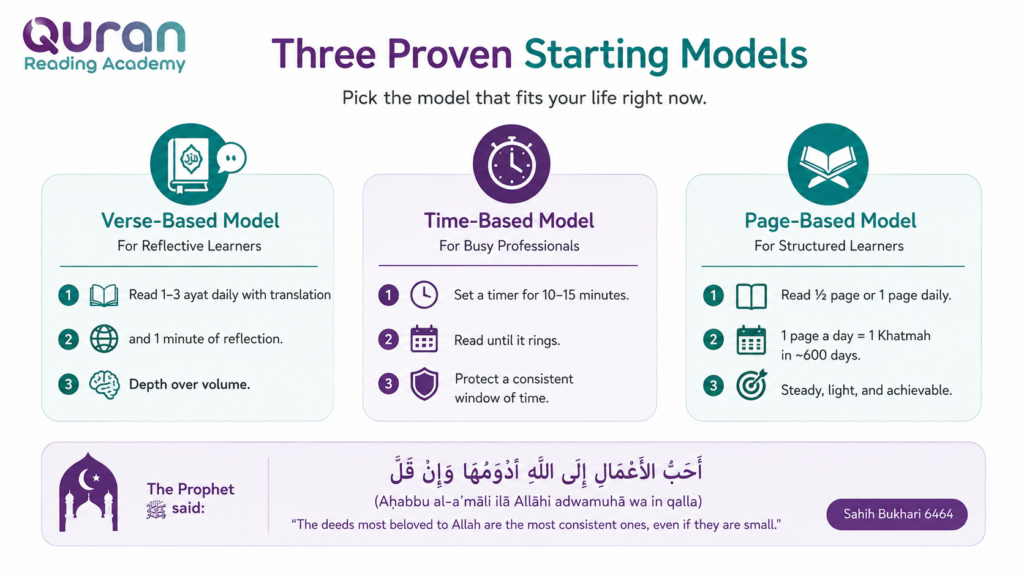
The Verse-Based Model for Reflective Learners
Commit to reading one to three ayat per day, including a translation and one minute of reflection. This model prioritizes depth over volume. A person who sits with Surah Al-Mulk 67:1 for three minutes — reading it, understanding it, and thinking about it — has done more spiritually than someone who rushed through a page without comprehension.
The Time-Based Model for Busy Professionals
Set a timer for 10 to 15 minutes and read until it rings. You are not measuring pages — you are protecting a window of time. This works best for people with unpredictable schedules because the commitment is always identical regardless of how far you get.
The Page-Based Model for Structured Learners
Commit to half a page or one page daily. A practical detail most articles skip: reading one page per day consistently completes a full Khatmah (complete recitation of the Quran) in approximately 600 days — less than two years — at a pace that feels light.
The Prophet ﷺ said:
أَحَبُّ الأَعْمَالِ إِلَى اللَّهِ أَدْوَمُهَا وَإِنْ قَلَّ
(Aḥabbu al-aʿmāli ilā Allāhi adwamuhā wa in qalla)
(“The deeds most beloved to Allah are the most consistent ones, even if they are small”) Sahih Bukhari 6464
Step 3. Stack Your Daily Quran Reading onto an Existing Habit
The most reliable way to guarantee that daily Quran reading actually happens is to attach it to something you already do without thinking. Behavioral scientists call this “habit stacking,” and it removes the need for willpower entirely.
Anchor It to Prayer
The cleanest anchor point is Fajr. You already wake up for prayer — the Mushaf simply needs to be in the same location where you pray. When Fajr ends, you do not decide to read Quran; you just continue.
Why Fajr Recitation Carries Extra Weight?
This is not merely a scheduling convenience. The Prophet ﷺ specifically highlighted the blessing of recitation at this time:
وَقُرْآنَ الْفَجْرِ إِنَّ قُرْآنَ الْفَجْرِ كَانَ مَشْهُودًا
(Wa Qurʾāna al-fajri inna Qurʾāna al-fajri kāna mashhūdā)
(“And recite the Quran at dawn — indeed, the recitation of dawn is ever witnessed”)
The angels of the night shift and the day shift both witness recitation at Fajr (Sunan Ibn Majah 670), meaning it is recorded twice in your Book of Deeds.
Alternative Anchor Points That Work
If Fajr reading feels too rushed, try: immediately before bed (the last content your mind processes before sleep has stronger retention), or right after Asr when many working adults have a natural pause. The anchor matters less than the consistency.
Step 4 Prepare Your Physical Environment for Zero-Friction Starts
One overlooked reason people fail to build a daily Quran reading habit is that the setup itself creates friction. When picking up the Quran requires finding it, finding a bookmark, and clearing a space, the small resistance adds up to skipped days.
The Night-Before Setup Rule
Every evening before bed, place your Mushaf — already bookmarked to your current page — exactly where you plan to read the next morning. This 30-second act eliminates all decision-making at the moment when your willpower is lowest.
Visual Cues as Passive Reminders
A Mushaf placed visibly on your bedside table or prayer mat acts as a constant cue. The visual trigger fires the habit loop before you have consciously decided to act. This is not a trick — it is how strong habits function.
For learners who want structured guidance on correct pronunciation from the very beginning, Quran Reading Academy’s Noorani Qaida Course builds the precise phonetic foundation that makes daily reading accurate and rewarding. Expert Arabic instructors teach each letter individually before connecting sounds into full Quranic text.
Start your Noorani Qaida journey with Quran Reading Academy today
Step 5. Build Recitation Accuracy Into Your Daily Practice
Starting to read Quran daily without attention to correct pronunciation is like building on sand — the habit forms, but the recitation carries uncorrected errors that become harder to fix over time. Accuracy is not an advanced concern; it is a day-one concern.
The Two-Error Types Every Beginner Makes
The first type is makhraj errors — producing a letter from the wrong articulation point. Saying a ض (Dad) like a ظ (Zha), for example, changes meaning within the Quran. The second type is harakat errors — misreading short vowel marks (fatha, kasra, damma) that change grammatical function entirely.
Daily Listening as a Self-Correction Tool
Pair your reading session with a brief listening session. Choose a clear, measured reciter — Sheikh Mahmoud Khalil Al-Husary’s Muallim recitation was designed specifically for learners and is available free on tanzil.net. Read a section aloud, then listen to the same section. Discrepancies you hear are your correction list for the next day.
When to Bring In a Teacher?
A Quran teacher catches systematic makhraj errors that recorded recitations cannot diagnose, because they hear your specific voice producing specific sounds. If you notice you always stumble on the same letters, that is a clear signal that a live session will save months of embedded mistakes.
Quran Reading Academy’s Quran Recitation Course trains students in the art of Tarteel — the measured, rhythmic recitation the Prophet ﷺ commanded — under the supervision of certified instructors with Ijazah chains.
Refine your daily recitation with expert guidance
Step 6. Maintain Momentum and Overcome Obstacles in Daily Reading
Every person who sets out to read Quran daily will face days when motivation disappears. This is not a spiritual failure — it is a predictable phase that every habit goes through during its first 40 to 60 days of formation.
Apply the “Never Miss Twice” Rule
Missing one day does not break a habit. Missing two consecutive days begins to break it. When you miss a session, the only recovery protocol that matters is: read something — even one ayah — the very next day without exception.
Plan Your Low-Energy Sessions in Advance
Decide in advance what your “minimum viable session” looks like on a sick day or a travel day. For most people, this is one to three ayat read slowly before sleep. Having this pre-decided means you never have to negotiate with yourself in the moment.
Read Also: How to Learn Quran Reading with Tajweed for Beginners?
The Reward Mechanism
Small rewards tied to consistency streaks create positive associations with the habit. After seven consecutive days of reading, give yourself something you enjoy — a meal, a book, extra rest. The reward is not a bribe; it is neurological reinforcement.
Read Also: How to Learn Noorani Qaida Online Step by Step
Step 7. Gradually Increase Your Daily Quran Pages Over Time
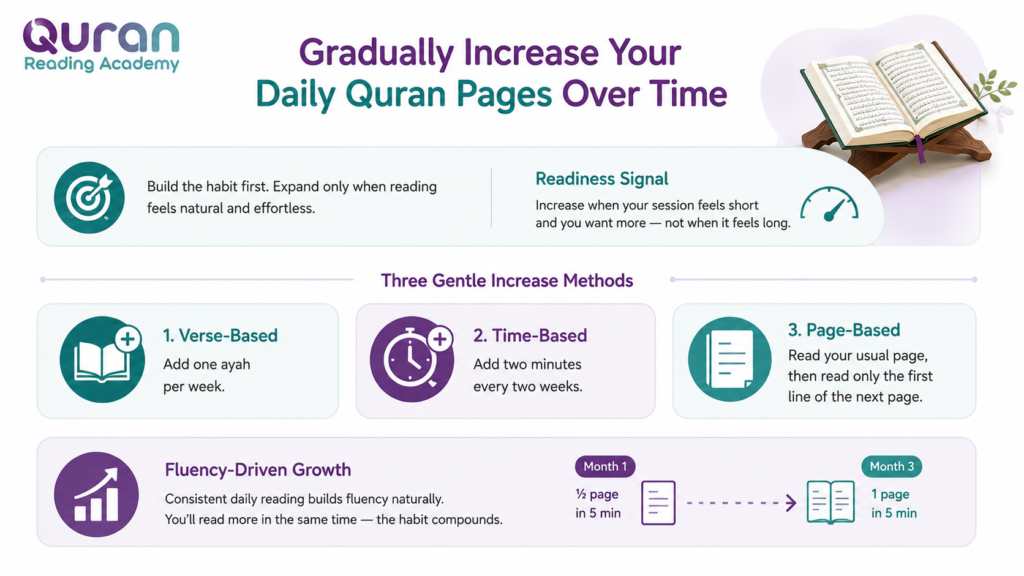
Once your daily reading habit feels effortless — when you notice yourself reaching for the Mushaf automatically rather than reminding yourself — you are ready to expand. Expanding too early is the most common reason the habit collapses at the 30-day mark.
Read Also: How to Learn Quran Recitation with Tajweed?
The Readiness Signal
You are ready to increase when your current session feels short, not long. If you finish your three ayat and feel satisfied that you are done, wait. If you finish and feel like you want more, increase.
Read Also: How to Learn Quran Reading with Tajweed Juz 30
Three Gentle Increase Methods
If your habit is verse-based: add one ayah per week, not per day. If your habit is time-based: add two minutes every two weeks. If your habit is page-based: read your usual page, then read only the first line of the next page. That single overlap line psychologically primes the following day’s session.
Read Also: How to Learn to Read Quran Online for Kids Step by Step
Fluency-Driven Growth
One of the least-discussed benefits of consistent daily Quran reading is that fluency increases automatically. A reader who reads half a page in five minutes in month one may find they read a full page in the same five minutes by month three, simply through repeated exposure to common Quranic word patterns. The habit does not just persist — it compounds.
For learners ready to move beyond basic reading and begin engaging with the meaning behind what they recite every day, Quran Reading Academy’s Quranic Arabic Course equips students with the vocabulary and grammatical tools to understand Allah’s address directly — without depending entirely on translations.
Read Also: How to Concentrate While Reading Quran
Begin reading Quran with real comprehension
Inside Our Live Classroom
We believe in complete transparency. Take a look inside our virtual classrooms to experience our premium teaching tools and engaging learning environment firsthand.
Start Your Quran Learning Journey Today
Join Quran Reading Academy and begin structured, step-by-step Quran reading with expert guidance.
Try your first class for freeStart Your Daily Quran Reading with Guided Expert Support
Building a daily Quran reading habit is a beautiful commitment. The fastest way to protect it is to build it alongside a patient, qualified teacher from the very beginning.
Quran Reading Academy specializes in helping students at every level — complete beginners, fluent readers seeking Tajweed refinement, and adults returning to the Quran after years away — develop a consistent, accurate, and spiritually meaningful daily reading practice.
Expert Arabic instructors, many holding Ijazah certification through unbroken chains of transmission, guide students through every stage: from recognizing Arabic letters with the Quran Reading Course for Beginners, to reciting with Tajweed, to building long-term memorization habits.
Our Quran Courses
- Quran Reading Classes
- Quran Reading Classes for Kids
- Quran Reading Classes for Adults
- Quran Reading Classes for Female/Sisters
- Quran Reading Classes for New Muslims
- Quran Reading Course for Beginners
- Online Quran Reading Course with Tajweed
- Reading and Memorizing the Quran Course
- Noorani Qaida Course
- Quran Course for Beginners
- Quran Tajweed Course
- Quran Recitation Course
- Quran Hifz Course
- Online Quran Qirat Classes
- Quranic Arabic Course
- Arabic Reading Practice Course

Claim your free trial session and start your daily reading habit today
Conclusion
How to start reading Quran daily comes down to four things done well: a sincere intention renewed each morning, a target small enough to succeed on your worst day, an anchor in your existing routine, and an environment that removes all friction. None of these require special talent or prior knowledge of Arabic.
The Prophet ﷺ told us that the most beloved deeds to Allah are the consistent ones, even if small. A daily Quran reading habit that produces five pages is less valuable than one that produces five ayat — if the second habit runs for life and the first collapses after a month.
Start with the minimum. Protect the streak. Let fluency and volume grow naturally from the consistency you build in the first 90 days.
Frequently Asked Questions
How many pages should a beginner read daily?
One page per day is a solid beginner target because it is achievable on any schedule and produces a complete Khatmah in roughly 600 days. If even one page feels difficult at first, start with half a page or a timed 10-minute session until the habit is established.
What is the best time to start reading Quran daily?
Immediately after Fajr prayer is the most recommended time because it is witnessed by the angels of both shifts (Sunan Ibn Majah 670), and it anchors the habit to an existing daily act of worship before distractions begin.
How do I stay consistent when I miss a day?
Apply the “never miss twice” rule: if you miss one day, make certain you read something — even a single ayah — the following day without exception. One missed day does not break a habit; two consecutive missed days begin to.
Do I need to read in Arabic to build a daily habit?
Arabic recitation carries its own reward, with ten good deeds per letter (Tirmidhi). However, pairing recitation with a reliable translation of the Quran deepens connection and comprehension. Beginners who cannot yet read Arabic script can start with a transliteration while learning the alphabet in parallel.
How long does it take for daily Quran reading to feel automatic?
Research on habit formation suggests that automatic behavior solidifies between 40 and 66 days of consistent repetition. Most students who complete 30 consecutive days of even minimal Quran reading report that skipping the session begins to feel uncomfortable — which is the signal the habit has taken root.
What should I do if my pronunciation is weak?
Weak pronunciation is not a reason to delay — recitation with difficulty carries a double reward (Sahih Bukhari 4937). To improve, listen to a slow, clear reciter such as Sheikh Al-Husary while following the text, and consider working with a certified teacher who can diagnose specific makhraj errors that self-study cannot catch.








Leave a Reply