 How to read Quran
Parents searching for how to learn to read Quran online for kids often find conflicting advice — some sources say start with memorization, others jump straight to Tajweed. The correct path is simpler: begin with letters, build through Noorani Qaida, then move to reading full verses with proper pronunciation.
This guide gives every parent a clear, sequential roadmap that works for children aged four and above, regardless of their starting point or Arabic background.
Step 1. Right Age to Start Quran Reading for Kids
Children can begin structured Quran reading as early as age four. At this stage, the brain’s sound imitation ability is at its peak — Arabic letters that seem difficult to adults come naturally to young children with consistent daily exposure.
Readiness Signals Before the First Lesson
Three behavioral signs indicate a child is ready: they can follow a two-step instruction, sustain focus for five minutes without prompting, and show curiosity when they hear Arabic sounds. Starting before these signals appear creates frustration for both child and parent.
Waiting too long wastes the window when sound acquisition is effortless. Age four to five is the optimal entry point for most children.
Recommended Session Length by Age Group
Short daily sessions always outperform long infrequent ones. Exceeding the attention window produces resistance, not progress.
| Age Group | Session Length | Primary Focus |
| 4–6 years | 10–15 minutes | Letter recognition and audio repetition |
| 7–10 years | 15–25 minutes | Word joining and short verses |
| 11–15 years | 25–35 minutes | Tajweed rules and reading fluency |
End every session before the child wants to stop. That small discipline builds long-term love for the Quran.
Step 2. Noorani Qaida as the Correct Starting Point
Noorani Qaida is the foundational methodology used by Quran teachers worldwide to introduce Arabic phonetics before Mushaf reading begins. It covers Arabic letters, short vowels, letter joining, Sukoon, Tanween, Madd, and Shaddah in a fixed sequential order.
The Most Damaging Mistake in Early Quran Education
Moving a child directly to the Mushaf before completing Noorani Qaida is the single most common error parents make. A child who skips this stage learns to approximate sounds rather than produce them from their correct articulation point. Correcting mispronunciation after years of practice requires far more effort than building accuracy from the start.
Children who complete Noorani Qaida correctly can read any Quranic word they encounter — including words they have never seen — because they understand the phonetic system rather than relying on memorized patterns alone.
Quran Reading Academy’s Noorani Qaida Course guides children through every sequential stage with a certified instructor who identifies and corrects articulation errors before they become permanent.
Enroll your child in the Noorani Qaida Course and build the right foundation
Step 3. Arabic Letter Articulation Basics for Children
Every Arabic letter originates from a specific point in the mouth or throat — this is called Makharij. A child who learns where each sound comes from produces it correctly under pressure, including during Salah when nervousness affects pronunciation.
Letters That Challenge Non-Arabic Speaking Children Most
Four letters consistently cause difficulty for children from English-speaking homes: ع (Ayn), غ (Ghayn), ح (Ha), and خ (Kha). These sounds have no English equivalent, so the child’s brain has no existing pathway for them.
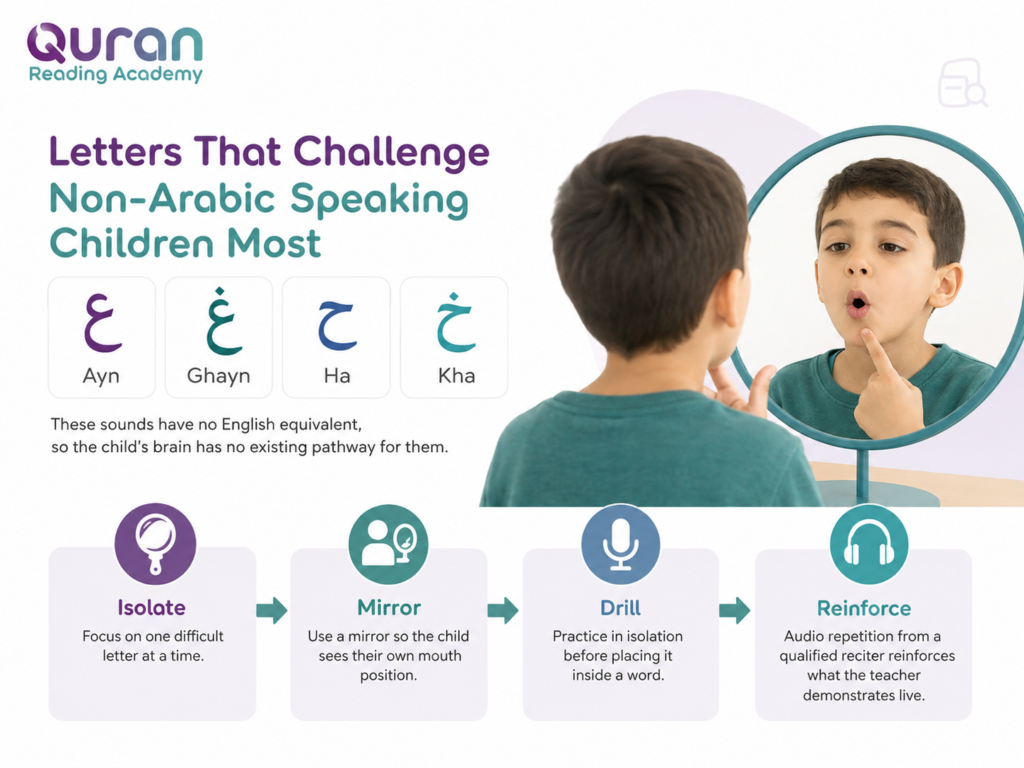
The correct teaching approach isolates each difficult letter, uses a mirror so the child sees their own mouth position, then drills it in isolation before placing it inside a word. Audio repetition from a qualified reciter reinforces what the teacher demonstrates live.
Short Vowels as the First Reading System
Once letters are recognized individually, short vowels — Fatha, Kasra, and Damma — are introduced as a complete system. A child who understands that every vowel mark tells them exactly how to shape their mouth gains a reading strategy that applies to every word in the Quran without exception.
See Our Academy in Action
Discover what a typical session looks like! Watch these brief highlights from our live, interactive classes to see how our instructors engage with students of all ages.
Start Your Quran Learning Journey Today
Join Quran Reading Academy and begin structured, step-by-step Quran reading with expert guidance.
Try your first class for freeStep 4. Core Tajweed Rules Suitable for Young Students
Tajweed means giving each letter its full right — correct articulation, duration, and characteristic sound. Basic rules should be introduced once a child reads individual words smoothly, not before.
Four Rules to Teach First
Begin with the four rules that appear most frequently in the short surahs children already know. Madd elongates a vowel sound for two or six counts and appears in almost every verse. Ghunna is the nasal sound held for two counts on Noon and Meem letters. Qalqalah is the slight bounce on five specific letters that prevents flat pronunciation. Waqf rules teach a child where stopping mid-verse is permitted.
Introducing all Tajweed rules simultaneously overwhelms young learners. These four appear constantly in Juz Amma, so mastering them first creates immediate improvement in the surahs children already recite in Salah.
Quran Reading Academy’s Quran Tajweed Course delivers these rules through targeted drills and live correction, ensuring each rule is applied consistently before the next is introduced.
Join the Quran Tajweed Course and recite with full confidence
Step 5. Interactive Ways to Teach Quran Reading for Kids
Interactive ways to teach Quran reading for kids turn necessary repetition into active engagement. Children retain far more from doing than from listening, and the right activities make daily practice feel natural rather than forced.
Finish the Ayah Game for Daily Sessions
Say the opening words of a short surah and let your child complete it. This builds recall and spoken confidence simultaneously. It works best with surahs from Juz Amma that the child has been hearing passively at home before formal study began.
Arabic Letter Hunt Activity
Write three Arabic letters on sticky notes and place them around the room. Call out a letter sound and ask your child to find it. This physical game anchors letter recognition in the body, not just the memory, and is ideal for ages four to seven during the Noorani Qaida phase.
Weekly Sticker Progress Chart
Create a simple weekly grid. Every completed reading session earns one sticker. After five stickers, a small meaningful reward follows. Children who can see their own progress stay consistent — visible achievement is one of the most reliable motivators at this age group.
Allah says:
وَرَتِّلِ ٱلْقُرْءَانَ تَرْتِيلًا
(Warattili al-Qur’āna tartīlā)
“And recite the Quran with measured recitation.”
This verse confirms that quality of recitation matters more than speed — a principle every interactive activity should reinforce in young learners.
Step 6. Daily Home Routine That Builds Reading Consistency
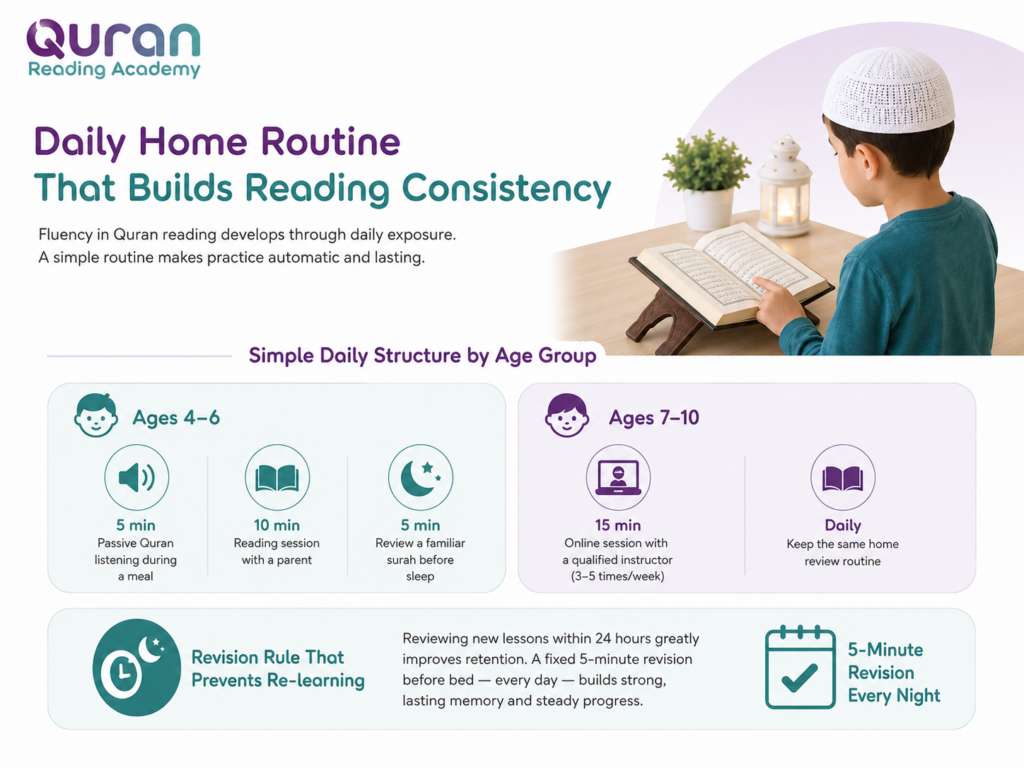
Fluency in Quran reading develops through daily exposure, not occasional long sessions. A structured home routine removes decision fatigue and makes practice automatic rather than something that competes with other activities.
Read Also: How to Learn to Read the Quran for Adults?
Simple Daily Structure by Age Group
For children aged four to six: five minutes of passive Quran listening during a meal, one ten-minute reading session with a parent, and a short review of a familiar surah before sleep. For children aged seven to ten: add a fifteen-minute online session with a qualified instructor three to five times per week alongside the home review routine.
Read Also: How to Learn Noorani Qaida Online Step by Step
Revision Rule That Prevents Re-learning
A child who learns new letters or a new verse without revising it within 24 hours retains significantly less than one who reviews it the same evening. A fixed five-minute revision slot before bed — every day without exception — separates children who progress steadily from those who keep relearning the same material week after week.
Read Also: How to Learn Quran Reading with Tajweed Juz 30
Inside Our Live Classroom
We believe in complete transparency. Take a look inside our virtual classrooms to experience our premium teaching tools and engaging learning environment firsthand.
Start Your Quran Learning Journey Today
Join Quran Reading Academy and begin structured, step-by-step Quran reading with expert guidance.
Try your first class for freeRead Also: How to Concentrate While Reading Quran
Step 7. Selecting a Qualified Online Quran Academy for Kids
The quality of the instructor and the structure of the curriculum determine whether a child builds genuine reading ability or simply memorizes without a phonetic foundation. Not every online platform delivers what its marketing promises.
Four Criteria to Verify Before Enrolling
Confirm the teacher holds a recognized Ijazah — a certification proving their recitation chain traces back to the Prophet ﷺ. Verify the curriculum follows a sequential methodology beginning with Noorani Qaida. Check that sessions are one-on-one or in very small groups so articulation errors are caught in real time. Confirm the platform sends parents regular progress reports between sessions.
Read Also: How to Start Reading Quran Daily in 7 Proven Steps
Free Trial as a Direct Qualification Test
Any reputable academy offers a free trial lesson. Use it to evaluate the teacher directly — do they correct mispronunciation immediately, do they explain why a sound is wrong, and do they adjust their pace to the child’s responses? These behaviors in lesson one predict teaching quality across the entire program.
Quran Reading Academy’s Quran Reading Classes for Kids provide certified instructors, one-on-one sessions, and a curriculum designed specifically for children learning to read Quran online for kids programs from English-speaking homes.
Book your child’s free trial class at Quran Reading Academy now
Begin Your Child Quran Journey at Quran Reading Academy
Every day without the correct phonetic foundation is a day of building habits that become harder to fix later. Quran Reading Academy offers a complete curriculum for children at every stage — from absolute beginners who cannot yet identify a single Arabic letter to students refining Tajweed before beginning Hifz.
Certified instructors, flexible scheduling, and child-focused methods ensure every session moves your child measurably forward.
Our Quran Courses
- Quran Reading Classes
- Quran Reading Classes for Kids
- Quran Reading Classes for Adults
- Quran Reading Classes for Female/Sisters
- Quran Reading Classes for New Muslims
- Quran Reading Course for Beginners
- Online Quran Reading Course with Tajweed
- Reading and Memorizing the Quran Course
- Noorani Qaida Course
- Quran Course for Beginners
- Quran Tajweed Course
- Quran Recitation Course
- Quran Hifz Course
- Online Quran Qirat Classes
- Quranic Arabic Course
- Arabic Reading Practice Course
Start today and give your child the strongest possible Quran reading foundation
Conclusion
The path to fluent Quran reading for children follows one clear sequence: establish readiness, build letter foundations through Noorani Qaida, introduce Tajweed rules at the right stage, and maintain a consistent daily practice routine. No step can be skipped without creating gaps that slow everything that follows.
Applying interactive ways to teach Quran reading for kids — games, sticker charts, letter hunts, and passive listening — makes daily practice sustainable because it matches how children naturally learn and retain information. Qualified one-on-one instruction closes the gap that home practice alone cannot fill.
Start early, stay consistent, and choose a certified instructor. The child who begins this journey on solid ground builds a connection with the Quran that lasts a lifetime.
Frequently Asked Questions
What is the best age to learn to read Quran online for kids?
Children can begin as early as age four. At this stage, Arabic sound imitation is natural and letter recognition develops quickly with consistent short daily sessions under qualified guidance.
How long does it take a child to read Quran fluently?
With daily practice and certified instruction, most children aged five to seven can read basic Quranic words within three to six months of completing Noorani Qaida. Full reading fluency with Tajweed typically develops over one to two years.
Is Noorani Qaida necessary before opening the Mushaf?
Yes. Noorani Qaida teaches the complete Arabic phonetic system from its foundation. Children who skip it and read directly from the Mushaf develop mispronunciation habits that require significant time and effort to correct.
What are the most effective interactive ways to teach Quran reading for kids?
The most effective methods combine passive audio listening, physical games like the letter hunt, recall games like Finish the Ayah, and visible progress tracking through weekly sticker charts. Rotating across these four types prevents boredom and reinforces learning through multiple channels simultaneously.
How do I verify that an online Quran teacher is qualified for children?
Look for an Ijazah certification, specific experience teaching non-Arabic-speaking children, and a free trial lesson. During the trial, observe whether the teacher corrects pronunciation immediately and adjusts teaching pace to the child’s live responses.
Can a child learn Quran reading at home without a teacher?
Home routines build familiarity with Arabic sounds and short surahs effectively. However, correct Makharij and Tajweed require live correction from a qualified instructor — articulation errors cannot reliably self-correct without expert real-time feedback.
Related Articles
How to read Quran



Leave a Reply