 How to read Quran
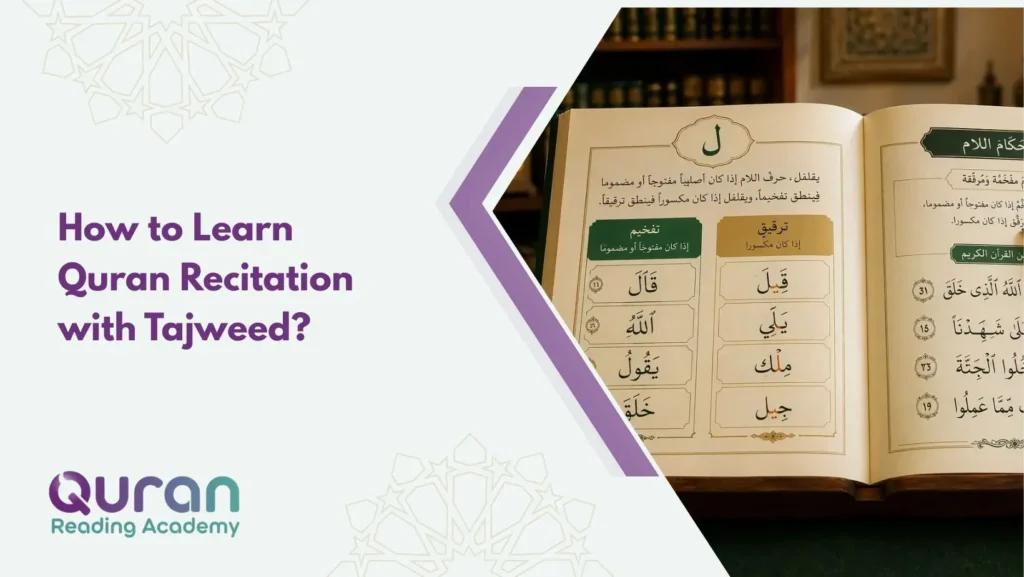
You recite Surah Al-Fatiha seventeen times daily, yet unnoticed Tajweed errors may remain. The Quran was revealed with a precise system of pronunciation transmitted through oral correction.
Learning Quran recitation with Tajweed means pronouncing letters from their correct articulation points, applying Tajweed rules properly, and stopping where the meaning requires. This guide explains the practical journey toward accurate Quran recitation from the very beginning.
1. Tajweed Protects Meaning, Not Just Sound Quality
The most important fact every beginner must understand before starting is this: Tajweed mistakes are not merely aesthetic imperfections. Many of them change the meaning of words entirely.
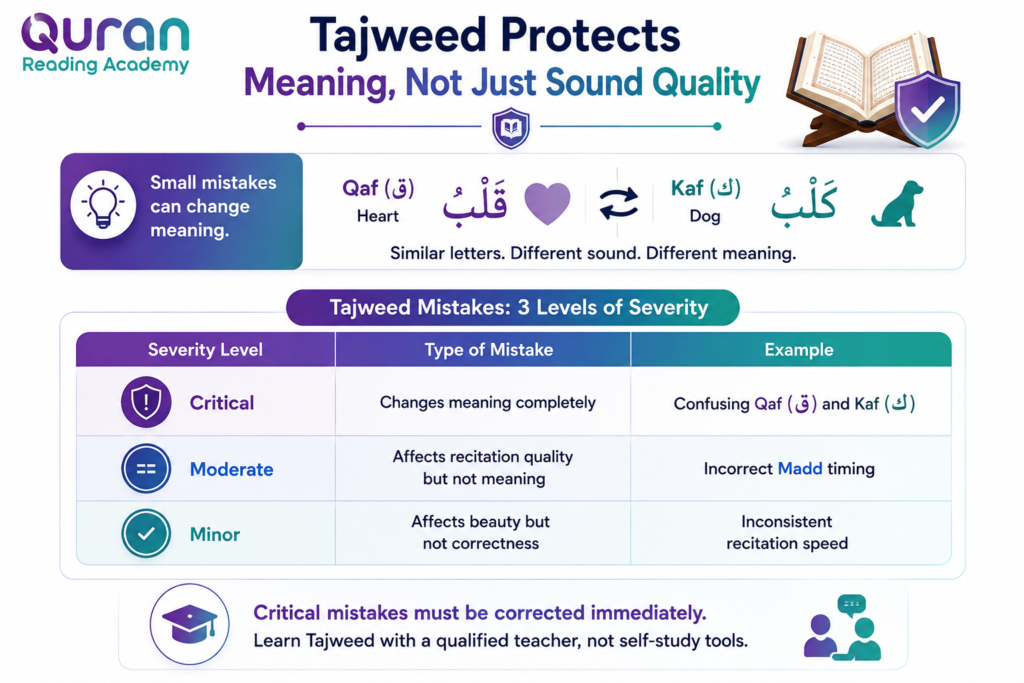
Confusing the letter Qaf with Kaf, for example, changes the word “heart” (قَلْب) into the word “dog” (كَلْب). These two letters are visually similar and produced from nearby points in the mouth, but their articulation points are different, and mixing them produces a different word in a Quranic verse.
Tajweed mistakes are classified into three severity levels:
| Severity Level | Type of Mistake | Example |
| Critical | Changes meaning completely | Confusing Qaf and Kaf |
| Moderate | Affects recitation quality but not meaning | Incorrect Madd timing |
| Minor | Affects beauty but not correctness | Inconsistent recitation speed |
Critical mistakes must be corrected immediately and cannot be treated as minor adjustments. Understanding this from the start explains why learning to read Quran with Tajweed requires a qualified teacher rather than self-study tools alone.
Many beginners start with apps and YouTube videos and unknowingly build incorrect pronunciation habits that take months to correct later. The Quran Reading Academy’s Quran Tajweed Course corrects errors in real time during live sessions before they become permanent habits, guided by Ijazah-certified tutors who specialize in teaching non-Arabic speakers.

Start correcting your Tajweed correctly from the first lesson.
2. The Noorani Qaida Builds the Right Foundation Before the Quran
Adults who attempt to learn Quran recitation with Tajweed by opening the Mushaf immediately face a fundamental problem: they are trying to apply rules to text before they have mastered the building blocks that rules are built on.
The Noorani Qaida solves this by teaching everything in the correct sequence before the learner encounters a single Quranic verse. The Noorani Qaida teaches the following in order:
- The 28 Arabic letters with their correct Makharij and how each letter changes shape in different positions within a word.
- Short vowels (Harakat): Fatha, Kasra, and Damma, and how each changes a letter’s pronounced sound.
- Sukoon: the marker indicating a vowel-less letter that must be closed without any trailing sound.
- Shaddah: the doubling marker requiring the letter to be held and then released cleanly.
- Tanwin: the double-vowel endings that appear frequently in Quranic text.
- Basic Madd rules: natural elongation of two counts applied to the three Madd letters.
- Foundational Noon and Meem rules in simple word combinations before encountering them in complex Quranic sentences.
Most adult students who work through the Noorani Qaida with a qualified teacher complete it within a few weeks and emerge able to read any Arabic word correctly, not just recognize memorized patterns.
See Our Academy in Action
Discover what a typical session looks like! Watch these brief highlights from our live, interactive classes to see how our instructors engage with students of all ages.
Start Your Quran Learning Journey Today
Join Quran Reading Academy and begin structured, step-by-step Quran reading with expert guidance.
Try your first class for free3. Listening to Certified Reciters Trains the Ear Before the Tongue
Tajweed is an oral science. The Prophet (peace be upon him) received the Quran from Jibreel (peace be upon him) through direct oral transmission, and the Companions learned through the same direct listening and repetition. The ear must be calibrated to recognize correct sounds before the tongue can reproduce them reliably.
A learner who begins reciting without adequate listening exposure consistently makes errors that are audible to others but invisible to themselves. They cannot hear the difference because their ear has not yet been trained to perceive it.
The most effective listening practice for Tajweed development follows these steps:

- Select one Surah and one certified Qari.
- Listen to that Qari recite the selected Surah five times without reciting yourself.
- Listen specifically to the Madd lengths, the nasal Ghunna sounds, and the Qalqalah bounce.
- Attempt to imitate the passage verse by verse, pausing after each verse.
- Record your imitation and compare it directly to the original.
Reciters recommended by traditional Tajweed scholars for this purpose include Sheikh Al-Husary, Sheikh Minshawi, and Sheikh Abdul Basit, all of whom are known for clarity of articulation that makes each rule audibly distinct.
4. Applying Tajweed Rules on Real Quranic Text Fixes Them Permanently
Knowing a Tajweed rule theoretically and applying it automatically during recitation are two completely different cognitive states. Many learners who can correctly name and explain the four Noon Sakinah rules still hesitate or make errors when they encounter Ikhfa or Idgham mid-verse in real recitation.
The gap between knowledge and automaticity is bridged only through deliberate, repeated application on actual Quranic text. The proven method for fixing rules through practice is:
- Select one rule to focus on per session, for example, the four rules of Noon Sakinah.
- Open the Mushaf Tajweed and locate every occurrence of that rule on the page being practiced.
- Recite each occurrence slowly, applying the rule deliberately at each instance.
- Do not move to the next page until every occurrence on the current page feels natural without hesitation.
- Record the session and listen back specifically for that rule only.
This approach of focused, single-rule practice on real Quranic text is significantly more effective than drilling isolated word lists. The learner simultaneously builds Tajweed accuracy and reading fluency in the exact context where both will be needed during Salah and personal recitation.
Sisters who need a private learning environment while learning to read Quran with Tajweed will find The Quran Reading Academy’s Quran Reading Classes for Sisters provides sessions conducted exclusively with female tutors holding Ijazah in recitation.

Enroll and practice Tajweed in a private, supported environment.
5. Seven Learning Mistakes That Prevent Real Progress
Many learners fail not because Tajweed is too difficult, but because their learning approach contains structural errors that prevent genuine progress regardless of how much time they invest. Identifying these mistakes is as important as learning the rules themselves.
The seven most common learning mistakes that block Tajweed progress are:
- Relying on unverified online sources: YouTube videos and PDFs without certified authorship often contain errors that create bad habits before the learner knows any better.
- Studying theory without applying it in recitation: Memorizing rule names does nothing unless every rule is practiced during actual recitation sessions repeatedly.
- Skipping Makharij and Sifaat foundations: Jumping directly to Noon and Meem rules before mastering letter articulation produces a weak foundation where every subsequent rule sits incorrectly.
- Never recording own recitation: Learners rarely hear their own errors during live recitation because attention is split between reading, pronouncing, and applying rules simultaneously.
- Practicing without teacher feedback: Self-learning alone allows errors to calcify into habits. A qualified teacher catches mistakes before they become permanent.
- Practicing irregularly: Tajweed builds through daily muscle memory repetition. Practicing for two hours once a week produces far less progress than fifteen minutes every day.
- Beginning memorization while Tajweed is still weak: Memorizing text with incorrect pronunciation encodes the mistakes into memory, making them significantly harder to correct later.
Read Also: How to Learn Noorani Qaida Online Step by Step
6. Consistent Daily Practice Produces Faster Results Than Long Irregular Sessions
The most common mistake adult learners make regarding practice is assuming that longer sessions produce faster results. Tajweed accuracy is built through muscle memory, and muscle memory develops through repetition distributed across time, not through volume in a single sitting.
Fifteen focused minutes every day produces demonstrably faster Tajweed improvement than two hours once a week. A practical daily session structure for a beginner learning Quran recitation with Tajweed:

- Minutes 1 to 5: Review letters or rules from the previous session to reinforce retention.
- Minutes 6 to 15: Practice the new material introduced by the teacher in that week’s lesson.
- Minutes 16 to 20: Listen to a certified Qari reciting the same passage and compare it to your own recorded recitation.
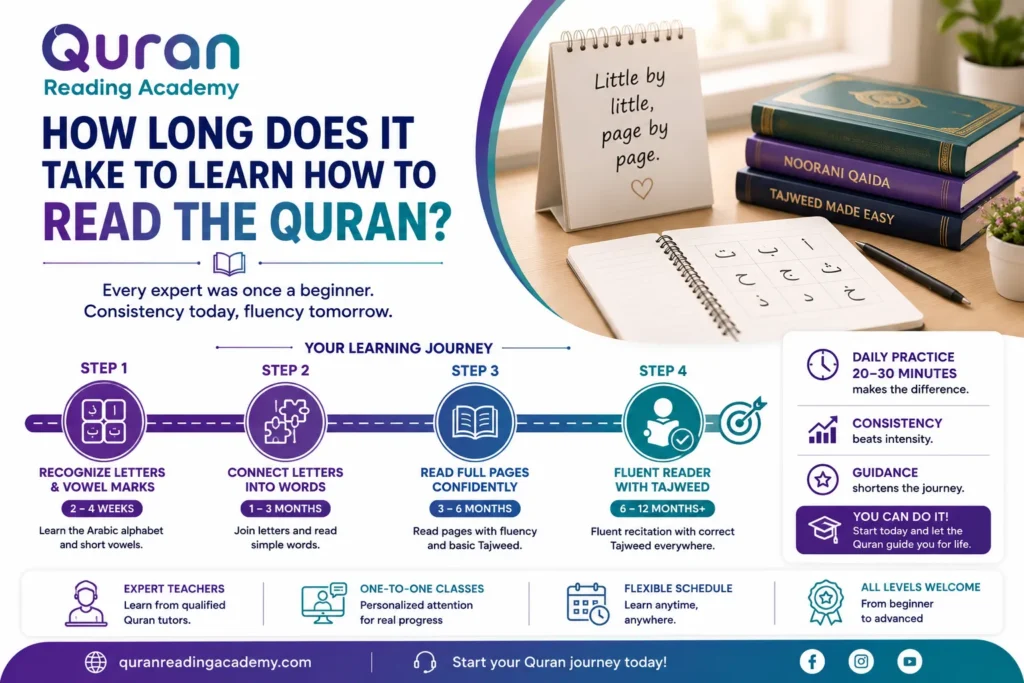
Adult learners who follow this structure consistently report reaching independent Surah reading with correct Tajweed within three to six months of starting from zero. The key variable is not the length of each session but the number of consecutive days the practice is maintained without breaks.
Read Also: How to Learn to Read the Quran for Adults?
7. Recording Your Own Recitation Reveals Errors That Are Invisible During Live Practice
One of the most consistently effective self-improvement tools for Tajweed learners is recording their own recitation and listening back critically. During live recitation, the learner’s attention is divided between reading the text, pronouncing each letter, and applying rules simultaneously. This cognitive load prevents the brain from fully monitoring the output. Recording removes this constraint entirely.
Errors that are clearly audible in playback are completely invisible during live recitation. This is not a failure of the learner’s ability; it is a predictable consequence of how divided attention works during active reading.
A structured self-recording practice for Tajweed improvement involves these steps:
- Record five to ten verses at a natural pace without stopping to self-correct.
- Play back the recording and listen specifically for one category of error at a time, not everything simultaneously.
- Mark the exact words in the Mushaf where the error occurred.
- Practice those specific words slowly until the correct pronunciation is automatic.
- Record the same passage again and compare the two recordings.
Learners who maintain a written log of errors identified through recordings consistently track which mistakes are recurring versus which have been corrected. Recurring errors on the same letter or rule point to a Makharij foundation problem that requires teacher intervention.
Read Also: How to Learn Quran Reading with Tajweed for Beginners?
Inside Our Live Classroom
We believe in complete transparency. Take a look inside our virtual classrooms to experience our premium teaching tools and engaging learning environment firsthand.
Start Your Quran Learning Journey Today
Join Quran Reading Academy and begin structured, step-by-step Quran reading with expert guidance.
Try your first class for freeStart Your Tajweed Journey at The Quran Reading Academy
The Quran Reading Academy provides every learner with what Tajweed learning genuinely requires:
- Certified Arab tutors holding Ijazah in recitation from recognized institutions.
- One-on-one live sessions tailored specifically to each student’s individual mistake patterns.
- Real-time Makharij correction using audio-visual feedback during every session.
- Flexible scheduling covering all global time zones including EST, PST, GMT, CET, and IST.
- Monthly progress reports and written feedback provided after every session.
- Affordable pricing with transparent packages and family enrollment discounts.
- Serves students across North America, Europe, Asia, and the Middle East.
Our Quran Courses
- Quran Reading Classes
- Quran Reading Classes for Kids
- Quran Reading Classes for Adults
- Quran Reading Classes for Female/Sisters
- Quran Reading Classes for New Muslims
- Quran Reading Course for Beginners
- Online Quran Reading Course with Tajweed
- Reading and Memorizing the Quran Course
- Noorani Qaida Course
- Quran Course for Beginners
- Quran Tajweed Course
- Quran Recitation Course
- Quran Hifz Course
- Online Quran Qirat Classes
- Quranic Arabic Course
- Arabic Reading Practice Course

Register now and book your free trial today.
Conclusion
How to learn Quran recitation with Tajweed follows a clear sequence: understand how Tajweed protects meaning, build a foundation through the Noorani Qaida, train your ear through listening, apply rules to Quranic text, avoid common learning mistakes, practise daily, and use self-recording for correction. Each stage builds on the previous one, helping prevent gaps that can develop into persistent recitation errors.
Frequently Asked Questions
Is Tajweed obligatory for every Muslim who recites the Quran?
Yes. Scholars of Ahl al-Sunnah wal-Jama’ah hold that applying Tajweed during recitation is obligatory on every Muslim who recites.
How long does it take to correct an established Tajweed mistake?
Correcting a critical mistake that has become habit requires two to six months of consistent daily practice with qualified teacher feedback, depending on the severity.
Can someone learn Quran recitation with Tajweed entirely through apps?
No. Apps provide exposure but cannot identify Makharij errors or apply real-time correction. A certified teacher is necessary for genuine Tajweed accuracy.
What is the difference between Madd Asli and Madd Far’i?
Madd Asli is the natural two-count elongation that occurs when a Madd letter is not followed by a Hamzah or Sukoon. Madd Far’i is the extended elongation of four, five, or six counts triggered by specific conditions.
Why does Tajweed require daily practice rather than longer weekly sessions?
Because Tajweed accuracy is built through muscle memory, which develops through repeated daily practice, not through volume in isolated sessions.
At what point should a learner move from the Noorani Qaida to the Quran?
When the learner can read any connected Arabic text fluently, apply basic vowel and Sukoon rules automatically, and produce all 28 letters from their correct Makharij without hesitation.
Related Articles
How to read Quran









Leave a Reply