 How to read Quran
Learning to learn Quran reading with Tajweed for beginners can feel confusing when too many rules are introduced at once. Tajweed for beginners is not about memorizing every rule immediately, but building correct pronunciation habits step by step. With the right roadmap, proper foundations, and consistent practice, beginners can gradually develop accurate Quran recitation.
1. Setting a Clear Goal Before Anything Else Determines Your Path
The first question a beginner must answer before opening any Tajweed book or enrolling in any class is: what does success look like for me? This is not a generic motivational point. It has direct consequences for how the entire learning journey is structured.
A beginner whose goal is to recite Surah Al-Fatiha correctly in Salah needs a completely different starting point than someone whose goal is to read the entire Quran with fluent Tajweed. The table below shows how goals determine the appropriate starting path:
| Goal | Starting Point | Realistic Timeline |
| Correct Salah recitation | Master Surah Al-Fatiha with Tajweed | 4 to 6 weeks of daily practice |
| Read Juz Amma with Tajweed | Complete Noorani Qaida, then short Surahs | 3 to 5 months |
| Read full Quran with Tajweed | Noorani Qaida, then Nazra with Tajweed | 6 months to 1 year |
Without this clarity, beginners try to learn everything simultaneously and master nothing. Setting one concrete goal and following the path that leads directly to it is what separates beginners who succeed from those who give up.
Many beginners who are new to Islam have the specific goal of reading the Quran correctly as part of their journey of faith. The Quran Reading Academy’s Quran Reading Classes for New Muslims is built specifically around this starting point, guiding new learners from their first Arabic letter through their first confident recitation.

Start your Quran reading journey with a teacher who understands your beginning.
2. The Color-Coded Mushaf Tajweed Makes Rules Visible While You Read
One of the most underused tools for beginners learning Quran reading with Tajweed is the Mushaf Tajweed, a printed Quran copy that marks every Tajweed rule with a specific color directly on the text. Instead of stopping to ask which rule applies to a word, the learner sees it on the page while reading.
This tool works in practice because it connects rule knowledge to real Quranic text immediately. The beginner does not need to remember which letters trigger Ikhfa during recitation.
The color marking on the Mushaf shows it. Over time, the learner begins to associate the color with the correct sound automatically, and the rule becomes internalized through the reading itself rather than through separate memorization.
The standard color system in the Mushaf Tajweed works as follows:
- Red marks Madd letters and elongation rules.
- Blue marks Ghunna, the nasal sound in Mim and Nun.
- Green marks Qalqalah letters requiring the echoing bounce sound.
- Yellow and orange mark Ikhfa, Iqlab, and Idgham rules.
Using this tool from the first week of Quran reading removes the mental load of remembering rules separately from reading, and allows the learner to build Tajweed habits through recitation itself.
See Our Academy in Action
Discover what a typical session looks like! Watch these brief highlights from our live, interactive classes to see how our instructors engage with students of all ages.
Start Your Quran Learning Journey Today
Join Quran Reading Academy and begin structured, step-by-step Quran reading with expert guidance.
Try your first class for free3. Accuracy Before Speed Is the Rule That Prevents All Major Mistakes
The most damaging habit beginners develop is rushing. Reading fast creates a false sense of progress while destroying the quality of every letter and rule simultaneously. Tajweed accuracy is built through slow, deliberate, correct recitation that is then gradually sped up only after correctness is established.
This principle applies at every level of the beginner’s journey:
- When learning a new letter, say it slowly ten times before connecting it to the next letter.
- When practicing a new rule, apply it deliberately every single time it appears before moving forward.
- When reading a verse, prioritize pronouncing every letter correctly over reaching the end of the verse quickly.
The practical method for applying this principle is to read in units of three to five words rather than full verses. Recite three words slowly and correctly, pause, then recite the same three words again. Only after both recitations feel natural should the learner add the next three words.
This word-by-word building approach prevents the accumulation of errors that come from reading full verses before individual word accuracy is established.
4. Five Beginner Tajweed Rules That Appear Most Frequently in Actual Reading
Beginners are often told to learn all Tajweed rules before starting to read. This is incorrect. Five rules cover the overwhelming majority of what a beginner will encounter in Juz Amma and daily Salah recitation. Mastering these five before any others gives the beginner functional Tajweed for actual reading:
Makharij
The articulation points of every Arabic letter. This is the foundation without which every other rule sits incorrectly. Each letter originates from a specific location in the mouth, throat, lips, or nasal cavity. Pronouncing a letter from the wrong location produces a different letter.
Noon Sakinah and Tanwin rules
The four rules (Izhar, Idgham, Iqlab, Ikhfa) that govern how a vowel-less Noon or double-vowel ending behaves before different letters. These appear in virtually every line of Quranic text.
Madd (elongation)
The natural two-count Madd that applies to the three Madd letters (Alif, Waw, Ya) when they appear without a Hamzah or Sukoon following them. Getting the basic count right prevents the most common beginner elongation errors.
Qalqalah
The echoing bounce sound required on five specific letters (Qaf, Ta, Ba, Jim, Dal) when they carry a Sukoon or appear at the end of a word during a stop.
Heavy and light letters (Tafkhim and Tarqiq)
Seven letters are always heavy and must be recited with the back of the tongue raised. All other letters carry a light, flat sound. Mixing these changes the acoustic character of recitation fundamentally.
Learning these five rules in this order, applied to real Quranic text, gives the beginner everything needed for correct daily recitation before moving to more advanced rules.
5. Practicing with Familiar Surahs Accelerates Tajweed Acquisition
One of the most effective yet underused strategies for beginners learning Quran reading with Tajweed is practicing on Surahs they already know from memory. When a learner already knows what comes next, they are freed from the reading task entirely. All cognitive attention shifts to the Tajweed application, which is exactly where the focus needs to be.
Surah Al-Fatiha, for example, is recited by every Muslim in every unit of every prayer. A beginner who applies Tajweed rules to Al-Fatiha specifically will encounter Madd in multiple positions, Ghunna in the nasalized letters, and correct stopping at each verse end. Because they already know the text, they can focus entirely on the quality of each sound.
The recommended practice progression using familiar Surahs is:
- Begin with Surah Al-Fatiha and identify every rule that applies using the Mushaf Tajweed.
- Recite it rule by rule, focusing on one rule category per session.
- Move to Al-Ikhlas, An-Nas, Al-Falaq, Al-Kawthar, and Al-Asr in that order.
- Record each session and listen back, comparing the recitation to a certified Qari.
- Only move to unfamiliar Surahs after all familiar Surahs feel natural with Tajweed applied.
This approach builds real confidence because the learner experiences what correct Tajweed feels like on text they know, before applying it to new text they must read simultaneously.
The children in a family often benefit from the same structured approach as beginners.
The Quran Reading Academy’s Quran Reading Classes for Kids uses exactly this method, building Tajweed through familiar Surahs before progressing to new reading material.

Enroll your child in a program that teaches Tajweed correctly from the first lesson.
6. Daily Listening Outside of Practice Sessions Trains Pronunciation Passively
Listening to correct Quranic recitation outside of active practice sessions is one of the fastest ways to develop natural Tajweed pronunciation. The ear processes correct sounds even during passive exposure, and this exposure creates a reference point the learner unconsciously compares their own pronunciation against.
Beginners who incorporate daily listening report that certain errors in their own recitation become suddenly obvious once their ear is calibrated to the correct sound. Rules they struggled to apply consciously begin to feel natural because the ear has heard them hundreds of times and now recognizes when they are missing.
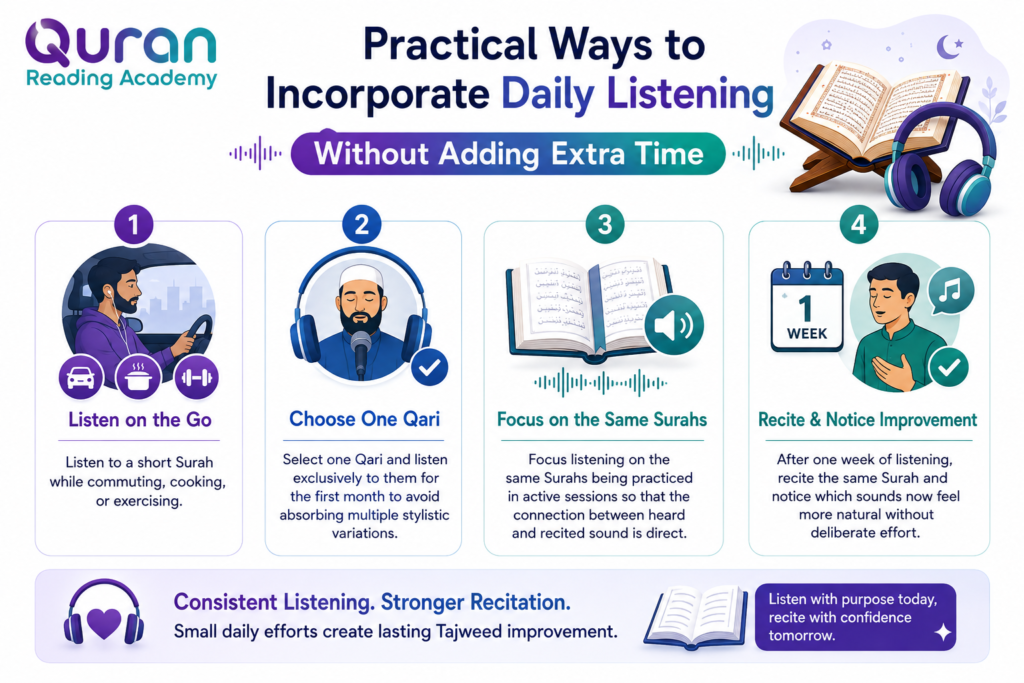
Practical ways to incorporate daily listening without requiring additional time:
- Listen to a short Surah while commuting, cooking, or exercising.
- Select one Qari and listen exclusively to them for the first month to avoid absorbing multiple stylistic variations.
- Focus listening on the same Surahs being practiced in active sessions so that the connection between heard and recited sound is direct.
- After one week of listening, recite the same Surah and notice which sounds now feel more natural without deliberate effort.
Listening transforms from a passive activity into an active learning tool when it is paired with the same material being practiced in sessions. The two reinforce each other in a way that neither accomplishes alone.
Read Also: How to Learn to Read the Quran for Adults?
7. Immersing Yourself in the Meaning Deepens Commitment to Correct Recitation
A significant number of beginners who start learning Quran reading with Tajweed for beginners lose motivation after a few weeks because the process feels purely technical.
They are practicing sounds and rules without connecting them to what they are actually saying. Connecting Tajweed practice to the meaning of verses transforms that technical exercise into an act of worship with real spiritual weight.
This does not require studying advanced Tafsir. It requires only reading a reliable English translation of the Surahs being practiced.
When a beginner understands that Surah Al-Asr is telling them that every human being is in a state of loss except those who have faith, act righteously, counsel each other to truth, and counsel each other to patience, their recitation of that Surah changes. They are no longer practicing a sequence of sounds. They are reciting a message they understand.
Practical ways to connect meaning to Tajweed practice for beginners:
- Read the English translation of each Surah being practiced before beginning the recitation session.
- Pause briefly at the end of each verse and reflect on what was just said.
- Recite in Salah with the intention of saying what the verse means, not merely producing the sounds.
This connection between meaning and pronunciation makes Tajweed practice sustainable across months rather than weeks, which is exactly the timeline required to build genuine reading proficiency.
Read Also: How to Learn Quran Recitation with Tajweed?
Inside Our Live Classroom
We believe in complete transparency. Take a look inside our virtual classrooms to experience our premium teaching tools and engaging learning environment firsthand.
Start Your Quran Learning Journey Today
Join Quran Reading Academy and begin structured, step-by-step Quran reading with expert guidance.
Try your first class for freeStart Learning Quran Reading with Tajweed at The Quran Reading Academy
The Quran Reading Academy gives beginners everything needed to build Tajweed correctly from the very first lesson:
- Certified Arab tutors holding Ijazah in recitation from recognized institutions.
- One-on-one live sessions tailored specifically to each student’s individual mistakes.
- Real-time Makharij correction using audio-visual feedback during every session.
- Flexible scheduling covering all global time zones including EST, PST, GMT, CET, and IST.
- Monthly progress reports and written feedback provided after every session.
- Affordable pricing with transparent packages and family enrollment discounts.
- Serves students across North America, Europe, Asia, and the Middle East.
Our Quran Courses
- Quran Reading Classes
- Quran Reading Classes for Kids
- Quran Reading Classes for Adults
- Quran Reading Classes for Female/Sisters
- Quran Reading Classes for New Muslims
- Quran Reading Course for Beginners
- Online Quran Reading Course with Tajweed
- Reading and Memorizing the Quran Course
- Noorani Qaida Course
- Quran Course for Beginners
- Quran Tajweed Course
- Quran Recitation Course
- Quran Hifz Course
- Online Quran Qirat Classes
- Quranic Arabic Course
- Arabic Reading Practice Course

Register now and book your free trial today.
Conclusion
How to learn Quran reading with Tajweed for beginners follows a practical sequence: set a clear goal, use the Mushaf Tajweed as a visual guide, prioritize accuracy over speed, master the most frequent Tajweed rules, practise with familiar Surahs, listen daily to improve your ear, and understand the meaning of what you recite. These steps are accessible to beginners from the first week and provide a structured path toward accurate Quran recitation.
Frequently Asked Questions
Do beginners need to learn the Arabic alphabet before starting Tajweed?
Yes. Tajweed rules are applied to Arabic letters. Without knowing the letters and their basic sounds, no rule can be applied correctly.
Is it possible to learn Quran reading with Tajweed for beginners without a teacher?
Apps and self-study books develop some rule knowledge, but they cannot identify Makharij errors in a learner’s own pronunciation. A qualified teacher is essential for genuine accuracy.
How many Tajweed rules does a beginner need to know to start reading?
Five foundational rules cover most of what appears in daily recitation: Makharij, Noon Sakinah and Tanwin rules, basic Madd, Qalqalah, and heavy and light letter distinction.
Why is accuracy more important than speed when learning Tajweed?
Because incorrect pronunciation practiced at speed becomes a muscle memory habit that takes months to correct. Slow and correct builds habits that speed up naturally over time.
How long does it take to learn Quran reading with Tajweed for beginners?
A beginner practicing daily reaches functional Tajweed accuracy in three to six months. Full reading fluency with Tajweed across the Quran takes longer depending on commitment.
Can children and adults use the same learning approach for Tajweed?
The foundational sequence is the same. The teaching methods and pacing are adjusted based on age and learning capacity, but the order of skill acquisition remains identical.
Related Articles
How to read Quran









Leave a Reply