 How to read Quran
If you’ve just started looking into this, you’ve probably already noticed the wildly different answers online — some sites promise 60 days, others talk about years. Here’s the honest version: how long it takes to learn how to read the Quran depends mainly on your starting point and how consistently you practice, not on any fixed calendar.
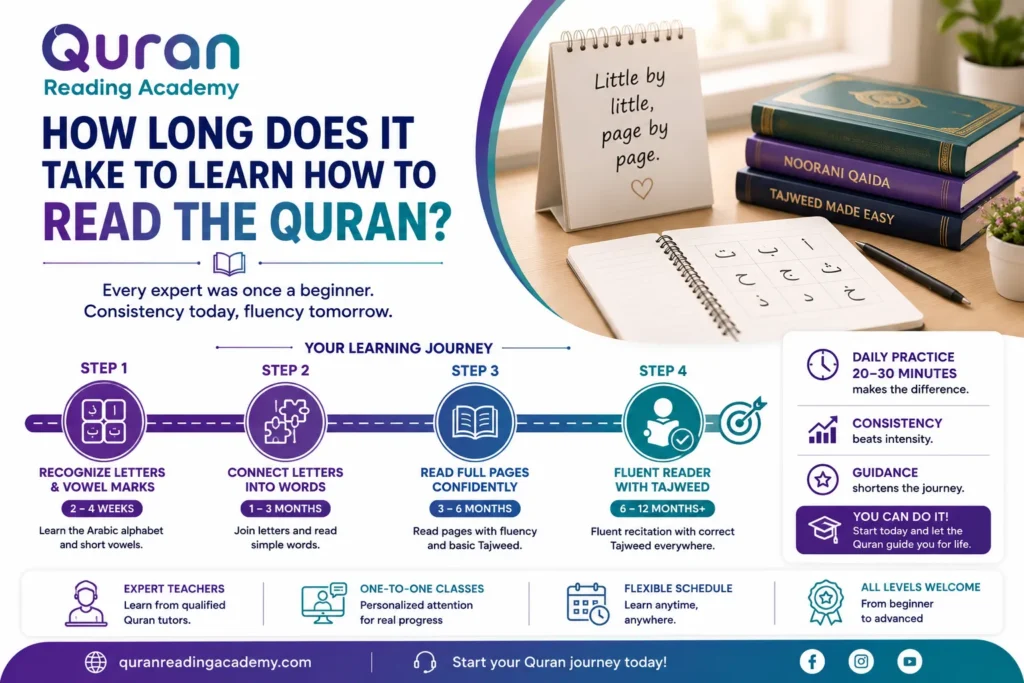
For a complete beginner studying 20 to 30 minutes a day, reading the Arabic text of the Quran with reasonable fluency typically takes 3 to 6 months. Recognizing the alphabet alone takes 2 to 4 weeks, connecting letters into words takes another 1 to 3 months, and reading full pages smoothly with basic Tajweed usually follows within 3 to 6 months of steady practice.
At Quran Reading Academy,”how long does it take to learn how to read the Quran” is the very first question almost every new student asks us, and we’ve watched hundreds of adult students move through this process. The pattern is consistent: the students who show up daily for short sessions outpace the ones who study in long, irregular bursts by a wide margin.
How Long Does It Take To Learn How To Read The Quran?
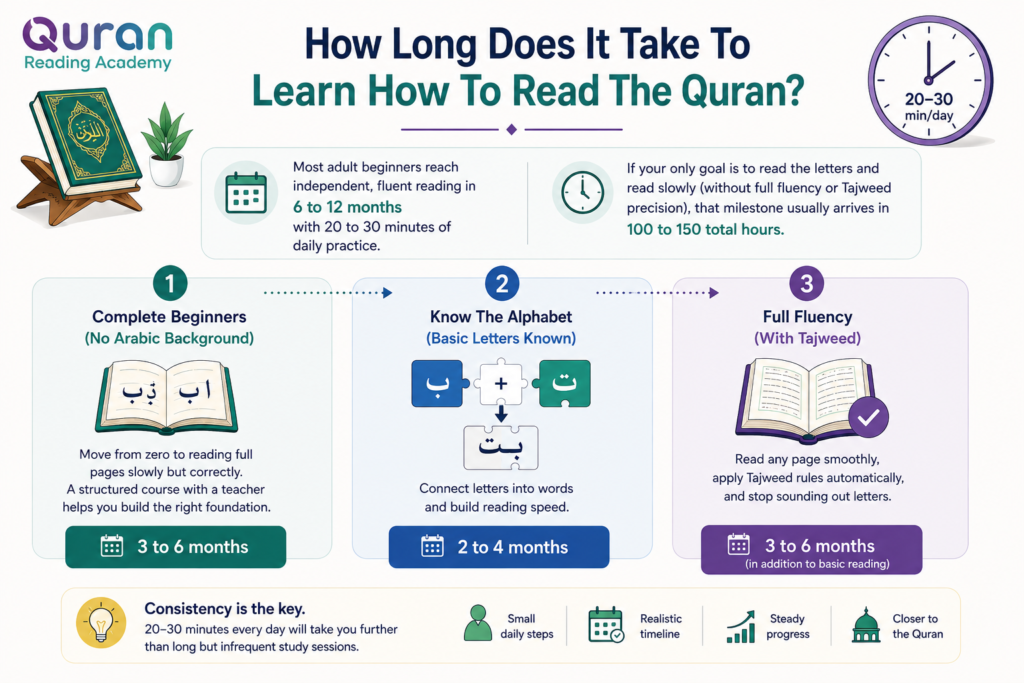
The direct answer: most adult beginners reach independent, fluent reading in 6 to 12 months with 20 to 30 minutes of daily practice. If your only goal is to sound out the letters and read slowly (without full fluency or Tajweed precision), that milestone usually arrives in 100 to 150 total hours of focused learning.
That range is wide because “learning to read the Quran” isn’t one skill — it’s three stacked skills, and people usually only ask how long does it take to learn how to read the Quran without realizing it’s several stages bundled into one question.
Read also: How Long Does It Take To Read One Juz Of The Quran?
1. Complete Beginners With No Arabic Background
Expect 3 to 6 months to move from zero to reading full pages slowly but correctly. This is the stage where a structured Quran Reading Course for Beginners makes the biggest difference, because a teacher catches pronunciation mistakes before they become habits.
2. Know The Arabic Alphabet
You’ll likely skip 4 to 8 weeks of the timeline. Your remaining work is connecting letters into words and building reading speed, which usually takes 2 to 4 months rather than the full 3 to 6.
3. Full Fluency With Correct Tajweed
Add another 3 to 6 months on top of basic reading. Fluency here means reading any unfamiliar page smoothly, applying core Tajweed rules automatically, and not stopping to sound out individual letters.
Read Also: How Long Does It Take To Read One Juz Of The Quran?
What “Learning To Read The Quran” Actually Means?
Before the timeline makes sense, it helps to separate the three things people usually lump together when they ask how long does it take to learn how to read the Quran. Confusing these three stages is the single biggest reason people misjudge the process.
1. Recognizing The Alphabet And Vowel Marks
This is the foundation: the 28 Arabic letters, their different shapes depending on position in a word, and the short vowel marks (fatha, kasra, damma) that tell you how to pronounce each letter. Most students learn this stage through a Noorani Qaida, the traditional primer used to teach Quranic reading from the ground up.
Non-Arabic speakers face a real hurdle here that Arabic speakers don’t: producing sounds that don’t exist in English, like the heavy ض or the throat-cleared ح. This is normal, not a sign you’re bad at languages — it’s a physical skill that improves with repetition, not memorization.
2. Connecting Letters Into Words
Once you know the letters, you learn how they join together, since Arabic script changes letter shapes depending on whether a letter starts, sits in the middle of, or ends a word. Students who skip a dedicated Qaida and jump straight to a Mushaf often struggle here longer than they need to, because they’re decoding shapes and reading meaning at the same time.
A Noorani Qaida Course exists specifically to isolate this skill so you’re not fighting two problems at once.
3. Reading Fluently With Basic Tajweed
This is the finish line most people actually mean when they ask “how long does it take.” Fluent reading means opening any page and reciting it smoothly, applying the basic rules of correct pronunciation (Tajweed) without consciously thinking through each rule.
You can technically read Arabic script without knowing the formal names of Tajweed rules, but applying the correct sounds isn’t optional if the goal is proper Quran recitation. An Online Quran Reading Course with Tajweed builds this in from the start rather than treating it as an afterthought.
Read also: How Long Does It Take to Read 20 Pages of Quran?
See Our Academy in Action
Discover what a typical session looks like! Watch these brief highlights from our live, interactive classes to see how our instructors engage with students of all ages.
Start Your Quran Learning Journey Today
Join Quran Reading Academy and begin structured, step-by-step Quran reading with expert guidance.
Try your first class for freeThe Stage-By-Stage Timeline To Learn Quran Reading
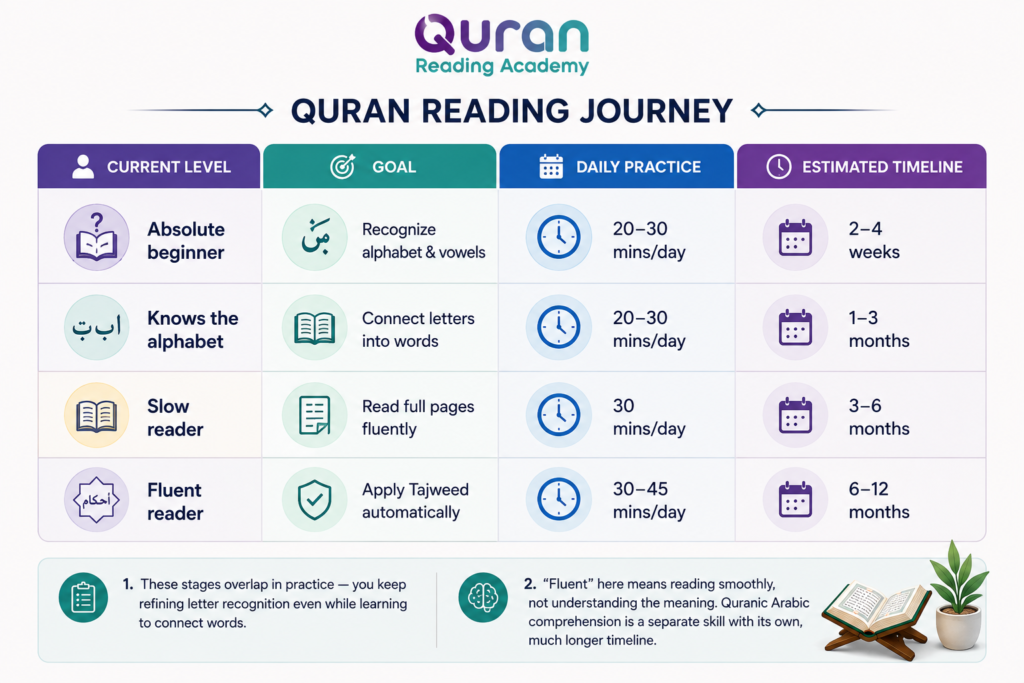
Once you know how long does it take to learn how to read the Quran in general terms, it helps to see the stages laid out side by side, assuming consistent daily practice rather than occasional study sessions.
| Current level | Goal | Daily practice | Estimated timeline |
| Absolute beginner | Recognize alphabet & vowels | 20–30 mins/day | 2–4 weeks |
| Knows the alphabet | Connect letters into words | 20–30 mins/day | 1–3 months |
| Slow reader | Read full pages fluently | 30 mins/day | 3–6 months |
| Fluent reader | Apply Tajweed automatically | 30–45 mins/day | 6–12 months |
Two things worth noting about this table. First, these stages overlap in practice — you keep refining letter recognition even while learning to connect words. Second, “fluent” here means reading smoothly, not understanding the Arabic meaning of what you’re reading; that’s a separate skill (Quranic Arabic comprehension) with its own, much longer timeline.
What Changes Your Personal Timeline?
Every student who asks how long does it take to learn how to read the Quran is really asking about three variables that explain almost all the difference between someone who reaches fluency in 6 months and someone who’s still stuck after two years. None of them are about natural talent.
1. Your Daily Practice Consistency
Twenty minutes every single day outperforms two hours once a week, and it isn’t close. Each session you skip means the next session starts by re-learning what your brain half-forgot, rather than building on what you knew. Consistency compounds; intensity without consistency mostly resets.
2. Whether You Have A Teacher Correcting You In Real Time
Self-teaching from apps or videos works for the alphabet stage, but pronunciation mistakes are hard to hear in your own voice.
A teacher catches a mispronounced ح or a swallowed vowel in real time, before it hardens into a habit you’ll spend months unlearning. This is the main reason online, one-on-one instruction consistently outpaces solo study for the Tajweed stage specifically.
3. Your Language Background
Speakers of Urdu, Farsi, or other languages that use Arabic script (even with different letters added) often move through the alphabet stage faster, since the right-to-left reading direction and letter-joining logic already feel familiar. Native English or European-language speakers typically need the full 2 to 4 weeks on letter recognition alone, since both the script direction and several sounds are entirely new.
Rather than moving to the next stage on a fixed schedule, test yourself against three checkpoints before advancing. Can you name any letter shown in isolation without hesitating? Can you read a five-letter word without sounding out each letter separately? Can you read one full line without stopping to decode a shape?
If you can answer yes to a checkpoint, move forward. If not, stay on the current stage for another 1 to 2 weeks rather than pushing ahead on a fixed timetable — rushing past a shaky checkpoint is the single most common reason students plateau later.
This is also where working with a teacher through Quran Reading Academy’s Quran Reading Course for Beginners helps, since an instructor tests these checkpoints for you instead of leaving it to guesswork.
Read also: How Long Does It Take to Read 20 Pages of Quran?
Reading The Quran Vs. Memorizing It: Two Different Timelines
It’s worth being direct about this, because a lot of the confusion around how long does it take to learn how to read the Quran comes from mixing up two separate goals.
Learning to read the Quran means being able to open the Mushaf and recite any page correctly, without necessarily knowing it by heart. Memorizing the Quran (Hifz) means committing the text to memory so you can recite it without the book in front of you — a much longer undertaking that typically takes several years of dedicated daily effort.
You cannot skip reading fluency to get to memorization faster. Trying to memorize a page you can’t yet read smoothly means your brain is doing two difficult jobs at once — decoding the script and storing it in memory — and both suffer.
Students who spend their first months purely on reading, then move into a Reading and Memorizing the Quran Course, consistently memorize faster than those who try to do both from day one.
Read Also: Do You Have to Read the Quran in Arabic?
Common Mistakes That Slow Down Quran Reading Progress
A few avoidable habits explain most of the “I’ve been trying for a year and I’m still stuck” stories we hear.
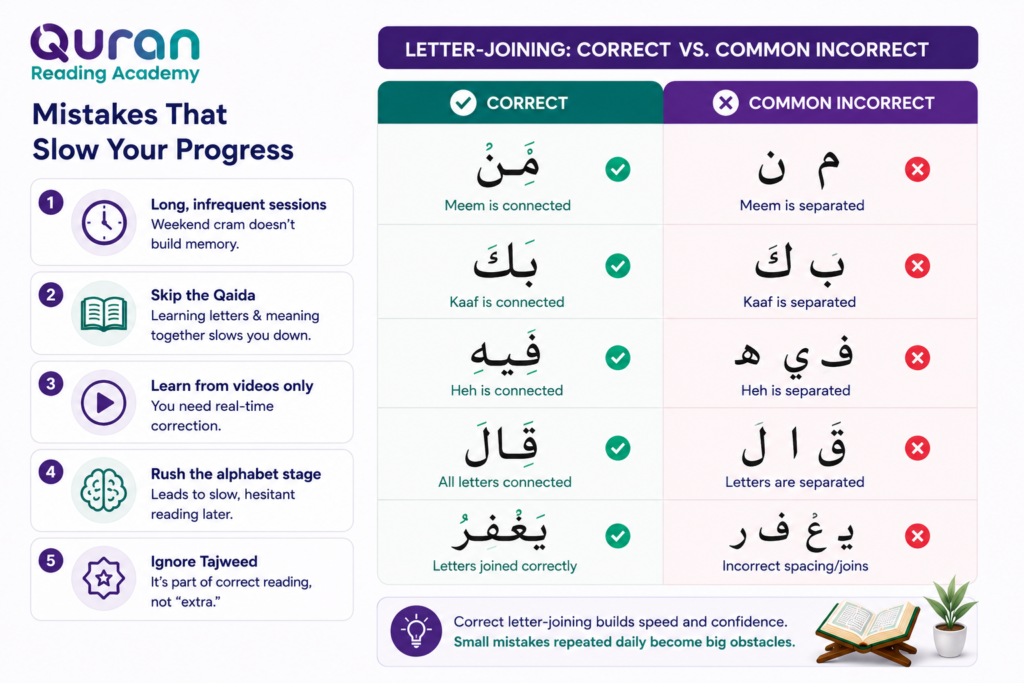
- Studying in long, infrequent sessions instead of short daily ones — a weekend cram session doesn’t build the muscle memory that daily repetition does.
- Skipping the Qaida and jumping straight to Quran text, which forces you to learn letter-joining and meaning simultaneously.
- Learning from disconnected videos without anyone correcting your pronunciation in real time.
- Rushing past the alphabet stage before letter recognition is automatic, which shows up later as slow, hesitant reading.
- Treating Tajweed as optional “extra credit” rather than part of correct reading from the start.
Inside Our Live Classroom
We believe in complete transparency. Take a look inside our virtual classrooms to experience our premium teaching tools and engaging learning environment firsthand.
Start Your Quran Learning Journey Today
Join Quran Reading Academy and begin structured, step-by-step Quran reading with expert guidance.
Try your first class for freeStart Reading The Quran With Confidence Today
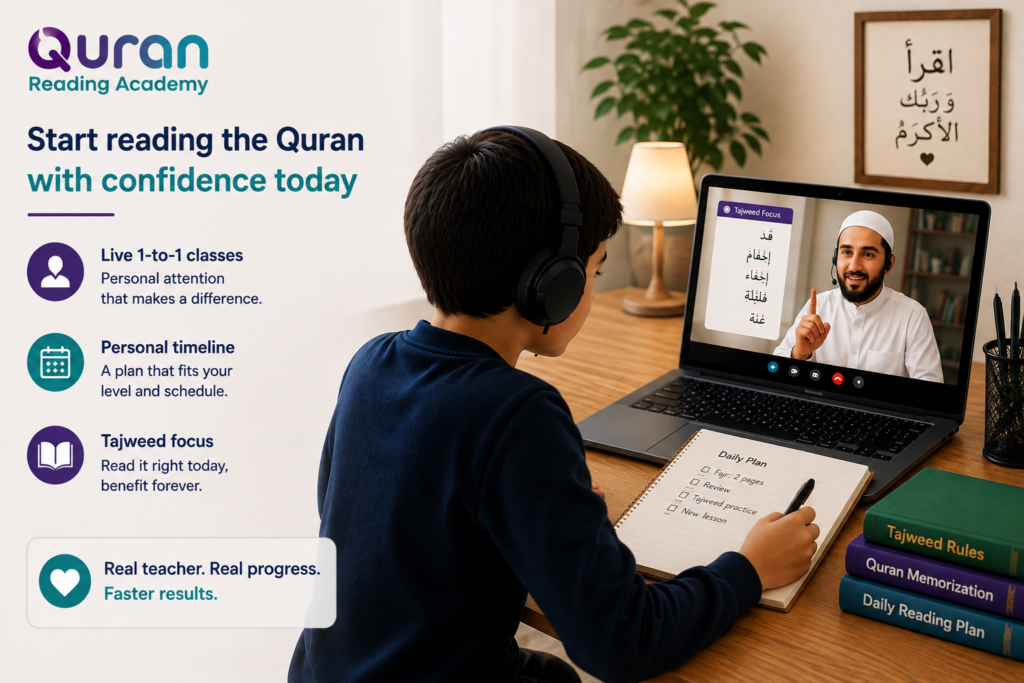
You don’t need to solve this alone, and you don’t need a two-year plan to get started — you need the next 20 minutes of practice done correctly. Quran Reading Academy pairs you with a dedicated instructor who builds your personal reading timeline around your actual schedule and current level, not a generic course calendar.
Whether you’re starting from zero, coming back after years away from the Mushaf, or ready to move from slow reading into full Tajweed fluency, a real teacher shortens the timeline more than any app or video series can.
Our Quran Courses:
- Quran Reading Classes
- Quran Reading Classes for Kids
- Quran Reading Classes for Adults
- Quran Reading Classes for Female/Sisters
- Quran Reading Classes for New Muslims
- Quran Reading Course for Beginners
- Online Quran Reading Course with Tajweed
- Reading and Memorizing the Quran Course
- Noorani Qaida Course
- Quran Course for Beginners
- Quran Tajweed Course
- Quran Recitation Course
- Quran Hifz Course
- Online Quran Qirat Classes
- Quranic Arabic Course
- Arabic Reading Practice Course
If you’re new to Islam specifically, Quran Reading Academy’s Quran Reading Classes for New Muslims start from true zero and move at a pace built for that starting point.
Start Your Quran Learning Journey Today
Join Quran Reading Academy and begin structured, step-by-step Quran reading with expert guidance.
Try your first class for freeConclusion
So, how long does it take to learn how to read the Quran? It isn’t a single milestone — it moves through recognizing the alphabet, connecting letters into words, and reading fluently with correct Tajweed, and each stage has its own realistic timeframe. Most adult beginners studying 20 to 30 minutes a day can expect 3 to 6 months to read comfortably and 6 to 12 months to reach real fluency.
The variables that matter most are daily consistency and having a teacher who corrects your pronunciation in real time — not talent, not age, and not how many hours you can occasionally squeeze into a weekend.
Whatever pace fits your life, a structured plan through Quran Reading Academy will get you reading the Quran with confidence faster than guessing your way through it alone.

Frequently Asked Questions
The questions below cover the details adult learners ask most often once they’ve decided to start — from timelines for specific situations to how reading differs from memorization.
1. How long does it take to learn to read the Quran as a complete beginner?
Most complete beginners reach basic reading fluency within 3 to 6 months, studying 20 to 30 minutes daily. This assumes starting with the Arabic alphabet and progressing through a structured Qaida rather than jumping directly into Quran text.
2. Can adults learn to read the Quran, or is it easier for children?
Yes, adults learn to read the Quran successfully and often progress faster than expected. Adults tend to grasp grammatical logic and letter-joining rules more quickly than young children, even if pronunciation takes a bit more conscious practice.
3. How long does Noorani Qaida take to complete?
Most students complete a Noorani Qaida in 1 to 3 months with consistent daily practice. The exact pace depends on prior exposure to Arabic script and how many minutes per day you dedicate to it.
4. Do I need to already know Arabic to start reading the Quran?
No, you don’t need any prior Arabic knowledge to start. A structured beginner course starts from the alphabet itself, so complete beginners and those with no Arabic background follow the same starting point.
5. How long does it take to read the entire Quran once, from start to finish?
Reading the full Quran once, cover to cover, typically takes 20 to 30 hours of active reading time for someone who already reads Arabic script fluently. Beginners still building fluency will take considerably longer, since reading speed is still developing.
6. Is learning to read the Quran different from memorizing it?
Yes, these are two distinct skills with very different timelines. Reading fluency (recognizing and reciting the text correctly) typically takes months, while memorization (Hifz) is a multi-year commitment that should generally begin only after reading fluency is solid.
Related Articles
How to read Quran



Leave a Reply