 Times for Reading
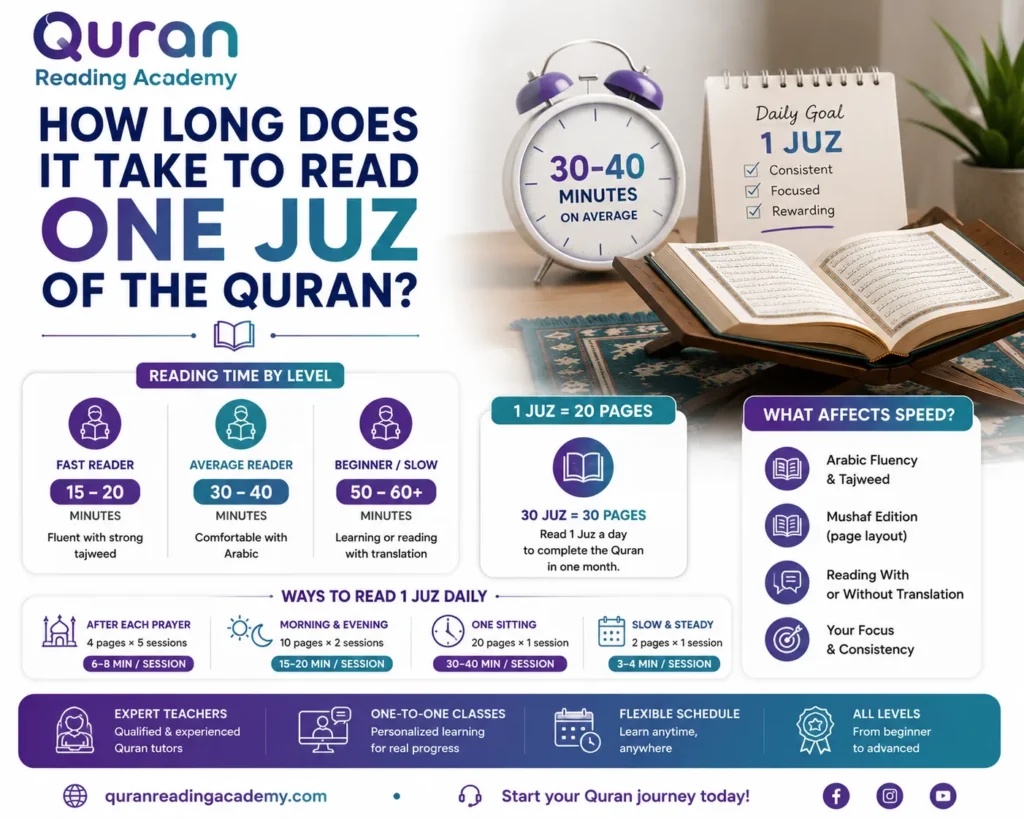
If you’re planning a daily Quran reading habit, the question “how long does it take to read one juz of the Quran” usually comes up first. On average, reading one juz takes 30 to 40 minutes for someone who reads Arabic comfortably. A juz is roughly 20 pages of the standard Madani Mushaf, so the time comes down mostly to your reading speed and how familiar you are with the Arabic script.
That range shifts depending on who’s reading. A fluent reader with strong tajweed can move through a juz in 15 to 20 minutes, while a beginner working through unfamiliar letters, or reading alongside a translation, may need an hour or more. Neither pace is wrong — they just serve different goals.
This guide breaks down realistic reading speeds, what actually changes the time it takes, and how to split one juz into a schedule you can stick to. At Quran Reading Academy, we work with students at every reading level, so the pacing advice below reflects what we see play out in real classes, not just theory.
How Long Does It Take To Read One Juz Of The Quran On Average?
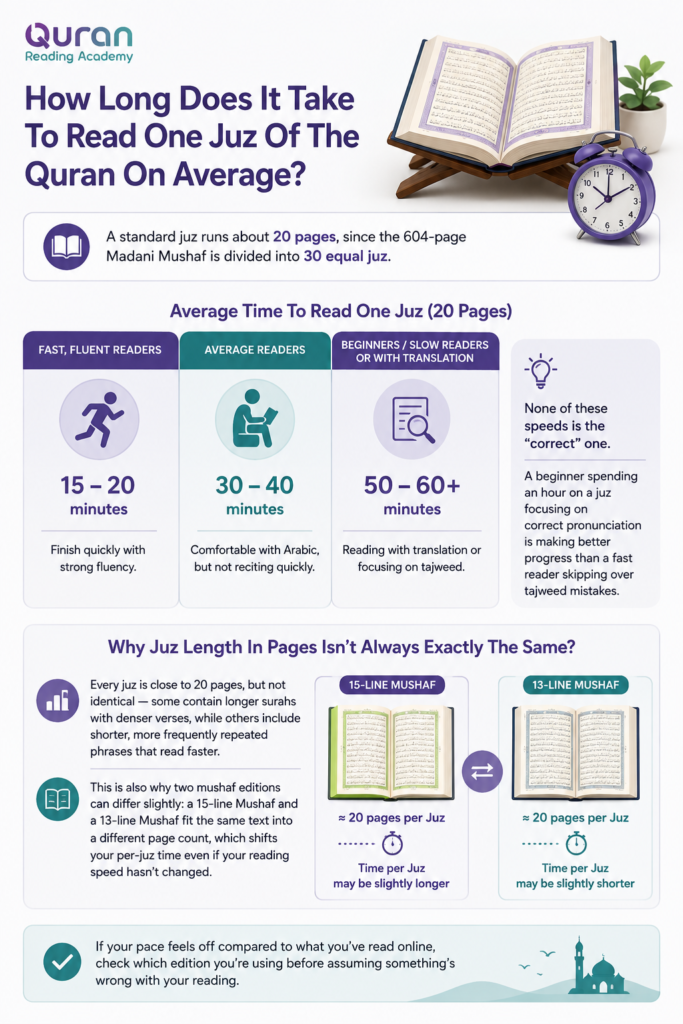
A standard juz runs about 20 pages, since the 604-page Madani Mushaf is divided into 30 equal juz. That fixed page count is why reading time scales so predictably with reading speed — you’re always working through roughly the same amount of text.
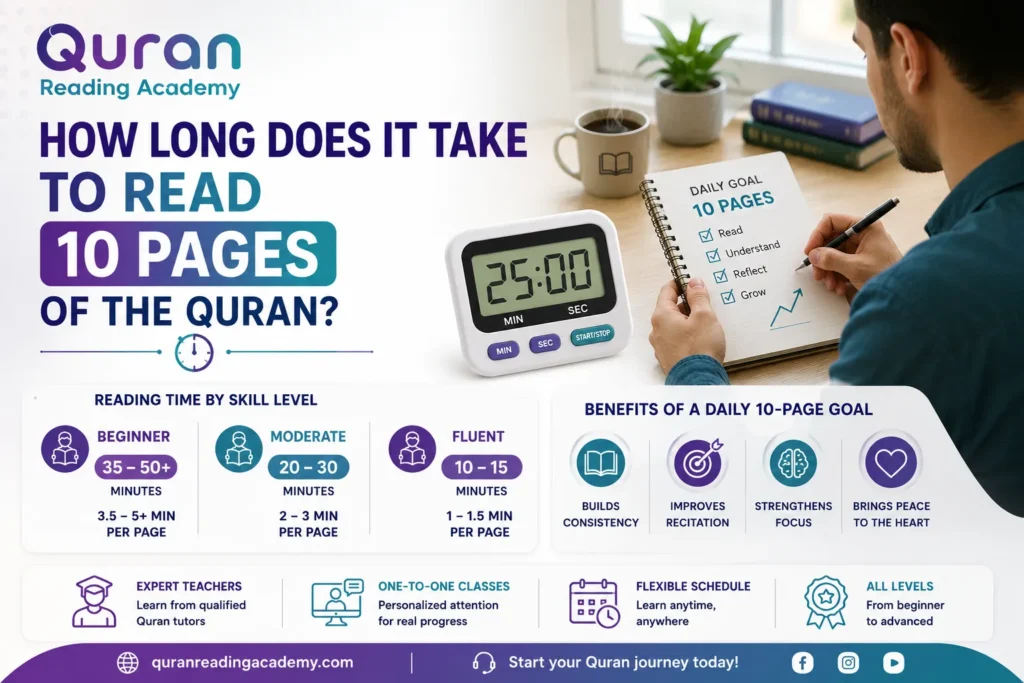
Fast, fluent readers typically finish a juz in 15 to 20 minutes. Average readers — comfortable with Arabic but not reciting quickly — take 30 to 40 minutes. Beginners, slow readers, or anyone reading with a translation alongside the Arabic often need 50 minutes to over an hour, especially if they’re also practicing tajweed rules carefully rather than just moving through the pages.
None of these speeds is the “correct” one. A beginner spending an hour on a juz while focusing on correct pronunciation is making better progress than a fast reader skipping over tajweed mistakes.
Read also: How Long Does It Take to Read 20 Pages of Quran?
Why Juz Length In Pages Isn’t Always Exactly The Same?
Every juz is close to 20 pages, but not identical — some contain longer surahs with denser verses, while others include shorter, more frequently repeated phrases that read faster.
This is also why two mushaf editions can differ slightly: a 15-line Mushaf and a 13-line Mushaf fit the same text into a different page count, which shifts your per-juz time even if your reading speed hasn’t changed. If your pace feels off compared to what you’ve read online, check which edition you’re using before assuming something’s wrong with your reading.
Students in our Quran Reading Classes often notice their reading time drop by several minutes per juz within the first few weeks — not because they’re rushing, but because a teacher correcting small tajweed habits early removes the hesitation that slows most self-taught readers down.
Read also: How Long Does It Take to Read 20 Pages of Quran?
What Affects How Long It Takes to Read a Juz?
Reading speed isn’t really about talent — it’s about a handful of specific factors that either add friction or remove it, and they’re the real reason the answer to how long does it take to read one juz of the Quran varies so much from person to person.
1. Arabic Fluency And Tajweed
Recognizing letter forms and rules like idghaam, ikhfaa, or elongation (madd) without stopping to think is what separates a 20-minute juz from a 50-minute one. This isn’t something that improves with silent repetition alone — it improves with correction, which is why guided practice moves faster than reading alone.
2. The Mushaf Edition You Use
As mentioned above, page-per-juz counts vary slightly by edition (Hafs vs. Warsh script, or different line layouts). If you’re timing yourself against a published average, use the same edition type as your reference point.
3. Reading With Or Without Translation
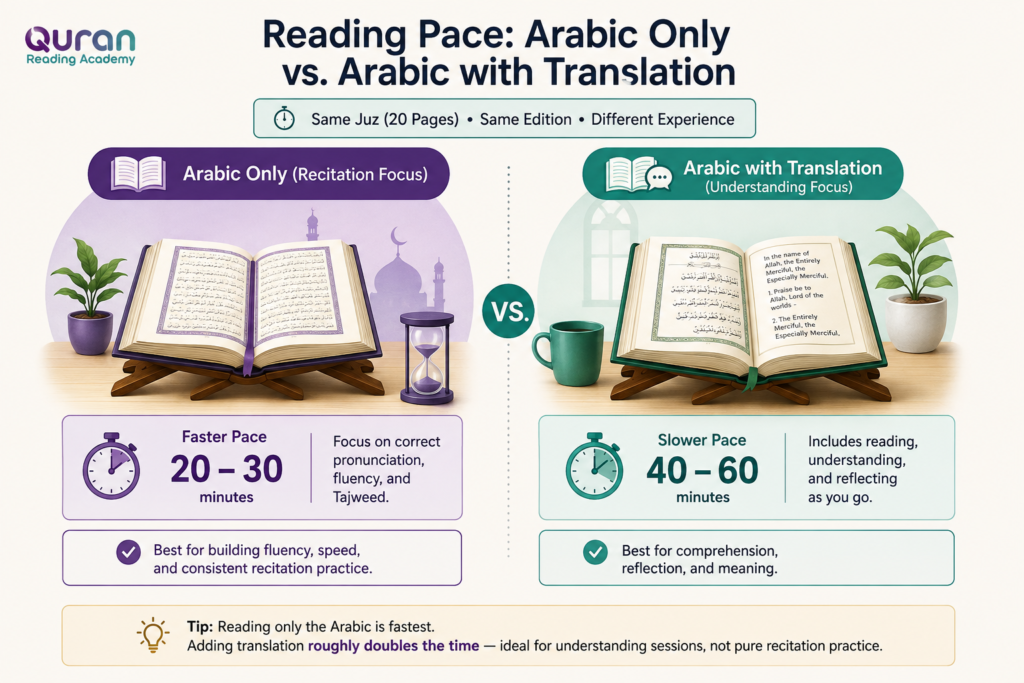
Reading only the Arabic is fastest. Reading Arabic alongside an English translation, checking meaning as you go, roughly doubles the time — which is fine for comprehension-focused sessions, but worth planning for separately from pure recitation practice.
How To Split One Juz Into A Daily Reading Schedule?
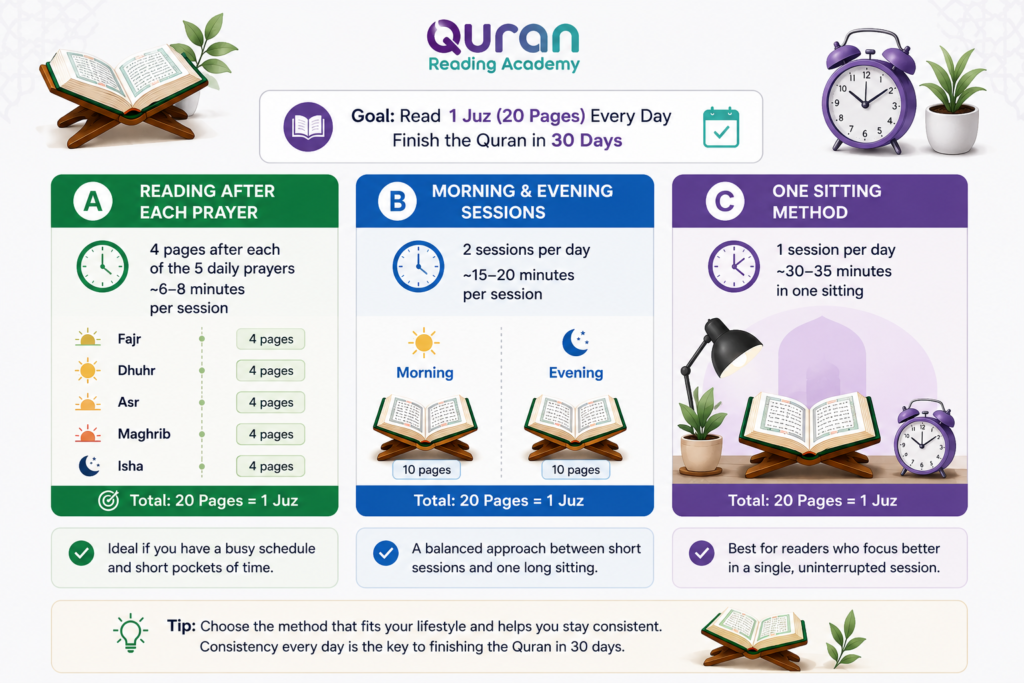
If your goal is to read one juz a day and finish the Quran in 30 days, the 20 pages break down easily into smaller sessions rather than one long sitting. Once you know roughly how long does it take to read one juz of the Quran at your own pace, the table below compares the main ways to split it, based on an average reading speed:
| Method | Pages per session | Sessions per day | Time per session |
| After each prayer | 4 pages | 5 | 6–8 minutes |
| Morning and evening | 10 pages | 2 | 15–20 minutes |
| One sitting | 20 pages | 1 | 30–40 minutes |
| Slow and steady | 2 pages | 1 | 3–4 minutes (finishes the juz every 10 days) |
A. Reading After Each Prayer
Reading 4 pages after each of the five daily prayers completes a full juz by the end of the day, in sessions of roughly 6 to 8 minutes each. This works well if long, uninterrupted reading blocks are hard to find in your schedule.
B. Morning and Evening Sessions
Reading 10 pages in the morning and 10 in the evening splits the juz into two sessions of about 15 to 20 minutes each — a good middle ground between the prayer-by-prayer method and one long sitting.
C. One Sitting Method
Setting aside a single half-hour block, ideally somewhere quiet, covers the full juz at once. This suits readers who focus better in one continuous session than across several short interruptions.
If you only manage 2 pages a day, you’ll still finish a juz every 10 days — slower, but consistent, which matters more than speed for building a lasting habit. Our Quran Reading Classes for Adults build daily timetables around exactly this kind of realistic pacing, rather than assuming everyone can commit a full 30 minutes at once.
Read also: How Long Does It Take To Read 1 Page Of The Quran?
Choosing Your Pace: A Simple Decision Framework
Most advice treats “how fast should I read a juz” as one question with one answer. It isn’t — the right pace depends on what you’re actually trying to achieve.
1. Finishing the Quran in a Month
If your target is completing all 30 juz in Ramadan or another 30-day window, work backward from one juz a day using whichever split above fits your schedule. Consistency matters more here than reading speed on any single day.
2. Reading for Tajweed Accuracy
If precision matters more than finishing quickly, slow down deliberately — 45 minutes to an hour per juz is normal when you’re pausing to apply rules correctly rather than reading on autopilot. Speed should be the last thing you optimize for, not the first.
3. Reading While Preparing to Memorize
Reading and memorizing a juz are different tasks with very different timeframes. Reading takes minutes; memorizing one juz to a solid standard commonly takes several weeks to a few months, depending on how much daily time you dedicate and how familiar you already are with the material.
If memorization is the eventual goal, treat your reading sessions as the repetition groundwork rather than expecting reading speed alone to get you there.
See Our Academy in Action
Discover what a typical session looks like! Watch these brief highlights from our live, interactive classes to see how our instructors engage with students of all ages.
Start Your Quran Learning Journey Today
Join Quran Reading Academy and begin structured, step-by-step Quran reading with expert guidance.
Try your first class for freeCommon Mistakes That Slow Down Juz Reading
A few habits quietly add time to every session, and most readers don’t notice them until they’re corrected.
Rushing through tajweed rules to “get through the pages” usually backfires — it creates pronunciation habits that need to be unlearned later, which costs more time overall than reading carefully the first time.
Skipping revision of the previous day’s pages is another common gap; without a quick review, small mistakes repeat unnoticed for weeks. And switching mushaf editions midway through a reading plan — say, from a 15-line to a 13-line copy — can make your pace feel inconsistent for reasons that have nothing to do with your ability.
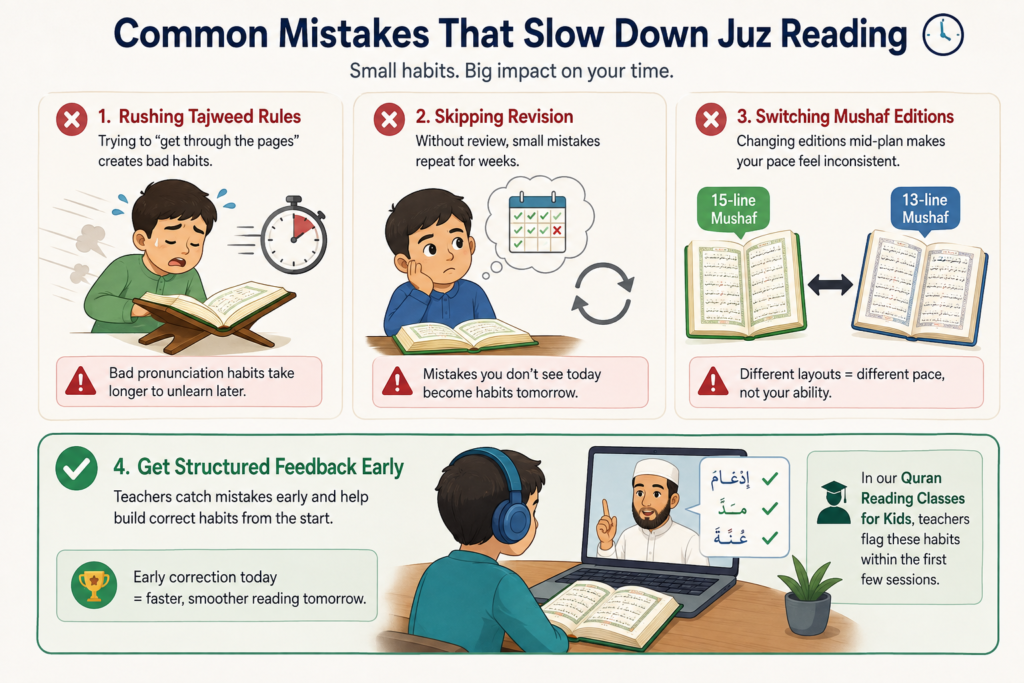
Structured feedback catches these early. In our Quran Reading Classes for Kids, for example, teachers flag these habits within the first few sessions rather than letting a child practice the same tajweed error for months.
Inside Our Live Classroom
We believe in complete transparency. Take a look inside our virtual classrooms to experience our premium teaching tools and engaging learning environment firsthand.
Start Your Quran Learning Journey Today
Join Quran Reading Academy and begin structured, step-by-step Quran reading with expert guidance.
Try your first class for freeStart Reading With Confidence At Quran Reading Academy
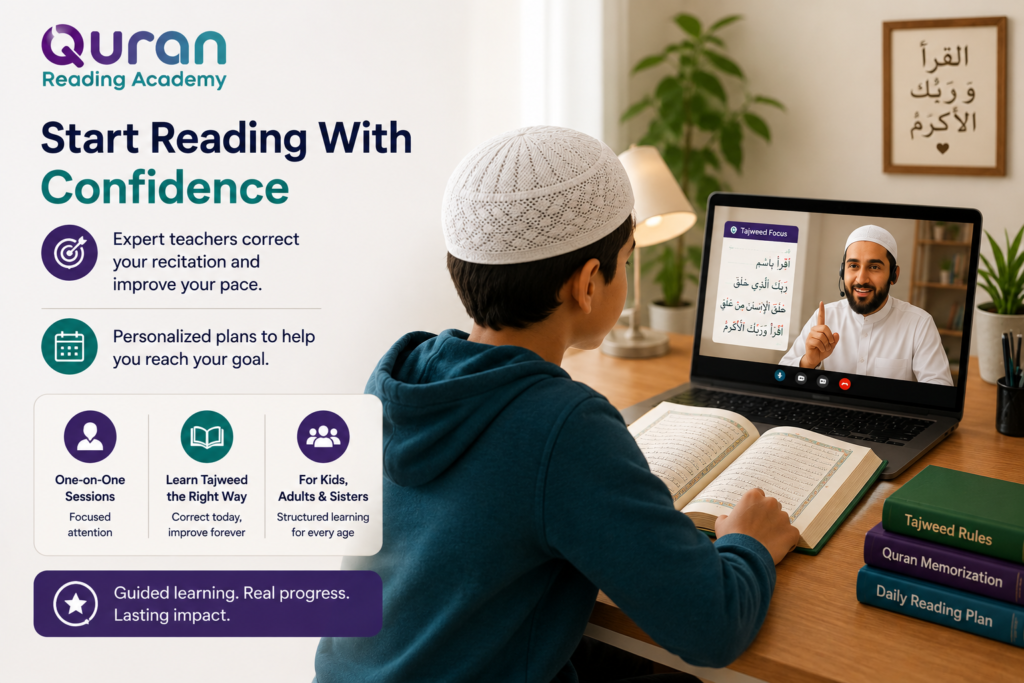
Reading time improves fastest with correction, not just repetition. A qualified teacher can spot the exact habits slowing you down and adjust your pace to match your actual goal — whether that’s finishing the Quran in 30 days, reading with proper tajweed, or laying the groundwork for memorization.
Quran Reading Academy offers structured, one-on-one guided sessions for kids, adults, and sisters, built around realistic daily timetables rather than generic pacing advice.

Our Quran Courses:
- Quran Reading Classes
- Quran Reading Classes for Kids
- Quran Reading Classes for Adults
- Quran Reading Classes for Female/Sisters
- Quran Reading Classes for New Muslims
- Quran Reading Course for Beginners
- Online Quran Reading Course with Tajweed
- Reading and Memorizing the Quran Course
- Noorani Qaida Course
- Quran Course for Beginners
- Quran Tajweed Course
- Quran Recitation Course
- Quran Hifz Course
- Online Quran Qirat Classes
- Quranic Arabic Course
- Arabic Reading Practice Course
Start Your Quran Learning Journey Today
Join Quran Reading Academy and begin structured, step-by-step Quran reading with expert guidance.
Try your first class for freeConclusion
How long it takes to read one juz of the Quran comes down to a fairly narrow range: 15 to 20 minutes for fast, fluent readers, 30 to 40 minutes for the average reader, and 50 minutes to over an hour for beginners or anyone reading with a translation.
The 20-page length of a juz stays roughly constant, so your pace is really the only variable — and that pace should match your goal, whether that’s finishing in 30 days, reading with careful tajweed, or preparing to memorize.
Splitting the 20 pages into smaller sessions — after each prayer, morning and evening, or one focused half-hour — makes daily consistency realistic even on busy days. If your pace feels stuck, the fastest fix usually isn’t reading more; it’s getting feedback from a teacher who can correct the small habits adding minutes to every session, which is exactly what structured classes at Quran Reading Academy are built around.

Frequently Asked Questions
A few questions come up often alongside how long does it take to read one juz of the Quran — here are direct answers to the ones this guide hasn’t already covered in full.
1. How many pages are in one juz of the Quran?
One juz is approximately 20 pages in the standard Madani Mushaf, since the full 604-page Quran is divided into 30 equal juz. The exact count can shift by a page or two depending on the edition and line layout.
2. Can I finish reading the whole Quran in 30 days by reading one juz a day?
Yes — reading one juz daily for 30 days completes the entire Quran, which is why this pace is common during Ramadan. Splitting each juz into smaller sessions, such as 4 pages after each prayer, makes the daily target easier to hit consistently.
3. Is it faster to read the Quran without tajweed?
Reading without applying tajweed rules is faster in the moment, but it builds pronunciation habits that take longer to correct later. Reading at a slower, tajweed-accurate pace from the start is more time-efficient over the long run.
4. How long does it take to memorize one juz compared to reading it?
Reading a juz takes minutes; memorizing one to a solid standard typically takes several weeks to a few months, depending on daily time invested and prior familiarity with the text. The two are separate skills with very different timeframes.
5. Do children read a juz at the same pace as adults?
Not usually — children often need more time per juz while they’re still building letter recognition and tajweed fluency. Structured, age-appropriate pacing, like what’s used in dedicated kids’ classes, tends to build consistent speed faster than unguided practice.
6. What’s the best time of day to read a juz?
There’s no single best time — what matters most is consistency. Reading after each of the five daily prayers, or splitting the juz between morning and evening, both work well because they fit reading into moments already built into the day.
Related Articles
Times for Reading







Leave a Reply