 benefits of reading quran

Yes, can you read Quran anytime? Whether during the day or at night. There is no specific hour when Quran recitation is generally prohibited. You can read the Quran in the morning, afternoon, evening, or before going to sleep, depending on your schedule and ability to focus.
This also means you can recite the Quran after Fajr or Asr. The restrictions associated with certain times of the day primarily concern Salah, particularly voluntary prayers, rather than Quran recitation itself.
What matters most is maintaining a respectful approach to the Quran and observing the relevant rules concerning purity and the handling of the physical Mus-haf. This allows you to make Quran reading a consistent part of your daily life rather than limiting it to a particular time.
Can You Read Quran During Sunrise, Zawal, and Sunset?
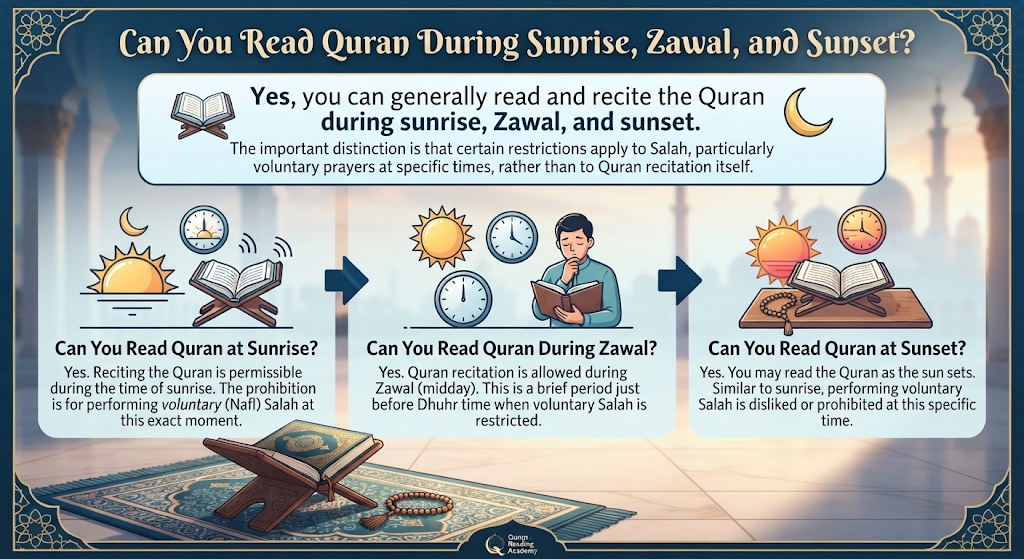
Yes, you can generally read and recite the Quran during sunrise, Zawal, and sunset. The important distinction is that certain restrictions apply to Salah, particularly voluntary prayers at specific times, rather than to Quran recitation itself.
Can You Read Quran at Sunrise?
The period around sunrise is associated with restrictions on certain prayers. However, this does not mean that you must stop reciting the Quran. You may continue your Quran reading, whether you are reciting from memory or reading in a manner permitted for your situation.
Can You Read Quran During Zawal?
Zawal refers to the time when the sun reaches its highest point before beginning its apparent movement toward the west. Certain voluntary prayers are restricted around this period, but Quran recitation is a separate act of worship.
Therefore, if you have scheduled Quran reading during Zawal, you do not generally need to postpone your recitation simply because of the prayer-related restriction.
Can You Read Quran at Sunset?
You can also recite the Quran around sunset. The restrictions associated with the sunset period concern Salah and should not automatically be interpreted as a prohibition on Quran recitation.
This distinction is important: a restricted time for a particular prayer does not necessarily mean a restricted time for reading the Quran.
Can You Read Quran After Fajr or Asr?
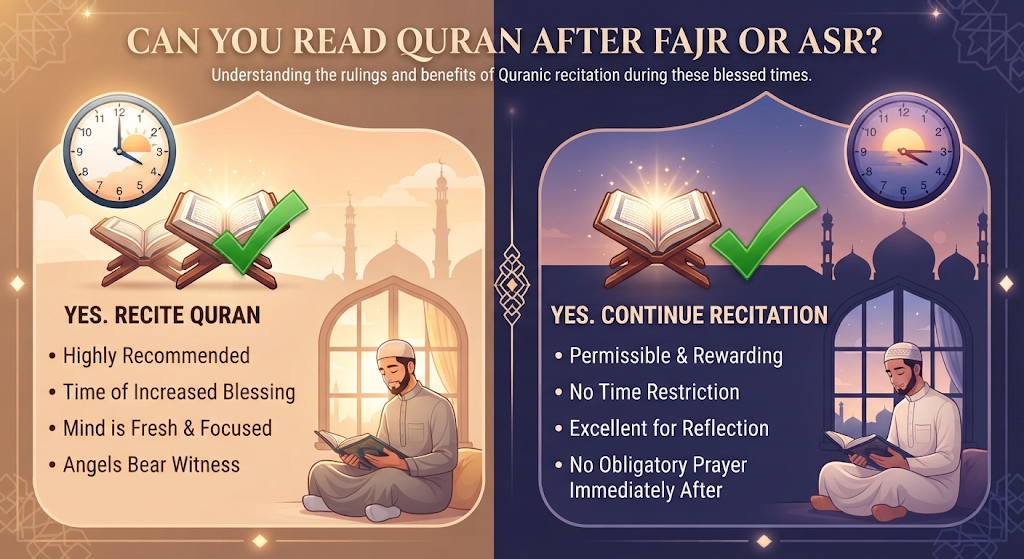
You can read the Quran after both Fajr and Asr. The important point is to distinguish Quran recitation from voluntary Salah, because the restrictions discussed after these prayers relate primarily to prayer rather than to reading the Quran.
Can You Read Quran After Fajr?
Yes, can you read Quran anytime after Fajr? In fact, the early morning can be a peaceful time for Quran recitation because there are often fewer distractions and more opportunities for reflection.
The restriction on performing certain voluntary prayers after Fajr until sunrise does not mean that Quran recitation is prohibited during this period. You can therefore continue reading from the Quran, reciting from memory, or following your regular Quran reading routine.
Can You Read Quran After Asr?
Yes, Quran recitation is also permissible after Asr. Although certain voluntary prayers are restricted during part of the period after Asr, this should not be confused with a restriction on reading or reciting the Quran.
If you have dedicated time for Quran reading after Asr, you can use it for recitation, memorization, review, or reflection without needing to postpone your Quran routine simply because it is after Asr.
Can You Read Quran at Night?
Yes, you can read Quran at night. There is no general restriction that prevents Quran recitation after Isha, before sleeping, or during the later part of the night.
a. Reading Quran Before Sleep
Reading a few verses or a longer passage before bed can be a simple way to maintain a daily Quran routine. You can recite from a physical Mus-haf, read from a digital device, or recite from memory, while observing the relevant rules for each method.
b. Reading Quran During the Last Third of the Night
The last third of the night is also an opportunity for Quran recitation, particularly for those who combine their nighttime worship with Tahajjud. Quran reading does not have to be limited to this period, however. The most important consideration is choosing a time that allows you to recite consistently and with attention.
What Is the Best Time to Read the Quran?
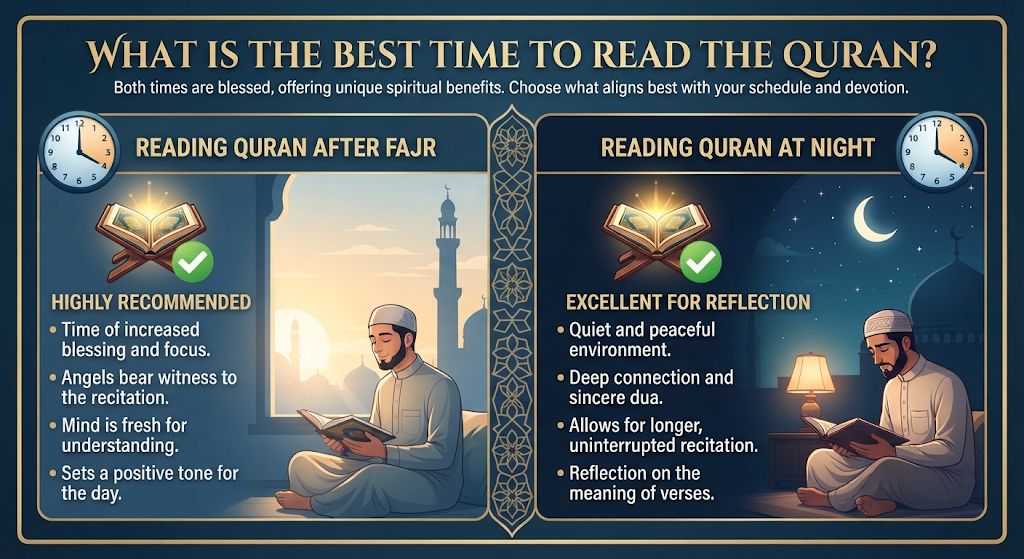
There is no single best time to read the Quran that applies to everyone. The best time is often the part of the day when you can read consistently, focus on the verses, and avoid unnecessary distractions. For some people, this may be after Fajr, while others may find the evening or nighttime more suitable.
Reading Quran After Fajr
The time after Fajr can be an excellent opportunity for Quran reading because the morning is often quiet and peaceful. Starting the day with Quran recitation can also help you establish a regular reading routine before daily responsibilities become demanding.
Reading Quran at Night
If your mornings are busy, reading Quran at night can be just as practical for building a consistent habit. You can read after Isha, before going to sleep, or during the last part of the night if that fits your schedule.
Ultimately, the best time to read Quran is the time you can maintain regularly. Even a short daily session can you read Quran anytime? is a part of your routine when you approach it with consistency, attention, and sincerity.
Do You Need Wudu to Read the Quran?
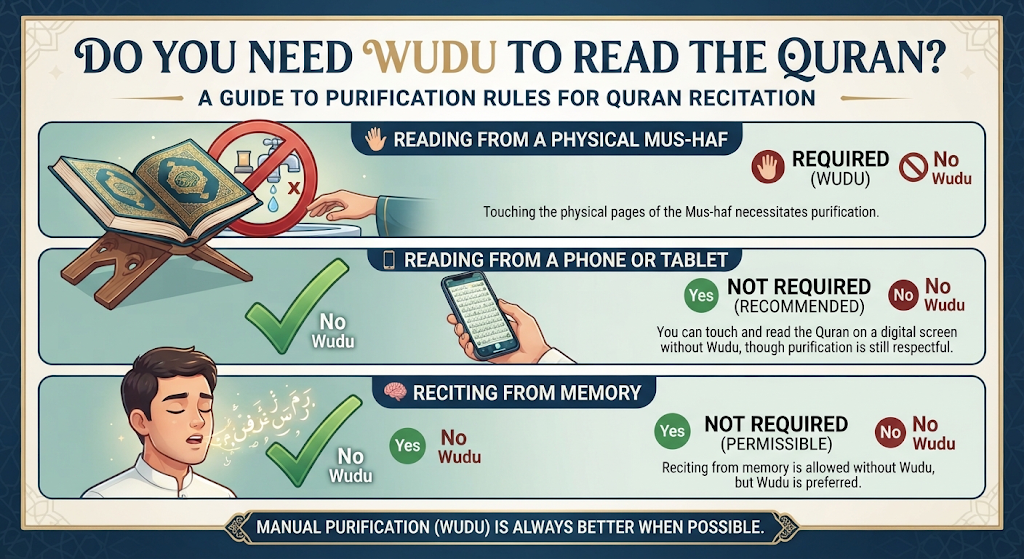
Whether you need Wudu to read the Quran depends on how you are reading it. There is an important distinction between handling a physical Mus-haf and reciting the Quran from memory or reading it on a digital device.
a. Reading From a Physical Mus-haf
If you are reading from a physical Mus-haf, maintaining Wudu is required according to the majority scholarly view before directly touching the Arabic text of the Quran. This is why Muslims commonly perform Wudu before handling the physical Mus-haf.
If you do not have Wudu, you can still recite Quran from memory rather than directly touching the physical Mus-haf, subject to the relevant rules of purity.
b. Reading From a Phone or Tablet
Reading Quran from a phone or tablet is different from handling a physical Mus-haf. You can generally read Quran from a digital device without Wudu, as long as the device is not being treated as a physical Mus-haf.
So, can you read Quran anytime? When you want to maintain your daily Quran reading routine while away from home or when Wudu is not readily available.
c. Reciting From Memory
You can recite Quran from memory without physically handling a Mus-haf. This can be especially helpful for reviewing memorized Surahs, practicing recitation, or keeping up with your Quran routine throughout the day.
For situations involving major ritual impurity, such as Janabah, different rules apply, so it is important to distinguish this from simply not having Wudu.
Are There Conditions for Reading the Quran?
Although you can read the Quran at different times of the day and night, there are some guidelines to keep in mind. These guidelines help maintain respect for the Quran and distinguish between ordinary recitation and situations involving specific rules of ritual purity.
One important consideration is Wudu. As discussed above, handling a physical Mus-haf directly is generally associated with being in a state of Wudu. However, reading from a phone or tablet, or reciting from memory, is treated differently.
It is also important to choose a clean and respectful place for Quran reading whenever possible. You do not need to wait for a particular hour to recite, but approaching the Quran with proper manners, attention, and respect is an important part of the experience.
If a person is in a state of Janabah, the rules concerning Quran recitation are different from those that apply to minor impurity. In such circumstances, performing Ghusl before reciting is the appropriate way to return to a state of ritual purity.
Therefore, the question is not simply “Can you read Quran anytime?” but also how you are reading it and what state of purity you are in. Understanding these distinctions makes it easier to maintain a consistent Quran reading routine while observing Islamic etiquette.
Start Your Quran Learning Journey Today
Join Quran Reading Academy and begin structured, step-by-step Quran reading with expert guidance.
Try your first class for freeHow to Build a Simple Daily Quran Reading Routine
Knowing that you can read Quran anytime makes it easier to create a routine that fits your daily life. You do not need to dedicate hours to Quran reading to develop a meaningful habit. A consistent few minutes each day can be a practical starting point.
1. Choose a Consistent Time
Pick a time that naturally fits your schedule. You might read after Fajr, during a quiet afternoon break, after Asr, or before going to sleep. Choosing a regular time makes it easier to turn Quran reading into a daily habit.
2. Start With a Realistic Amount
If you are busy, begin with a small portion rather than setting an unrealistic goal. You could start with a few verses, one page, or 10 minutes of focused reading. As your consistency improves, you can gradually increase the amount you read.
3. Read, Reflect, and Review
A Quran routine does not have to focus only on completing a certain number of pages. Give yourself time to recite carefully, understand the meaning, and reflect on the verses.
You can also use part of your session to review Surahs you have already memorized. This combines Quran reading, recitation, memorization, and revision in one simple routine.
4. Make Your Routine Flexible
Missing your usual reading time does not mean you have to abandon the day completely. Since you can read Quran at different times, move your session to another suitable part of the day.
The goal is to build a sustainable relationship with the Quran rather than creating a routine that feels difficult to maintain.

Can You Read Quran Anywhere?
Yes, you can generally read the Quran in many different places, as long as the setting is clean, respectful, and suitable for Quran recitation. You do not have to be inside a mosque or at home to read the Quran.
Can you read Quran anytime at home, at work, while traveling, or in another quiet and appropriate place? If you use a phone or tablet, digital Quran reading also makes it easier to continue your daily routine when you are away from home.
However, choosing a clean and respectful environment helps you maintain the proper manners of engaging with the Quran. It is also better to avoid places where Quran recitation would be disrespectful or inappropriate.
Why Is Reading the Quran Regularly Important?
Reading the Quran regularly helps you build a stronger and more consistent connection with its verses. Instead of limiting Quran reading to a specific day or occasion, making it part of your daily routine gives you more opportunities to recite, reflect, and continue learning.
A regular Quran reading habit can also make it easier to improve your Quran recitation, pronunciation, and fluency over time. Even if you only have a short amount of time each day, consistent practice can be more sustainable than waiting for a long period of free time.
For beginners and experienced readers alike, daily Quran reading can support continued learning and revision. You can set a realistic goal based on your schedule, such as reading a few pages each day, completing a Surah, or dedicating time to improving your recitation.
The most important thing is consistency. Can you read Quran anytime? Throughout the day and night, you can choose a routine that fits your life and make Quran recitation a lasting part of your day.
Quran Reading Anytime: A Quick Guide
If you are wondering “Can you read Quran anytime?”, the answer is generally yes. You can make Quran recitation part of your day without limiting it to one particular hour. The following guide summarizes the main situations covered in this article.
- After Fajr: You can read and recite the Quran after Fajr. Restrictions on certain voluntary prayers do not mean that Quran recitation is prohibited.
- After Asr: You can continue your Quran reading routine after Asr, even though certain prayers are restricted during part of this period.
- At sunrise: The prayer-related restrictions around sunrise do not generally prohibit Quran recitation.
- During Zawal: You can generally read the Quran during Zawal; the relevant restrictions concern particular prayers.
- At sunset: Quran recitation is generally permissible around sunset.
- At night: You can read Quran after Isha, before sleep, or during the later part of the night.
- On your phone: You can generally read Quran from a digital device at any time, including when you do not have Wudu.
- From memory: You can recite Quran from memory without physically handling a Mus-haf.
- With a physical Mus-haf: Follow the relevant rules concerning Wudu and physically touching the Mus-haf.
- When you miss your usual time: Simply move your Quran reading session to another suitable time rather than abandoning your routine.
The key takeaway is simple: Quran recitation can be part of your daily life at different times. Choose a time that helps you remain consistent, focused, and respectful when engaging with the Quran.
Why Is Reading the Quran Regularly Important?
Reading the Quran regularly is not only about completing a certain number of pages. A consistent Quran reading habit allows you to recite, understand, reflect on Allah’s guidance, and strengthen your connection with the Quran over time.
Allah says:
Surah Ar-Ra’d 13:28 is a well-known verse from the Quran that highlights inner peace and tranquility through the remembrance of God (dhikr).
الَّذِينَ آمَنُوا وَتَطْمَئِنُّ قُلُوبُهُم بِذِكْرِ اللَّهِ ۗ أَلَا بِذِكْرِ اللَّهِ تَطْمَئِنُّ الْقُلُوبُ
“Those who believe and whose hearts find rest in the remembrance of Allah. Unquestionably, in the remembrance of Allah do hearts find rest.”
Regular reading can also help you improve your recitation, strengthen memorization, and become more familiar with the meanings of different Surahs. Even a short reading session can become valuable when it is approached with attention and consistency.
Consistency Is More Important Than Reading a Large Amount
You do not have to read a large portion of the Quran every day to build a meaningful routine. Starting with a manageable amount can make the habit easier to maintain.
For example, you might begin with a few verses or one page each day and gradually increase your reading as your schedule allows.
Turn Quran Reading Into a Daily Habit
Because you can read Quran at different times of the day, you can choose a routine that works naturally with your lifestyle. After Fajr, during a quiet break, after Asr, in the evening, or before sleep can all provide opportunities for regular recitation.
What matters most is continuing to return to the Quran and making its recitation a consistent part of your life.
Learn to Read the Quran With Quran Reading Academy
Knowing that you can read Quran anytime makes it easier to build a consistent learning routine. But if you want to improve your recitation, pronunciation, reading fluency, or understanding, learning with a qualified Quran teacher can give you the guidance you need.
Quran Reading Academy provides online Quran classes designed to help students learn from the comfort of home. Whether you are a beginner learning how to read Quran for the first time or an experienced student looking to improve your recitation, structured lessons can help you make steady progress.
With online Quran lessons, you can choose a schedule that fits your daily routine and continue learning consistently. This flexibility makes it easier to combine Quran classes with school, work, family responsibilities, and your personal Quran reading time.
Start Learning Quran Online
If you want to improve your Quran reading skills and develop a regular connection with the Quran, Quran Reading Academy can support you throughout your learning journey. Learn with experienced teachers, follow a structured approach, and make Quran learning a consistent part of your life.
Start Your Quran Learning Journey Today
Join Quran Reading Academy and begin structured, step-by-step Quran reading with expert guidance.
Try your first class for freeConclusion
So, can you read Quran anytime? Yes. You can generally read and recite the Quran during the day or night, including after Fajr, after Asr, and before sleep. The restrictions that apply to certain prayer times should not be confused with restrictions on Quran recitation.
What matters is approaching the Quran with respect, observing the relevant rules of purity, and building a reading routine that you can maintain consistently. If you want to improve your Quran reading and recitation with expert guidance, Quran Reading Academy can help you learn online with qualified teachers and flexible lessons.
Start learning Quran online today and make Quran reading a consistent part of your daily life.
FAQs
Can you read Quran anytime of the day?
Yes. You can generally read and recite the Quran at any time of the day or night. There is no specific hour that generally prohibits Quran recitation.
Can you read Quran without Wudu?
The answer depends on how you are reading. The majority scholarly view requires Wudu for directly touching a physical Mus-haf, while reading from a phone or tablet or reciting from memory is treated differently.
Can you read Quran on your phone without Wudu?
Yes, you can generally read Quran on a phone or tablet without Wudu. A digital device is not treated in the same way as a physical Mus-haf.
What is the best time to read Quran?
There is no single best time for everyone. After Fajr, during a quiet part of the day, and at night can all be suitable. The best time is the one that allows you to read consistently and with attention.
Can you read Quran during Zawal?
Yes, Quran recitation is generally permissible during Zawal. The restrictions associated with Zawal concern certain prayers rather than Quran recitation itself.
Related Articles
benefits of reading quran








Leave a Reply