 Times for Reading
If you’ve just opened a Mus’haf and started counting minutes, you’re not alone. How long does it take to read 1 page of the Quran is one of the most common questions new reciters ask, right after “am I doing this correctly?” The honest answer depends on your Arabic level, your Tajweed accuracy, and how much you pause to reflect — but there are real ranges you can plan around.
At Quran Reading Academy, we hear this question from students on day one of every course, and the pattern is consistent: pace improves fast once pronunciation stops being a guessing game.
This article breaks down realistic timing for every level, the factors that actually move the needle, and how to build a page-by-page habit that sticks.
How Long Does It Take To Read One Page Of The Quran?
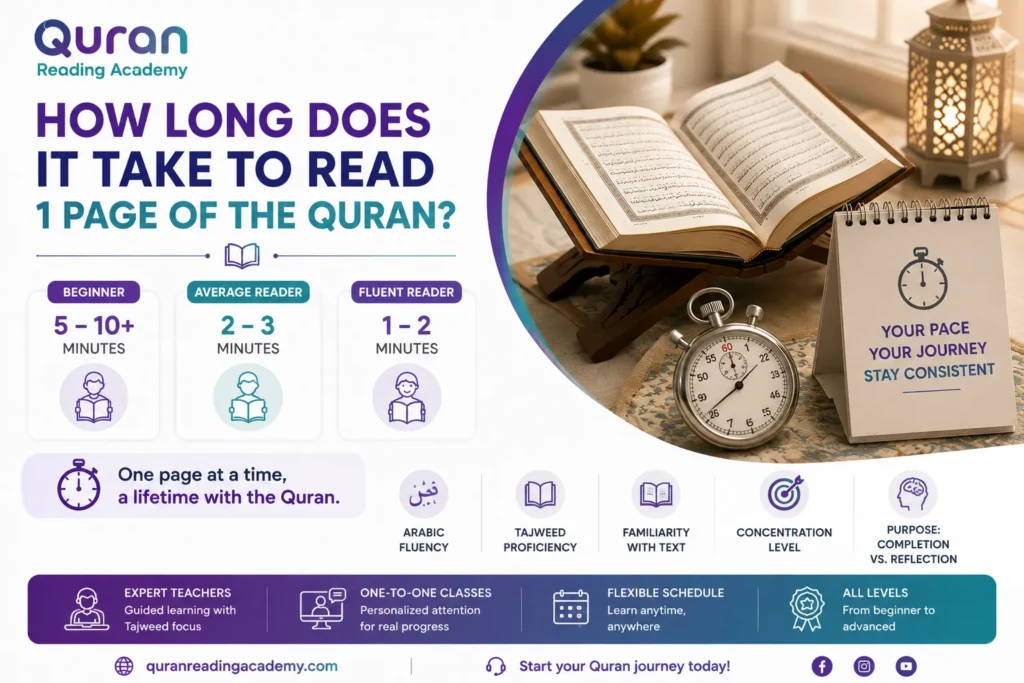
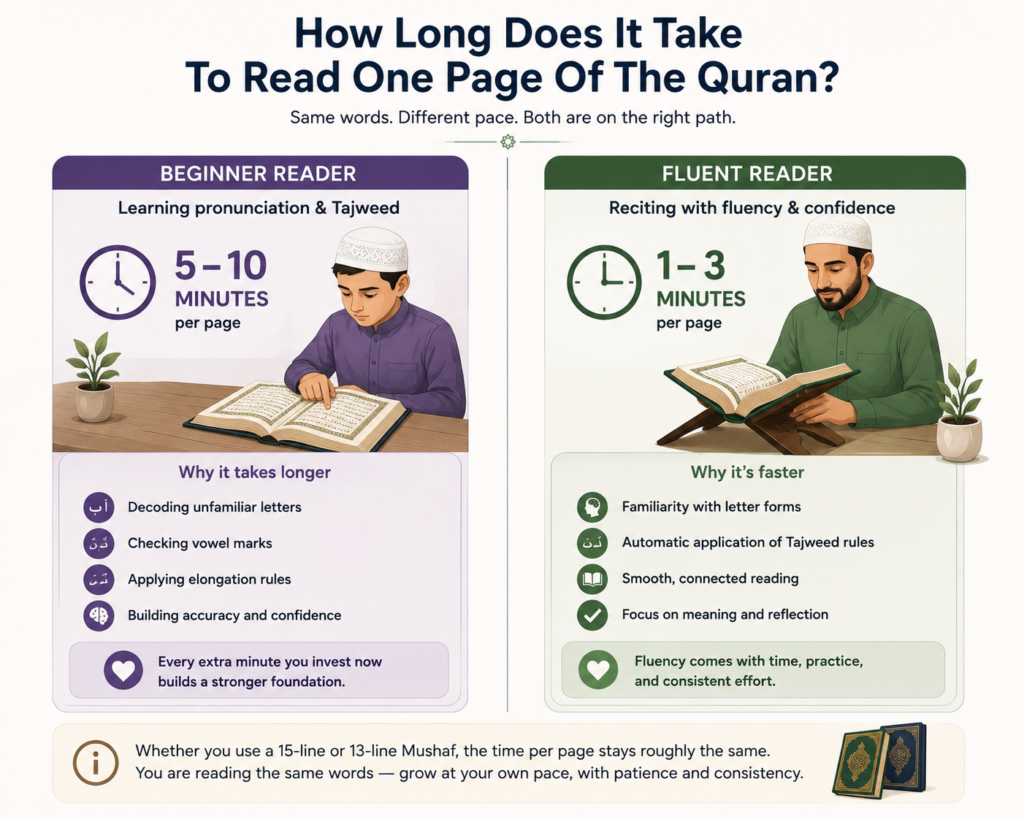
Reading one standard page of the Quran takes about 1 to 3 minutes for a fluent reader reciting at a normal, measured pace. A beginner who is still learning pronunciation and Tajweed rules typically needs 5 to 10 minutes, sometimes longer, for the same page.
That range holds whether you’re using a 15-line Mus’haf or a 13-line edition — the page count differs slightly between print styles, but the time per page stays roughly the same because you’re reading the same words either way.
So when students ask us how long does it take to read 1 page of the Quran, we always start by asking which skill level they’re reading at, because the gap between 3 minutes and 10 minutes isn’t laziness or lack of effort — it’s the direct cost of decoding unfamiliar letters, checking vowel marks, and applying elongation rules you haven’t yet made automatic.
Read also: Can You Read The Whole Quran In One Day?
Reading Pace By Skill Level
Here’s how the pace typically breaks down once you separate readers by experience:
Beginner / slow reader: 5 to 10+ minutes per page, mostly because attention is split between sounding out letters and applying Tajweed at the same time.
Average / moderate reader: 2 to 3 minutes per page. This is the most common pace among students who’ve completed a structured beginner course and read a few times a week.
Fluent / fast reader: 1 to 2 minutes per page, reading smoothly with correct pronunciation already automatic.
Hafiz reciting from memory: often under a minute per page during regular Muraja’ah (revision), since there’s no need to track the script line by line.
A common misconception is that faster is always better. It isn’t. Reading one page correctly with Tajweed in 6 minutes produces more benefit than rushing it in 2 minutes with mispronounced letters — the point of the page is accurate recitation, not a finish time.
If you’re still in the “sounding things out” phase, a structured Quran Reading Course for Beginners shortens that phase considerably, because a tutor corrects small pronunciation habits before they become permanent.
Read Also: Do You Have to Read the Quran in Arabic?
Factors That Change How Long It Takes To Read A Page
Reading speed isn’t random — it’s the sum of a small number of specific skills, and each one is trainable.
Five factors control your pace on any given page: Arabic fluency, Tajweed proficiency, familiarity with the specific text, concentration level, and your purpose for reading (completion versus reflection).
1. Arabic Fluency
Recognizing letters, word connections, and grammar patterns instantly is what separates a 2-minute page from an 8-minute page.
Native speakers and long-time reciters read faster not because they rush, but because decoding no longer takes conscious effort — the brain processes familiar word shapes the way a fluent English reader processes whole words instead of individual letters.
2. Tajweed Rules
Correct application of elongation (madd), nasalization (ghunnah), and stopping rules (waqf) genuinely slows a page down compared to reading without any rules at all — and that’s the point.
A page read with proper Tajweed in 3 minutes is doing more than a page read carelessly in 90 seconds. Students in an Online Quran Reading Course with Tajweed usually see their per-page time drop over a few weeks, not because they skip rules, but because applying them becomes second nature.
3. Familiarity With The Text
Surahs you’ve read dozens of times move faster than unfamiliar ones, simply because your eyes and tongue already know the shape of the sentence before you finish reading it. This is why regular, repeated reading — even of the same juz’ — builds speed faster than jumping around the Quran.
Read also: Can You Read The Whole Quran In One Day?
4. Concentration Level
A distracted page takes longer than a focused one, even at the same skill level. Reading in a quiet space with no phone nearby consistently cuts reading time, because re-reading lines after losing your place is one of the most common (and avoidable) time drains for beginners.
5. Purpose: Completion vs. Reflection
Reading for khatm (completion) moves faster than reading for tadabbur (reflection), where you pause on a verse, check a translation, or sit with its meaning. Both are valid goals — they just produce different page times, and it helps to know which one you’re doing before you start the clock.
Non-Arabic speakers who want to combine correct pronunciation with real comprehension often benefit from a class built specifically for that transition — the Reading and Memorizing the Quran Course pairs both skills together rather than treating them separately.
Read also: Motivation To Read Quran – How To Build A Habit That Lasts?
See Our Academy in Action
Discover what a typical session looks like! Watch these brief highlights from our live, interactive classes to see how our instructors engage with students of all ages.
Start Your Quran Learning Journey Today
Join Quran Reading Academy and begin structured, step-by-step Quran reading with expert guidance.
Try your first class for freeHow Page Time Adds Up to Full-Quran Reading Plans
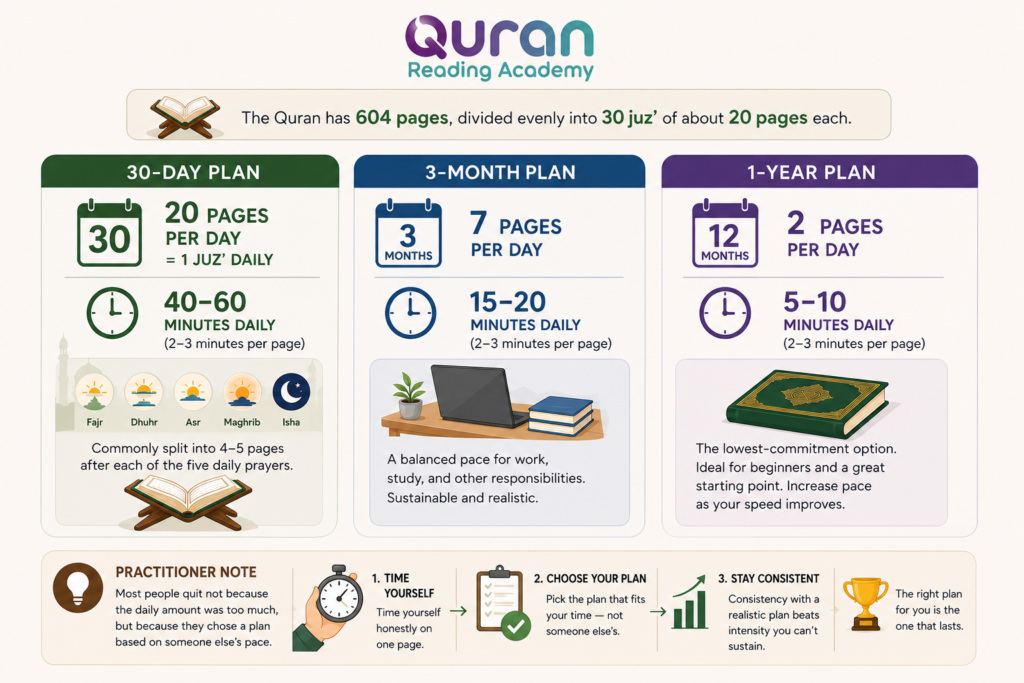
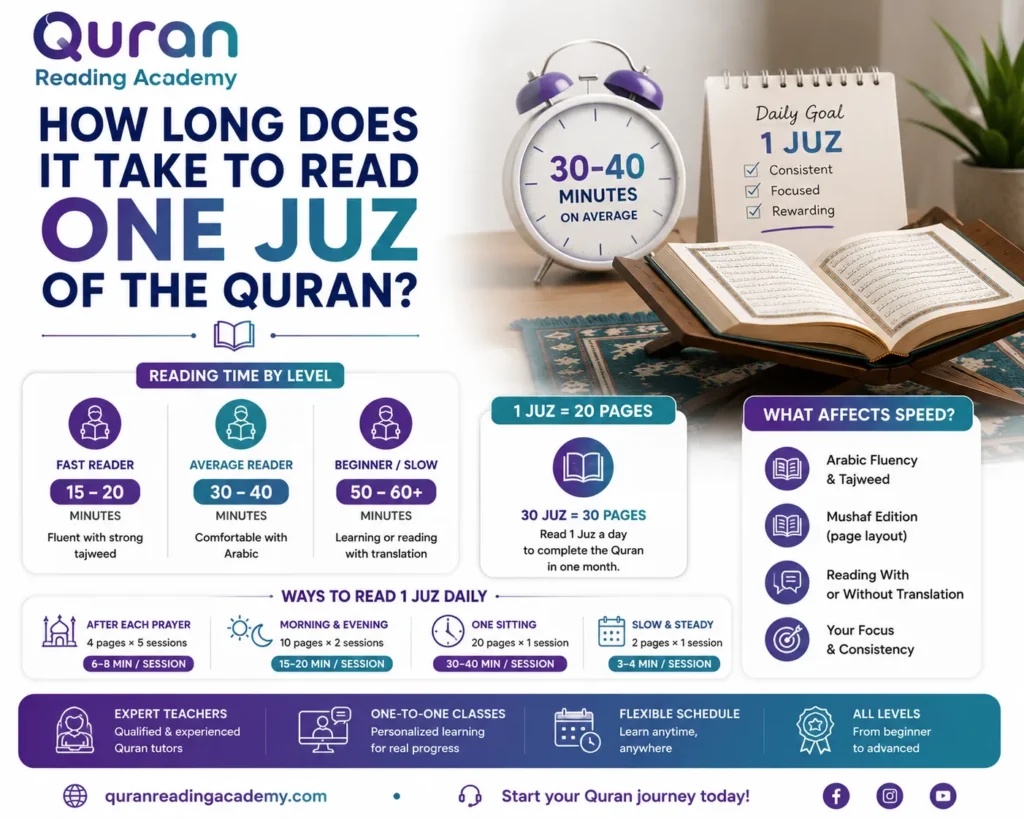
Once you know your per-page pace, you can work backward to a realistic completion schedule, and the Quran’s structure makes this easy: 604 pages, divided evenly into 30 juz’ of about 20 pages each.
The 30-Day Plan
Reading 20 pages a day completes the Quran in exactly one juz’ per day. At a 2-to-3-minute average pace, that’s roughly 40 to 60 minutes daily — commonly split into 4 to 5 pages after each of the five daily prayers rather than done in one sitting.
The 3-Month Plan
At around 7 pages a day, the time commitment drops to 15 to 20 minutes daily for an average reader. This pace suits people balancing work or study, since it’s light enough to sustain without gaps.
The 1-Year Plan
Roughly 2 pages a day, or 5 to 10 minutes, is the lowest-commitment option and still completes a full khatm annually. This is often the realistic starting point for total beginners, who can then shorten the timeline as their per-page speed improves.
A practitioner note worth flagging: most people who quit a reading plan don’t quit because the daily amount was too much — they quit because they picked a plan based on an experienced reader’s pace instead of their own. Time yourself honestly on one page before choosing a daily target; it’s the single biggest predictor of whether the plan survives past week two.
Read also: How Long Does It Take To Read 10 Pages Of The Quran?
Read also: Where Should I Start Reading The Quran? A Beginner’s Roadmap
Practical Tips To Read Each Page Faster Without Losing Accuracy
Speed should be a byproduct of accuracy, not a separate goal you chase in parallel.
Fix pronunciation before chasing pace. Every minute spent correcting a mispronounced letter now saves repeated corrections on every future page containing that letter or sound.
Read the same juz’ more than once before moving on. Repetition builds the word-recognition speed that naturally shortens page time — this is the same mechanism that makes Hafiz recitation so fast.
Separate your reflection sessions from your completion sessions. Trying to do both at once on every page is the most common reason beginners feel like they’re never getting faster; they’re actually just doing two different tasks simultaneously.
Track your actual page time weekly, not daily. Daily numbers vary with tiredness and distraction; a weekly average shows the real trend.
Avoid switching between unrelated surahs mid-session. Constantly reorienting to new sentence structures adds time that a steady, sequential reading order avoids.
Women who prefer a learning environment tailored specifically to their pace and comfort can start with the Quran Reading Classes for Female/Sisters, and new Muslims building these skills from the very beginning often progress fastest with the Quran Reading Classes for New Muslims, where pacing starts from zero assumptions about prior Arabic exposure.
Read Also: How to Read Quran If You Don’t Know Arabic?
Inside Our Live Classroom
We believe in complete transparency. Take a look inside our virtual classrooms to experience our premium teaching tools and engaging learning environment firsthand.
Start Your Quran Learning Journey Today
Join Quran Reading Academy and begin structured, step-by-step Quran reading with expert guidance.
Try your first class for freeStart Reading With Confidence Today
You don’t have to guess your way through pronunciation or wonder if your pace is “normal.” A qualified tutor watches your recitation in real time, corrects small habits before they become permanent, and helps you build a page-by-page routine that actually fits your schedule.
Quran Reading Academy offers live, one-on-one guidance for every level — from your very first page to full memorization — with courses for adults, beginners, sisters, new Muslims, and Tajweed mastery.
Our Quran Courses:
- Quran Reading Classes
- Quran Reading Classes for Kids
- Quran Reading Classes for Adults
- Quran Reading Classes for Female/Sisters
- Quran Reading Classes for New Muslims
- Quran Reading Course for Beginners
- Online Quran Reading Course with Tajweed
- Reading and Memorizing the Quran Course
- Noorani Qaida Course
- Quran Course for Beginners
- Quran Tajweed Course
- Quran Recitation Course
- Quran Hifz Course
- Online Quran Qirat Classes
- Quranic Arabic Course
- Arabic Reading Practice Course
Start Your Quran Learning Journey Today
Join Quran Reading Academy and begin structured, step-by-step Quran reading with expert guidance.
Try your first class for freeRead also: How Long Does It Take To Read 1 Page Of The Quran?
Conclusion
How long does it take to read 1 page of the Quran comes down to three things: your Arabic fluency, your Tajweed accuracy, and how much of the page is spent on reflection versus straight recitation.
A beginner should expect 5 to 10 minutes; an average reader lands around 2 to 3 minutes; a fluent reciter or Hafiz often finishes in under 2. None of these numbers are fixed — they shift as your skills improve, and tracking your own pace honestly is more useful than comparing yourself to someone further along.
Whatever your current speed, consistent daily reading with correct guidance closes that gap faster than most people expect.
Frequently Asked Questions
Here are quick answers to the questions readers most often ask alongside how long does it take to read 1 page of the Quran.
1. How long does it take a beginner to read one page of the Quran?
A beginner typically takes 5 to 10 minutes per page, since attention is split between decoding unfamiliar letters and applying Tajweed rules at the same time. This time shortens noticeably after a few weeks of structured practice.
2. Is it a sin to read the Quran quickly?
No, reading speed itself is not sinful. What matters is reciting with correct pronunciation and sincere intention; rushing becomes a problem only if it causes consistent mispronunciation or careless errors.
3. How many pages of the Quran should I read per day?
The right number depends on your goal: 20 pages a day completes the Quran in 30 days, 7 pages a day completes it in about 3 months, and 2 pages a day completes it in roughly a year.
4. How long does it take a Hafiz to read one page?
An experienced Hafiz often reads a page in under a minute during regular Muraja’ah, since recitation comes from memory rather than tracking the script line by line.
5. Should I read the Quran slowly or quickly?
Both have a place: slow reading supports reflection and understanding, while a quicker, accurate pace suits completion goals like Ramadan targets. The right choice depends on whether your current session is for tadabbur or khatm.
Related Articles
Times for Reading






Leave a Reply