 How to read Quran
If you’ve just picked up a Quran for the first time, you’ve probably asked yourself where should I start reading the Quran, because starting from page one and working straight through rarely works. The Quran isn’t arranged by difficulty or by story order — it’s arranged by chapter length, which means the very first pages after Al-Fatiha drop you into some of the longest, most detailed material in the entire book.
That’s not a flaw in you. It’s a structural fact about the Quran that almost nobody explains to beginners before they open it.
This guide walks through where to start reading the Quran in a way that actually builds confidence: which surahs to read first, whether you need Tajweed before you begin, what etiquette to follow, and how to choose between Arabic, transliteration, and translation while you’re still learning. At Quran Reading Academy, this is the same starting sequence we walk new students through in our own classes.
The short answer: start with Surah Al-Fatiha, move into the short surahs at the end of the Quran, then read a story-driven surah like Yusuf or Maryam once you want longer, connected reading.
Beginning here works because each of these three groups gives you something the Quran needs you to have before Al-Baqarah’s density makes sense — memorized prayer content, a feel for rhythm and short-surah structure, and narrative context.
1. Start with Surah Al-Fatiha
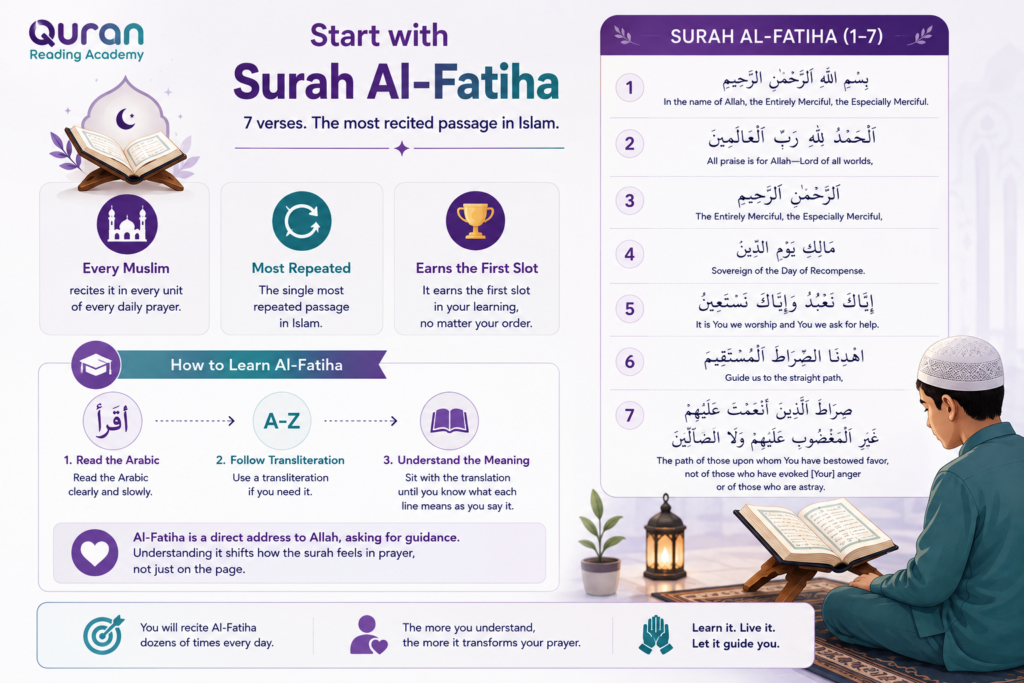
Surah Al-Fatiha is seven verses long, and every Muslim recites it in every unit of every daily prayer, which makes it the single most repeated passage in Islam. Because you’ll say these words dozens of times a day for the rest of your life, it earns the first slot regardless of what reading order you choose afterward.
Read the Arabic, follow a transliteration if you need one, and sit with the translation until you know what each line means as you say it. Al-Fatiha is structured as a direct address to Allah, asking for guidance — understanding that shifts how the surah feels in prayer, not just on the page.
Read also: Reading the Quran Without Understanding – Possible And Valid?
2. Move To The Short Surahs In Juz Amma
The Quran’s final section, Juz Amma, holds the last 37 chapters, and most of them are short — some under ten verses. Surah Ikhlas, Surah Falaq, Surah Nas, and Surah Kawthar are the common starting points, and they’re also the surahs most beginners recite in prayer alongside Al-Fatiha.
Surah Ikhlas centers on tawheed, the oneness of Allah. Surah Falaq and Surah Nas both ask for protection from harm and from the influence of shaytaan. Learning these four gives your prayer variety within your first few weeks, instead of repeating Al-Fatihah alone.
3. Explore Surah Yusuf Or Maryam For The Stories
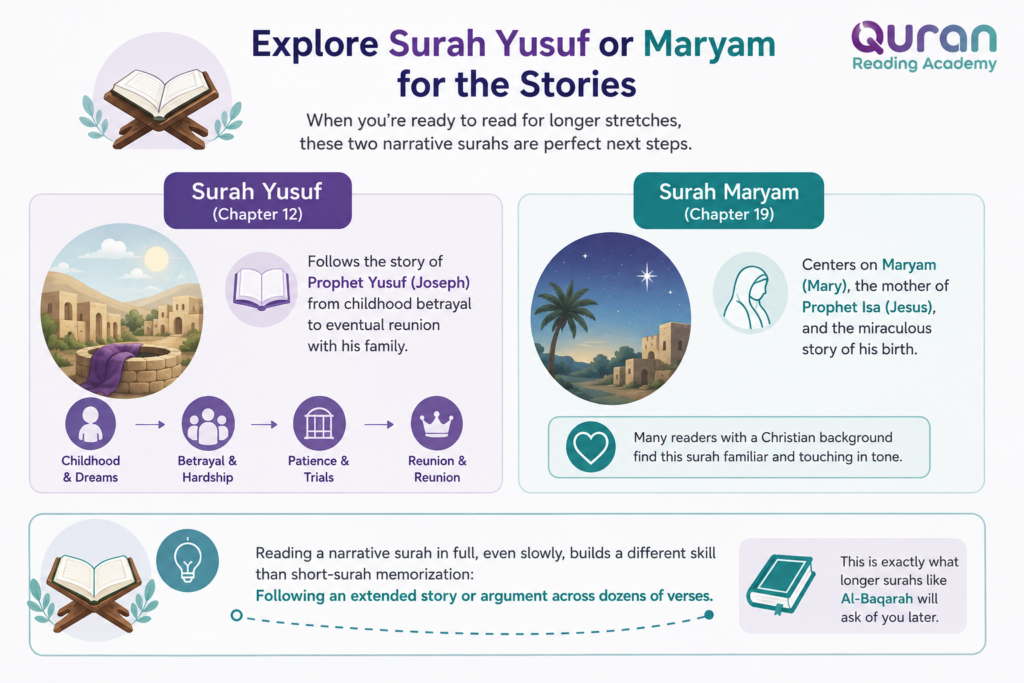
Once you want to read for longer stretches rather than short bursts, Surah Yusuf (chapter 12) and Surah Maryam (chapter 19) carry you through sustained narrative. Yusuf follows the Prophet Yusuf from childhood betrayal to eventual reunion with his family; Maryam centers on the mother of the Prophet Isa and the story of his birth, a chapter many readers with a Christian background find immediately familiar in tone.
Reading a narrative surah in full, even slowly, builds a different skill than short-surah memorization: following an extended argument or story across dozens of verses, which is exactly what longer surahs like Al-Baqarah will ask of you later.
Read also: How To Complete The Quran In 3 Days? (Plus 4 Day And 5 Day Khatm Plans)
A practical way to build the habit while you work through these surahs is to pair a short daily reading target with a structured class, which is what our Quran Reading Academy programs are built around — a set sequence, a teacher checking your pronunciation, and no guessing about what to read next.
Read Also: How to Read Quran If You Don’t Know Arabic?
See Our Academy in Action
Discover what a typical session looks like! Watch these brief highlights from our live, interactive classes to see how our instructors engage with students of all ages.
Start Your Quran Learning Journey Today
Join Quran Reading Academy and begin structured, step-by-step Quran reading with expert guidance.
Try your first class for free4. Setting The Right Intention Before You Begin
Niyah is the intention you form before an act of worship, and in Quran reading it’s the difference between a habit and a ritual that carries reward. Before you open the Quran, it helps to be specific about why: to increase in good deeds, to strengthen imaan and taqwa, to seek intercession on the Day of Judgement, to seek shifa from illness, or simply to seek guidance.
A clear intention matters practically, not just spiritually. Motivation built on “I should read the Quran” fades within weeks; motivation built on a specific reason you return to survives the days when you don’t feel like opening the book.
In fact, most readers asking where should I start reading the Quran are really asking how to make the habit stick — and intention is the part of that question that has nothing to do with which surah comes first.
Read also: How To Complete The Quran In 3 Days? (Plus 4 Day And 5 Day Khatm Plans)
5. You Should Not Learn Tajweed Before You Start Reading
No — Tajweed is not a requirement before you begin reading the Quran. Tajweed is the science of reciting the Quran with the Prophet Muhammad ﷺ’s exact pronunciation, and it refines your recitation rather than gatekeeping your access to it.
What is required, at every level, is correct pronunciation of Arabic letters, because pronunciation mistakes can change a word’s meaning. Tajweed and correct pronunciation are related but not identical: Tajweed perfects the sound, while accurate letter pronunciation protects the meaning.
Tajweed governs things like elongation (madd), where a vowel is held for an extra count, and how letters are pronounced clearly when they sit next to certain other letters.
None of these rules alter what a word means — they govern how beautifully and precisely it’s recited. That’s why beginners are told to focus on pronunciation first and layer Tajweed on afterward, rather than delaying reading until Tajweed is mastered.
How to Build Correct Pronunciation From Day One?
The Prophet Muhammad ﷺ said: “He who reads the Quran and falters in it, finding it difficult, will have two rewards” (Sahih Muslim).
That hadith is worth reading twice — struggling with pronunciation as a beginner is not a lesser form of worship, it’s rewarded worship in its own right.
In practice, this means: read out loud rather than silently, since your mouth needs repetition as much as your memory does; listen to a slow, clear reciter and follow the Arabic with your eyes while you listen; and get correction early rather than practicing a mistake into a habit.
A teacher who can hear you recite catches errors that self-study alone never will, which is the whole premise behind Quran Reading Academy’s one-to-one recitation classes.
6 Keep Etiquettes of Reading the Quran
Reading the Quran carries adab, etiquette, that shapes how the act is approached rather than what’s technically permitted. Three etiquettes come up most for beginners.
A. Wudu And The State You Read In
Being in a state of wudu, ritual purity, before reading the Quran is a recommended Sunnah, not a mandatory condition. Many scholars treat touching a printed Mushaf differently from reading on a phone or app, though views differ on the details.
Making wudu first is always good practice and never wasted effort, even where it isn’t strictly required.
B. Starting Each Surah With The Basmalah
Each surah (except one) opens with the Basmalah — “In the name of Allah, the Most Gracious, the Most Merciful” — and reciting it before you begin is part of how the Quran itself is structured to be read. Saying it consciously, rather than skimming past it, is a small habit that keeps your reading anchored in intention.
C. Reciting With Tarteel, Not Speed
Tarteel means reciting clearly and at a measured pace, distinct from rushing through verses to cover more ground.
The Quran describes its own revelation as gradual, “in stages… at a deliberate pace” (Quran 17:106), and that same pacing is the model for how it should be read. Ten unhurried minutes daily builds more understanding than an hour rushed through once a week.
7. Read the Arabic text alongside a translation
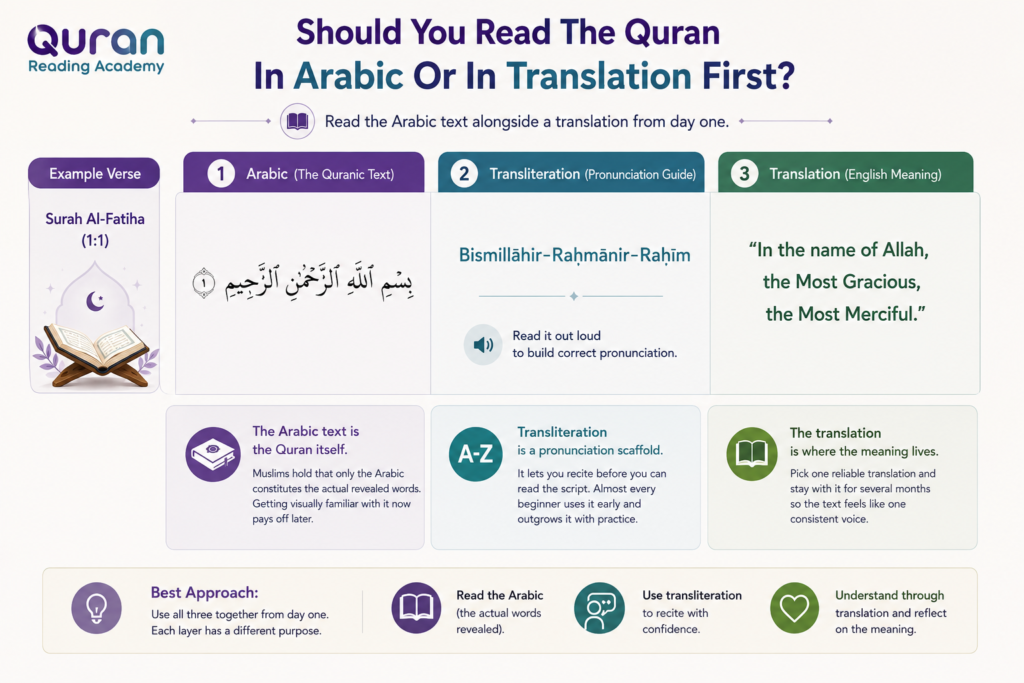
Read the Arabic text alongside a translation from day one; don’t wait until your Arabic is strong enough to drop the translation. Most editions present up to three layers together, and each one does a different job.
The Arabic text is the Quran itself — Muslims hold that only the Arabic constitutes the actual revealed words, so it stays present even in fully translated editions, and getting visually familiar with it now pays off later.
Transliteration, the Arabic written in Latin letters, is a pronunciation scaffold that lets you recite before you can read the script; almost every beginner uses it early and outgrows it with practice.
The translation is where the meaning lives while your Arabic develops — pick one reliable translation and stay with it for several months so the text feels like one consistent voice rather than several competing ones.
Read Also: How to Improve Recitation of the Quran?
8. Which Surah Should I Begin Reciting First?
There’s no surah you’re required to start with, but Surah Al-Fatiha is the near-universal first choice, since it’s the one surah every Muslim recites in every prayer. Getting its pronunciation and meaning solid comes before anything else.
After Al-Fatiha, the common next step is the short surahs of Juz Amma: Surah Ikhlas for its statement on tawheed, Surah Nas and Surah Falaq for seeking protection from harm, and Surah Kawthar for a short reminder of Allah’s blessings.
These five surahs alone give a new reader enough material to vary their daily prayer within the first month, well before tackling longer chapters.
Inside Our Live Classroom
We believe in complete transparency. Take a look inside our virtual classrooms to experience our premium teaching tools and engaging learning environment firsthand.
Start Your Quran Learning Journey Today
Join Quran Reading Academy and begin structured, step-by-step Quran reading with expert guidance.
Try your first class for freeStart Your Quran Journey With Quran Reading Academy Today
You don’t have to work out pronunciation, pacing, and Tajweed rules on your own from a book or an app.
A teacher who listens to your recitation live catches mistakes you can’t hear in yourself, and keeps you moving through the right surahs in the right order.
Quran Reading Academy runs structured one-to-one classes for exactly this stage: starting with Al-Fatiha, building through Juz Amma, and correcting pronunciation as you go, with a teacher rather than guesswork.
Our Quran Courses:
- Quran Reading Classes
- Quran Reading Classes for Kids
- Quran Reading Classes for Adults
- Quran Reading Classes for Female/Sisters
- Quran Reading Classes for New Muslims
- Quran Reading Course for Beginners
- Online Quran Reading Course with Tajweed
- Reading and Memorizing the Quran Course
- Noorani Qaida Course
- Quran Course for Beginners
- Quran Tajweed Course
- Quran Recitation Course
- Quran Hifz Course
Start Your Quran Learning Journey Today
Join Quran Reading Academy and begin structured, step-by-step Quran reading with expert guidance.
Try your first class for freeConclusion
Where you start reading the Quran matters more than most beginners realize going in. Al-Fatiha first, the short surahs of Juz Amma next, and a narrative surah like Yusuf or Maryam once you want longer reading — that sequence builds the memorization, rhythm, and context that make the rest of the Quran, including denser chapters like Al-Baqarah, far more approachable later.
Tajweed refines your recitation but doesn’t gate your access to it; correct pronunciation and a sincere intention are what actually matter from day one.
Read the Arabic alongside a translation rather than waiting to “earn” the Arabic first, keep your etiquette simple and consistent, and let a teacher catch what self-study misses. That combination is what turns “where should I start reading the Quran” from an open question into a habit you keep.

Frequently Asked Questions
The questions below cover what beginners most often ask once they’ve decided where should I start reading the Quran — from surah order to daily reading amounts.
1. Where should I start reading the Quran as a complete beginner?
Start with Surah Al-Fatiha, since it’s recited in every prayer, then move to the short surahs of Juz Amma such as Ikhlas, Falaq, and Nas. Reading front to back from Al-Baqarah onward is the most common beginner mistake, since that chapter is the Quran’s longest and most detail-dense.
2. Do I need to know Tajweed before I start reading the Quran?
No, Tajweed is not required to begin. Correct pronunciation of Arabic letters is what protects meaning, while Tajweed refines and beautifies your recitation on top of that foundation. Beginners are encouraged to start reading immediately and build Tajweed skills alongside their reading.
3. Is it okay to read the Quran in translation instead of Arabic?
Yes, reading a reliable English translation is how most beginners build their first real understanding of the Quran’s meaning. Keep the Arabic text present alongside it so you grow familiar with the original wording as you read.
4. Do I need wudu to read the Quran?
Wudu, ritual purity, is a recommended Sunnah before reading the Quran, not a strict requirement in every case, and scholarly views vary on details such as touching a printed Mushaf versus reading from a phone. Ask a scholar you trust for guidance specific to your situation, and treat wudu as good practice either way.
5. Which surah should I begin reciting first?
Surah Al-Fatiha is the standard first choice, since every Muslim recites it in daily prayer. After that, the short surahs of Juz Amma, including Ikhlas, Nas, Falaq, and Kawthar, are the most common next step for beginners.


Leave a Reply