 How to read Quran
You want to open the Mushaf and read, but the Arabic script looks like a code you were never given the key to. You have been reciting the same Surahs in Salah for years without understanding a single word. This is the reality for approximately 80% of Muslims worldwide, including the vast majority in Turkey, Indonesia, India, Pakistan, Europe, and North America, who recite the Quran phonetically without grasping its meaning.
Learning how to read Quran if you don’t know Arabic is not about becoming an Arabic scholar. It is about building two specific skills simultaneously through a structured path that produces real results within the first two weeks.
1. Reading and Understanding Are Two Separate Skills You Build at the Same Time
Most beginners assume they must learn Arabic as a full language before opening the Quran. This assumption is wrong and has prevented millions of sincere Muslims from beginning a journey they could have started immediately.
The two skills are fundamentally different:
- Reading: Recognizing letter shapes, knowing their sounds, and blending them into words.
- Understanding: Knowing what those words mean in context.
The Islamic tradition has always treated these skills separately. Classical scholars taught script recognition first, then layered meaning through translation alongside it, never after finishing the entire alphabet.
Starting this way means a beginner can read short Surahs correctly and understand their meaning within the first two weeks, without waiting for full Arabic fluency.
Many new Muslims and beginners have the intention but no structured starting point. The Quran Reading Course for Beginners at The Quran Reading Academy builds both skills from the very first lesson.
Enroll today and start with a free trial session.
2. Transliteration Helps for the First Few Days Only and Must Be Dropped Early
Most beginner guides recommend reading the Quran in Latin transliteration, writing “Bismillahi r-Rahmani r-Raheem” instead of the Arabic script, as a permanent starting method. This advice causes serious long-term damage to pronunciation.
The problem with transliteration is clear when you look at what it collapses:
| Arabic Letters | Sound | Transliteration Shows |
| ح and ه | Two completely different throat sounds | Both written as “h” |
| س and ص | Produced at different points in the mouth | Both written as “s” |
| ع and أ | Entirely different articulation points | Both often written as “a” |
A student who internalizes the wrong sound from day one spends more time unlearning it than they would have spent learning the correct sound from scratch. Use transliteration only as a temporary visual aid during the first three to five days, always alongside the actual Arabic letters, then drop it entirely once fifteen to twenty letter shapes are recognizable.
See Our Academy in Action
Discover what a typical session looks like! Watch these brief highlights from our live, interactive classes to see how our instructors engage with students of all ages.
Start Your Quran Learning Journey Today
Join Quran Reading Academy and begin structured, step-by-step Quran reading with expert guidance.
Try your first class for free3. Learning Arabic Letters in Groups by Sound Produces Faster Results
The standard approach of learning Arabic letters in alphabetical order from Alif to Ya is not the most efficient method for Quran reading specifically. Grouping letters by their point of articulation, meaning where in the mouth or throat each sound originates, trains the muscles needed for each sound group far more rapidly.
The most effective letter groupings for beginners are:
- Throat letters: ء ه ع ح غ خ — practiced together because they all require throat engagement.
- Tongue tip letters: ت د ط ن ل — share similar placement at the front of the mouth.
- Lip letters: ب م و ف — all produced using the lips with minimal throat involvement.
Within the first fourteen days, a structured beginner using this grouping approach can read Surah Al-Fatiha, An-Nas, Al-Falaq, and Al-Ikhlas correctly with a teacher confirming pronunciation in real time. This is the real and checkable milestone, not a vague sense of having made progress.
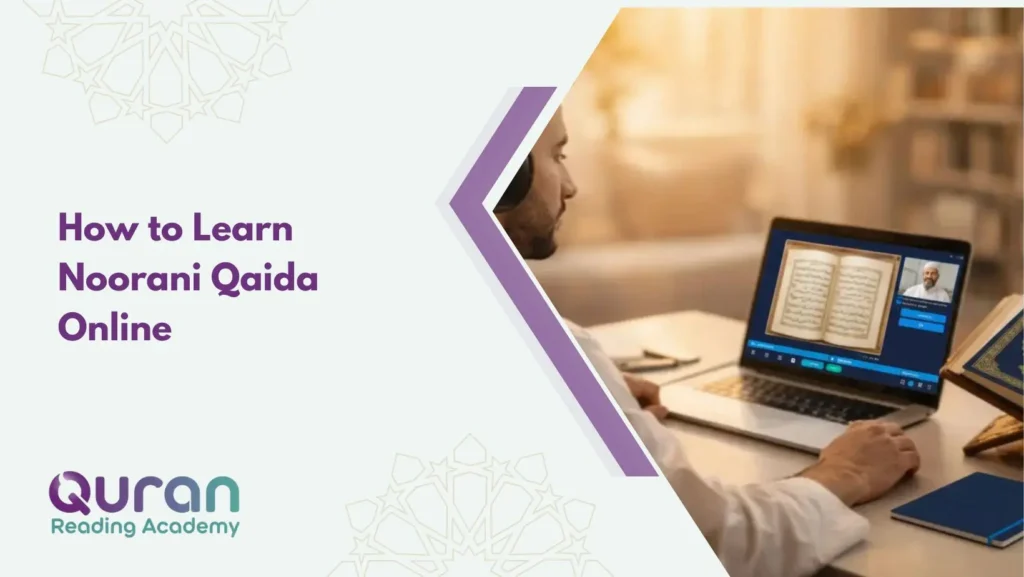
The Noorani Qaida Course at The Quran Reading Academy uses exactly this structured grouping methodology with certified tutors who correct every letter live.
Register today and build the right foundation from day one
4. Starting with a Trusted Translation Alongside the Arabic Text Connects Sound to Meaning Immediately
A translation gives you the meaning of the words. Reading it alongside the Arabic, not instead of it, is what builds the connection between what you hear yourself reciting and what Allah is actually saying to you.
The most recommended translations for non-Arab beginners are:
| Translation | Strengths | Best For |
| Sahih International | Clear, neutral, minimal archaic terms | All levels including complete beginners |
| The Clear Quran (Dr. Mustafa Khattab) | Modern English, helpful section headings | Beginners needing extra reading support |
| Abdullah Yusuf Ali | Classical and poetic with full commentary | Learners who want detailed footnotes |
The most effective reading habit is:
- Read one Ayah in Arabic aloud.
- Immediately read the translation of that same Ayah.
- Pause before moving to the next verse.
Using a word-by-word Quran resource rather than a full-page translation allows you to see exactly which Arabic word maps to which English word. This accelerates recognition of repeated words across Surahs within the first month.
5. Learning 125 Core Quranic Words Unlocks Half the Entire Quran
The Quran contains approximately 80,000 words, but the vast majority are repetitions of a much smaller core vocabulary. Linguists who analyzed the Quranic text discovered the following:
| Words Learned | Percentage of Quran Understood |
| 125 most frequent words | 50% of the entire text |
| 250 most frequent words | 75% of the entire text |
| 200 most frequent verbs | Appear over 18,000 times across the text |
This means that with 125 words, fewer than the vocabulary of a two-year-old child in any language, a reader can understand half of every page they open. The ten most important words to learn first are:
- الله (Allah) — appears over 2,600 times.
- رَب (Rabb) — Lord, used in every Fatiha.
- يَوْم (Yawm) — Day, especially “Day of Judgment.”
- رَحْمَة (Rahmah) — Mercy, root of Rahman and Raheem.
- قُلْ (Qul) — Say, opens many Surahs directly.
- نَاس (Naas) — People, humanity.
- كِتَاب (Kitaab) — Book, often referring to the Quran itself.
- آيَة (Ayah) — Sign or verse.
- أَرْض (Ard) — Earth.
- سَمَاء (Samaa) — Sky or heaven.
Learning three to five of these words daily takes under five minutes and produces over 100 words within a month.
The Prophet ﷺ said that the most beloved deed to Allah is the most consistent one, even if it is small.
The Quranic Arabic Course at The Quran Reading Academy builds this vocabulary through direct Ayah analysis so every word learned is immediately encountered in its real Quranic context.
Read Also: How to Make Reading Quran More Interesting?
6. Listening to the Quran with Intention Builds Recognition Before You Can Read Fluently
Listening to the Quran produces genuine spiritual and practical benefits even before a learner can read the script independently. Allah says in the Quran:
“وَإِذَا قُرِئَ الْقُرْآنُ فَاسْتَمِعُوا لَهُ وَأَنصِتُوا لَعَلَّكُمْ تُرْحَمُونَ”
Wa idhaa quri’a al-Qur’aanu fastami’oo lahu wa ansitoo la’allakum turhamoon
“So when the Qur’an is recited, then listen to it and pay attention that you may receive mercy.”
The most effective listening habits for beginners who don’t yet know Arabic are:
- Follow along with the transliteration during the first days to familiarize yourself with Arabic sounds.
- Once basic letter recognition develops, follow along in the Mushaf instead of transliteration.
- Listen to the same Surah for three to five consecutive days before moving to the next.
- Pause after each verse and read its translation before continuing.
As vocabulary grows through daily word learning, recognized words begin appearing during listening sessions. Each recognized word is a moment of genuine connection between the listener and the text that no passive listening without learning can produce.
Read Also: How to Improve Recitation of the Quran in 10 Proven Steps
Inside Our Live Classroom
We believe in complete transparency. Take a look inside our virtual classrooms to experience our premium teaching tools and engaging learning environment firsthand.
Start Your Quran Learning Journey Today
Join Quran Reading Academy and begin structured, step-by-step Quran reading with expert guidance.
Try your first class for freeRead Also: How to Read and Understand Quran in 8 Proven Steps
7. Studying Tafsir Prevents the Misinterpretation That Translation Alone Cannot Protect Against
Translation gives the surface meaning of words. Tafsir gives the reason a verse was revealed, the historical context surrounding it, and how scholars across fourteen centuries understood and applied it. Without Tafsir, a reader who encounters a verse about fighting, judgment, or social law is left to interpret it alone, which is precisely how dangerous misreadings of the Quran occur.
Al-Qurtubi described readers who recite without knowing Tafsir as people who receive a letter from their king at night with no lamp, frightened and unable to know what it contains. Tafsir is the lamp.
The most accessible Tafsir works for non-Arab beginners are:
- Tafsir Ibn Kathir (abridged): Explains reasons for revelation and includes authenticated narrations from early Muslims.
- Tafsir As-Sa’di: Written in simple language focused on spiritual clarity, avoids lengthy scholarly debates.
- Ma’ariful Quran (Mufti Shafi Usmani): Contemporary explanation in English focusing on practical application.
The practical habit is to read the Tafsir introduction of any Surah before reciting it. This costs two extra minutes per session and transforms the entire reading experience by giving every verse a context that makes it personally relevant rather than historically distant.
The Quran Reading Classes for New Muslims at The Quran Reading Academy integrate Tafsir context into every lesson so that reading and understanding develop together from the very start.
Start Your Quran Journey at The Quran Reading Academy Today
The Quran Reading Academy removes every barrier between you and a confident, meaningful relationship with the Quran. Certified Arab tutors holding Ijazah deliver one-on-one live sessions with real-time Makharij correction using audio-visual feedback in every class. Key advantages include:
- Flexible scheduling across EST, PST, GMT, CET, IST, and MYT.
- Monthly progress reports and written feedback after every session.
- Structured progression from Noorani Qaida through to Ijazah certification.
- Affordable pricing with family enrollment discounts available.
Our Quran Courses
- Quran Reading Classes
- Quran Reading Classes for Kids
- Quran Reading Classes for Adults
- Quran Reading Classes for Female/Sisters
- Quran Reading Classes for New Muslims
- Quran Reading Course for Beginners
- Online Quran Reading Course with Tajweed
- Reading and Memorizing the Quran Course
- Noorani Qaida Course
- Quran Course for Beginners
- Quran Tajweed Course
- Quran Recitation Course
- Quran Hifz Course
- Online Quran Qirat Classes
- Quranic Arabic Course
- Arabic Reading Practice Course
Start Your Quran Learning Journey Today
Join Quran Reading Academy and begin structured, step-by-step Quran reading with expert guidance.
Try your first class for freeEnroll today and start with a free trial session
Conclusion
Learning how to read Quran if you don’t know Arabic is a journey built on seven parallel tracks. Separating reading from understanding removes the false prerequisite of full Arabic fluency. Dropping transliteration early prevents permanent pronunciation errors. Learning letters by sound group builds accuracy faster than alphabetical order.
Reading a trusted translation alongside the Arabic connects sound to meaning from day one. Learning 125 core Quranic words unlocks half the entire text within weeks. Listening with intention builds recognition before full reading fluency arrives. And studying Tafsir protects against the misinterpretation that translation alone cannot prevent.
Frequently Asked Questions
Can I pray Salah before I learn to read Arabic properly?
Yes. You can memorize short Surahs by ear while building your reading skill. The goal is to move toward reading and understanding the Arabic yourself as soon as possible.
How long does it take to read short Surahs correctly from scratch?
Most beginners can read four to five short Surahs correctly within two weeks of consistent daily practice with live teacher correction.
Is it enough to read only an English translation of the Quran?
No. Translation gives meaning but not the actual wording of revelation. Reading translation alongside the Arabic, not instead of it, is the correct approach.
Do I need to learn all Tajweed rules before starting to read?
No. Start with accurate letter sounds and basic vowel marks first. Add Tajweed rules gradually once you can read a full short Surah without stopping.
How many Arabic words do I need to understand most of the Quran?
Learning 125 most frequent words gives approximately 50% comprehension. Learning 250 words brings that to approximately 75% of the entire Quranic text.
Is it sinful to make mistakes while learning to read the Quran?
No. The Prophet ﷺ said the one who recites with difficulty while sincerely trying receives a double reward, so sincere mistakes during learning carry no sin whatsoever.
Related Articles
How to read Quran


Leave a Reply