 How to read Quran
You want to read the Quran, but the Arabic script looks like a code you were never given the key to. You open the Mushaf, recognize nothing, and close it again feeling that this goal is somehow not meant for you. This experience is shared by millions of non-Arab Muslims worldwide, and it has nothing to do with intelligence or sincerity.
It has everything to do with the absence of a clear, sequential method. Learning how to read and understand Quran is achievable for every Muslim who approaches it with the right steps, the right tools, and a teacher who corrects rather than discourages. This guide gives you exactly that, drawn from established Islamic scholarship and practical learning principles that have proven effective for beginners across every age group and language background.
1. Renewing Your Intention Before Every Session Activates Real Learning
The Prophet ﷺ said:
“إِنَّمَا الأَعْمَالُ بِالنِّيَّاتِ”
Innamaa al-a’maalu bin-niyyaat
“The reward of deeds depends upon the intentions.”
Your intention when learning how to read and understand Quran must be directed toward one of the following three purposes:
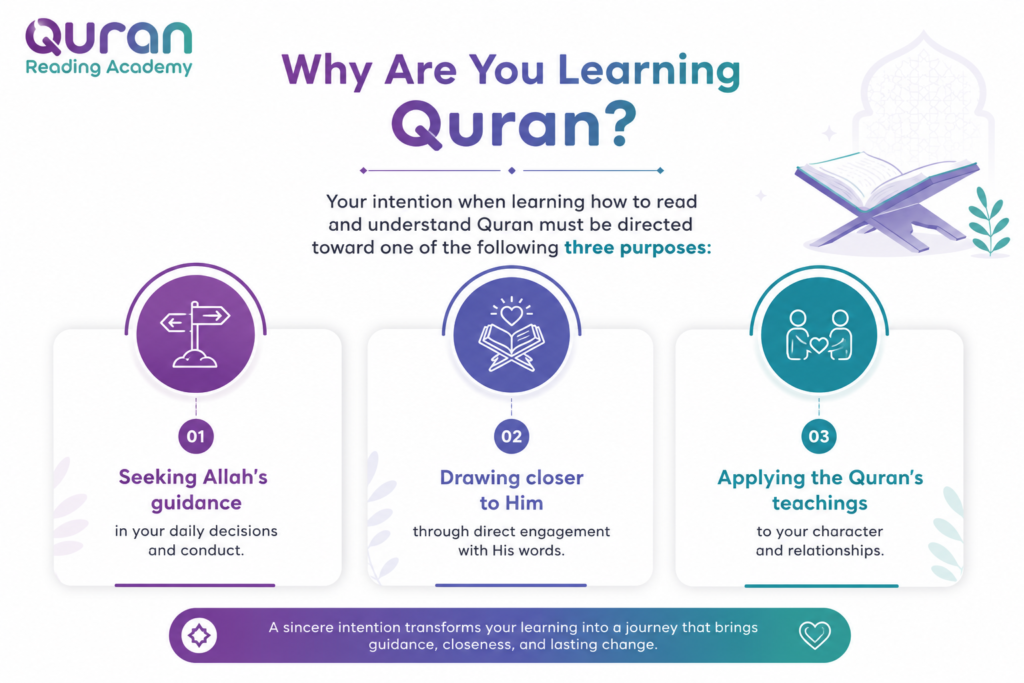
- Seeking Allah’s guidance in your daily decisions and conduct.
- Drawing closer to Him through direct engagement with His words.
- Applying the Quran’s teachings to your character and relationships.
A sincere Niyyah does something no textbook can replicate. It opens the heart before the mind begins working, so every verse lands with personal weight rather than passing through as unfamiliar sound.
Learners who begin with a worldly goal such as finishing quickly or gaining social approval tend to abandon the process within weeks. Those rooted in a spiritual goal remain consistent even through slow periods, because every sitting with the Quran carries its own reward regardless of how many pages were covered.
Many beginners carry this sincere intention but have no structured path to channel it into real action. The Quran Course for Beginners at The Quran Reading Academy provides that structure from the very first lesson.
Enroll today and give your intention the method it deserves
2. Learning the Arabic Alphabet Through Noorani Qaida Removes Every Barrier
The Arabic alphabet contains twenty-eight letters, each produced from a specific point of articulation in the mouth or throat.
Unlike English, Arabic letters change shape depending on their position within a word, appearing differently at the beginning, middle, end, or standalone position. Recognizing all four forms of each letter is essential before a learner attempts to read even the shortest Surah from the page.
The Noorani Qaida is the most trusted methodology for teaching this stage to non-Arab beginners. It introduces letters individually, connects them into syllables, then builds toward short Quranic words in a sequence that prevents overwhelm and builds genuine recognition.
The short vowels marked in the Quran, known as harakat, tell the reader exactly how each letter sounds in context. These diacritical marks are one of the Quran’s greatest gifts to learners, because they eliminate ambiguity and make correct pronunciation accessible even without a native Arabic background.
See Our Academy in Action
Discover what a typical session looks like! Watch these brief highlights from our live, interactive classes to see how our instructors engage with students of all ages.
Start Your Quran Learning Journey Today
Join Quran Reading Academy and begin structured, step-by-step Quran reading with expert guidance.
Try your first class for free3. Reading with Tajweed Preserves the Meaning of Every Word You Recite
Allah says in the Quran:
“وَرَتِّلِ الْقُرْآنَ تَرْتِيلًا ﴿٤﴾”
Wa rattil il-Qur’aana tarteelaa
“and recite the Qur’an with measured recitation.”
When a learner recites with correct Tajweed, three things happen simultaneously. The words become clearer and more distinct. The meanings are preserved exactly as Allah revealed them.
The act of reflection, known as Tadabbur, becomes significantly easier because the reciter is no longer struggling with pronunciation and can give full attention to meaning. The essential Tajweed rules every beginner must master first are:
- Makharij al-Huruf: the precise point of articulation for each letter, which prevents confusion between similar sounds.
- Madd: the rules governing the lengthening of vowel sounds, which preserves the rhythm and meaning of each verse.
- Ghunnah: the nasal resonance applied to specific letters, which is one of the most frequently mispronounced aspects of beginner recitation.
- Waqf: the rules for stopping and pausing at correct positions, which protects the meaning of each verse from being distorted by an ill-placed pause.
Learners who attempt to self-teach Tajweed without live correction consistently develop errors that harden over time and become far more difficult to fix later.
The Quran Tajweed Course at The Quran Reading Academy pairs every student with a certified tutor who corrects Makharij in real time using audio-visual feedback during every session.
Recite with precision from the start
4. Choosing the Right Translation Connects Arabic Sound to Real Meaning
Arabic carries layered meanings that a single English word rarely captures. The word “love” in English is one word. In Arabic, there are more than ten distinct words for love, each expressing a different depth and quality of that emotion.
This richness means that the translation you choose directly shapes the understanding you build. The two most recommended translations for beginners are:
| Translation | Strengths | Best Suited For |
| Sahih International | Neutral language, minimal archaic terms, widely trusted | All levels including complete beginners |
| The Clear Quran by Dr. Mustafa Khattab | Modern English, helpful section headings, brief contextual notes | Beginners who need additional reading support |
The most effective reading method is to read one or two verses in Arabic first, then read the translation, then pause before moving to the next verse. This sequence trains the mind to connect the sound of the Quran with its meaning, making recitation progressively more mindful and impactful with every sitting.
5. Studying Tafsir Reveals What Translation Alone Can Never Show You
Many verses in the Quran were revealed in direct response to specific events, questions, or circumstances during the Prophet’s lifetime.
This context, known as Asbab al-Nuzul, is essential for correct understanding. Reading a verse in isolation from its context of revelation has historically been the primary cause of dangerous misinterpretation, including the misuse of Quranic verses to justify violence or extremism, which directly contradicts the Quran’s central message of mercy and justice.
For beginners, two works stand above others in accessibility and authenticity. Tafsir Ibn Kathir explains reasons for revelation and includes authenticated narrations from the early generations of Muslims, making it the most comprehensive classical reference available in English.
Tafsir As-Sa’di by Abdur Rahman ibn Nasir As-Sa’di uses simple language focused on spiritual clarity and avoids the lengthy scholarly debates that overwhelm new learners. Starting with abridged editions of either work is entirely appropriate for beginners.
The Quranic Arabic Course at The Quran Reading Academy integrates Tafsir directly into language instruction, teaching grammar through actual Ayah analysis so that every lesson deepens both linguistic skill and Quranic understanding simultaneously.
Enroll today and move beyond surface-level reading..
6. Reflecting on Each Verse Daily Transforms Recitation Into a Living Practice
Allah says in the Quran:
“أَفَلَا يَتَدَبَّرُونَ الْقُرْآنَ”
Afalaa yatadabbaroona al-Qur’aan
“Then do they not reflect upon the Qur’an?”
The practical method for Tadabbur requires no special equipment or advanced knowledge. Read a small portion, stop completely, and ask yourself two questions.
What is Allah teaching me through this verse? How does this verse apply to my current situation, relationships, or struggles? This pause is not wasted time. It is the mechanism through which the Quran moves from the page into the reader’s actual life and behavior.
Learners who build a daily Tadabbur habit consistently report that their connection with the Quran deepens over time in a way that pure recitation practice alone never produces. Verses they once passed over quickly begin to carry personal weight and answer questions they did not know they were asking.
Read Also: How to Read Quran If You Don’t Know Arabic: 7 Proven Ways
7. Listening to Expert Recitation Daily Trains Both Ear and Tongue Together
Golden Zone: The brain absorbs pronunciation most effectively through repeated auditory exposure. Daily listening to accurate Quranic recitation accelerates reading accuracy and Tajweed application far beyond what reading practice alone can achieve.
Allah says in the Quran:
وَإِذَا قُرِئَ الْقُرْآنُ فَاسْتَمِعُوا لَهُ وَأَنصِتُوا لَعَلَّكُمْ تُرْحَمُونَ ﴿٢٠٤﴾
Wa idhaa quri’a al-Qur’aanu fastami’oo lahu wa ansitoo la’allakum turhamoon
“So when the Qur’an is recited, then listen to it and pay attention that you may receive mercy. (204) .”
The most effective listening method involves three specific habits. Follow along in your Mushaf while the reciter reads so the eye and ear work together. Choose one Surah and listen to it for three to five consecutive days before moving to the next, allowing repetition to fix correct sounds in the mind.
Pause after each verse and read the word-by-word meaning before continuing, so that listening becomes an act of understanding rather than passive background noise. Many learners report measurable improvement in their own recitation within two weeks of applying this method consistently, without any additional study effort.
The Quran Recitation Course at The Quran Reading Academy takes listening further by teaching the art of Tarteel with live feedback from certified tutors who correct every sound during every session.
Read Also: How to Make Reading Quran More Interesting?
Register today and let your voice honor every word.
8. Building a Consistent Daily Plan Makes Quran Reading an Unbreakable Habit
The brain forms habits through a process called neuroplasticity, which is its ability to reorganize itself by reinforcing neural pathways that are used repeatedly. Every time you sit with the Quran at the same time each day, that pathway strengthens.
Within weeks, the brain begins to expect and seek the session rather than resist it. The two most practical reading plans for beginners are:
| Plan | Daily Requirement | Completion |
| 6-Month Plan | 3.5 pages per day | 5 Juz per month |
| 30-Day Plan | 4 pages after each of the 5 prayers | Full Quran in one month |
If both plans feel demanding at your current level, a single page or even a single verse per day is a completely valid starting point. The goal is never speed. The goal is an unbroken chain of daily contact with the Quran that grows stronger with every sitting.
Setting a fixed time, preferably after Fajr when the mind is clear and distraction is minimal, dramatically increases the likelihood that the habit takes root and remains.
Read Also: How to Improve Recitation of the Quran in 10 Proven Steps
Inside Our Live Classroom
We believe in complete transparency. Take a look inside our virtual classrooms to experience our premium teaching tools and engaging learning environment firsthand.
Start Your Quran Learning Journey Today
Join Quran Reading Academy and begin structured, step-by-step Quran reading with expert guidance.
Try your first class for freeBegin Your Quran Journey at The Quran Reading Academy Today
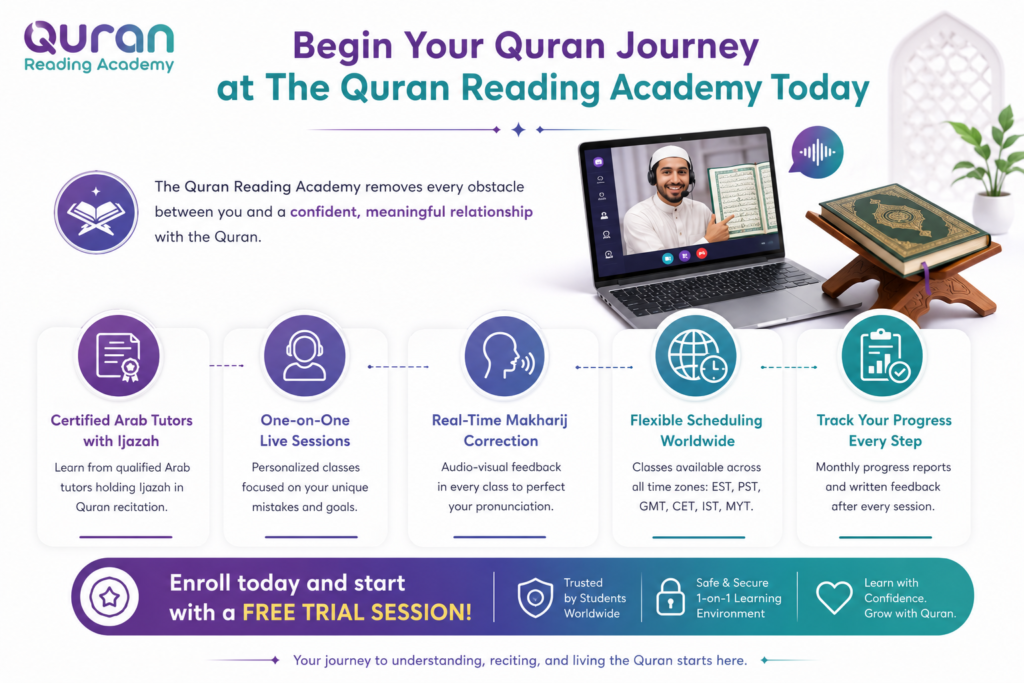
The Quran Reading Academy removes every obstacle between you and a confident, meaningful relationship with the Quran. Certified Arab tutors holding Ijazah in recitation deliver one-on-one live sessions tailored to your individual mistakes, with real-time Makharij correction using audio-visual feedback in every class.
Flexible scheduling covers all global time zones including EST, PST, GMT, CET, IST, and MYT, ensuring no learner is left without access. Monthly progress reports and written feedback after every session keep your development measurable.
Our Quran Courses
- Quran Reading Classes
- Quran Reading Classes for Kids
- Quran Reading Classes for Adults
- Quran Reading Classes for Female/Sisters
- Quran Reading Classes for New Muslims
- Quran Reading Course for Beginners
- Online Quran Reading Course with Tajweed
- Reading and Memorizing the Quran Course
- Noorani Qaida Course
- Quran Course for Beginners
- Quran Tajweed Course
- Quran Recitation Course
- Quran Hifz Course
- Online Quran Qirat Classes
- Quranic Arabic Course
- Arabic Reading Practice Course
Enroll today and start with a free trial session.
Conclusion
Learning how to read and understand Quran is a journey that begins with a sincere intention and builds through correct pronunciation, Tajweed, reliable translation, Tafsir study, daily reflection, attentive listening, and consistent habit. None of these steps is optional, and none of them is beyond your reach.
Every letter you learn correctly, every verse you reflect upon, and every session you show up for is an act of worship that Allah rewards. Begin today, begin with the right method, and trust that every step forward brings you closer to the Book that was always meant for you.
Frequently Asked Questions
Is reading the Quran in English translation acceptable for beginners?
Yes. A trusted English translation helps beginners understand Quranic meaning before building full Arabic reading fluency over time.
How many pages should a beginner read daily?
Even one verse daily is valid and rewarded. Consistency over time matters far more than the quantity covered in any single session.
What is the practical difference between translation and Tafsir?
Translation gives word meanings in another language. Tafsir explains the context, reasons for revelation, and scholarly understanding behind each verse.
Is a qualified teacher necessary for learning Quran reading?
Yes. A qualified teacher corrects Makharij and Tajweed errors in real time, preventing mistakes from becoming permanent habits.
Is it sinful to make mistakes while learning to read the Quran?
No. The Prophet ﷺ said the one who recites with difficulty receives a double reward, so sincere mistakes during learning carry no sin.
Can adults learn how to read and understand Quran from scratch?
Absolutely. Adults learn effectively with structured instruction, consistent practice, and a qualified teacher who tailors correction to their specific errors.
Related Articles
How to read Quran



Leave a Reply