 Fatawa
| Key Takeaways |
| Reading the Quran in Arabic is religiously required during Salah for all Muslims who are able to learn. |
| Translations of the Quran are considered interpretations of meaning only — they are not regarded as the Quran itself by scholarly consensus. |
| Outside of Salah, reading translations is permitted to understand meanings, but carries no substitute for Arabic recitation’s reward. |
| The majority of Islamic scholars rule that Salah is invalid if recited in a language other than Arabic. |
| Non-Arabic speakers are obligated to learn Surah Al-Fatihah in Arabic — practical learning resources are widely available. |
For millions of Muslims raised outside Arabic-speaking countries, this question carries real weight. You want to connect with the Quran sincerely, but Arabic feels distant — and you wonder whether your prayer, your reading, and your spiritual effort truly count.
Do You Have to Read the Quran in Arabic During Salah?
Yes — reading the Quran in Arabic is obligatory during Salah for anyone who is capable of learning it. The majority of Islamic scholars across all four major madhabs agree that reciting Quranic verses in any language other than Arabic renders the prayer invalid. This applies especially to Surah Al-Fatihah, which is a pillar of every unit of prayer.
This ruling rests on a foundational reality: the Quran was revealed in Arabic, and that linguistic form is inseparable from its divine nature. Allah says:
إِنَّا أَنزَلْنَـٰهُ قُرْءَٰنًا عَرَبِيًّا لَّعَلَّكُمْ تَعْقِلُونَ
Innā anzalnāhu Qur’ānan ‘Arabiyyan la’allakum ta’qilūn
“Indeed, We have sent it down as an Arabic Quran so that you might understand.” (Yusuf 12:2)
This is why translations — however accurate and beautifully written — are referred to by scholars as tafsir al-ma’ani (interpretation of meanings), not as the Quran itself.
If you are a beginner who hasn’t yet learned Arabic reading, the obligation is to begin learning immediately.
At The Quran Reading Academy, our Quran Reading Classes for Beginners are designed specifically for non-Arabic speakers starting from absolute zero — with certified instructors who guide you step by step until you can recite Al-Fatihah and short surahs correctly in Arabic.
Enroll in Our Quran Reading Course for Beginners with a Free Trial
Is It Compulsory to Read the Quran in Arabic for Those Who Cannot Yet Do So?
The obligation to recite in Arabic applies to those who are able — and for those who are not yet able, you must learn, and in the meantime, you make dhikr (remembrance of Allah) during Salah until you can recite properly.
scholars affirm that a person who genuinely cannot recite Al-Fatihah in Arabic substitutes with other forms of permitted dhikr while actively pursuing Arabic reading instruction, or at least recites one verse of Al-Fatiha in Arabic 7 times.
This is not a permanent exemption — it is a grace period with a deadline defined by sincere effort.
Shots Videos from Our Courses
Start Your Quran Learning Journey Today
Join Quran Reading Academy and begin structured, step-by-step Quran reading with expert guidance.
Try your first class for freeDoes the Quran Have to Be Read in Arabic Outside of Salah?
Outside of Salah, reading translations of the Quran is permitted and actively encouraged for understanding. However, it does not replace Arabic recitation and does not carry the same reward as reading the original Arabic text.
Scholars are unanimous that what is translated is the meaning of the Quran, not the Quran itself.
The reward promised for every letter of Quranic recitation — as established in hadith — applies specifically to the Arabic text. Reading a translation is a scholarly and devotional act, but it occupies a different category.
The Reward of Arabic Recitation Is Unique
The Prophet ﷺ said: “
Whoever reads a letter of the Book of Allah will have a reward, and that reward will be multiplied by ten.”
This hadith, recorded in Sunan al-Tirmidhi (hadith 2910), refers to the Arabic letters of the Quran specifically.
Scholars have consistently interpreted this reward as attached to reciting the revealed Arabic text — not its translation.
This is not meant to diminish the value of reading translations. Understanding what you recite deepens your connection to the words.
But the spiritual mathematics of Arabic recitation are irreplaceable, which is precisely why learning to read the Quran in Arabic is one of the most rewarding investments a Muslim can make.
The Quran Reading Academy offers dedicated Quran Reading Classes for New Muslims that understand exactly where you are starting from — spiritually, linguistically, and emotionally. Our certified instructors approach new Muslim students with particular care, beginning with what is needed most urgently for Salah.
Start Reading Quran With a Free Trial Today
How Non-Arabic Speakers Can Begin Reading the Quran in Arabic?
Learning to read the Quran in Arabic as a non-Arabic speaker is entirely achievable — and more structured and accessible today than ever before. The key is following a proven methodology rather than attempting to learn in isolation.
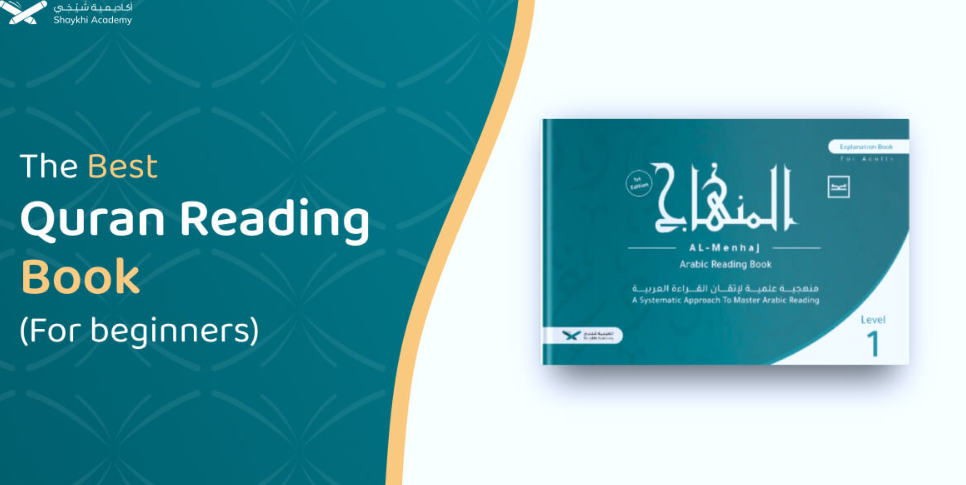
The most effective starting point for absolute beginners is Noorani Qaida or a structured equivalent like the Al-Menhaj Book, developed by experienced Quran teachers at The Quran Reading Academy.
Al-Menhaj Book was specifically authored for English-speaking beginners and covers Arabic letter recognition, harakat (vowel marks), and foundational reading mechanics before moving into Quranic text.
Explore The Best Quran Reading Book for FREE
A Practical Learning Path for Beginners
| Stage | Focus | Typical Duration |
| Stage 1 | Arabic letter recognition (all 28 letters) | 2–4 weeks |
| Stage 2 | Harakat and basic vowelization | 3–5 weeks |
| Stage 3 | Joining letters into words | 4–6 weeks |
| Stage 4 | Reading Quranic words and short surahs | 6–10 weeks |
| Stage 5 | Applying basic Tajweed rules in reading | Ongoing |
These timeframes reflect what our instructors typically observe with students who practice fifteen to twenty minutes daily. Progress varies, but this framework has proven reliable across hundreds of adult learners in our Quran Reading Classes for Adults.
Book your FREE trial class to start reading Quran

One pattern I’ve noticed consistently: students who try to skip Stage 2 — the harakat stage — almost always struggle later when they encounter unfamiliar Quranic words. The vowel system is the engine of Arabic reading. Giving it proper time early saves significant difficulty later.
If you’re concerned about common mistakes that slow down progress, our guide on common mistakes when reading the Quran covers the most frequent errors beginners make — and how to correct them before they become habits.
Our Students Reviews
Start Your Quran Learning Journey Today
Join Quran Reading Academy and begin structured, step-by-step Quran reading with expert guidance.
Try your first class for freeStart Reading the Quran in Arabic with The Quran Reading Academy
You now understand the ruling — Arabic is required, the path is clear, and the tools are available.
The Quran Reading Academy offers:
- Certified Qari instructors with years of teaching non-Arabic speakers
- Structured courses from absolute beginner to Tajweed application
- The Al-Menhaj Book — purpose-built for English-speaking beginners
- Flexible online scheduling that fits your life
- A free trial lesson to experience the methodology firsthand
Book your free trial today and take your first step toward reading the Quran in the language it was revealed.
Check out our top courses to help you read the Quran with confidence:
- Quran Reading Course With Tajweed
- Noorani Qaida Course
- Quran Reading Course for Beginners
- Quran Reading Classes for Adults
- Quran Reading Classes for Sisters
- Quran Reading Classes for Kids
- Quran Hifz Course
- Arabic Reading Practice Course
- Quranic Arabic Course
Book your free class today—it’s the perfect start to learning the Quran
Conclusion
Reading the Quran in Arabic is not an arbitrary religious formality — it is a connection to the exact words Allah revealed, letter by letter, in a form no translation can replicate. For Salah, it is obligatory. Outside of Salah, it remains the highest and most rewarding form of Quranic engagement.
The path for non-Arabic speakers is demanding but deeply rewarding. Thousands of our students at The Quran Reading Academy began exactly where you are — with zero Arabic — and are now reciting the Quran with confidence in their prayers. Insha’Allah, the same is true for you. Begin with one lesson, one letter, one surah at a time.
Start Your Quran Learning Journey Today
Join Quran Reading Academy and begin structured, step-by-step Quran reading with expert guidance.
Try your first class for freeRead Also: Can You Read Ayatul Kursi in Salah?
Frequently Asked Questions About Reading the Quran in Arabic
Is It Compulsory to Read the Quran in Arabic During Prayer?
Yes — it is compulsory to recite Quranic verses in Arabic during Salah, according to the scholarly consensus. Reciting in any other language is not considered valid Quranic recitation. A person who cannot yet do so must substitute with permitted dhikr while actively learning Arabic recitation as soon as possible.
Does the Quran Have to Be Read in Arabic to Count as Quran?
Yes — only the Arabic text constitutes the Quran itself. Any translation, however accurate, is classified by scholars as tafsir al-ma’ani — an interpretation of meanings. The specific reward mentioned in hadith for reciting the Quran applies to the Arabic letters of the revealed text, not to translated versions.
Can I Read a Translation of the Quran to Understand Its Meaning?
Yes — reading translations outside of Salah is not only permitted but encouraged for developing understanding. Scholars distinguish between reciting the Quran for worship and reading translations for comprehension. Both have value, but they serve different purposes. Learning to read Quran word by word in Arabic alongside a translation is one of the most effective approaches for non-Arabic speakers.


Leave a Reply