 Times for Reading
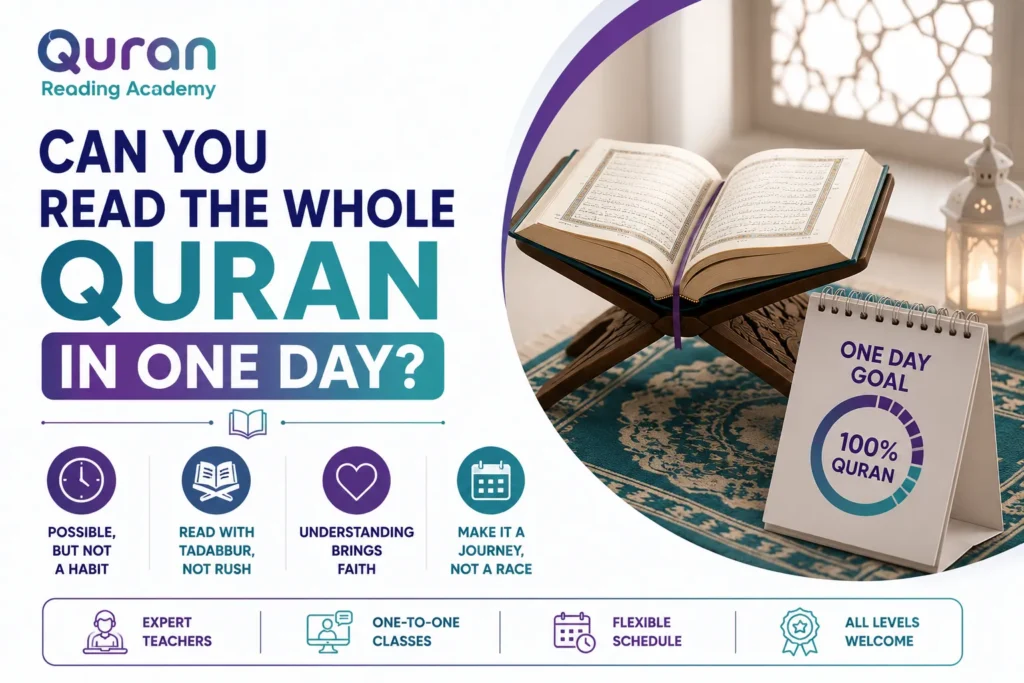
Reading the entire Quran from cover to cover in a single day is something many students at Quran Reading Academy ask about, especially during Ramadan or before a personal milestone. The question “can you read the whole Quran in one day” comes up often, and the short answer is yes, it is physically possible, but Islamic scholarship treats it as an exception rather than a daily habit.
Understanding why requires looking at what the Prophet Muhammad (peace be upon him) actually taught his companions about pacing their recitation.
This article walks through the scholarly guidance on completing the Quran quickly, how long a full reading actually takes, and when reading it in one day is genuinely appropriate.
Is It Permissible To Read The Whole Quran In One Day?
Many students ask can you read the whole Quran in one day and expect a simple yes or no. The honest answer is that it is permissible on an occasional basis, but classical scholars agree it should not become a regular practice. The distinction matters more than the act itself.
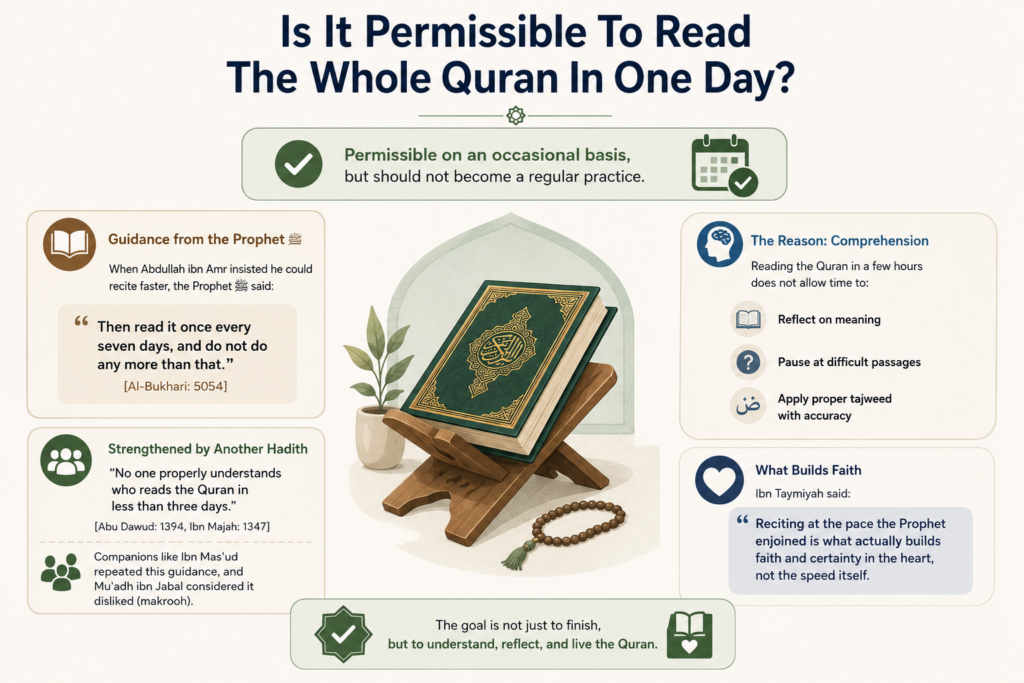
This guidance comes directly from a hadith in which the Prophet (peace be upon him) advised Abdullah ibn Amr ibn al-Aas.
When Abdullah insisted he could recite faster than the monthly pace the Prophet first suggested, the Prophet eventually told him:
“Then read it once every seven days, and do not do any more than that” (Al-Bukhari).
This exchange is the foundation most scholars point to when discussing recitation speed.
A second hadith sharpens the boundary further: “No one properly understands who reads the Quran in less than three days” (Abu Dawud, Ibn Majah).
Companions such as Ibn Mas’ud repeated this same guidance to those they taught, and Mu’adh ibn Jabal considered it disliked (makrooh) to complete a full recitation in under three days.
The reasoning is not about restricting worship. It is about comprehension. A person moving through the Quran’s roughly 6,000 verses in a matter of hours cannot reflect on meaning, pause at difficult passages, or apply proper tajweed rules with accuracy.
Ibn Taymiyah observed that reciting at the pace the Prophet enjoined is what actually builds faith and certainty in the heart, not the speed itself.
Read also: Motivation To Read Quran – How To Build A Habit That Lasts?
Read Also: Can You Read the Quran in English?
How Long Does It Take To Read The Entire Quran?
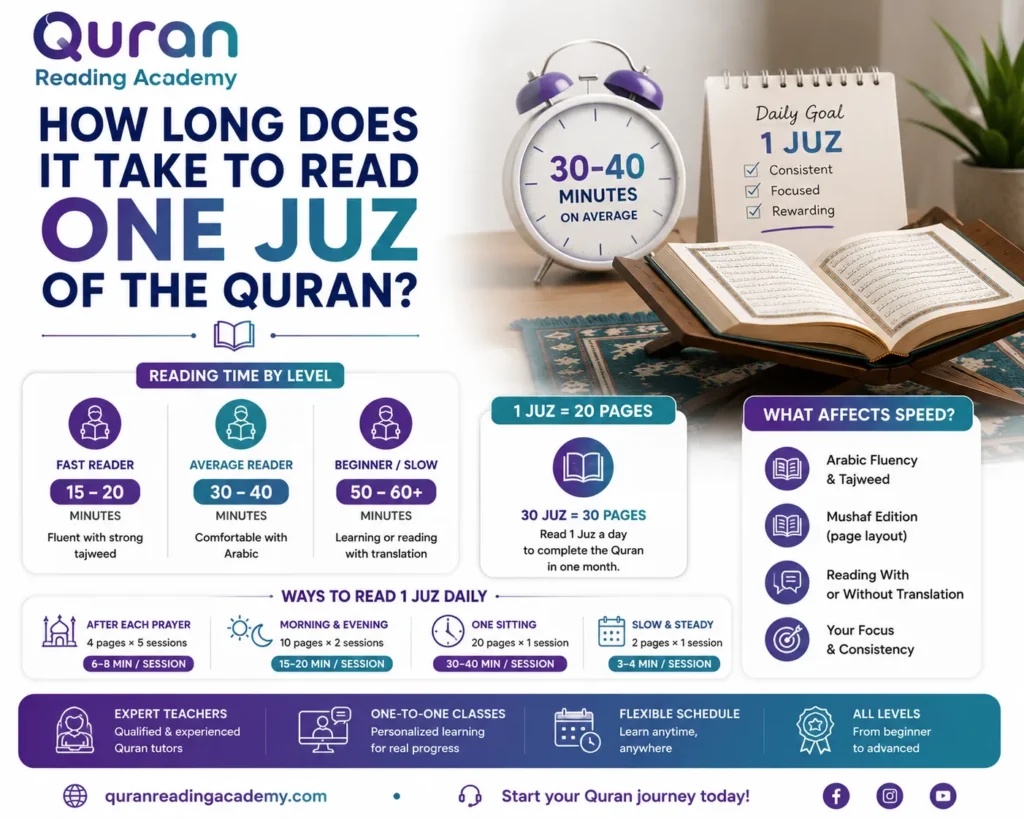
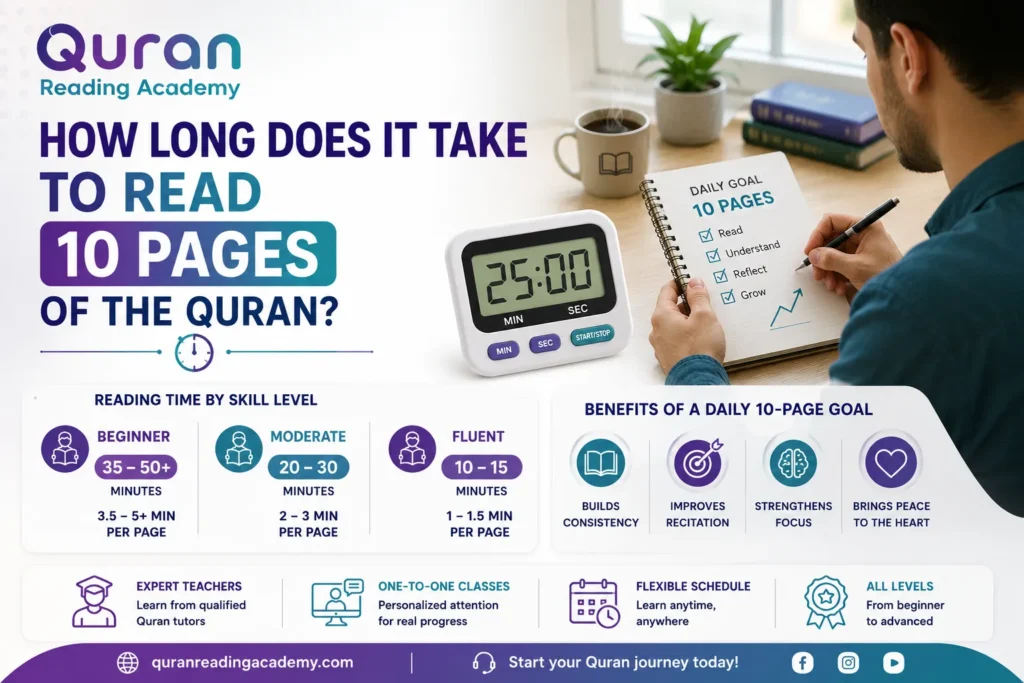
Reading the entire Quran at a moderate, fluent pace takes approximately 15 to 20 hours of continuous recitation. This figure assumes steady reading without long pauses for reflection or tajweed correction.
For someone reading more carefully, applying tajweed rules, and pausing to absorb meaning, the realistic range extends to 30 to 40 hours. This is closer to how most reciters, including non-native Arabic speakers, actually experience a complete reading.
Several factors change this estimate. Arabic literacy level affects reading speed directly, since classical Quranic Arabic differs from spoken dialects.
Familiarity with the text through memorization or repeated exposure also speeds recitation. Someone reading the Quran with proper tajweed, where small changes in pronunciation change the meaning of a word, naturally reads slower than someone skimming a translation.
This is one reason instructors at Quran Reading Academy emphasize tajweed accuracy from the earliest lessons rather than treating pronunciation as an advanced skill added later.
At Quran Reading Academy, students working through the Online Quran Reading Course with Tajweed typically build reading speed gradually, page by page, precisely because rushed recitation undermines the accuracy the Prophet’s guidance was protecting.
The Risks Of Reading The Quran Too Quickly
Reading the Quran too quickly causes problems because Arabic pronunciation is highly sensitive to small changes, and rushing increases the risk of altering a word’s meaning entirely.
Classical Arabic distinguishes words through subtle differences in vowel length, letter emphasis, and articulation point. A reciter moving too fast can shorten a long vowel, drop a letter’s proper emphasis, or blend two words together, any of which can change what the verse actually says.
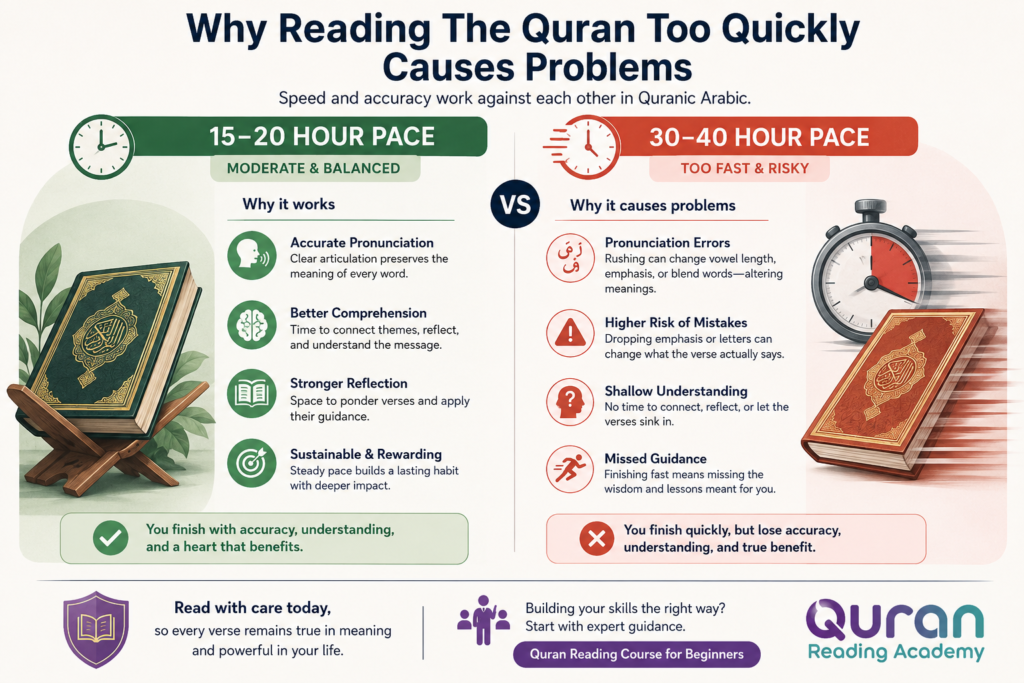
This is the practical mechanism behind the hadith warning that reading in under three days prevents proper understanding: speed and accuracy work against each other in Quranic Arabic specifically, more than in most other reading tasks.
There is also a comprehension cost that has nothing to do with pronunciation. A reader who finishes 20 pages in an hour has no time to connect one surah’s themes to the next, notice repeated words across different chapters, or sit with a verse that raises a question. Reflection requires unhurried pace by definition.
Students who are still building foundational reading skills benefit from starting with a Quran Reading Course for Beginners, where pace is deliberately kept slow so that accuracy becomes automatic before speed is introduced at all.
Read also: Where Should I Start Reading The Quran? A Beginner’s Roadmap
When Is It Acceptable To Complete The Quran In A Single Day?
Completing the Quran in a single day is acceptable when it happens occasionally, for a specific reason, rather than as a person’s regular habit. Scholars including Ibn Rajab al-Hanbali documented exactly this pattern among early generations of Muslims.
Several legitimate occasions come up repeatedly in the classical sources. Reviewing what has already been memorized is one, since a hafiz revisiting familiar text is not reading for first-time comprehension the way a new reader is.
Making the most of an especially blessed time, such as the last ten nights of Ramadan or the night Laylat al-Qadr is sought, is another; Qatadah, for example, completed the Quran every night during those final ten nights specifically because of their spiritual weight.
A third is being in Makkah for a limited visit, where non-residents historically increased their recitation to make the most of the location. Observing i’tikaad, the retreat for worship inside the mosque, is a fourth recognized exception.
It is worth being cautious with historical claims about extremely rapid completions, such as finishing the Quran between Maghrib and Isha prayers.
Scholars like An-Nawawi acknowledged that some early figures, including Uthman ibn Affan, Tamim ad-Dari, and Sa’id ibn Jubayr, completed the Quran in a single prayer unit (rak’ah), but reports of finishing it four times in one night are treated with skepticism, since the time available makes accurate recitation at that speed implausible.
The practical takeaway for most readers: an occasional single-day reading during Ramadan or a spiritually significant period is within the tradition. Making it a permanent weekly or daily habit, at the expense of prayer, family obligations, or work, moves outside what the Prophet’s guidance intended.
For anyone building this into a Ramadan routine, working through a structured Reading and Memorizing the Quran Course beforehand makes an intensive reading period more manageable, since familiarity with the text naturally increases reading speed without sacrificing comprehension.
Read Also: How to Concentrate While Reading Quran?
See Our Academy in Action
Discover what a typical session looks like! Watch these brief highlights from our live, interactive classes to see how our instructors engage with students of all ages.
Start Your Quran Learning Journey Today
Join Quran Reading Academy and begin structured, step-by-step Quran reading with expert guidance.
Try your first class for freeWhat Is The Recommended Pace For Regular Quran Reading?
The recommended pace for regular Quran reading is once every seven days, based on the Prophet’s direct instruction to Abdullah ibn Amr ibn al-Aas, with three days as the minimum for anyone reading more frequently.
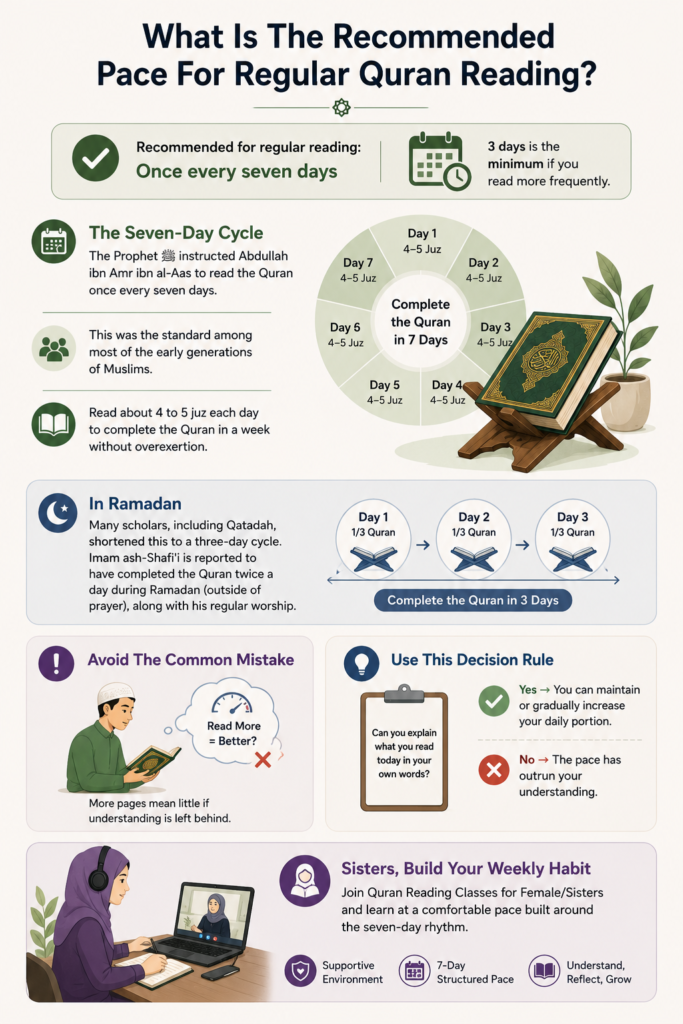
This seven-day cycle was the standard among most of the early generations of Muslims. It divides naturally into the Quran’s existing structure: reading roughly one-seventh of the text (about 4 to 5 juz) each day completes a full cycle in a week without requiring marathon reading sessions.
During Ramadan specifically, many scholars, including Qatadah, shortened this to a three-day cycle, and Imam ash-Shafi’i is reported to have completed the Quran twice a day during that month, outside of prayer, in addition to his regular worship.
A common mistake among new reciters is treating “read more” as always better, without accounting for whether comprehension keeps pace with volume.
A decision rule that works well in practice: increase your daily portion only if you can still explain, in your own words, what you read that day. If you cannot, the pace has outrun your understanding, regardless of how many pages were covered.
Sisters looking for a structured, comfortable environment to build this weekly habit can start with Quran Reading Classes for Female/Sisters, which pace lessons around exactly this seven-day rhythm rather than pushing for maximum daily volume.
Read also: Motivation To Read Quran – How To Build A Habit That Lasts?
Inside Our Live Classroom
We believe in complete transparency. Take a look inside our virtual classrooms to experience our premium teaching tools and engaging learning environment firsthand.
Start Your Quran Learning Journey Today
Join Quran Reading Academy and begin structured, step-by-step Quran reading with expert guidance.
Try your first class for freeBuild a sustainable Quran reading habit with expert guidance
A rushed reading you cannot remember by the next day is not the goal, and it never was. What actually builds lasting connection to the Quran is steady, accurate, well-paced recitation guided by someone who can correct your pronunciation before mistakes become habits.
Quran Reading Academy’s instructors work with students at every level, from complete beginners to those refining tajweed for a faster, more accurate reading pace, all through live one-on-one classes built around your schedule.
Register for a free trial class today and start building a Quran reading habit that lasts well beyond Ramadan.
Our Quran Courses:
- Quran Reading Classes
- Quran Reading Classes for Kids
- Quran Reading Classes for Adults
- Quran Reading Classes for Female/Sisters
- Quran Reading Classes for New Muslims
- Quran Reading Course for Beginners
- Online Quran Reading Course with Tajweed
- Reading and Memorizing the Quran Course
- Noorani Qaida Course
- Quran Course for Beginners
- Quran Tajweed Course
- Quran Recitation Course
- Quran Hifz Course
- Online Quran Qirat Classes
Start Your Quran Learning Journey Today
Join Quran Reading Academy and begin structured, step-by-step Quran reading with expert guidance.
Try your first class for freeConclusion
So, can you read the whole Quran in one day and still benefit from it spiritually? Yes, it is achievable in terms of raw time, roughly 15 to 20 hours at a moderate pace, but Islamic scholarship treats it as an occasional practice, not a routine.
The Prophet’s guidance to read the Quran over seven days, with three days as a minimum, exists specifically to protect comprehension and pronunciation accuracy, both of which suffer when Arabic text is rushed.
Single-day completions remain acceptable during Ramadan, while reviewing memorization, during i’tikaaf, or while visiting Makkah, situations where early scholars themselves practiced increased recitation.
Outside those specific circumstances, the seven-day cycle followed by companions like Ibn Mas’ud remains the pace most likely to produce real understanding rather than a completed page count.
New Muslims looking for the most beginner-friendly starting point should look at the dedicated Quran Reading Classes for New Muslims, which start from the Arabic alphabet before building toward full recitation.

Frequently asked questions about reading the Quran quickly
The questions below cover the practical concerns that come up most often once someone understands the seven-day guideline, particularly around Ramadan, memorization review, and tajweed accuracy at faster speeds.
1. Can you read the whole Quran in one day?
Yes, reading the whole Quran in one day is physically possible within roughly 15 to 20 hours of continuous recitation, but scholars view it as acceptable only on occasion, not as a regular habit, since speed at that scale works against comprehension.
2. Is it a sin to read the Quran in less than three days?
It is not a sin, but classical scholars including Mu’adh ibn Jabal considered it disliked (makrooh) as a regular habit. The concern is comprehension, not the act of reading itself, since reciting that fast makes reflection on meaning nearly impossible.
3. Can you read the Quran fast during Ramadan specifically?
Yes, increased recitation speed during Ramadan is well documented among early scholars, including Imam ash-Shafi’i completing it twice daily. The exception applies to the month’s heightened spiritual value, not to speed as a general practice.
4. How many hours does it take to read the whole Quran once?
It takes approximately 15 to 20 hours at a moderate, fluent pace, or 30 to 40 hours when reading more slowly with attention to tajweed and reflection. Arabic fluency and familiarity with the text are the biggest factors affecting this range.
5. Does reading fast count if I do not understand what I recited?
According to the hadith on this topic, reading in under three days is specifically criticized because the reader “does not understand” what was recited. The recitation still holds spiritual merit, but scholars view understanding as the deeper goal the seven-day pace is meant to protect.
6. What is the minimum number of days scholars recommend for completing the Quran?
Most scholars recommend three days as the practical minimum for regular recitation, based directly on the Prophet’s statement that reading in less than three days prevents proper understanding. Seven days remains the more commonly followed cycle.
Related Articles
Times for Reading







Leave a Reply