 Quran Reading Plans
Most people who start learning to read the Quran feel excited in the first week. Then life gets busy, and that motivation to read Quran quietly disappears. If this sounds familiar, you are not failing — you are missing a system, not willpower.
This article breaks down the exact steps that rebuild motivation to read Quran, why it fades in the first place, and how the daily habit becomes something you no longer have to force. At Quran Reading Academy, this is the exact pattern we see in students who go from stopping every few weeks to reading consistently for years.
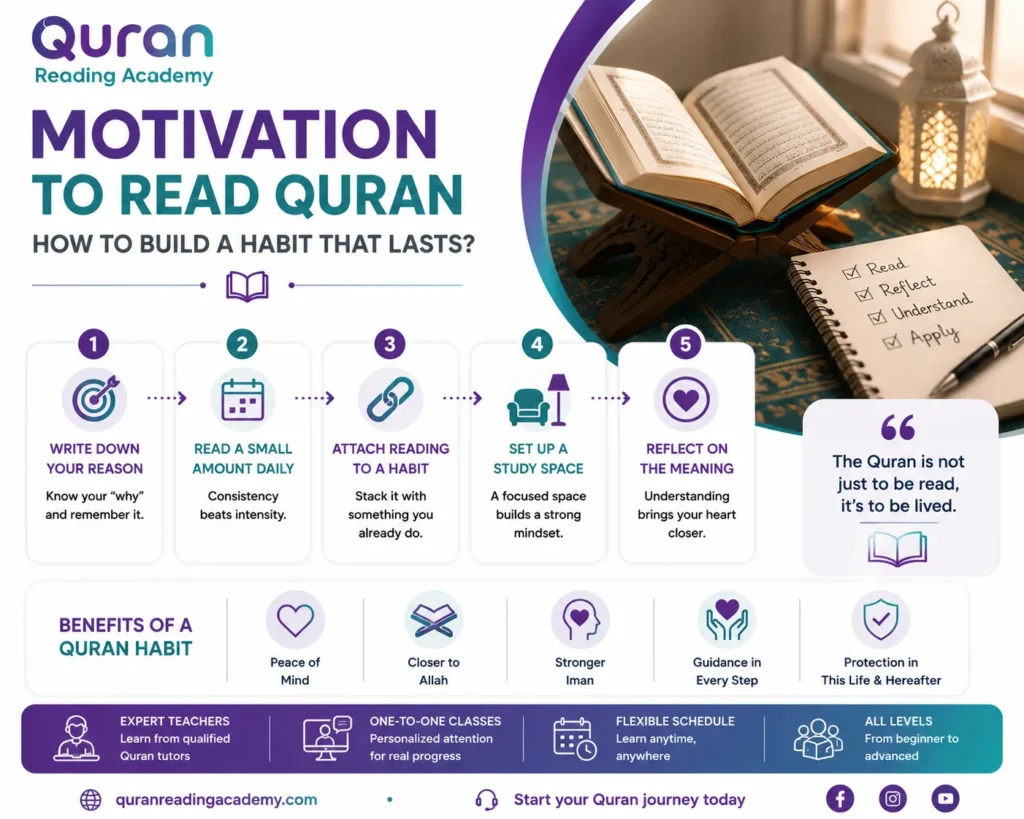
Motivation to read Quran is built through a specific set of habits, not a single burst of willpower. The list below is the order we recommend to students at Quran Reading Academy, from the most foundational step to the most advanced.
1. Write Down Your Personal Reason
Motivation is temporary. A reason — your actual “why” — is stable. Someone learning to read the Quran to raise their children with a stronger connection to Islam has different staying power than someone who signed up because a friend did.
Write your reason down. Keep it somewhere you’ll see it: a sticky note, a phone lock screen, the inside cover of your Mushaf. On the days motivation is at zero, the reason is what gets you to open the page anyway.
A vague reason like “I want to be a better Muslim” fades quickly because it doesn’t point to a specific action.
A stronger reason is tied to something concrete: “I want to understand Surah Al-Fatiha well enough to feel it in my prayer,” or “I want to read one page to my daughter before bed every night.” The more specific the reason, the easier it is to remember why you started on the exact day you don’t feel like continuing.
It also helps to revisit the reason periodically, not just write it once. What motivates a beginner in week one is often different from what keeps a student going in month six — reread your note every few weeks and update it if it no longer feels true.
Read also: Where Should I Start Reading The Quran? A Beginner’s Roadmap

2. Read A Small, Fixed Amount Daily
A common mistake is trying to read several pages in one sitting after days of skipping. This burns people out fast. Reading two or three verses every day, without exception, builds retention and consistency far better than an hour-long session once a week.
The logic here is simple: consistency trains a habit, and habits don’t rely on how much energy or motivation you have on a given day.
A student who commits to two verses a day will almost always read more than a student who commits to “an hour whenever I have time,” because the small goal is easy to start and hard to skip, while the big goal is easy to postpone indefinitely.
This also applies to memorization specifically. Trying to memorize half a page in one session often means forgetting most of it within a week, because there wasn’t enough repetition to move it into long-term memory.
Memorizing two or three lines and reviewing them daily for several days before adding new lines produces far more durable results.
This is also why structured Quran Reading Classes work better than self-study for most beginners — a teacher sets a realistic daily pace instead of leaving it to guesswork, and adjusts it when a student is struggling or ready to move faster.
Read Also: How to Concentrate While Reading Quran?
Read also: Reading the Quran Without Understanding – Possible And Valid?
3. Attach Reading To An Existing Habit
Instead of creating a new time slot, attach Quran reading to something you already do daily: right after Fajr prayer, right before Maghrib, or during a daily commute using audio recitation. This removes the need to “find time” — the time already exists.
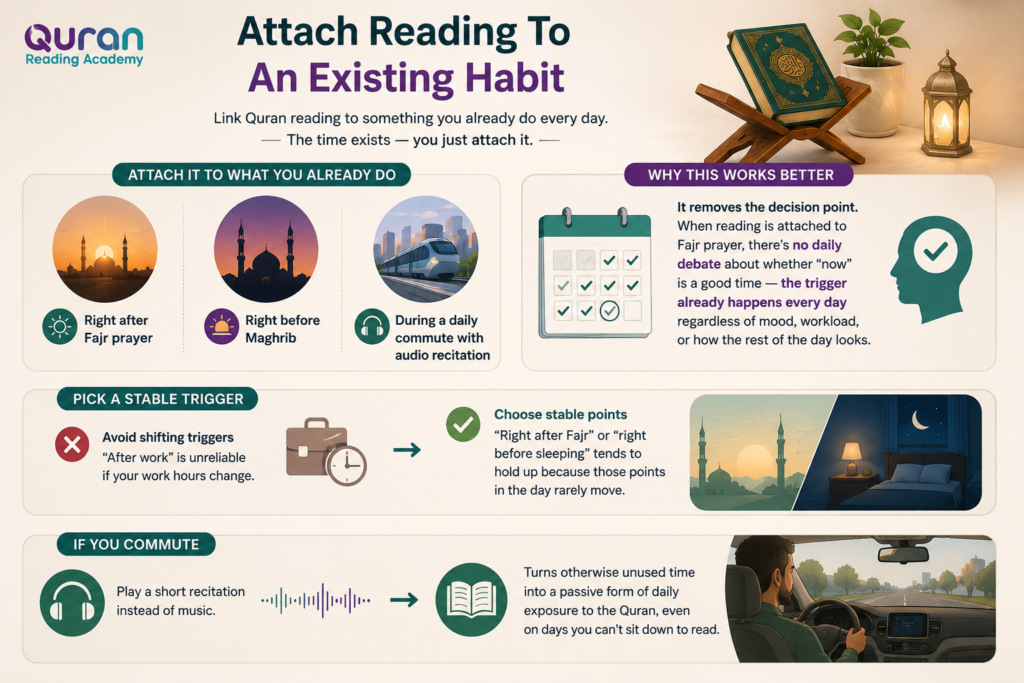
The reason this works better than scheduling a brand-new block of time is that it removes the decision point. When reading is attached to Fajr prayer, there’s no daily debate about whether “now” is a good time — the trigger already happens every day regardless of mood, workload, or how the rest of the day looks.
Pick a trigger that’s stable, not one that shifts constantly. “After work” is unreliable if your work hours change; “right after Fajr” or “right before sleeping” tends to hold up because those points in the day rarely move.
If you commute, playing a short recitation instead of music turns otherwise unused time into a passive form of daily exposure to the Quran, even on days you can’t sit down to read.
Read also: Reading the Quran Without Understanding – Possible And Valid?
4. Set Up A Dedicated Study Space
Environment matters as much as scheduling. A quiet corner, phone out of reach, and Mushaf within reach turns a 20-minute session into focused reading instead of a distracted scroll-and-read cycle.
A dedicated space doesn’t need to be elaborate — a specific chair, a shelf where the Mushaf always sits, or even a corner of a room reserved for this purpose is enough. What matters is that your mind associates that space with reading, so sitting there becomes a cue to start, the same way a desk becomes a cue to work.
Removing the phone is the single biggest factor here. Even having it nearby on silent creates a pull toward checking it between verses, which breaks concentration and turns a 20-minute session into 40 minutes of stop-and-start reading. Leaving it in another room, even for the short duration of a reading session, noticeably improves focus.
If family members share the space, a short, clear request — “please give me 20 minutes of quiet” — is usually enough. Most household distractions during Quran reading come from assuming others will guess you need quiet, rather than simply asking.

5. Remember That Struggling Readers Are Still Rewarded
One of the most common reasons beginners quit is the fear of reading incorrectly. The Quran addresses this directly. The Prophet Muhammad (PBUH) said:
“The one who recites the Quran and stumbles through its verses will have twice that reward.” (Sahih Muslim)
This single hadith removes the most common excuse for quitting early — the fear of not being “good enough” yet.
In practice, this means the discomfort of mispronouncing a letter or repeating a word three times before getting it right is not a sign of failure — it’s part of the process the reward is specifically tied to. Many beginners assume fluency has to come before the reward starts counting, when the hadith says the opposite: the effort of struggling through is rewarded more, not less.
This is worth remembering specifically in the first few weeks of learning Tajweed, when unfamiliar letters like ض or ظ feel awkward to pronounce. That awkward stage is exactly the stage this hadith is describing — not a stage to rush past out of embarrassment.
Read also: How to Learn Quran Reading with Tajweed for Beginners? A Practical Guide
See Our Academy in Action
Discover what a typical session looks like! Watch these brief highlights from our live, interactive classes to see how our instructors engage with students of all ages.
Start Your Quran Learning Journey Today
Join Quran Reading Academy and begin structured, step-by-step Quran reading with expert guidance.
Try your first class for free6. Accept Weak Days Without Quitting
There will be days you miss a session or forget what you memorized the day before. This is normal and does not erase progress. On low-energy days, listening to a short recitation or reviewing one familiar verse keeps the connection alive without adding pressure.
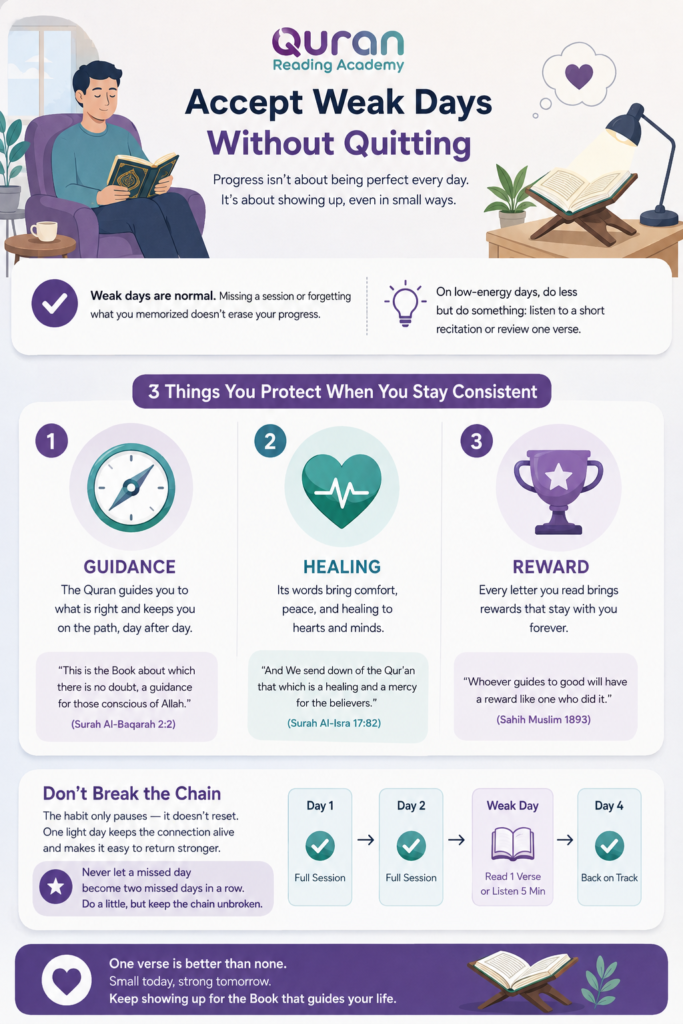
The mistake most learners make on a weak day is treating it as proof the habit has failed, which often leads to abandoning the routine entirely rather than just having one light day.
A missed or reduced session doesn’t reset progress — it only pauses it, and the habit picks back up the next day exactly where it left off, as long as you don’t let one weak day turn into a week of silence.
A useful rule here: never let a missed day become two missed days in a row. Even reading a single verse or listening to five minutes of recitation on a hard day keeps the routine technically unbroken, which makes it far easier to return to a full session the next day than if the habit had stopped completely.
7. Join A Structured Class
Motivation naturally weakens without a fixed pace and outside accountability. A guided structure — rather than pure self-discipline — produces better long-term results.
A teacher does three things self-study usually can’t: sets a pace matched to your actual ability rather than your optimism on day one, corrects pronunciation mistakes before they become habits that are hard to unlearn later, and creates a scheduled class time that functions as accountability — it’s harder to skip a session with a teacher waiting than to skip a private goal only you know about.
Whether you’re a parent looking to start your child early with Quran Reading Classes for Kids, an adult starting later in life through Quran Reading Classes for Adults, or a new Muslim building this habit for the first time with Quran Reading Classes for New Muslims, the same principle applies: a teacher and a fixed schedule replace the need to constantly “feel” motivated.
For sisters who prefer a female-led, respectful learning environment, Quran Reading Classes for Female/Sisters offer that structure without compromising comfort.
If you’re starting from zero, our Quran Reading Course for Beginners is built specifically around this early stage, where motivation is highest but skill is lowest — the gap where most people quit.
What The Quran Itself Says About Reading It?
Motivation to read Quran also comes from understanding what the Quran promises its reader. This is not just a religious formality — it is documented reward, described directly in hadith and verse.
The Prophet Muhammad (PBUH) said: “The example of someone who recites the Quran is like that of a citron, which tastes well and smells pleasant.” (Sahih al-Bukhari)
This hadith places the reciter in a category distinct from someone who has faith but does not engage with the text directly.
The Quran Offers Mental Steadiness, Not Just Spiritual Reward
Beyond the hereafter, regular recitation is described as a source of calm in this life. Ibn al-Qayyim wrote that connecting with the Quran works “in ways that physical remedies do not,” describing it as support for the heart alongside — not instead of — physical health.
Practically, many students describe a noticeable drop in daily stress once Quran reading becomes a fixed part of their morning or evening, particularly right after Fajr, when the mind is quiet and undistracted.
Read Also: How to Read Quran If You Don’t Know Arabic?
Inside Our Live Classroom
We believe in complete transparency. Take a look inside our virtual classrooms to experience our premium teaching tools and engaging learning environment firsthand.
Start Your Quran Learning Journey Today
Join Quran Reading Academy and begin structured, step-by-step Quran reading with expert guidance.
Try your first class for freeStart Learning With Quran Reading Academy Today
Motivation gets you started. A structured class is what keeps you going after motivation runs out.
At Quran Reading Academy, our teachers build a realistic pace around your schedule, correct your Tajweed as you go, and give you a reason to show up even on the days you don’t feel like it.

Our Quran Courses:
- Quran Reading Classes
- Quran Reading Classes for Kids
- Quran Reading Classes for Adults
- Quran Reading Classes for Female/Sisters
- Quran Reading Classes for New Muslims
- Quran Reading Course for Beginners
- Online Quran Reading Course with Tajweed
- Reading and Memorizing the Quran Course
- Noorani Qaida Course
- Quran Course for Beginners
- Quran Tajweed Course
- Quran Recitation Course
- Quran Hifz Course
- Online Quran Qirat Classes

Start Your Quran Learning Journey Today
Join Quran Reading Academy and begin structured, step-by-step Quran reading with expert guidance.
Try your first class for freeConclusion
Motivation to read Quran is not something you wait for — it is something you build through the seven steps above: a clear reason, small daily steps, a fixed routine, and acceptance that some days will be weak.
The Quran itself rewards the effort, not just the fluency, which removes the biggest excuse most beginners have for quitting. Whether you’re a parent, a new Muslim, or someone returning to the Quran after years away, structured guidance from Quran Reading Academy turns a fragile intention into a lasting habit.

Frequently Asked Questions
The questions below cover what learners most often ask when motivation to read Quran starts to drop, and are answered directly so you can act on them right away.
1. How can I stay motivated to read the Quran daily?
Attach your reading to an existing daily habit, such as right after Fajr, and keep sessions short and consistent rather than long and occasional. Writing down your personal reason for learning also helps on low-motivation days.
2. What if I struggle to recite the Quran correctly?
The Quran and hadith both address this directly — a reader who stumbles through recitation receives double the reward for the extra effort involved. Struggling is part of learning, not a reason to stop.
3. Is it better to read a little every day or a lot once a week?
Reading a small, fixed amount every day builds retention and consistency far better than long, infrequent sessions, and it’s easier to sustain during busy weeks.
4. Why do I lose motivation to read Quran so quickly?
Motivation is a temporary feeling, not a stable habit driver. Without a routine or a clear personal reason, motivation naturally fades once the initial excitement of starting wears off.
5. Can Quran classes help if I’ve tried self-study before and quit?
Yes — a structured class sets a realistic pace, adds accountability, and corrects mistakes early, which are the three things most self-taught learners are missing when motivation runs out.
Related Articles
Quran Reading Plans







Leave a Reply