 Quran Reading Plans
If you want to know how to read Quran in 2 weeks, the short answer is that it takes a realistic daily plan, not just motivation. Finishing the Holy Quran in two weeks is a goal many Muslims set during Ramadan, before a special occasion, or simply to reconnect with their faith.
The good news: knowing how to read Quran in 2 weeks comes down to one thing — a realistic daily plan you actually follow. At Quran Reading Academy, we’ve helped students of every age and reading level build that plan and stick to it.
This guide breaks the goal into daily page targets, the best prayer times to read, the tools that keep you consistent, and the mistakes that derail most people before day five.
Step 1: Calculate Your Daily Page Target
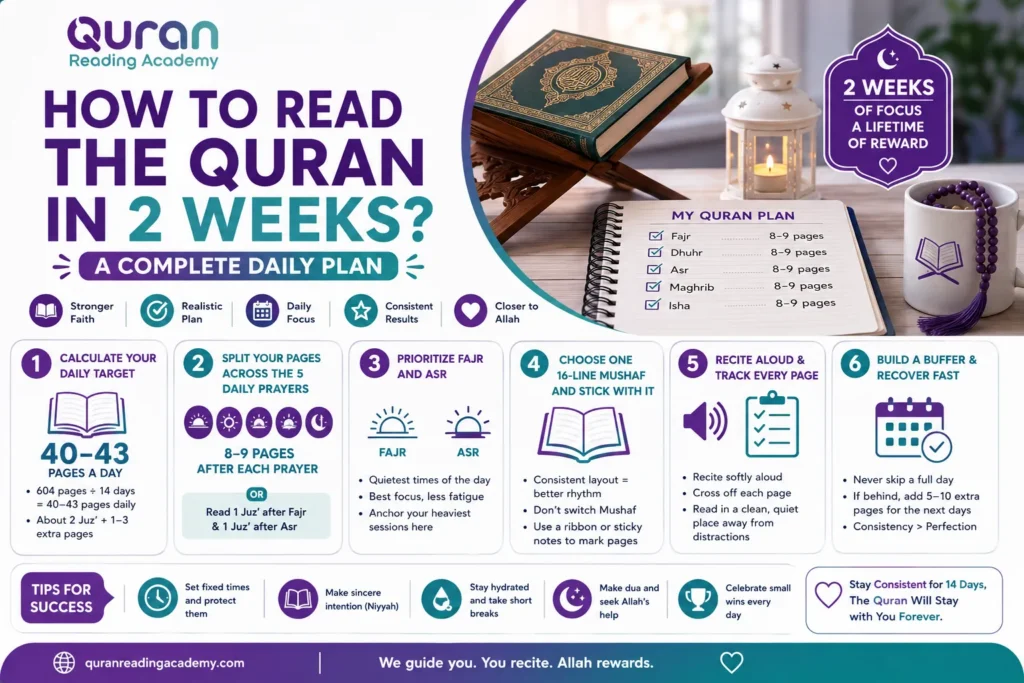
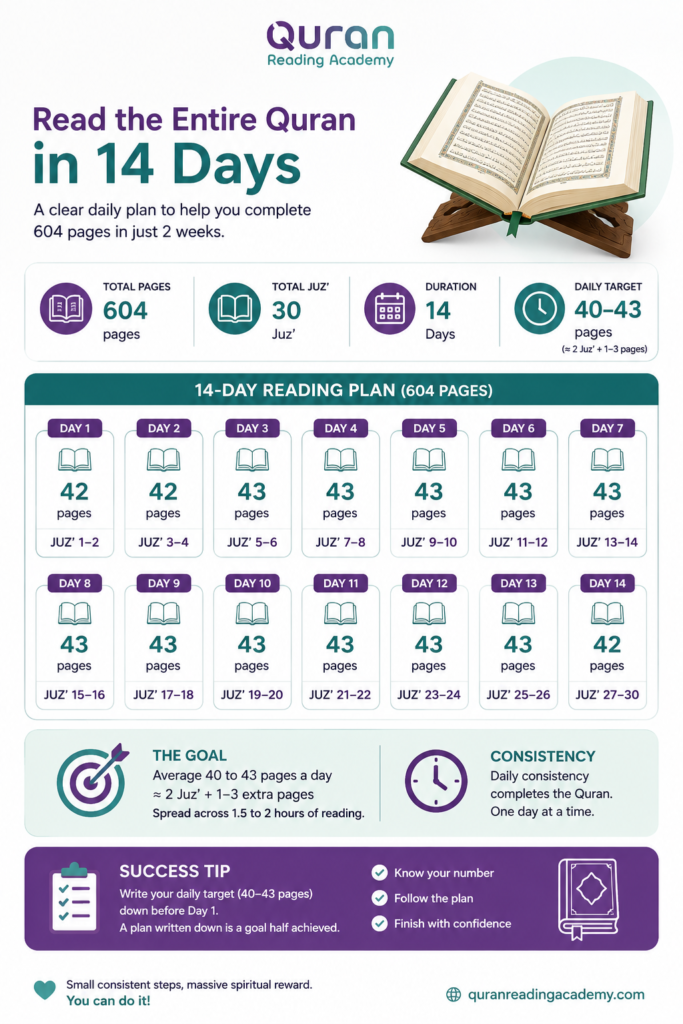
To read Quran in 2 weeks, you need to average 40 to 43 pages a day, since a standard Mushaf contains 604 pages across 30 Juz’. That works out to roughly 2 Juz’ plus a small buffer of 1 to 3 extra pages daily, spread across 1.5 to 2 hours of reading rather than one long sitting.
Write this number down before day one. Most people who quit a two-week goal never calculated a real daily target — they simply read “as much as they can” each day, which almost never adds up to 40-plus pages without a plan.
Read also: How To Read the Quran In 2 Months? A Complete 60-Day Plan
Step 2: Split Your Pages Across The Five Daily Prayers
Read about 8 to 9 pages after each of the five daily prayers. Spread this way, the 40-plus page daily goal never feels like a single tiring task — it becomes five short, manageable sessions bookended by prayer, which is when your mind is already still.
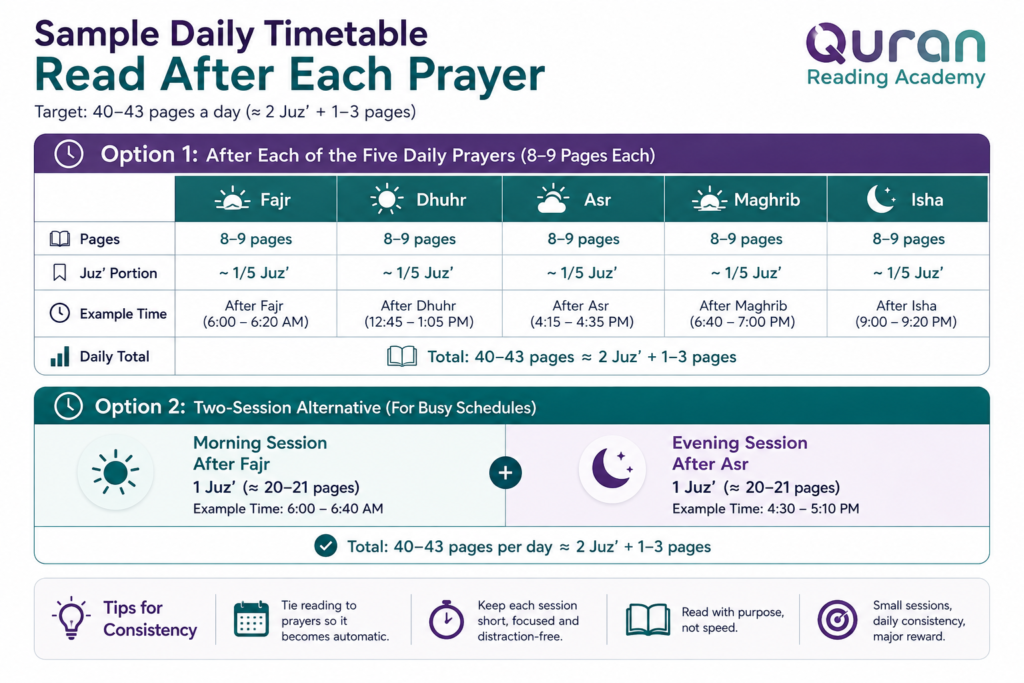
If five separate sessions don’t fit your day, split the target in half instead: one full Juz’ in the morning after Fajr, and the second Juz’ in the evening, ideally after Asr. This two-session alternative works well for people with a structured work or school schedule who can protect two fixed blocks of time.
See Our Academy in Action
Discover what a typical session looks like! Watch these brief highlights from our live, interactive classes to see how our instructors engage with students of all ages.
Start Your Quran Learning Journey Today
Join Quran Reading Academy and begin structured, step-by-step Quran reading with expert guidance.
Try your first class for freeStep 3: Prioritize Fajr And Asr For Your Heaviest Sessions
Fajr and Asr are the best times to read because they fall during the quietest hours of the day — before the household wakes up, and during the late-afternoon lull when phone notifications and errands slow down.
A reader who anchors their two heaviest sessions to these windows finishes the daily target with far less mental fatigue than one who tries to catch up late at night.
Anchoring your schedule this way is one of the simplest tricks for anyone learning how to read Quran in 2 weeks without exhausting themselves by day four.
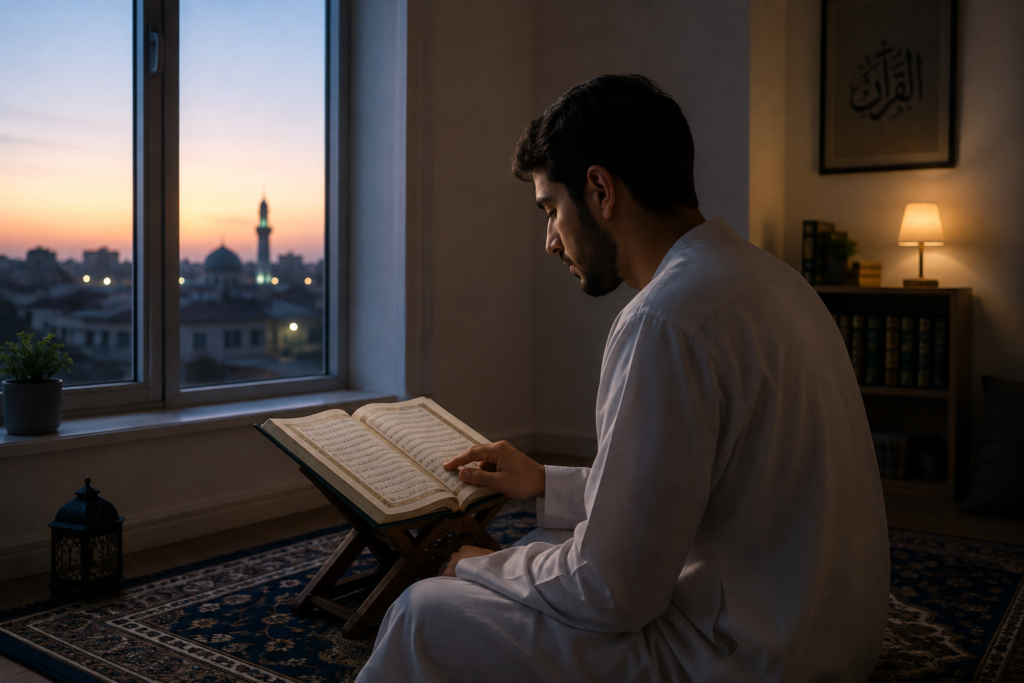
A common mistake beginners make: they schedule their reading “whenever there’s time” instead of a fixed slot. Without a fixed time, the two-week goal quietly slips because reading always loses to whatever else is happening that day.
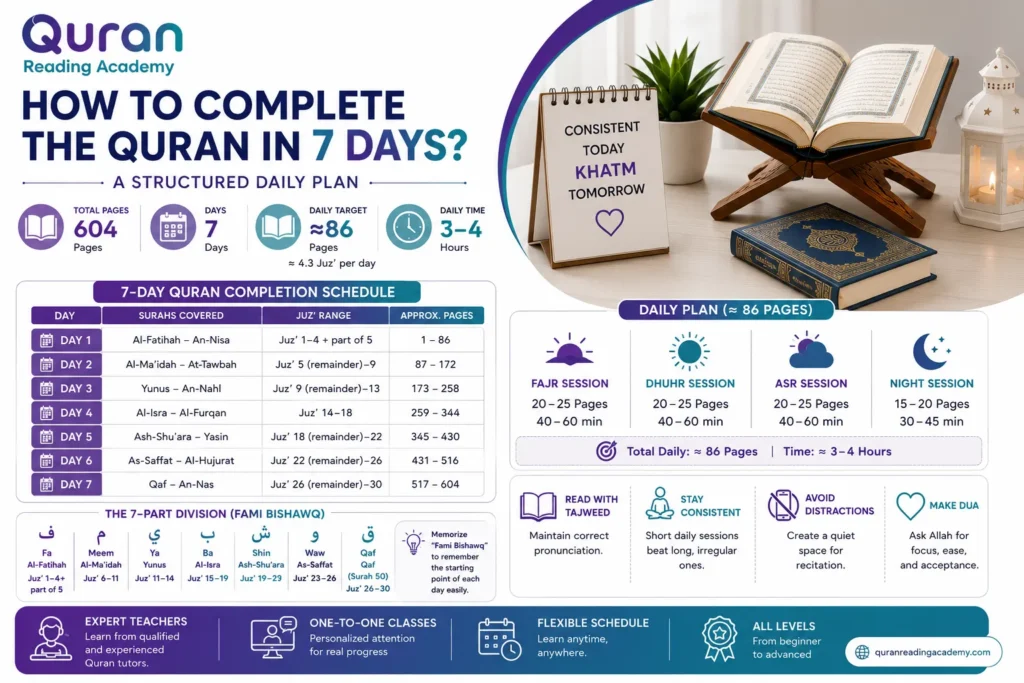
Read also: How To Complete the Quran In 7 Days? A Structured Daily Plan
Step 4: Choose One 16-Line Mushaf And Stick With It
A 16-line Mushaf is the standard choice for intensive reading goals because its layout is predictable — the same number of lines per page, page after page, which helps your eyes and memory settle into a rhythm. Switching between different Mushaf editions mid-goal disrupts that rhythm and slows your pace, since each edition breaks pages at different points.
Pick one Mushaf before day one and stay with it for the full two weeks. If you use sticky notes or a page-marking ribbon, mark your daily stopping point clearly — a lost page is a lost ten minutes of searching.
Adults building this habit from scratch, or returning to it after years away, often benefit from a structured starting point rather than self-teaching. Our Quran Reading Course for Beginners is built for exactly this: pacing, correction, and a realistic path to reading fluently rather than just quickly.
Read also: How Long Does It Take to Learn How to Read the Quran?
Step 5: Recite Aloud And Track Every Page
Recite softly aloud rather than reading silently. Moving your lips and hearing your own voice keeps your focus locked on the text and prevents the drowsiness that creeps in during long silent reading. This is a basic Tajweed habit as well as a focus technique — reciting aloud, even quietly, reinforces correct pronunciation as you go.
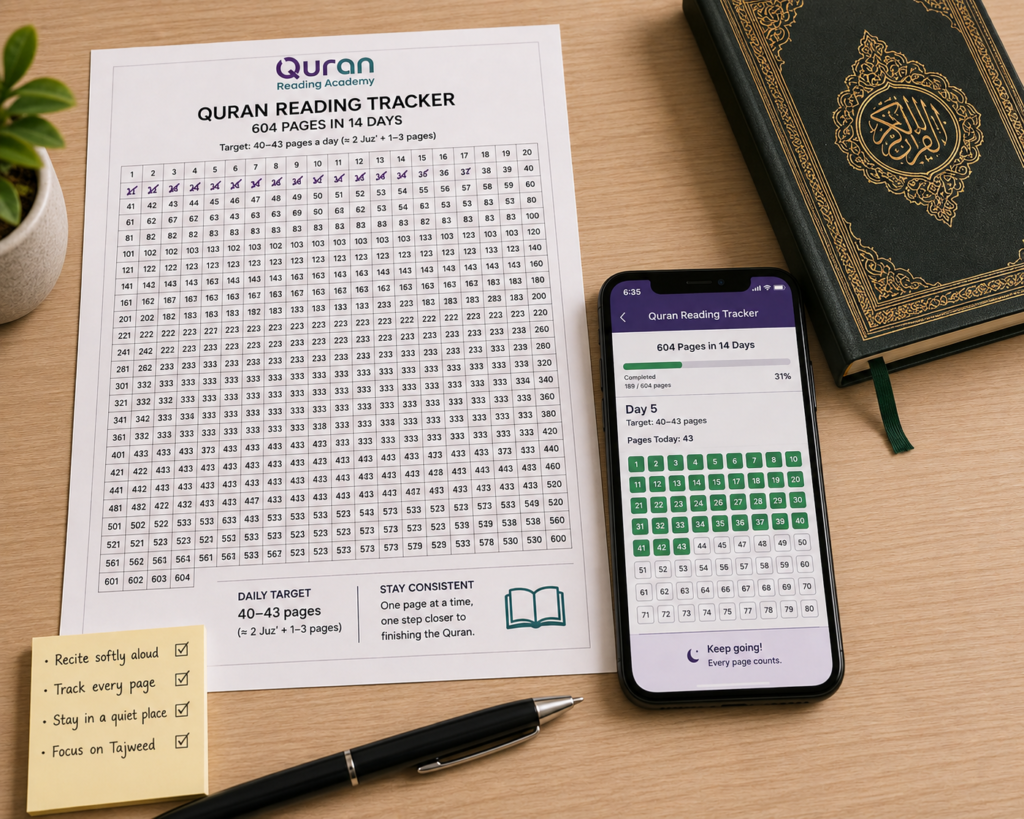
Alongside this, use a digital tracker or a simple printed checklist and cross off each page as you finish it. Seeing 43 pages checked off is a stronger motivator on day nine than any reminder app notification.
Sit somewhere clean and quiet while you read, away from your phone and household noise. Reading speed drops sharply the moment you’re interrupted mid-page, because you lose your place in the Mushaf and have to re-orient.
If you’re building this habit with your children, a live class removes the guesswork of pacing and correction — our Quran Reading Classes for Kids are structured around exactly this kind of daily-target approach, adjusted to a child’s attention span.
Step 6: Build In A Buffer And Recover Fast From A Missed Day
Never skip a full day. If you fall behind, your catch-up pages compound onto the next day’s target, and a missed Tuesday can turn Wednesday into an 80-page day. If a day goes badly, read even half your target rather than nothing — a partial session is far easier to recover from than a zero.
This is exactly why the daily target in Step 1 includes a 1 to 3 page buffer: it exists to absorb the slower days without derailing the full 14-day plan.
Read also: How Long Does It Take To Read 10 Pages Of The Quran?
Step 7: Switch To A 20-Day Plan If 14 Days Isn’t Realistic
If 40-plus pages a day isn’t realistic around your work, family, or study schedule, a 20-day plan lowers the daily target to about 30 pages, or 1.5 Juz’, per day. Two practical splits work well here: 6 pages after each of the five prayers, or 3 pages before and 3 pages after each prayer.
This adjustment doesn’t abandon the goal — it simply gives you a more forgiving path than the strict version of how to read Quran in 2 weeks.
The 20-day version uses the same habits from Steps 2 through 6 — fixed prayer-time sessions, a single Mushaf, a tracker — just with more breathing room per day. Choose whichever timeline you can realistically sustain without burning out by the halfway mark; a completed 20-day Quran is worth more than an abandoned 14-day attempt.
For sisters balancing this goal around home and family responsibilities, our Quran Reading Classes for Female/Sisters are timed and paced with exactly that kind of schedule in mind.
Common Mistakes That Slow Down A Two-Week Quran Goal
The most common failure point is starting at full speed without checking whether the daily page count is realistic against work, school, or family commitments — then quitting entirely after missing the first target. This single miscalculation is behind most failed attempts at how to read Quran in 2 weeks.
A better approach is to test your actual reading speed on day one, adjust the daily page count honestly, and commit to that adjusted number rather than the theoretical ideal.
The second most common mistake is reading silently and quickly in a way that skips correct pronunciation. Reading fast is only useful if the letters are still correct — recitation without attention to Tajweed builds bad habits that are harder to unlearn later than they are to avoid from the start.
Inside Our Live Classroom
We believe in complete transparency. Take a look inside our virtual classrooms to experience our premium teaching tools and engaging learning environment firsthand.
Start Your Quran Learning Journey Today
Join Quran Reading Academy and begin structured, step-by-step Quran reading with expert guidance.
Try your first class for freeStart Your 14-Day Quran Journey With The Right Guidance
Reading the entire Quran on your own is possible, but pairing your daily schedule with a qualified teacher catches pronunciation mistakes you cannot hear in your own voice and keeps you accountable to the plan.
Quran Reading Academy structures exactly this kind of goal-based learning, whether you’re an adult building the habit for the first time, a new Muslim reading the Quran for the very first time, or a parent guiding a child through it.
Our Quran Courses:
- Quran Reading Classes
- Quran Reading Classes for Kids
- Quran Reading Classes for Adults
- Quran Reading Classes for Female/Sisters
- Quran Reading Classes for New Muslims
- Quran Reading Course for Beginners
- Online Quran Reading Course with Tajweed
- Reading and Memorizing the Quran Course
- Noorani Qaida Course
- Quran Course for Beginners
- Quran Tajweed Course
- Quran Recitation Course
- Quran Hifz Course
- Online Quran Qirat Classes
- Quranic Arabic Course
- Arabic Reading Practice Course
Start Your Quran Learning Journey Today
Join Quran Reading Academy and begin structured, step-by-step Quran reading with expert guidance.
Try your first class for freeConclusion
Learning how to read Quran in 2 weeks is less about willpower and more about arithmetic and habit: roughly 40 to 43 pages a day, split across the five prayers, read from a single 16-line Mushaf, recited aloud, and tracked page by page.
Miss a day, and read a partial session rather than none at all — the goal survives small setbacks far better than long silences.
Whether you follow the strict 14-day plan or the gentler 20-day version, the structure is what carries you to the last page, not the deadline itself. Quran Reading Academy builds that structure into every class, for every age and starting point.
Frequently Asked Questions
Here are direct answers to the most common questions readers ask about finishing the Quran in two weeks.
1. How many pages do I need to read per day to finish the Quran in 2 weeks?
You need to read roughly 40 to 43 pages a day, since a standard Mushaf contains 604 pages across 30 Juz’. Splitting this into 8 to 9 pages after each of the five daily prayers makes the target manageable.
2. What is the best time of day to read the Quran for a 2-week goal?
Fajr and Asr are the best times, since both fall during quiet hours with fewer distractions. Many readers complete one full Juz’ after Fajr and the second after Asr to hit their daily target in two focused sessions.
3. Which Mushaf is best for reading the Quran quickly?
A 16-line Mushaf is recommended because its consistent page layout helps you track progress and recall where you stopped. Switching between different Mushaf editions mid-goal slows you down.
4. What should I do if I miss a day during my 2-week Quran plan?
Read a partial session immediately rather than skipping entirely, since missed pages compound onto the following day’s target. Catching up gradually over two or three days is more sustainable than trying to double your reading in one sitting.
5. Is it better to read the Quran silently or aloud?
Reciting aloud, even softly, is generally better because it keeps your focus locked on the text and reinforces correct pronunciation. Silent reading is more prone to distraction and skipped words over a long session.
6. Do I need a teacher to read the Quran correctly in 2 weeks?
A teacher is not strictly required to complete the reading goal, but is strongly recommended if correct pronunciation matters to you, since mistakes in similar-sounding letters are hard to hear in your own voice. Quran Reading Academy’s classes for adults, kids, sisters, and new Muslims are built around this kind of guided, corrected reading.
Related Articles
Quran Reading Plans







Leave a Reply