 Quran
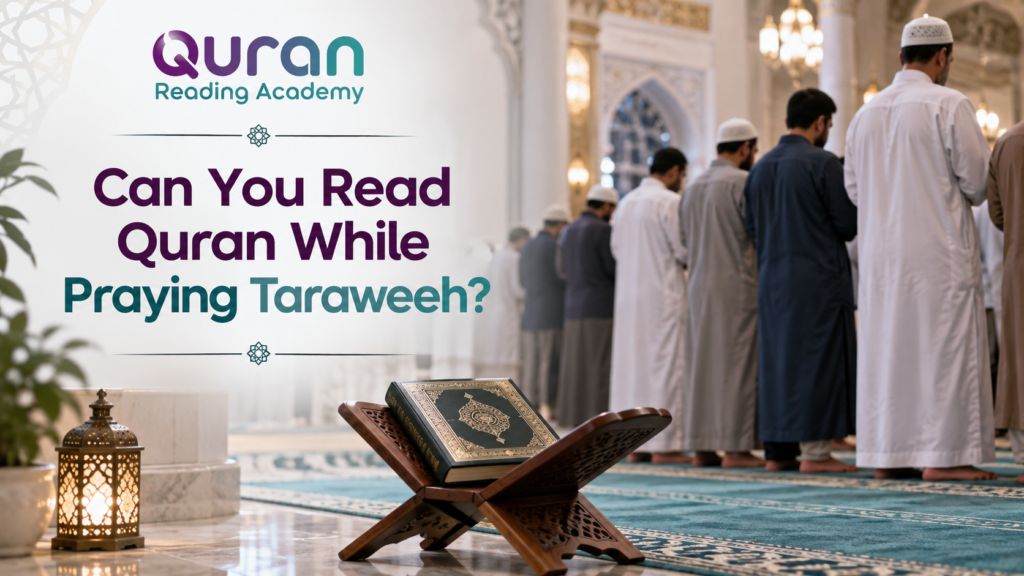
Many Muslims wonder whether picking up the Mushaf during Taraweeh prayer is allowed or whether it interrupts their salah. According to the vast majority of scholars across the four schools of Islamic law, yes, you can read the Quran while praying Taraweeh, and doing so does not invalidate your prayer.
This question becomes especially relevant during Ramadan, when Taraweeh prayer extends across long Surahs that not every Muslim has memorized. Knowing the correct ruling helps you worship with full confidence and direct your attention toward your connection with Allah rather than toward doubt.
What You’ll Learn
- The majority scholarly ruling on reading Quran during Taraweeh
- Evidence from the Sunnah and the actions of the Companions
- How each of the four schools of Islamic law views this issue
- A comparison of rulings for Taraweeh versus obligatory prayers
- How to use a phone or tablet as a Mushaf during prayer
- A practical framework for reducing Mushaf dependence over time
Is Reading from a Mushaf During Taraweeh Permissible?
Yes. Reading from the Mus-haf during Taraweeh prayer is permissible according to the majority of scholars, including the Shafi‘i, Hanbali, and Maliki schools. This applies to both the Imam and the person praying behind him.
The ruling is based on reports from the early generations, including the practice of having someone hold the Mus-haf for the Imam during voluntary prayer. Therefore, using a Mus-haf to follow or recite the Quran during Taraweeh is generally considered valid.
Evidence from the Companions on Mushaf Reading in Taraweeh
The Companions of the Prophet (peace be upon him) are a primary source of guidance in Islamic jurisprudence. When a practice was accepted among them without objection, it carries the weight of near-consensus (ijma’).
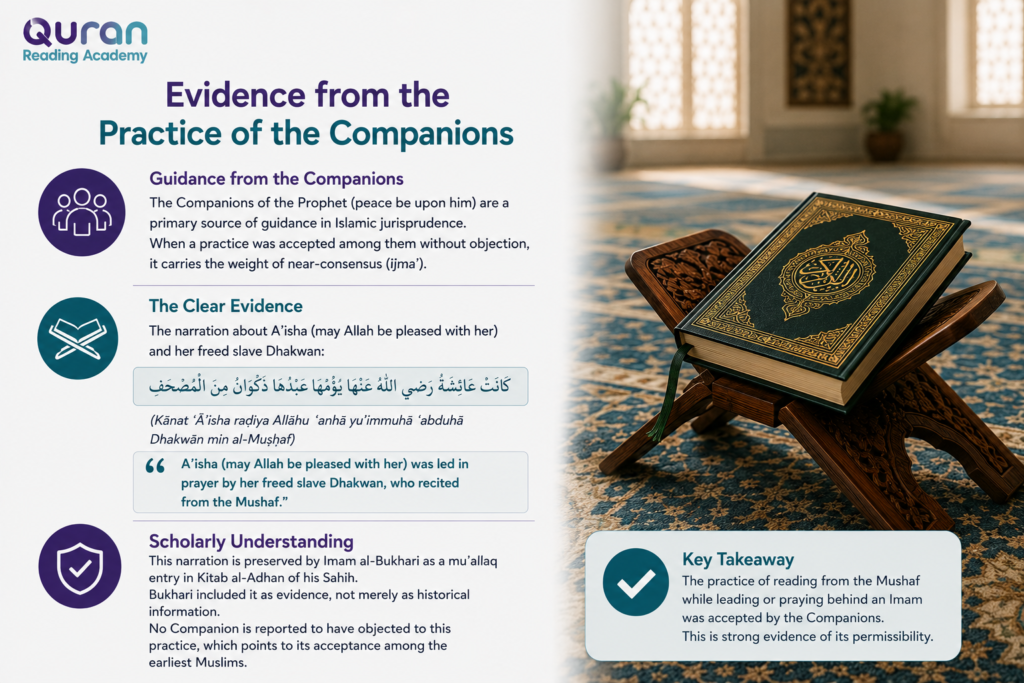
The clearest piece of evidence in this discussion is the narration about A’isha (may Allah be pleased with her) and her freed slave Dhakwan:
كانت عائشة رضي الله عنها يؤمها عبدها ذكوان من المصحف
(Kānat ʿĀʾisha raḍiya Allāhu ʿanhā yuʾimmuhā ʿabduhā Dhakwān min al-Muṣḥaf)
“A’isha (may Allah be pleased with her) was led in prayer by her freed slave Dhakwan, who recited from the Mushaf.”
This narration is preserved by Imam al-Bukhari as a mu’allaq entry — a narration included without a complete connected chain — in Kitab al-Adhan of his Sahih. Bukhari included it as evidence, not merely as historical information. No Companion of the Prophet (peace be upon him) is reported to have objected to this practice, which points to its acceptance among the earliest Muslims.
Read also: Can I Read from the Quran While Praying?
Does Holding and Turning Mushaf Pages Affect Salah?
Yes. Holding the Mushaf and turning its pages does not invalidate Salah, provided the movements remain limited and do not become excessive or unrelated to the prayer.
عَنْ أَبِي قَتَادَةَ أَنَّ النَّبِيَّ صَلَّى اللَّهُ عَلَيْهِ وَسَلَّمَ كَانَ يُصَلِّي وَهُوَ حَامِلٌ أُمَامَةَ بِنْتَ زَيْنَبَ
(ʿAn Abī Qatādah anna n-nabiyya ṣallallāhu ʿalayhi wa sallam kāna yuṣallī wa huwa ḥāmilun Umāmata binta Zaynab)
(“Abu Qatadah narrated that the Prophet, peace be upon him, used to pray while carrying Umamah, the daughter of Zaynab”)
Imam al-Nawawi (may Allah have mercy on him) stated: “If one recites from the Mushaf, this does not invalidate the prayer, whether one has memorized that portion or not.
Turning a page occasionally also does not invalidate the prayer. This is our position and the position of Malik, Abu Yusuf, Muhammad, and Ahmad.” (Al-Majmu’, 4/27.
Quran Reading Academy offers a structured Quran Recitation Course that trains students in proper Tajweed and builds the confidence to recite longer Surahs from memory, gradually reducing reliance on the Mushaf during Taraweeh.
Recite with precision and lead Taraweeh confidently, enroll in the Quran Recitation Course today
Read also: Do You Get Reward for Reading Quran on Phone
How the Four Madhabs View Mushaf Reading in Taraweeh
Each school of Islamic law reaches a clear ruling on this question, though with varying degrees of permission. Understanding these positions helps you apply the ruling that fits your own tradition correctly.
The table below summarizes where each school stands on reading from the Quran during Taraweeh versus obligatory prayers.
| School | Taraweeh Prayer | Obligatory Prayer |
| Shafi’i | Permissible, not disliked | Permissible, not disliked |
| Hanbali | Permissible, not disliked | Permissible, not disliked |
| Maliki | Permissible | Disliked |
| Hanafi (Abu Hanifa) | Invalidates prayer | Invalidates prayer |
| Hanafi (Abu Yusuf and Muhammad) | Valid, disliked | Valid, disliked |
Shafi‘i and Hanbali Views on Reading from a Mushaf
Both schools hold that reading from the Mushaf during any prayer, including obligatory ones, is permissible without dislike.
Imam Ahmad ibn Hanbal said: “There is no problem with the Imam of the Taraweeh prayer reciting while looking at the Mushaf.” (Kashaf al-Qina’, 1/361.)
Their reasoning is that recitation by looking at the Mushaf is itself an act of worship. The Dhikr of the Quran, however it is performed, constitutes ibadah, and minor movements involved in holding a book do not nullify that.
Read also: Can You Read Quran in State of Janaba
Maliki and Hanafi Views on Reading from a Mushaf
Imam Malik permitted reading from the Mushaf in Nafl and Taraweeh prayers. He said: “There is no problem with the Imam leading people in prayer while reading from the Mushaf in Ramadan and in voluntary prayers.”
His student Ibn al-Qasim added that it is disliked in obligatory prayers. (Al-Mudawwana, 1/224.)
Imam Abu Hanifa held that reciting from a Mushaf in any prayer invalidates it, since it resembles receiving prompting from an outside source. His two leading students, Imam Abu Yusuf and Imam Muhammad al-Shaybani, ruled that the prayer remains valid, though disliked.
When Hanafi communities face the practical reality that Taraweeh Imams must rely on the Mushaf, most Hanafi jurists issue fatwas based on the position of the two students rather than that of Abu Hanifa alone.
Quran Reading Academy provides a structured Quran Tajweed Course covering the precise articulation rules that transform reading into authentic recitation, giving students the technical foundation to recite entire Surahs accurately.

Master Tajweed and recite the Quran as it was revealed, enroll now
Read also: Can You Read Quran from Phone While Praying
Mushaf Reading in Taraweeh vs. Obligatory Prayer
The distinction between Taraweeh and obligatory prayers matters in Islamic legal reasoning. Taraweeh is a voluntary (Nafl) prayer, and this classification gives it wider permissibility thresholds than Fardh prayers under all four schools.
All four schools are more lenient toward Nafl prayers than toward obligatory ones when extra actions or deviations from standard practice arise.
The Ruling on Mushaf Reading in Fardh Prayer
In obligatory prayers, the standard ruling across most schools is to recite only what you have memorized. The Prophet (peace be upon him) instructed a man who was learning how to pray:
فَإِنْ كَانَ مَعَكَ قُرْآنٌ فَاقْرَأْ وَإِلاَّ فَاحْمَدِ اللَّهَ وَكَبِّرْهُ وَهَلِّلْهُ
(Fa-in kāna maʿaka Qurʾān faqraʾ, wa illā faḥmadi llāha wa kabbirhu wa hallilhu)
(“If you have Quran memorized, recite it; otherwise praise Allah, magnify Him, and declare His oneness”)
Hanafi scholars use this Hadith as evidence that when memorization is unavailable, Dhikr replaces Quranic recitation in obligatory prayer, not Mushaf reading. The Dhikr alternatives are what the Prophet prescribed, which implies that Mushaf reading was not presented as a substitute.
Read also: Can You Read Quran for a Dead Person?
What to Recite in Fardh Prayer with Limited Memorization
If you have only memorized Surah al-Fatiha and one or two short Surahs, you may repeat a memorized Surah in different raka’at of the same obligatory prayer without any issue. Repeating a Surah is completely valid.
According to the Shafi’i and Hanbali schools, reading from a Mushaf in obligatory prayer is valid if you genuinely cannot memorize enough for the prayer. However, this is meant as a temporary concession while you work toward adequate memorization, not as a permanent habit.
Allah commands in the Quran:
وَرَتِّلِ الْقُرْآنَ تَرْتِيلًا
(Wa rattil il-Qurʾāna tartīlā)
(“And recite the Quran with measured recitation”)
This command applies to all forms of Quranic recitation. Whether reading from memory or from text, the obligation of careful, deliberate delivery remains the same.
See Our Academy in Action
Discover what a typical session looks like! Watch these brief highlights from our live, interactive classes to see how our instructors engage with students of all ages.
Start Your Quran Learning Journey Today
Join Quran Reading Academy and begin structured, step-by-step Quran reading with expert guidance.
Try your first class for freeRead also: Can You Read Quran for Someone Else?
Using a Phone or Tablet to Read Quran During Taraweeh
Many Muslims today use a phone or tablet instead of a printed Mushaf. The ruling on using a Quran application during Taraweeh follows the exact same principles as using a physical book.
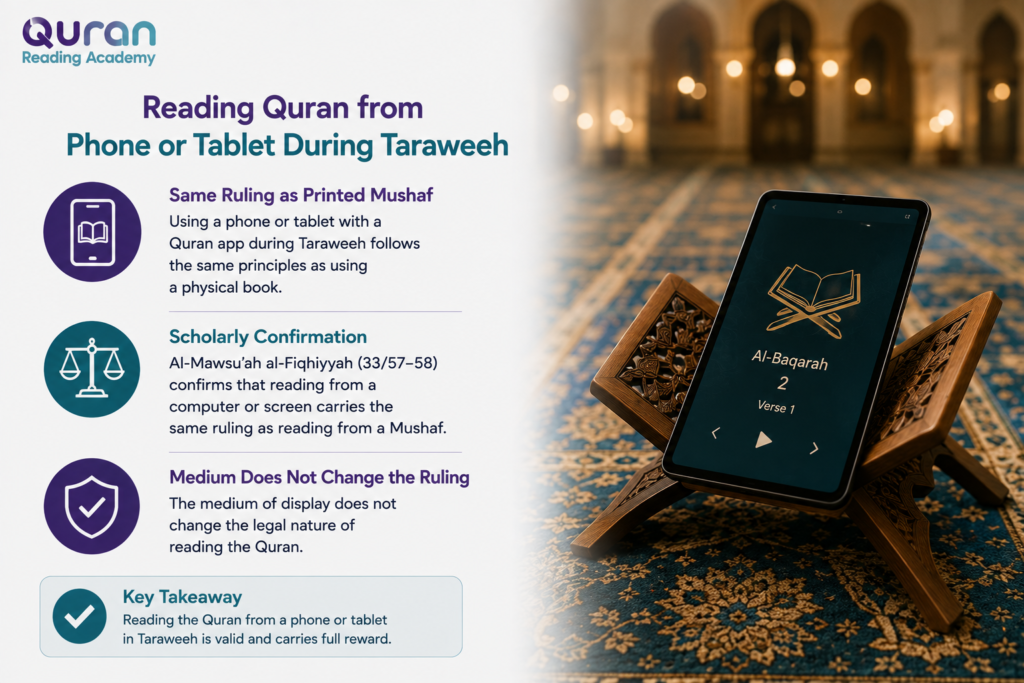
The Fiqh encyclopedia (Al-Mawsu’ah al-Fiqhiyyah, 33/57-58) confirms that reading from a computer or screen carries the same ruling as reading from a Mushaf. The medium of display does not change the legal nature of the act.
How to Use a Phone Properly During Taraweeh
When using a phone during Taraweeh, a few practical steps make the experience smoother and less disruptive. Place the device on a stand or small table at a comfortable reading height so you do not need to hold it awkwardly during the prayer.
Set screen brightness to a readable level that does not distract others nearby. Disable all notifications before the prayer begins.
Open the Quran app to the correct Surah and position before starting so no navigation is required once the prayer is underway.
Does Phone Movement or Swiping Affect Salah?
Yes. A small movement such as swiping a phone screen to turn a Quran page does not invalidate Salah, as long as the movement is occasional and limited. Swiping once or twice to move between pages is comparable to turning a physical Mushaf page.
The key consideration is whether the movement becomes excessive and continuous. According to the principle cited from Imam al-Nawawi, minor, occasional movements do not invalidate the prayer, whereas repeated and excessive movements unrelated to Salah may do so.
Therefore, swiping to continue reading, briefly placing the phone down, or picking it up again does not generally invalidate the prayer, provided these actions remain limited and do not distract from the prayer.
Quran Reading Academy offers a complete Quran Hifz Course using systematic memorization techniques that help students commit long portions of the Quran to memory, enabling them to lead or join Taraweeh without any dependence on a screen or book.
Begin your Hifz journey and memorize the Quran with expert guidance, enroll today
Read also: Can You Read Quran If You Are Impure?
Why Quran Memorization Is Preferred in Taraweeh
Scholars who permit reading from the Mushaf in Taraweeh consistently state that memorizing is the superior option.
Shaykh Salih al-Fawzan noted that reciting from memory is preferred in prayer because holding a Mushaf causes the worshipper to miss certain Sunnah postures, particularly placing the right hand over the left on the chest while standing. (Al-Muntaqa min Fatawa al-Fawzan, 2/35.)
A second practical concern scholars raise is that reliance on the Mushaf weakens the Imam’s motivation to memorize. If he knows the book is always available, the urgency to commit the Quran to heart diminishes across time.
A Simple Plan to Reduce Mushaf Dependence
The most effective approach to moving away from Mushaf reliance in Taraweeh follows a progressive memorization strategy across the year, not just during Ramadan.
- Stage one: is to complete the 30th Juz (Juz Amma) with full accuracy, including all Tajweed rules. This covers the short Surahs most commonly recited in Taraweeh opening nights.
- Stage two is to memorize Juz 29 and Juz 28, which contain medium-length Surahs suitable for full Taraweeh nights.
- Stage three is to work backward through the Quran progressively each year, adding one or two Juz per Ramadan cycle.
During Ramadan itself, use the Mushaf only for Surahs you have not yet memorized, while reciting memorized portions entirely from memory. This mixed approach is valid and keeps you advancing without pressure.
Allah says in the Quran:
بَلْ هُوَ آيَاتٌ بَيِّنَاتٌ فِي صُدُورِ الَّذِينَ أُوتُوا الْعِلْمَ
(Bal huwa āyātun bayyinātun fī ṣudūri lladhīna ūtū l-ʿilm)
(“Rather, it is distinct verses preserved in the breasts of those who have been given knowledge”)
This verse places the highest value on the Quran residing in the heart. It is the aspiration behind every Hifz journey and the reason memorization remains the ideal for Taraweeh prayer.
Read also: Why Do I Feel Sleepy When Reading Quran?
Inside Our Live Classroom
We believe in complete transparency. Take a look inside our virtual classrooms to experience our premium teaching tools and engaging learning environment firsthand.
Start Your Quran Learning Journey Today
Join Quran Reading Academy and begin structured, step-by-step Quran reading with expert guidance.
Try your first class for freeStart Taraweeh Preparation with a Free Session at Quran Reading Academy
Whether your goal is to recite correctly from the Mushaf or to work toward leading Taraweeh entirely from memory, expert guidance accelerates your progress. Quran Reading Academy offers a free trial session with qualified instructors who will evaluate your current recitation level and map out a clear path toward your Taraweeh goals.
You will receive direct, personalized feedback on your pronunciation, Tajweed application, and memorization readiness from the very first session. Booking takes less than a minute, and your trial lesson is completely free with no commitment required.
Our Quran Courses
- Quran Reading Classes
- Quran Reading Classes for Kids
- Quran Reading Classes for Adults
- Quran Reading Classes for Female/Sisters
- Quran Reading Classes for New Muslims
- Quran Reading Course for Beginners
- Online Quran Reading Course with Tajweed
- Reading and Memorizing the Quran Course
- Noorani Qaida Course
- Quran Course for Beginners
- Quran Tajweed Course
- Quran Recitation Course
- Quran Hifz Course
- Online Quran Qirat Classes
Book your free trial session at Quran Reading Academy today
Conclusion
Reading the Quran from a Mushaf during Taraweeh is permissible according to the Shafi’i, Hanbali, and Maliki schools, as well as the dominant fatwa position within the Hanafi school based on the rulings of Imam Abu Yusuf and Imam Muhammad al-Shaybani. The foundational evidence is the established practice of Dhakwan, A’isha’s freed slave, who led her in Taraweeh prayer during Ramadan while reading from the Mushaf, a narration recorded by Imam al-Bukhari and confirmed through multiple connected chains.
Whether you read from a printed Mushaf, a phone, or a tablet, your Taraweeh remains valid. Minor movements such as turning pages or placing the book on a stand during ruku’ do not break the prayer. The key condition is that movements remain minimal, purposeful, and limited to what the recitation genuinely requires.
While this permission is clear, every Muslim is encouraged to work toward memorizing more of the Quran so that Taraweeh becomes a prayer of the heart, not merely a prayer of the eyes. The more you memorize, the more your Taraweeh will carry the depth of presence and focus that Ramadan is meant to build throughout a lifetime of worship.
Read also: Can You Read Quran at the Graveyard?
Frequently Asked Questions
Can you read quran while praying taraweeh as an Imam?
Yes, an Imam can read from the Mushaf during Taraweeh. The practice of Dhakwan leading A’isha during Ramadan while reading from the Mushaf confirms this directly. Most scholars recommend placing the Mushaf on a stand or table to maintain proper posture during ruku’ and sujud.
Can you read from quran during taraweeh on your phone?
Reading from a Quran app during Taraweeh carries the same ruling as reading from a printed Mushaf. It is permissible under the Shafi’i, Hanbali, and Maliki schools. Place your phone on a stand, disable notifications, and avoid unnecessary swiping to keep movements minimal throughout the prayer.
Does holding a Mushaf in Taraweeh break the prayer?
Holding a Mushaf and turning pages occasionally does not break the prayer. Imam al-Nawawi confirmed this explicitly, and the Prophet’s example of carrying his granddaughter during prayer establishes that purposeful, minor movements do not invalidate salah.
Can you read from the quran during taraweeh in the Hanafi school?
Imam Abu Hanifa’s position is that it invalidates the prayer. However, his two leading students, Imam Abu Yusuf and Imam Muhammad al-Shaybani, ruled that the prayer is valid, though disliked. Most Hanafi scholars apply this second position when issuing fatwas for Taraweeh specifically, particularly in communities where full memorization is limited.
Is memorizing Quran better than reading from Mushaf in Taraweeh?
Yes, memorizing is better for several reasons. It allows full observance of every Sunnah posture, deepens spiritual focus by removing the visual distraction of a text, and fulfills the Quranic ideal of preserving the Quran in the heart. Reading from the Mushaf is a valid alternative while memorization is being built progressively.
Can a follower hold a Mushaf to follow along during Taraweeh?
Yes, a follower in Taraweeh can hold a Mushaf to follow the Imam’s recitation. This is a valid form of engagement with the prayer, not a disruption to it. The same permissibility ruling that applies to the Imam reading from the Mushaf applies equally to a follower holding one.









Leave a Reply