 Quran
| Key Takeaways |
| Reading Quran from a phone does not require hijab outside of prayer, when alone, with other women, or with male relatives who are mahram. |
| A phone is not classified as a Mus-haf in Islamic jurisprudence, so neither the wudu-for-touching rule nor any hijab condition applies to reading from a screen. |
| Hijab becomes mandatory during Quran recitation only in two cases: when non-mahram men are present, and during formal salah or sujud al-tilawah. |
| Women in a state of haidh (menstruation) may recite Quran from a phone, according to the majority of contemporary scholars including those at Al-Azhar University. |
Millions of Muslim women carry the entire Quran in their pocket today, yet the question of reading from a phone remains genuinely confusing for many.
Islamic scholarship draws a precise distinction between the digital screen and the physical Mus-haf. That distinction answers the hijab question directly and helps women build consistent recitation habits grounded in accurate scholarly guidance.
May a Muslim Woman Read Quran from Her Phone Without Wearing Hijab?
Yes, a woman may read Quran from her phone without wearing hijab, provided no non-mahram men are present. This ruling is affirmed by contemporary scholars at Al-Azhar University and the Egyptian Dar al-Ifta.
The phone is not legally classified as a Mus-haf in Islamic jurisprudence. Its Quranic text consists of electronic signals, not ink on parchment, so the strict Mus-haf conditions do not transfer to a phone screen.
Hijab in Islamic law is tied to modesty before non-mahram men. Quran recitation outside of salah, performed privately, does not trigger the hijab requirement under any of the four major madhabs.
Why Hijab Is Not a Condition for Quran Recitation Outside Salah?
Classical Islamic jurisprudence identifies specific prerequisites for valid Quran recitation. These include sincere intention, freedom from major ritual impurity (janabah), and wudu when touching a physical Mus-haf. Hijab appears in none of these conditions.
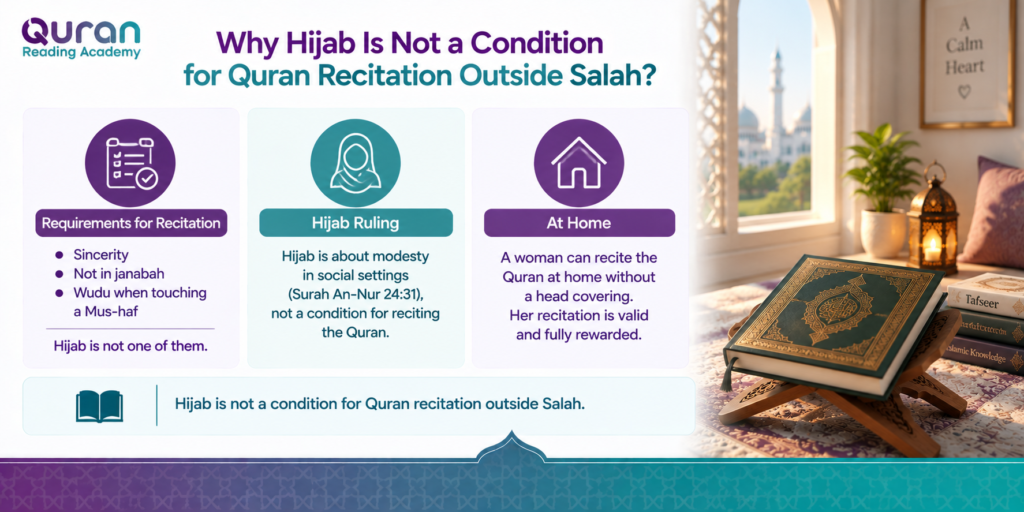
The obligation of hijab, established in Surah An-Nur 24:31, addresses modesty in social settings with those outside the immediate family circle. Fiqh scholars across all four schools have applied this obligation to public and social contexts, not to private acts of worship.
A woman reciting Quran alone in her home without a head covering is engaged in a fully valid act of worship. Neither the validity nor the reward of that recitation is diminished by the absence of hijab in that private, lawful setting.
Can I Read Translation of Quran on My Period?
Surah Aal-Imran 3:191 Confirms Quran Recitation Is Valid
One of the most frequently cited Quranic evidences for the flexibility of recitation is this verse:
الَّذِينَ يَذْكُرُونَ اللَّهَ قِيَامًا وَقُعُودًا وَعَلَىٰ جُنُوبِهِمْ
(Alladhina yadhkurūnallāha qiyāman wa qu’ūdan wa ‘alā junūbihim)
“Who remember Allah while standing or sitting or [lying] on their sides.”
Quran recitation is among the highest forms of dhikr (remembrance of Allah). This verse establishes that the remembrance of Allah is valid in any clean setting and in all three postures, without specifying dress requirements beyond general modesty for private worship.
Quran Reading Academy offers Quran Reading Classes for Sisters that guide female students through accurate recitation in a private, women-only environment led by qualified female instructors who understand the Islamic etiquette surrounding women’s recitation practice.

Book your free recitation session with a female instructor
Two Conditions That Make Hijab Mandatory During Quran Recitation
Two specific situations require hijab during Quran recitation, when using a phone or a printed Mus-haf. Outside these two situations, hijab is not a condition for valid recitation.
1. Non-Mahram Men Present During Quran Recitation Require Full Hijab Coverage
When non-mahram men are present, the hijab obligation applies regardless of what activity is underway, including Quran recitation. The ruling is tied to their presence, not to the act of recitation itself.
2. Salah and Sujud al-Tilawah Require Hijab as a Condition of Validity
During salah and sujud al-tilawah, full covering is a condition of validity. The majority of scholars treat sujud al-tilawah as requiring the same conditions as salah, including hijab and wudu.
A minority position, including that of Ibn Taymiyyah, holds that sujud al-tilawah does not require the full conditions of formal prayer. Apply the guidance of your school or scholar to this specific situation.
Read also: Can Men Listen to Women Recite Quran?
Wudu Rules for Reading Quran from a Phone Versus a Printed Mus-haf
Reading Quran from a phone screen does not require wudu. This applies in a state of minor ritual impurity (hadath asghar). The Egyptian Dar al-Ifta affirms this position, and it reflects mainstream scholarly consensus worldwide.
The principle is straightforward. The wudu-for-touching rule comes from Surah Al-Waqi’ah 56:79, “None shall touch it except those who are purified,” which classical scholars applied specifically to the physical Mus-haf. A phone screen displaying Quranic text is not a Mus-haf and does not carry that same ruling.
| Purity State | May Read Quran from Phone? | May Touch Printed Mus-haf? |
| With wudu | Yes | Yes |
| Minor impurity, no wudu | Yes | No |
| Menstruation (haidh) | Yes, majority view | No |
| Major impurity (janabah) | No recitation | No |
Quran Reading Academy offers an Online Quran Reading Course with Tajweed that builds accurate recitation under the guidance of Ijazah-certified instructors who also clarify the Islamic etiquette surrounding daily recitation from a phone.

Claim your free Tajweed lesson today
Contemporary Scholars Permit Reading Quran from a Phone During Menstruation
A woman experiencing haidh may read Quran from her phone. The majority of contemporary scholars, including those at Al-Azhar University and the Egyptian Dar al-Ifta, affirm this position clearly.
The classical madhabs disagreed on recitation during menstruation. The Hanafi and Shafi’i schools traditionally prohibited it, while the Maliki school and the position of Ibn Taymiyyah permitted recitation. Contemporary scholars have broadly adopted the permissive view.
A significant reason for the contemporary consensus is the length of the menstrual period. An extended restriction carries a genuine risk of losing memorized Quran portions, which contemporary scholars weighed heavily in adopting the permissive position.
A woman in haidh who personally follows the restrictive classical position should avoid formal loud tilawah. Quiet reading for revision purposes is permitted under the majority view. In all cases, she may not touch a physical Mus-haf directly during haidh, since that condition remains firm across all madhabs.
See Our Academy in Action
Discover what a typical session looks like! Watch these brief highlights from our live, interactive classes to see how our instructors engage with students of all ages.
Start Your Quran Learning Journey Today
Join Quran Reading Academy and begin structured, step-by-step Quran reading with expert guidance.
Try your first class for freeRuling on Reading Quran on Your Phone While Lying Down
Reading Quran from a phone while lying on your side or back is fully permissible. Surah Aal-Imran 3:191, cited above, establishes this explicitly. Recitation from memory or from a phone screen in any clean position is valid and carries its reward, Insha’Allah.
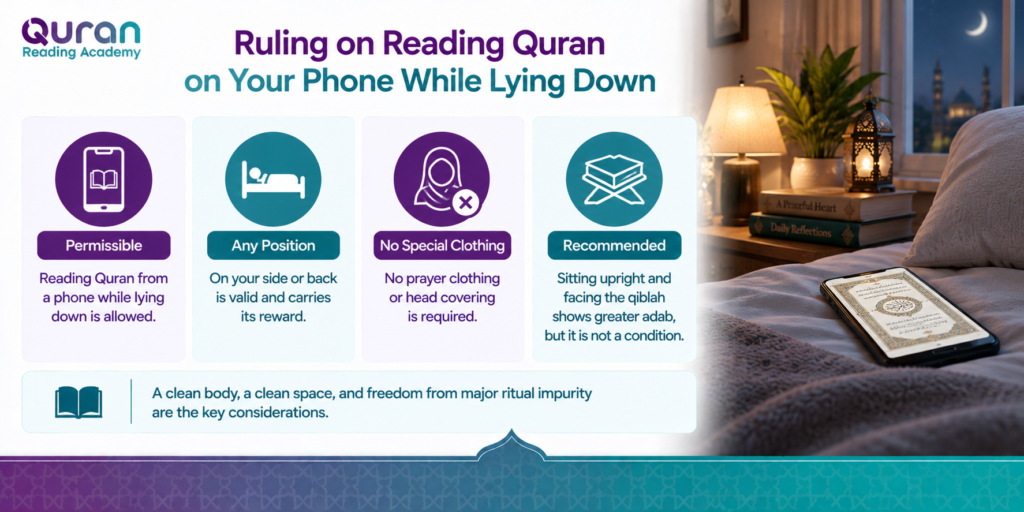
No specific prayer clothing or head covering is required for private Quran recitation from a phone outside of salah. The relevant considerations are a clean body, a clean space, and freedom from major ritual impurity.
Sitting upright and facing the qiblah while reciting is a recommended practice that reflects greater adab (reverence) toward the words of Allah. Scholars have noted this as a preferred habit, not a condition that affects the validity or reward of the recitation itself.
Quran Reading Academy offers a Quran Recitation Course that develops the fluency, pronunciation accuracy, and recitation confidence needed to make daily phone reading sessions genuinely rewarding, not a mechanical exercise.

Begin your recitation training with a certified instructor
Read also: Can I Read Translation of Quran on My Period?
Practices That Strengthen Phone Quran Reading Beyond the Minimum Legal Requirement
Knowing what is required is the floor, not the ceiling. Several practices lift phone Quran reading from a technically valid act to a deeply rewarding one.
Performing wudu before reading from a phone is strongly recommended even when not obligatory. It shifts the recitation from a routine activity into a conscious act of worship, and scholars are unanimous that this preparation carries its own reward.
Sitting in a clean, quiet space, reducing distractions, and setting an intention before opening the Quran app are habits the classical scholars described as components of proper tilawah etiquette. Dressing modestly as a personal choice, even when not obligatory, reflects the spirit of reverence that the words of Allah deserve.
Quran Reading Academy offers Quran Reading Classes for Adults that combine recitation training with practical Islamic etiquette guidance, helping adult students build habits that are both legally grounded and spiritually meaningful.
Reserve your free adult recitation lesson
Inside Our Live Classroom
We believe in complete transparency. Take a look inside our virtual classrooms to experience our premium teaching tools and engaging learning environment firsthand.
Start Your Quran Learning Journey Today
Join Quran Reading Academy and begin structured, step-by-step Quran reading with expert guidance.
Try your first class for freeQuran Reading Academy Provides Certified Instruction
Understanding the ruling on hijab and phone recitation removes an unnecessary barrier that has prevented many sisters from building a consistent daily reading habit.
Quran Reading Academy provides the structured instruction needed to move from knowing the ruling to reciting with real accuracy and confidence.
Quran Reading Academy advantages:
- Female instructors available for sisters who prefer women-only one-on-one sessions
- Ijazah-certified teachers with verified chains of Quran transmission authority
- Structured curricula that correct pronunciation and Tajweed errors in real time
Our Quran Courses
- Quran Reading Classes
- Quran Reading Classes for Kids
- Quran Reading Classes for Adults
- Quran Reading Classes for Female/Sisters
- Quran Reading Classes for New Muslims
- Quran Reading Course for Beginners
- Online Quran Reading Course with Tajweed
- Reading and Memorizing the Quran Course
- Noorani Qaida Course
- Quran Course for Beginners
- Quran Tajweed Course
- Quran Recitation Course
- Quran Hifz Course
- Online Quran Qirat Classes

Conclusion
Reading Quran from a phone without hijab is permissible when no non-mahram men are present. The phone is not a Mus-haf under Islamic jurisprudence, so the strict purity conditions of the printed Mus-haf do not apply in the same way to a screen.
Women in haidh may read from a phone according to the majority of contemporary scholars. Women in a state of minor impurity may read from a phone without wudu. The conditions that matter most for recitation are sincere intention, freedom from janabah, and wudu for touching a physical Mus-haf.
Daily Quran reading from a phone, in any clean and private setting, is a sound and fully rewarded habit. Quran Reading Academy’s structured programs help sisters build that habit with qualified scholarly instruction in each class.
Frequently Asked Questions About Reading Quran on Phone Without Hijab
Does Reading Quran on a Phone Earn the Same Reward as Reading from a Printed Mus-haf?
Yes, the reward of recitation is connected to the act of reading Allah’s words, not to the medium. The majority of scholars, including the position of Al-Azhar, affirm that accurate, sincere recitation from a phone screen earns the full reward of tilawah.
Can a Woman Hold a Physical Mus-haf Without Hijab?
Yes, a woman may hold a printed Mus-haf without hijab, provided she has wudu. Wudu is the condition for touching the Mus-haf, not hijab. The two requirements are independent: absence of hijab alone does not prevent her from handling the Mus-haf when wudu is present.
Does Reciting Quran Aloud from a Phone Change the Hijab Ruling Compared to Reading Silently?
No, volume of recitation does not change the ruling. The determining factor is who is present, not how loudly the woman recites. Hijab is not required during loud or silent recitation in a private setting where no non-mahram men are present.
Can Children Read Quran from a Phone Without Wudu or Hijab?
Yes, children who have not reached puberty are not bound by the full obligations of wudu and hijab. They may read Quran from a phone freely. Encouraging respectful posture and general cleanliness while reciting helps establish sound Quran habits from an early age.
Is Reading Quran Without Hijab at Home Considered Disrespectful to the Quran?
No, respect for the Quran is expressed through attentiveness, a clean space, and sincere recitation. Wearing hijab while reciting privately at home is a commendable personal choice that reflects devotion, but it is not an obligation that affects the validity or reward of recitation.









Leave a Reply