 Quran
| Key Takeaways |
| A Quran translation without Arabic text is classified by most scholars as a tafsir book, not the Mushaf, so menstruating women may touch and read it without restriction. |
| A bilingual Quran that contains Arabic text alongside a translation is treated as a Mushaf; a menstruating woman should use a physical barrier when handling it. |
| Reading a Quran translation on a phone or tablet is permitted during menstruation, as contemporary scholars do not classify a digital device as a Mushaf. |
| Verbal recitation from memory during menstruation is disputed: the Hanafi school permits it, while the Maliki, Shafi’i, and Hanbali schools generally prohibit it. |
Muslim women who read Quran daily face this question every month. No sister wants to disengage completely, yet she also cannot ignore a ruling that Islamic law attaches to the Mushaf’s sanctity.
Islamic scholarship separates the Quran as divine Arabic revelation from a translation as a human explanation of meanings. This article examines each format against rulings from the four major schools of Islamic law.
Can I Read a Quran Translation During My Period?
Yes, reading a Quran translation that contains no Arabic text is permitted for a menstruating woman. Most scholars classify a standalone translation as a book of tafsir, not the Mushaf itself.
The prohibition on touching the Quran attaches specifically to the Mushaf. A translation into English, Urdu, or any other language is a human rendering of meanings and does not meet the definition of the Mushaf.
How Scholars Define Mushaf vs. Translation
Scholars define the Mushaf as the Arabic text of the Quran as revealed to the Prophet Muhammad, peace be upon him. A translation is a human rendering of those meanings into another language.
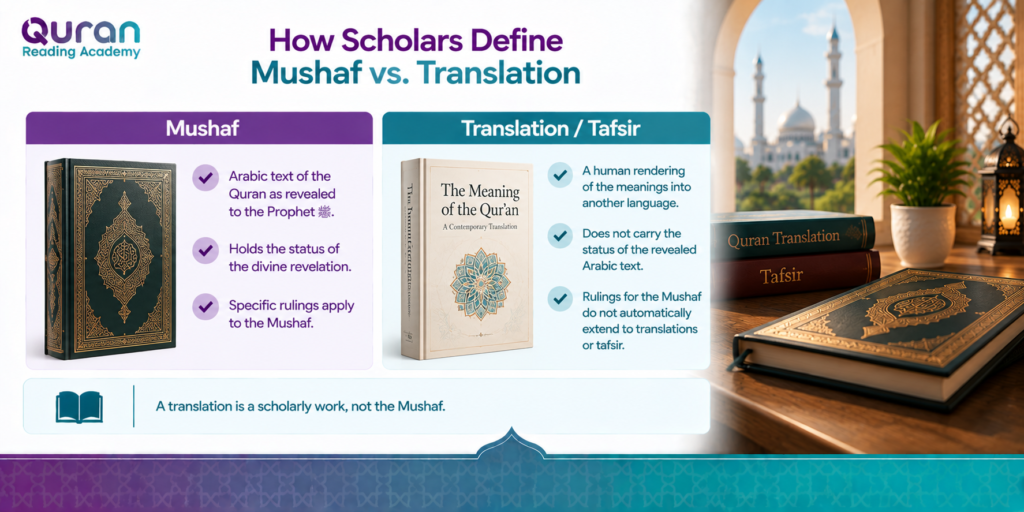
A translation does not carry the status of the revealed Arabic text. Specific rulings in Islamic law attach to the Mushaf itself and do not automatically extend to a book of tafsir or commentary.
A book of tafsir, even one that quotes Arabic verses alongside explanation, is treated differently from the Mushaf. Most scholars classify a translation-only volume as tafsir literature and not the Mushaf.
The verse most cited in this discussion comes from Surah Al-Waqi’ah:
لَّا يَمَسُّهُ إِلَّا الْمُطَهَّرُون
(Lā yamassuhu illā l-muṭahharūn)
Scholars note this verse refers either to the heavenly preserved tablet or to the earthly Mushaf. In either reading, the subject of the prohibition is the Arabic Quran in its revealed form.
A human translation into any other language does not fall within the scope of that prohibition. Most jurists therefore classify translation-only volumes as tafsir books, not as the Mushaf.
Bilingual Quran Ruling for Menstruating Women
A bilingual Quran that contains Arabic text alongside a translation requires a physical barrier when handled by a menstruating woman.
The Arabic Quran is physically present in the volume, so most scholars apply the same ruling as for the Mushaf. Direct contact with its pages should be avoided throughout the period.
A menstruating woman should handle the bilingual copy with gloves, a clean cloth, or another physical barrier. This applies regardless of how much Arabic text appears relative to the translation.
Some scholars permit holding a bilingual volume when the translation significantly outweighs the Arabic text, treating it closer to a commentary.
The safer and more widely accepted position is to use a barrier whenever Arabic text is present in the volume. Most contemporary scholars advise this out of caution.
Quran Reading Academy offers a Quran Recitation Course that helps sisters build consistent reading habits with Ijazah-certified instructors who provide structured correction and guidance at every level of learning.

Start your free trial and learn with a qualified instructor
Can I Read Translation of Quran on My Period?
Reading Quran Translation on a Phone or Tablet
A phone or tablet displaying a Quran translation, or even the full Arabic Quran, is not considered a Mushaf by most contemporary scholars.
Digital devices are not subject to the prohibition on touching the Mushaf, regardless of what they display on screen. This ruling covers phones, tablets, and computers equally.
This ruling is held by members of the Islamic Fiqh Academy and senior scholars from Al-Azhar and other major institutions.
A menstruating woman may open a Quran app, read a translation, and engage with Arabic text without wudu. No ritual barrier is required between her hand and the device screen.
Staying connected with the Quran throughout menstruation is fully achievable on any digital device. Reading, reflecting on, and studying Quranic meanings on a phone or tablet requires no ritual purity from a menstruating woman.
Silent Screen Reading and the Recitation Ruling
Reading the Quran silently from a screen is classified as study and reflection, not vocal recitation, by most scholars. Silent visual engagement does not trigger the rulings attached to vocal Quran recitation.
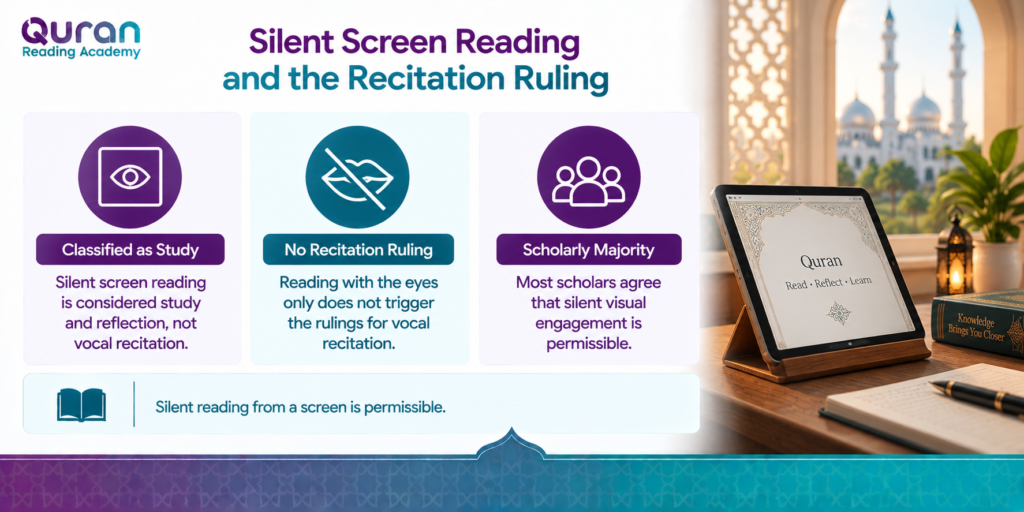
The restrictions on recitation target moving the lips to recite aloud. Reading with the eyes alone does not fall within that prohibition according to the scholarly majority.
Following Along During Tarawih on Your Period
A menstruating woman may listen to Quran recitation and follow along with a translation on her phone during Tarawih and group prayer gatherings.
Listening and reflecting are permitted without restriction throughout menstruation. No scholar requires her to leave the room or disengage from the session.
See Our Academy in Action
Discover what a typical session looks like! Watch these brief highlights from our live, interactive classes to see how our instructors engage with students of all ages.
Start Your Quran Learning Journey Today
Join Quran Reading Academy and begin structured, step-by-step Quran reading with expert guidance.
Try your first class for freeVerbal Recitation from Memory During Menstruation
The Hanafi school permits verbal recitation from memory during menstruation. Classical scholars Ibn Taymiyyah and Ibn Qayyim al-Jawziyyah held the same position. The Maliki, Shafi’i, and Hanbali schools generally prohibit it.
The Hanafi position rests on a key distinction. The prohibition on vocal recitation applies specifically to a person in janabah, meaning major ritual impurity following sexual intercourse.
Menstruation is a separate state governed by its own set of rulings. The two conditions are treated distinctly under classical Islamic jurisprudence.
No authentic hadith explicitly prohibits verbal recitation by a menstruating woman by name.
Ibn Taymiyyah and Ibn Qayyim cited this absence of specific prohibition as the basis for their permissive ruling, which is adopted by many contemporary scholars.
Quran Reading Academy offers a Quran Hifz Course that equips sisters with structured memorization techniques and daily review systems so that Hifz progress continues consistently without loss during any study interruption.

Book a free trial and speak with a certified Hifz instructor
Read also: Can I Read Quran on My Phone Without Hijab?
Maliki, Shafi’i, and Hanbali on Recitation During Menstruation
The majority position among Maliki, Shafi’i, and Hanbali scholars prohibits vocal Quran recitation during menstruation.
Their reasoning draws on analogy with the janabah state and a general principle of purity in direct verbal engagement with Allah’s words.
Classical fiqh literature from these three schools cites hadiths in support of the prohibition. Each school treats verbal recitation during menstruation the same way it treats recitation during the janabah state.
Exceptions for genuine necessity are recognized within each of these schools.
A teacher whose students depend on her live correction and a Hifz student who fears forgetting memorized portions have been granted dispensations by scholars within these traditions.
Protecting Hifz During Menstruation
Scholars who prohibit vocal recitation during menstruation generally allow exceptions for those who fear forgetting memorized Quran. Preserving memorized content takes precedence over the prohibition when genuine need is present.
A Hifz student may review memorized portions silently or listen to recordings of her own recitation during menstruation.
Following along while a teacher or audio recording recites aloud keeps retention intact without requiring vocal recitation from the student herself.
Years of memorization should not be lost to temporary rulings when a recognized scholarly exception is available. Sisters in Hifz programs should discuss their situation with their instructor to follow the ruling suited to their school.
Quran Reading Academy offers a Quran Course for Beginners that builds foundational reading skills with flexible scheduling designed to fit naturally around real life, including monthly breaks in a student’s study routine.

Start learning with a certified sister instructor today
Can a Menstruating Woman Enter a Mosque?
Mosque entry during menstruation is prohibited by the Shafi’i and Hanbali schools, permitted for genuine need by the Maliki school, and permitted for passing through by the Hanafi school.
Each school developed its ruling through classical jurisprudence, and a sister should consult her madhab for the applicable guidance.
Contemporary scholars note that modern mosques with dedicated sisters’ libraries and study sections raise new practical questions not addressed directly in classical texts.
A sister should follow the ruling of her school and consult her local imam for guidance suited to her specific context and mosque.
Read also: Can Men Listen to Women Recite Quran?
Quran Engagement Rules During Menstruation
A menstruating woman may read a standalone Quran translation in any language without restriction. She may also use a phone or tablet to engage with the Quran, including full Arabic text, without wudu.
Listening to recitation in any setting is permitted throughout her period. No ritual purity is required for any of these forms of Quran engagement.
For a bilingual Quran that contains Arabic text, she should use a physical barrier when handling it. Vocal recitation from memory should follow the ruling of her madhab, with an exception available for Hifz students who fear forgetting.
No complete disconnection from the Quran is required during menstruation. These distinctions give every sister a confident and informed framework for each format of Quran engagement during her period.
Quran Reading Academy offers a Noorani Qaida Course that teaches foundational Arabic letter recognition and pronunciation to sisters building their Quran reading journey from the first level with a qualified instructor.
Reserve your free trial lesson with a qualified sister teacher
Inside Our Live Classroom
We believe in complete transparency. Take a look inside our virtual classrooms to experience our premium teaching tools and engaging learning environment firsthand.
Start Your Quran Learning Journey Today
Join Quran Reading Academy and begin structured, step-by-step Quran reading with expert guidance.
Try your first class for freeLearn Quran with Quran Reading Academy Sister Instructors
Quran Reading Academy provides one-on-one live sessions with Ijazah-certified instructors, including qualified sister teachers who teach female students exclusively. Flexible scheduling allows sisters to continue Quran study around their monthly cycle and daily responsibilities.
Quran Reading Academy offers:
- Ijazah-certified sister instructors available for all female students
- One-on-one live sessions scheduled around each student’s availability
- Structured courses from beginner reading through advanced Hifz and Tajweed levels
Our Quran Courses
- Quran Reading Classes
- Quran Reading Classes for Kids
- Quran Reading Classes for Adults
- Quran Reading Classes for Female/Sisters
- Quran Reading Classes for New Muslims
- Quran Reading Course for Beginners
- Online Quran Reading Course with Tajweed
- Reading and Memorizing the Quran Course
- Noorani Qaida Course
- Quran Course for Beginners
- Quran Tajweed Course
- Quran Recitation Course
- Quran Hifz Course
- Online Quran Qirat Classes

Conclusion
A menstruating woman may read a Quran translation that contains no Arabic text, engage with the Quran on a phone or tablet, and listen to recitation freely.
Her connection with the Quran does not have to pause during her period. Islam does not require a complete withdrawal from Quranic engagement during menstruation.
Format and method are the deciding factors. A standalone translation is a tafsir book, not the Mushaf. A bilingual Quran requires a physical barrier.
A digital screen does not carry the Mushaf ruling. Vocal recitation from memory follows her madhab’s ruling, with an exception available for Hifz students who fear forgetting.
These distinctions give every sister a confident, informed foundation for staying connected with the Quran throughout her month. Consulting a qualified scholar from her tradition remains the best step for questions specific to her circumstances.
Frequently Asked Questions About Quran Translation
Can I touch a translated Quran on my period?
Yes, you may touch a Quran translation that contains no Arabic text during your period. Most scholars classify it as a tafsir book, not the Mushaf itself, so the prohibition on touching the Mushaf does not apply to a standalone translation-only volume.
Can I touch a bilingual Quran during menstruation?
Use a physical barrier such as gloves or a clean cloth when touching a bilingual Quran during menstruation. Because the Arabic Quran is present in the volume, most scholars apply the Mushaf ruling and require a barrier between the hand and the pages.
Can I read Quran on my phone without wudu during my period?
Yes, reading the Quran on a phone or tablet without wudu is permitted during menstruation. Most contemporary scholars hold that a digital device is not a Mushaf, so neither the wudu requirement nor the Mushaf-contact restriction applies to phones, tablets, or computers.
Can I recite Quran from memory during my period?
This depends on your school of Islamic law. The Hanafi school permits verbal recitation during menstruation. The Maliki, Shafi’i, and Hanbali schools generally prohibit it, though exceptions exist for Hifz students who genuinely risk forgetting memorized content. Consult a scholar from your madhab.
Can I reflect on Quran silently during menstruation?
Yes, silent mental reflection and remembrance of Quranic meanings are permitted for a menstruating woman without restriction. Scholars who restrict vocal recitation do not extend that restriction to silent reflection or heartfelt engagement with the meanings of the Quran.
Does a Quran translation have the same status as the Mushaf?
No, a Quran translation does not carry the same status as the Mushaf in Islamic jurisprudence. The Mushaf is the Arabic revelation of Allah. A translation is a human rendering of meanings and is treated by most scholars as tafsir literature, not the Mushaf itself.








Leave a Reply