 Fatawa
| Key Takeaways |
| A woman’s voice is not ‘awrah according to the majority of scholars in all four madhabs, but deliberately beautified recitation before non-mahram men is prohibited. |
| Men may listen to a woman recite Quran when the purpose is educational, her voice carries no melodic embellishment, and no fitnah exists in the gathering. |
| Ibn Mufliḥ al-Ḥanbalī and Al-Bujayrmī al-Shāfi’ī both confirmed that deriving sinful pleasure from a woman’s Quran recitation is prohibited regardless of the listener’s stated purpose. |
| Without a real need for recitation to be audible, scholars in all four madhabs prefer women recite quietly when non-mahram men are present. |
Muslim women who recite Quran daily encounter this question in learning circles, online classes, and family settings. The ruling touches on worship, modesty, and how Islamic law defines a woman’s voice before non-mahram men.
Scholars in all four madhabs addressed this question precisely, reaching neither a blanket prohibition nor unconditional permission. Their ruling is conditional: grounded in the manner of recitation, purpose, and context.
Is It Permissible for Men to Hear Women Recite Quran?
Men may listen to a woman recite Quran when specific conditions are met: no melodic beautification and no fitnah. The prohibition targets the manner of delivery, not the act of recitation itself.
A woman’s normal reciting voice is not ‘awrah according to the majority position. What classical jurists prohibited is the melodious, embellished delivery intended to please listeners, not the act of Quran recitation itself.
A Woman’s Normal Voice Is Not ‘Awrah in Islam
The majority position in all four madhabs holds that a woman’s normal voice is not ‘awrah. This conclusion rests on direct historical evidence from the time of the Prophet ﷺ that no classical scholar has disputed.
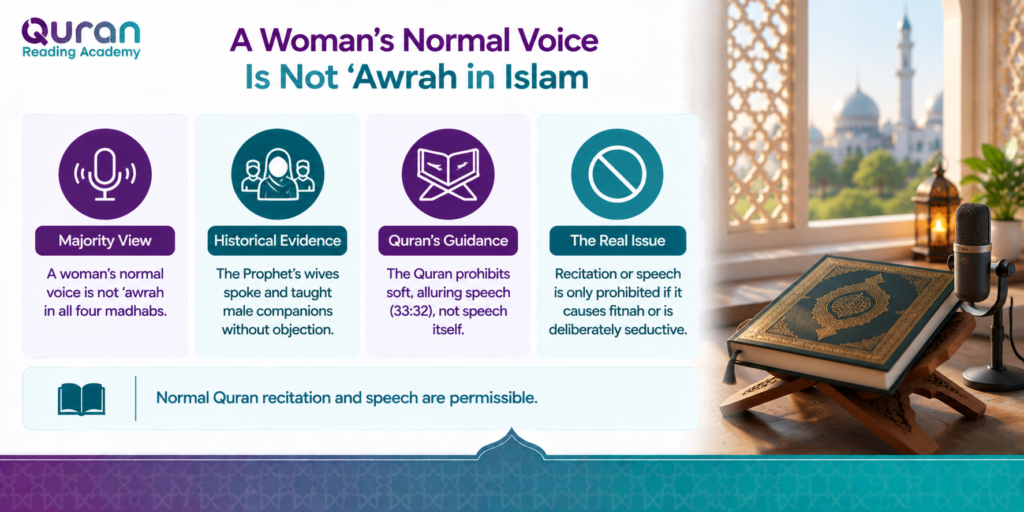
The wives of the Prophet ﷺ narrated hadiths to male companions and corrected their understanding of Islamic rulings directly. Female scholars throughout Islamic history taught men in matters of fiqh and hadith.
None of this was objected to, establishing that normal speech and recitation before non-mahram men carry no inherent prohibition. The voice itself is not the issue; its manner of use is.
Ibn Mufliḥ al-Ḥanbalī stated in Al-Furū’: “The voice of a non-mahram woman is not ‘awrah according to the most correct view, though deriving pleasure from hearing it, even during Quran recitation, is prohibited.”
Al-Bujayrmī al-Shāfi’ī added in his Ḥāshiyah: “Listening to a woman’s voice, even Quran recitation, is prohibited if fitnah is feared or if the listener derives pleasure from it; otherwise, it is not.”
The Quran itself draws this distinction explicitly. Allah ﷻ prohibited a specific quality of speech, not speech itself:
فَلَا تَخْضَعْنَ بِالْقَوْلِ فَيَطْمَعَ الَّذِي فِي قَلْبِهِ مَرَضٌ وَقُلْنَ قَوْلًا مَعْرُوفًا
(Falā takhḍa’na bil-qawli fayaṭma’a alladhī fī qalbihi maraḍun wa qulna qawlan ma’rūfā)
(“Do not be soft in speech, lest he in whose heart is disease should covet, but speak with appropriate speech.”)
The prohibition targets khuḍū’ fil-qawl, deliberate vocal softening and embellishment. Normal Quran recitation falls entirely outside this prohibition.
This verse addressed the wives of the Prophet ﷺ specifically. Scholars derived from it the general principle governing all Muslim women’s speech and recitation before non-mahram men.
Ḥanafī scholars of the Maydānī school recorded: “It is permissible for women to converse with non-mahram men at the time of need. It is not permissible for them to soften and raise their voice melodiously.”
Can I Read Translation of Quran on My Period?
What Makes a Woman’s Recitation Prohibited for Men to Hear
Two distinct factors make a woman’s recitation impermissible for non-mahram men to hear. Both operate independently, and either one alone is sufficient to trigger the prohibition.
The first factor is the manner of delivery. Recitation with deliberate melodic beautification, vocal softening, or embellishment intended to attract listeners crosses into prohibited territory.
The content being Quran does not remove this restriction. The prohibition applies to the delivery, not the content being recited.
The second factor is the listener’s state. When a man listens for enjoyment of the voice instead of reflection on the Divine words, his listening becomes impermissible regardless of the woman’s intent.
Ibn ‘Ābidīn stated in Radd al-Muḥtār: “It is unlawful to listen to the voice of a female in a melodious and musical tone, even if it is by reciting the Quran.”
These two factors work in combination in most real situations. A woman who recites with embellishment and a man who listens with enjoyment both carry responsibility.
Classical scholarship placed accountability on both parties, not restricting only the woman or only the man in an act of Quran recitation before non-mahram men.
Quran Reading Academy offers a Quran Recitation Course that trains students in correct Tajweed application and recitation etiquette through one-on-one certified instruction with teachers who correct recitation in real time.
Start Your Recitation Training with Expert Instructors
Inside Our Live Classroom
We believe in complete transparency. Take a look inside our virtual classrooms to experience our premium teaching tools and engaging learning environment firsthand.
Start Your Quran Learning Journey Today
Join Quran Reading Academy and begin structured, step-by-step Quran reading with expert guidance.
Try your first class for freeConditions That Allow Non-Mahram Men to Hear Women Recite
Scholars identify five conditions that, when all are present simultaneously, make a woman’s recitation permissible for non-mahram men to hear. A single absent condition alters the ruling.
| Condition | Requirement | If Violated |
| No fitnah | No risk the voice leads to sinful attraction | Recitation becomes prohibited |
| No khalwah | No seclusion with a non-mahram man | The gathering itself becomes impermissible |
| Modesty observed | Full Islamic dress and decorum maintained | Permissibility is conditional on overall modesty |
| No vocal embellishment | Recitation in a plain, everyday voice | Melodic delivery before non-mahram is prohibited |
| Genuine need | A real reason exists for recitation to be audible | Without need, quiet recitation is preferred |
When all five conditions hold simultaneously, the recitation carries no prohibition. This reflects the balanced position classical scholars maintained in all four madhabs.
Quran Reading Academy’s Quran Reading Classes for Sisters provide a private, modesty-centered environment where sisters develop correct recitation under qualified female instructors who hold Ijazah certification.
Book Your Free Trial Lesson for Sisters
Read also: Can I Read Quran on My Phone Without Hijab?
What All Four Madhabs Ruled on Men Hearing Women Recite
All four madhabs ruled that plain, un-embellished recitation is not prohibited for men to hear. Their phrasing and emphasis differ; the core conclusion does not.
| Scholar | Madhab | Core Position |
| Ibn Mufliḥ (Al-Furū’) | Ḥanbalī | Voice is not ‘awrah; pleasure from hearing it is prohibited |
| Al-Bujayrmī (Ḥāshiyah) | Shāfi’ī | Listening prohibited only if fitnah feared or pleasure derived |
| Al-Buḥūtī (Kashshāf al-Qinā’) | Ḥanbalī | Preferred that women recite quietly when non-mahram men can hear |
| Ibn ‘Ābidīn (Radd al-Muḥtār) | Ḥanafī | Melodious recitation before non-mahram men is unlawful |
| Al-Maydānī (Al-Lubāb) | Ḥanafī | Normal speech is permissible; melodiously raised voice is not |
None of these scholars issued a categorical ban on women reciting in settings where men may hear them. All conditioned the ruling on manner, purpose, and the presence or absence of fitnah.
This convergence closes the door on extreme positions in either direction, whether unnecessarily restrictive or carelessly permissive.
Al-Buḥūtī cited a narration from Imām Aḥmad’s companion Mahnā recommending that a woman lower her voice during recitation at night when non-mahram men may hear her.
This narration is framed as a recommendation grounded in caution, not a categorical ruling. Classical scholars consistently distinguished between what is prohibited and what is merely preferred.
Quran Reading Academy offers an Online Quran Reading Course with Tajweed that equips students with foundational recitation skills through structured one-on-one sessions with certified instructors who correct articulation in real time.

Start Your Tajweed Training with Expert Instructors
Ruling on Women Reciting Quran Loudly Near Non-Mahram Men
Volume alone does not determine whether women’s Quran recitation before non-mahram men is permissible. A woman may recite at a normal, audible volume when a real need exists for her recitation to be heard.
What is prohibited is not loudness but deliberate melodic embellishment, a manner of recitation intended to please the listener’s ear instead of directing attention to the words of Allah.
Al-Buḥūtī’s reference to lowering the voice is framed as a recommendation for caution, not a ruling of prohibition on normal audible recitation.
Shāfi’ī scholars distinguished specifically for Ṣalāh: raising the voice in prayer when non-mahram men can hear is makrūh (disliked), not ḥarām. Outside Ṣalāh, the ruling depends on fitnah and manner, not volume.
A woman reciting Quran at a normal volume for learning or teaching is not reciting in any prohibited sense. Prohibition requires melodic embellishment or fitnah, not mere audibility.
Read also: Can I Read Translation of Quran on My Period?
Online Settings Do Not Change the Ruling on Women Reciting
The five conditions governing in-person recitation apply without modification to digital classes and recorded sessions. The medium changes; the principles do not.
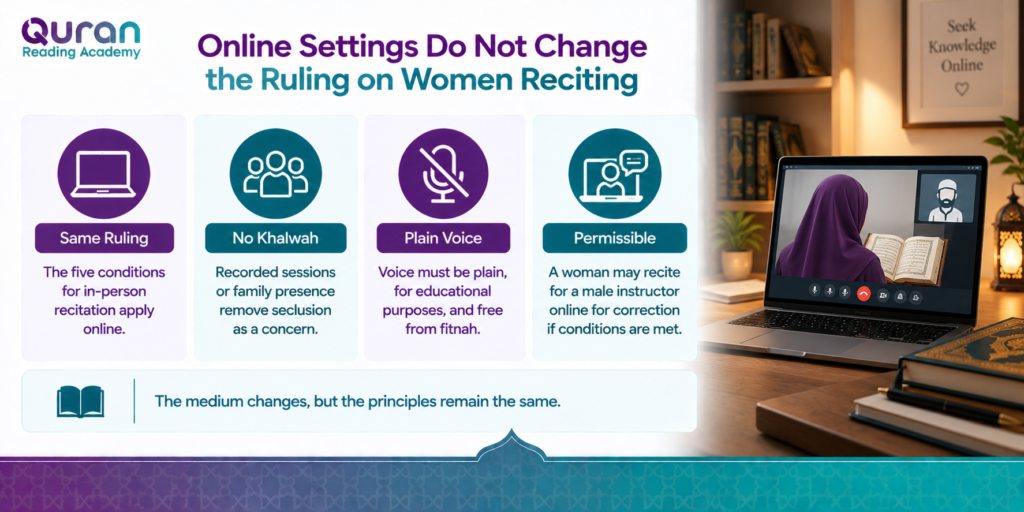
What changes in online settings is the natural elimination of khalwah. A recorded session, or one conducted with family present, removes seclusion as a concern.
Plain voice, educational purpose, and the absence of fitnah still apply in full. These conditions hold in both in-person and online Quran recitation contexts.
When a woman recites before a male Tajweed instructor online for correction, and her delivery carries no embellishment, the instructor’s listening is permissible.
This reflects what the Companions practiced when they learned from female scholars. The purpose must remain educational; the voice must remain plain.
Quran Reading Academy’s Quran Hifz Course offers a dedicated memorization path for students who want to commit the Quran to memory with precision, guided by qualified instructors who track progress and correct recitation systematically.
Begin Your Hifz Journey with a Free Trial
Inside Our Live Classroom
We believe in complete transparency. Take a look inside our virtual classrooms to experience our premium teaching tools and engaging learning environment firsthand.
Start Your Quran Learning Journey Today
Join Quran Reading Academy and begin structured, step-by-step Quran reading with expert guidance.
Try your first class for freeMaster Quran Recitation with Quran Reading Academy Instructors
Knowing the Islamic ruling is the first step. Developing correct recitation with proper Tajweed, accurate Makharij al-Huruf, and a confident plain voice is the ongoing practice that earns reward and builds a lasting connection with the Quran.
Quran Reading Academy offers:
- Ijazah-certified instructors who correct recitation errors in real time during each class.
- Female instructors available for sisters seeking a private, modesty-centered learning environment.
- One-on-one live sessions tailored to each student’s pace, level, and flexible schedule.
Our Quran Courses
- Quran Reading Classes
- Quran Reading Classes for Kids
- Quran Reading Classes for Adults
- Quran Reading Classes for Female/Sisters
- Quran Reading Classes for New Muslims
- Quran Reading Course for Beginners
- Online Quran Reading Course with Tajweed
- Reading and Memorizing the Quran Course
- Noorani Qaida Course
- Quran Course for Beginners
- Quran Tajweed Course
- Quran Recitation Course
- Quran Hifz Course
- Online Quran Qirat Classes

Conclusion
Men may listen to women recite Quran when recitation is plain, the purpose is genuine, and no fitnah is present. Scholars in all four madhabs reached this conclusion consistently.
None issued a categorical ban, and none granted unconditional permission. The ruling lives entirely in the conditions: the manner of delivery, the purpose of the gathering, and the absence of fitnah.
A woman’s voice is not ‘awrah. Deliberate melodic embellishment before non-mahram men is prohibited. Plain, purpose-driven recitation in a modest setting without fitnah is not.
Muslim women can recite Quran with confidence within those boundaries, whether in a classroom, a family gathering, or an online Quran session.
Frequently Asked Questions About Women Reciting Quran in Front of Men
Can men listen to women recite Quran for learning purposes?
Yes. When the purpose is genuine education, such as Tajweed correction or recitation study, men may hear a woman recite Quran provided her voice carries no deliberate melodic embellishment and no fitnah is present. All major madhabs affirm this position.
Is a woman’s voice ‘awrah in Islam?
No, according to the majority of scholars. Ibn Mufliḥ al-Ḥanbalī and Al-Bujayrmī al-Shāfi’ī both confirmed the voice itself is not ‘awrah. What is prohibited is deriving sinful pleasure from hearing it, or a woman deliberately softening her voice to attract non-mahram men.
Can a Woman Recite Quran Publicly Near Non-Mahram Men?
She may recite at a normal volume in public settings with a genuine worship or educational context, provided her voice carries no intentional beautification and no fitnah arises. Scholars prefer quiet recitation when no real need requires her voice to be audible.
When Is a Woman’s Quran Recitation Prohibited for Men to Hear?
Recitation becomes prohibited when it carries deliberate melodic beautification, or when the male listener derives pleasure from the voice instead of reflecting on the words of Allah. Either condition alone triggers the prohibition, regardless of the other party’s intent.
Can a Woman Study Quran Online with a Male Teacher?
Yes, under the standard conditions: no seclusion, which online settings naturally avoid through recording or family presence; a plain recitation voice; full modesty; and a genuine educational purpose. These conditions apply identically in online and in-person settings.








Leave a Reply