 benefits of reading quran
Have you ever wondered whether reading the Quran in Arabic truly makes a difference — especially if you don’t understand the language? It’s a question many Muslims face, and the answer goes deeper than most articles explain.
The benefits of reading the Quran in Arabic span two dimensions that no translation can replicate: an intellectual dimension where you access the precise meanings Allah intended, and a spiritual dimension where the very sound and structure of the Arabic words heal and transform the heart.
Understanding both is what separates a surface-level reading habit from a life-changing practice.
At Quran Reading Academy, we see this transformation daily — students who once relied solely on translations begin reciting in Arabic and report a shift not just in comprehension, but in how they feel during salah, how they handle difficulty, and how close they feel to Allah.
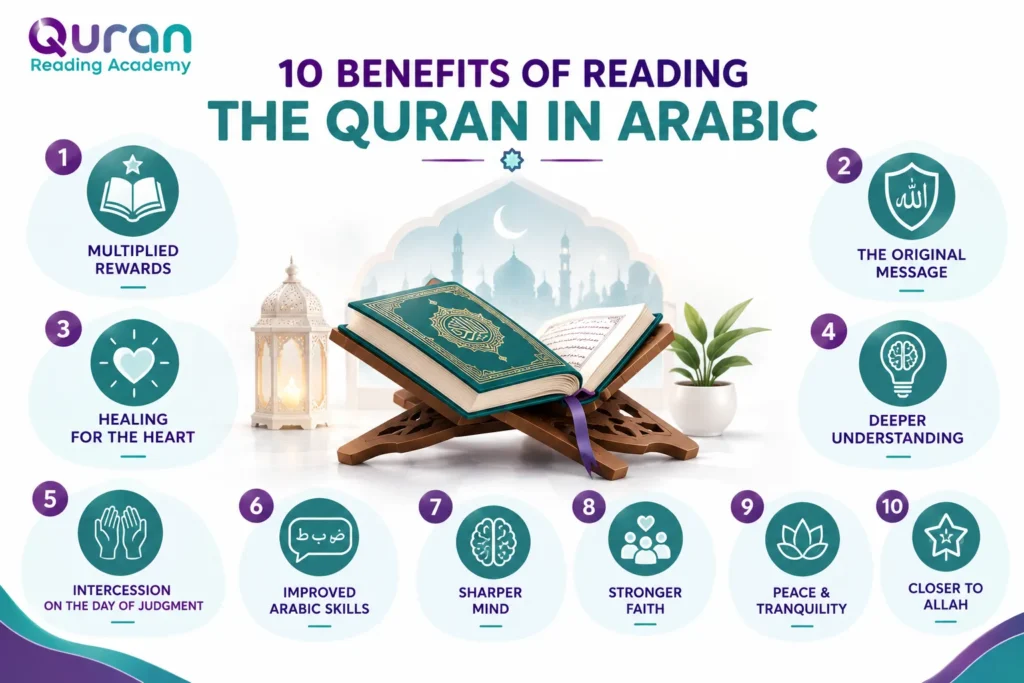
The benefits of reading the Quran in Arabic are not limited to spiritual reward alone. They touch language skills, cognitive development, emotional wellbeing, and — most importantly — the accuracy of your understanding of Islam itself. Below is a structured look at each benefit, drawn from Quranic evidence and prophetic guidance.
1. Earning Multiplied Rewards For Every Letter
Every Arabic letter you recite from the Quran carries a guaranteed reward from Allah — a promise no translation can deliver.
The Prophet (ﷺ) said:
“Whoever recites a letter from Allah’s Book, then he receives the reward from it, and the reward of ten the like of it. I do not say that Alif Lam Mim is a letter, but Alif is a letter, Lam is a letter and Mim is a letter.” [Jami’ at-Tirmidhi 2910]
This hadith establishes something often overlooked: the reward is attached to reciting the Arabic letters themselves, not to understanding them. Every single letter you pronounce counts.
A person reading Surah Al-Fatiha in Arabic earns reward for each of its approximately 139 letters — multiplied tenfold. No translation offers this.
Read Also: One Year Quran Reading Plan
2. Accessing The Original, Unaltered Message Of Allah
Reading the Quran in its original Arabic means engaging directly with the words Allah revealed — unchanged for over 1,400 years.
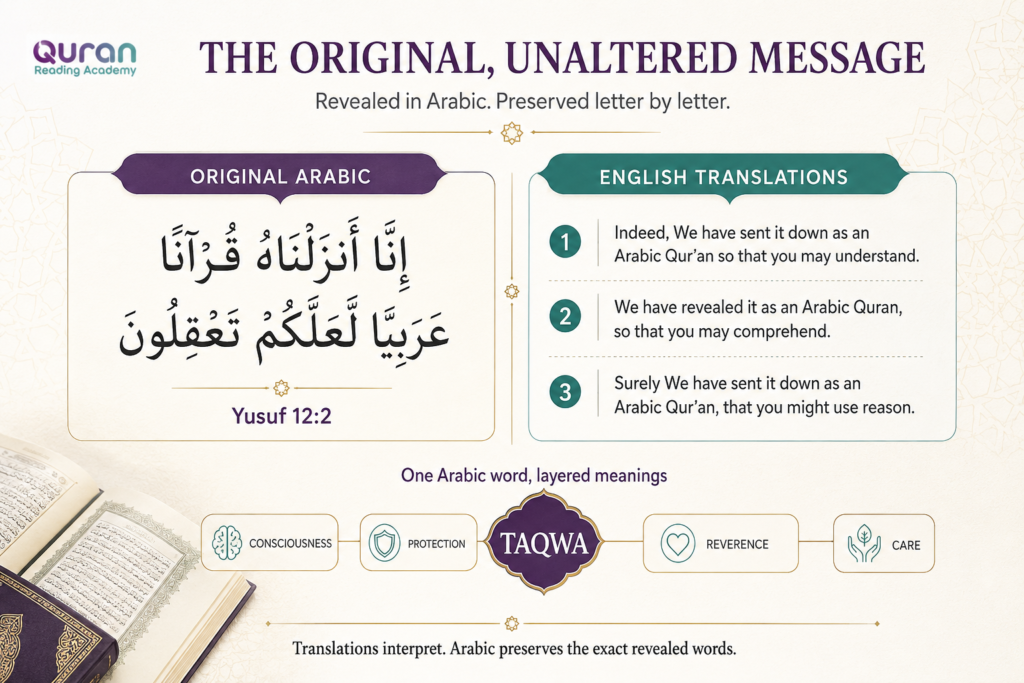
Allah says: “Indeed, We have sent it down as an Arabic Qur’an that you might understand.” [Yusuf: 2]
The Quran was revealed in Arabic — and it has been preserved letter by letter in that language for over 1,400 years. Translations are human interpretations.
Arabic is rich in layered meanings; a single word like “taqwa” carries connotations of consciousness, protection, fear, and care that no single English word captures. When you read in Arabic, you engage with the exact words Allah chose — not a translator’s best approximation.
3. Healing for the Heart and Spiritual Tranquility
The Quran describes itself as a cure for what lies in the hearts — and that healing power belongs to the Arabic text specifically.
Allah says: “O mankind, there has come to you instruction from your Lord and healing for what is in the breasts and guidance and mercy for the believers.” [Yunus: 57]
And: “And We send down of the Qur’an that which is healing and mercy for the believers.” [Al-Isra: 82]
The word “shifa” (healing) in these verses refers to the Arabic Quran — not its translation. Scholars of tafsir clarify that this healing addresses diseases of the heart: doubt, envy, anxiety, attachment to the world, and spiritual numbness.
Reciting the Arabic text, even slowly, carries a calming effect that students at Quran Reading Academy frequently describe — a stillness during and after recitation that reading a translation alone does not produce.
Read Also: 30 Day Ramadan Quran Reading Schedule
4. Understanding The True Teachings Without Distortion
Arabic carries layers of meaning that translations often flatten or shift — reading the original protects you from misinterpretation.
Islamic jurisprudence, theology, and ethics are all derived from the Quran’s Arabic text. Translations sometimes flatten or shift meaning.
For example, the Arabic word “daraba” in Surah An-Nisa (4:34) has been translated in vastly different ways — from “strike” to “separate from” — because the word itself carries multiple meanings that only Arabic grammar and context can resolve.
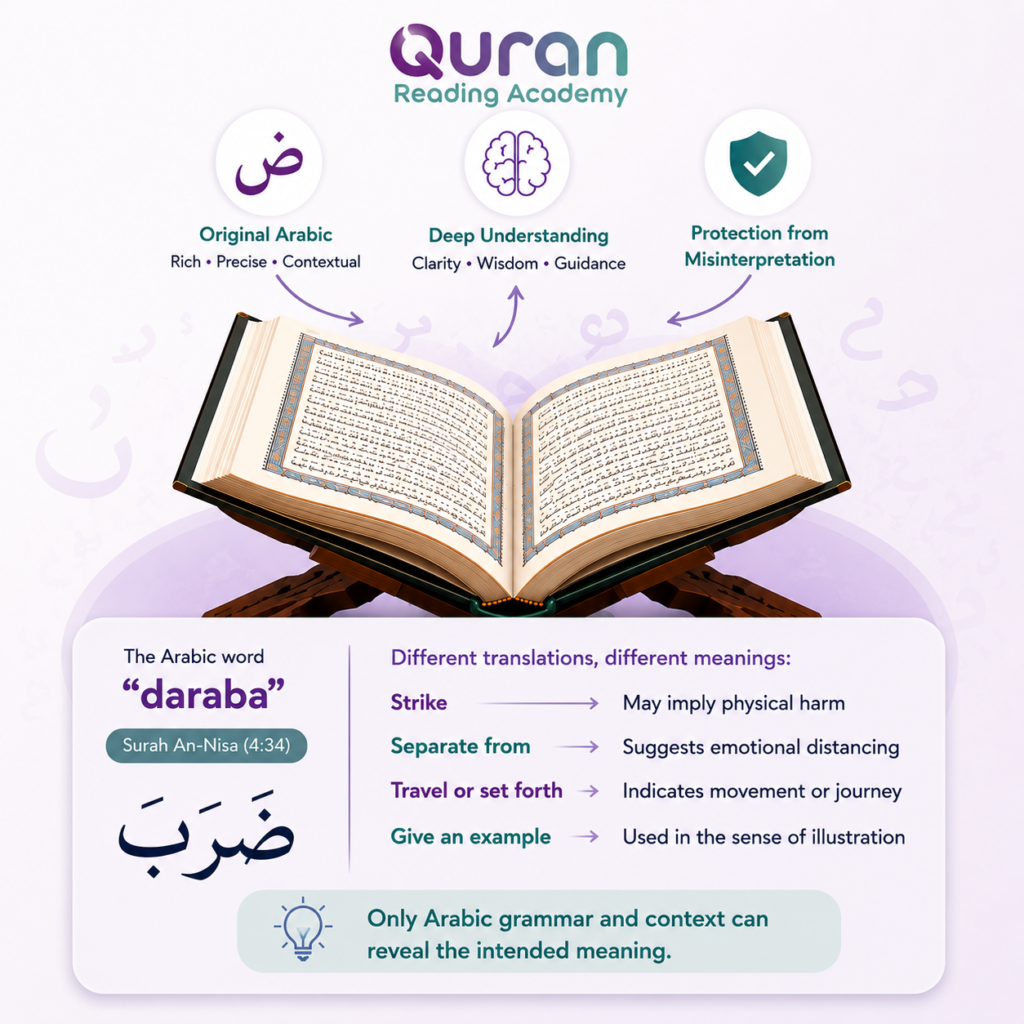
Reading the Quran in Arabic protects you from relying on a single translator’s interpretation and gives you direct access to the source. This is why scholars throughout Islamic history have insisted that serious students of the Quran must engage with the Arabic text.
At Quran Reading Academy, our courses are built around this principle — we don’t just teach pronunciation, we help students connect recitation with meaning from the very first lesson.
Read Also: How to Read the Quran If You Don’t Know Arabic?
See Our Academy in Action
Discover what a typical session looks like! Watch these brief highlights from our live, interactive classes to see how our instructors engage with students of all ages.
Start Your Quran Learning Journey Today
Join Quran Reading Academy and begin structured, step-by-step Quran reading with expert guidance.
Try your first class for free5. Intercession On The Day Of Judgment
The Quran will stand as a witness and advocate for those who recited it regularly when they need it most — on the Day of Resurrection.
The Prophet (ﷺ) said: “Read the Quran, for it will come as an intercessor for its companions on the Day of Resurrection.” [Sahih Muslim]
The scholars explain that “companions of the Quran” are those who recite it regularly and act upon it. This intercession — the Quran literally advocating for you before Allah — is tied to the Arabic recitation. The more you recite, the stronger that bond becomes.
6. Rising In Ranks In The Hereafter
Your level in Jannah is tied directly to how much Quran you memorized and recited — each verse lifts you one degree higher.
The Prophet (ﷺ) said:
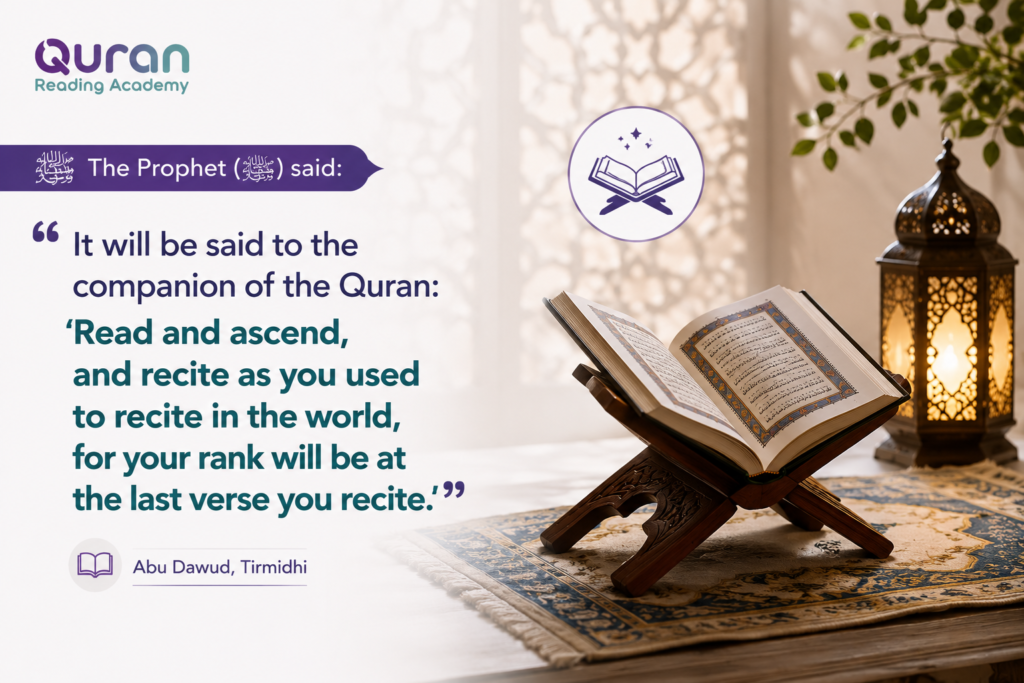
“It will be said to the companion of the Quran: ‘Read and ascend, and recite as you used to recite in the world, for your rank will be at the last verse you recite.'” [Abu Dawud, Tirmidhi]
Your position in Jannah is directly connected to how much the Quran you have memorized and how well you recite it. This is not about speed — it’s about consistent, correct Arabic recitation. Every surah you learn to recite properly is a permanent investment in your akhirah.
Read Also: Quran Reading Tracker
7. Strengthening Arabic Language Skills
Among the practical benefits of reading the Quran in Arabic is the rapid improvement in your Arabic language proficiency — vocabulary, pronunciation, and grammar all develop through regular recitation.
The Quran uses the highest register of classical Arabic — its vocabulary, sentence structures, and rhetorical devices train your ear and tongue simultaneously. Students who recite regularly develop better pronunciation (makhaarij), expanded vocabulary, and an intuitive sense of Arabic grammar.
This is why Quran Reading Academy integrates Arabic skill-building into every Quran recitation course — because recitation and language reinforcement happen together naturally.
8. Improving Memory And Cognitive Function
Quran recitation engages multiple brain systems at once — sound, sight, meaning, and articulation — sharpening memory and mental agility.
Learning to read and memorize the Quran in Arabic activates multiple cognitive systems at once: phonological processing (the sounds), visual processing (the script), semantic memory (the meanings), and motor memory (the articulation of letters from specific points in the mouth and throat).
Research on bilingual cognition consistently shows that engaging with a second language strengthens working memory, attention control, and mental flexibility. Quran recitation applies all of these mechanisms in a single practice.
9. Protection From Spiritual Neglect
Daily Arabic recitation keeps your heart connected to Allah’s words and prevents the gradual drift that comes from abandoning the Quran.
Allah describes a category of people:
“But their hearts are covered with confusion over this [Quran], and they have [evil] deeds besides disbelief which they are doing.” [Al-Mu’minun: 63]
Daily recitation in Arabic keeps the heart engaged with Allah’s words. The moment a Muslim stops reciting, the distance grows — not dramatically, but gradually.
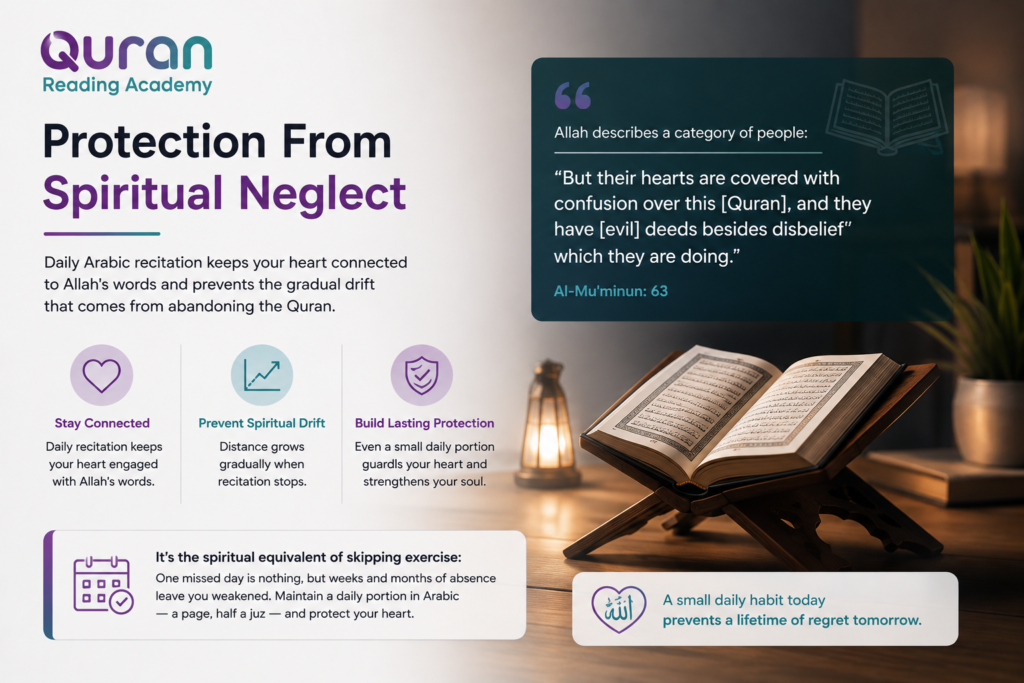
It’s the spiritual equivalent of skipping exercise: one missed day is nothing, but weeks and months of absence leave you weakened. Maintaining even a small daily portion in Arabic — a page, half a juz — guards against this drift.
10. Blessing And Light In Daily Life
Starting your day with Quran recitation fills your home and your hours with barakah — a tangible sense of ease and clarity.
The Prophet (ﷺ) said:
“The house in which the Quran is recited — its goodness increases, and the house in which the Quran is not recited — its goodness decreases.” [Sahih al-Bukhari]
Muslims who recite Quran in Arabic as part of their morning or evening routine consistently describe a sense of barakah — things flowing more smoothly, decisions feeling clearer, and a general lightness in their day.
This is not superstition; it is the direct result of beginning your day in conversation with Allah through His own words.
Should You Read The Quran In Arabic Or Translation?
The answer is both — but they serve different functions. Arabic recitation is the Quran. Translation is a study aid. You should read the Arabic text for worship, reward, and spiritual healing, and use translations alongside it to build understanding.
The practical approach Quran Reading Academy recommends to students: recite your daily portion in Arabic first, then read the translation of those same verses afterward. Over time, as your Arabic improves — especially through a structured Quran course for beginners — you’ll find you need the translation less and less.
A common mistake is treating this as either/or. It is not. The Muslim who recites in Arabic without understanding is doing something valuable — but incomplete. The Muslim who reads only translations is learning — but missing the reward and spiritual effect of the Arabic words.
Inside Our Live Classroom
We believe in complete transparency. Take a look inside our virtual classrooms to experience our premium teaching tools and engaging learning environment firsthand.
Start Your Quran Learning Journey Today
Join Quran Reading Academy and begin structured, step-by-step Quran reading with expert guidance.
Try your first class for freeStart Reading Quran In Arabic Today With Quran Reading Academy
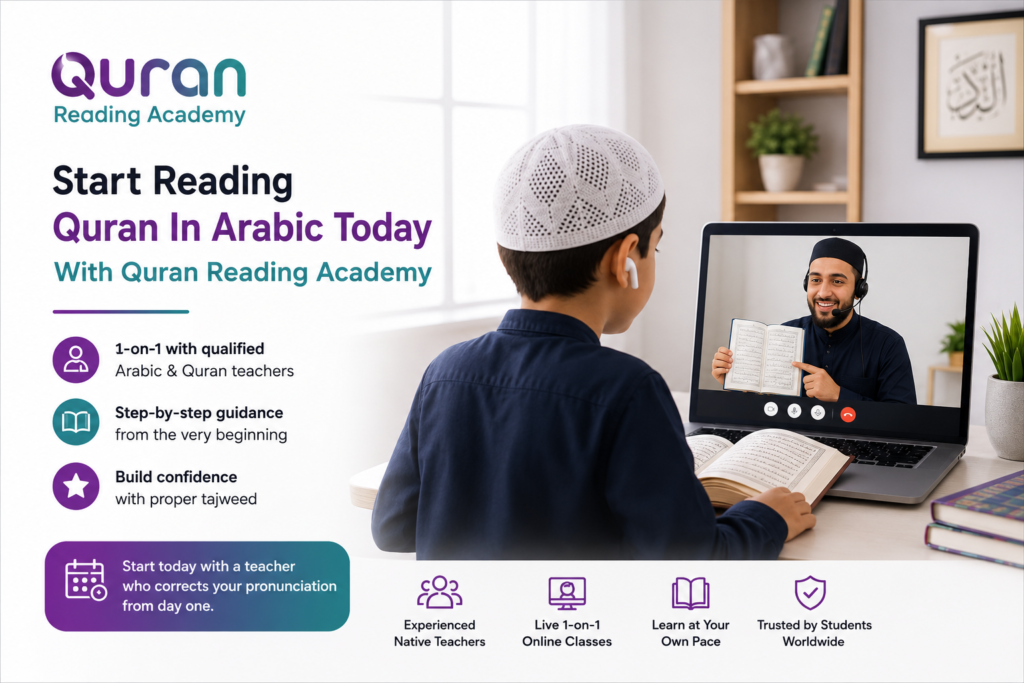
You don’t need to be fluent in Arabic to begin. Thousands of students at Quran Reading Academy started with no Arabic background and now recite with confidence and proper tajweed. The key is starting — and having a qualified teacher who corrects your pronunciation from day one.
Whether you want to learn the basics of recitation, master the rules of tajweed, or begin your Quran memorization journey, Quran Reading Academy offers structured online courses with experienced instructors who guide you step by step.
Our Quran Courses:
- Quran Reading Classes
- Quran Reading Classes for Kids
- Quran Reading Classes for Adults
- Quran Reading Classes for Female/Sisters
- Quran Reading Classes for New Muslims
- Quran Reading Course for Beginners
- Online Quran Reading Course with Tajweed
- Reading and Memorizing the Quran Course
- Noorani Qaida Course
- Quran Course for Beginners
- Quran Tajweed Course
- Quran Recitation Course
- Quran Hifz Course
- Online Quran Qirat Classes
- Quranic Arabic Course
- Arabic Reading Practice Course
Start Your Quran Learning Journey Today
Join Quran Reading Academy and begin structured, step-by-step Quran reading with expert guidance.
Try your first class for freeConclusion
The benefits of reading Quran in Arabic are both immediate and eternal — from the ten-fold reward for every letter, to the healing of the heart, to the intercession of the Quran on the Day of Judgment.
No translation, however excellent, can replace the Arabic original because the Quran is Arabic. It was revealed in Arabic, preserved in Arabic, and its spiritual power is carried in its Arabic words.
The practical takeaway is simple: recite in Arabic for worship and reward, study translations for comprehension, and work toward bridging the two through consistent learning.
Whether you are a complete beginner or someone returning to the Quran after years away, Quran Reading Academy provides the structure, the teachers, and the support to make this journey achievable.

Frequently Asked Questions About Reading Quran in Arabic
Below are the most common questions Muslims ask about the benefits of reading the Quran in Arabic, answered directly from Quranic evidence and scholarly guidance.
1. Is it OK to read the Quran without understanding Arabic?
Yes, it is completely permissible and rewarded. The Prophet (ﷺ) confirmed that every letter recited earns ten rewards — and he used the example of “Alif Lam Mim,” letters whose meaning is unknown to anyone, as proof that reward is tied to recitation itself. You should not wait until you understand Arabic to begin reciting. Start now, and build understanding over time.
2. Can I read the Quran in English if I don’t know Arabic?
Yes, you can read an English translation to understand the meanings and teachings. However, know that a translation is not the Quran — it is a human interpretation of it. For worship, reward, and spiritual healing, the Arabic recitation is what carries those benefits. The best approach is to recite in Arabic and use a translation alongside it for comprehension.
3. Why was the Quran revealed in Arabic specifically?
Allah chose Arabic because of its linguistic richness — its ability to carry layered meanings, precise legal rulings, and profound emotional depth in compact expressions. Arabic grammar allows for nuances that most languages cannot replicate in translation. The Quran states this directly: “Indeed, We have sent it down as an Arabic Qur’an that you might understand” [12:2].
4. Does reading the Quran in Arabic improve mental health?
Reciting the Quran in Arabic has a documented calming effect. The Quran describes itself as “healing for what is in the breasts” [10:57], referring to anxiety, doubt, grief, and spiritual diseases. Many Muslims report reduced stress and increased emotional stability with regular Arabic recitation. Additionally, the cognitive engagement of reading a second language supports memory and mental sharpness.
5. What is the reward for reading the Quran in Arabic?
Each Arabic letter you recite earns a minimum of ten good deeds (hasanat), as stated in the hadith narrated by Abdullah ibn Mas’ud [Tirmidhi 2910]. Beyond individual rewards, regular reciters receive the Quran’s intercession on the Day of Judgment and are elevated in rank in Jannah according to how much they recited and memorized.
6. How do I start reading the Quran in Arabic as a beginner?
Begin by learning the Arabic alphabet and basic pronunciation rules (makhaarij al-huroof). Then move to short surahs with a teacher who can correct your recitation in real time. Quran Reading Academy’s beginner course is designed for exactly this — taking students from zero Arabic to confident recitation with proper tajweed.
Related Articles
benefits of reading quran




Leave a Reply