 Quran
Quran
Every Muslim who opens the Quran and struggles through its verses earns a special promise directly from the Prophet Muhammad (PBUH). The hadith about reading Quran with difficulty confirms that a person who falters and finds recitation hard receives not one but two rewards from Allah.
This narration stands among the most motivating statements in prophetic tradition. It removes every excuse for avoiding the Quran and replaces hesitation with hope, proving that effort itself carries weight before Allah regardless of fluency level.
Authentic Hadith on Struggling to Read the Quran
The Prophet Muhammad (PBUH) addressed every level of Quran reader in one powerful narration. This hadith, reported by Aisha (may Allah be pleased with her), draws a clear distinction between the skilled reciter and the one who struggles, honoring both.
The Full Hadith on Reading Quran With Difficulty
The primary hadith about reading Quran with difficulty appears in the two most authentic collections of prophetic tradition. Imam Muslim recorded it with precise wording that scholars rely upon.
الْمَاهِرُ بِالْقُرْآنِ مَعَ السَّفَرَةِ الْكِرَامِ الْبَرَرَةِ وَالَّذِي يَقْرَأُ الْقُرْآنَ وَيَتَتَعْتَعُ فِيهِ وَهُوَ عَلَيْهِ شَاقٌّ لَهُ أَجْرَانِ
(Al-Maahiru bil-Qur’aani ma’a as-safaratil-kiraamil-bararah, walladhi yaqra’ul-Qur’aana wa yatatata’u feehi wa huwa ‘alayhi shaaqq, lahu ajraan)
(“One who is proficient in the Quran is associated with the noble, upright, recording angels; and he who falters in it and finds it difficult for him will have two rewards.”)
This same narration also appears in Sahih al-Bukhari with slightly different wording but identical meaning.
مَثَلُ الَّذِي يَقْرَأُ الْقُرْآنَ وَهُوَ حَافِظٌ لَهُ مَعَ السَّفَرَةِ الْكِرَامِ الْبَرَرَةِ، وَمَثَلُ الَّذِي يَقْرَأُ الْقُرْآنَ وَهُوَ يَتَعَاهَدُهُ وَهُوَ عَلَيْهِ شَدِيدٌ، فَلَهُ أَجْرَانِ
(Mathalul-ladhi yaqra’ul-Qur’aana wa huwa haafithun lahu ma’a as-safaratil-kiraamil-bararah, wa mathalul-ladhi yaqra’ul-Qur’aana wa huwa yata’aahaduhu wa huwa ‘alayhi shadeed, falahu ajraan)
(“Such a person as recites the Quran and masters it by heart will be with the noble righteous scribes in Heaven. And such a person who exerts himself to learn the Quran by heart and recites it with great difficulty will have a double reward.”)
Read also: Hadith About Reading Quran
Why Struggling Quran Readers Receive Two Rewards
Scholars of hadith explain that the struggling reader receives two distinct rewards for two distinct efforts. The first reward is for the act of recitation itself, which every reader earns regardless of skill level.
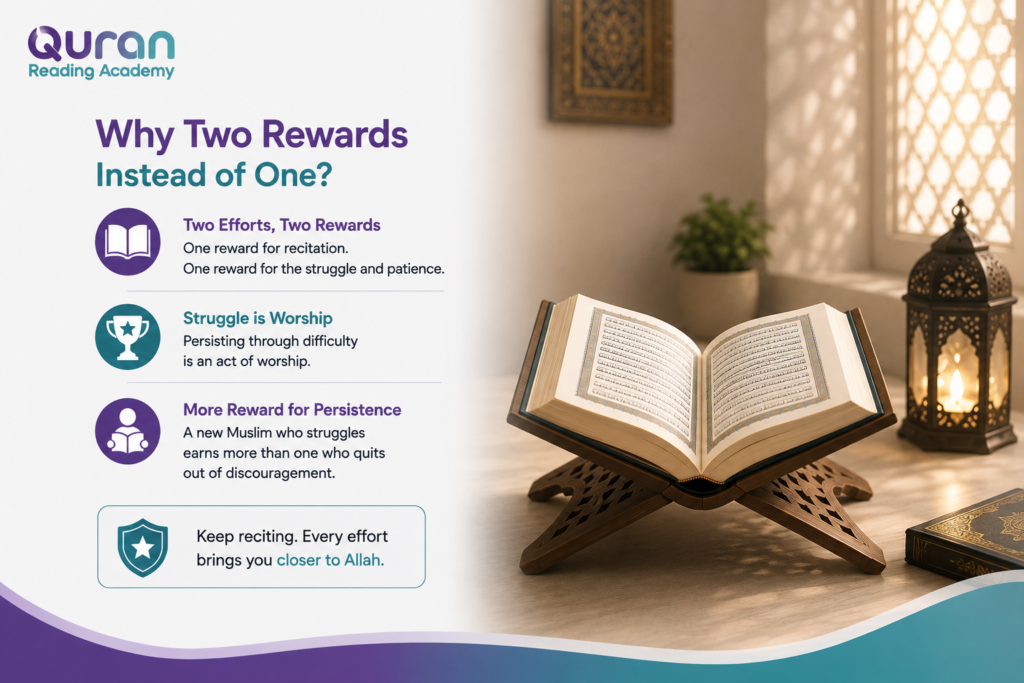
The second reward compensates specifically for the hardship and patience endured during recitation. Imam An-Nawawi noted in his commentary on Sahih Muslim that the struggle itself becomes an act of worship when the reader persists despite difficulty.
This means a new Muslim who stumbles through Surah Al-Fatiha earns more reward than someone who abandons reading entirely because of perceived inability. The Prophet (PBUH) designed this encouragement to close every door of excuse.
The Reward of Skilled Quran Reciters With the Noble Angels
The hadith about struggling to read Quran also raises the proficient reciter to a remarkable station. Being “with the noble, upright, recording angels” (as-safaratil-kiraamil-bararah) places the skilled reader in the company of the highest angelic beings.
The word “safarah” refers to angel-scribes who carry divine messages. Allah describes them directly in the Quran in Surah Abasa.
بِأَيْدِي سَفَرَةٍ كِرَامٍ بَرَرَةٍ
(Bi aydi safaratin kiraamin bararah)
This verse confirms that reaching fluency in Quran recitation places a person in the spiritual company of these honored angels. The motivation here works in both directions: struggle earns double reward, and mastery earns angelic companionship.
Prophetic Encouragement to Beautify Quran Recitation
Beyond addressing difficulty, the Prophet (PBUH) actively encouraged Muslims to recite the Quran with a beautiful voice. This section examines the authentic narrations that connect vocal effort with spiritual reward.
The Prophet’s Command to Beautify the Quran With Your Voice
The Prophet (PBUH) gave a clear, concise instruction about how Muslims should approach their recitation voice.
زَيِّنُوا الْقُرْآنَ بِأَصْوَاتِكُمْ
(Zayyinul-Qur’aana bi aswaatikum)
This hadith about reciting Quran beautifully does not mean professional-level singing. Scholars explain that “beautifying” means reading with care, proper Tajweed, measured pace, and real emotional engagement with the meaning.
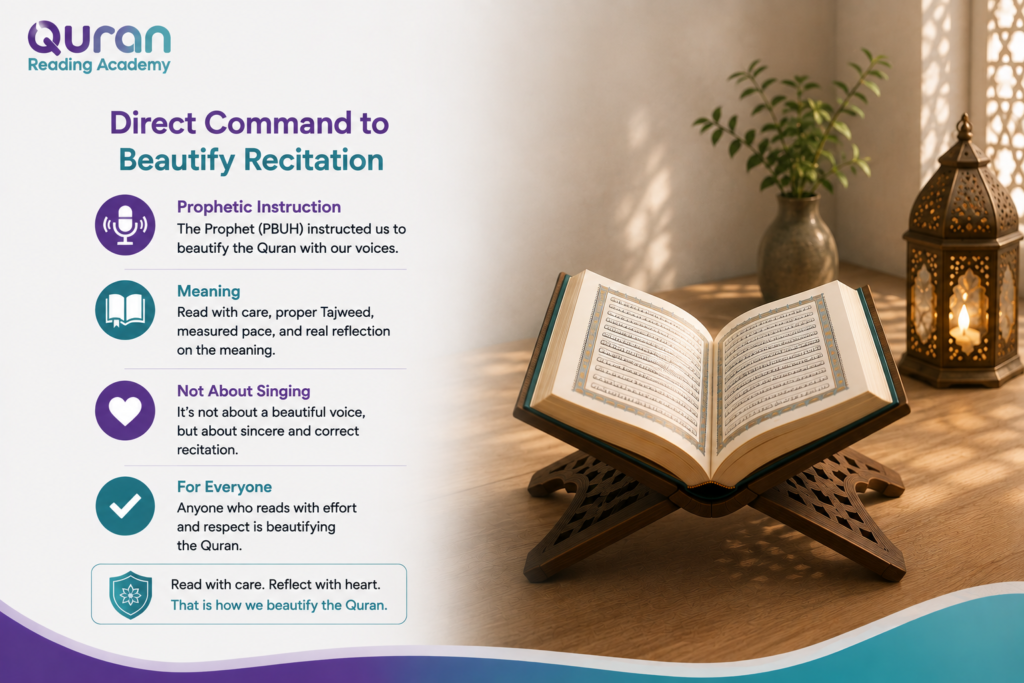
A common mistake learners make is assuming this command only applies to those with naturally pleasant voices.
In reality, every person who reads slowly, applies correct pronunciation rules, and pauses at the right stops is beautifying the Quran according to this prophetic standard.
The Virtue of Beautiful and Sincere Quran Recitation
The reward for vocal effort during recitation extends beyond human appreciation. Abu Huraira (may Allah be pleased with him) reported a hadith that reveals Allah’s direct attention to sincere recitation.
لَمْ يَأْذَنِ اللَّهُ لِشَىْءٍ مَا أَذِنَ لِلنَّبِيِّ صلى الله عليه وسلم يَتَغَنَّى بِالْقُرْآنِ
(Lam ya’dhanillahu li shay’in maa adhina lin-Nabiyyi sallallahu ‘alayhi wa sallam yataghanaa bil-Qur’aan)
(“Allah does not listen to a prophet as He listens to a prophet who recites the Quran in a pleasant tone.”)
The Arabic word “ya’dhan” here carries the meaning of attentive, pleased listening. This indicates that making vocal effort during Quran reading draws a special form of divine attention.
Quran Reading Academy offers a dedicated Quran Recitation Course where certified instructors train students to recite with Tarteel, the measured rhythmic cadence the Prophet (PBUH) practiced, combining vocal beauty with strict Tajweed accuracy.
Start your recitation training with expert guidance
Spiritual Rewards for Those Who Regularly Recite the Quran
The prophetic tradition presents a complete reward structure that covers listening, reading, memorizing, and teaching the Quran. Each level of engagement carries its own specific promise from Allah.
The Hadith Comparing a Quran Reciter to a Fragrant Citron
Every Muslim who opens the Quran earns a standing that the Prophet (PBUH) described through one of the most vivid comparisons in all of hadith literature. Abu Musa al-Ash’ari (may Allah be pleased with him) reported that the Messenger of Allah (PBUH) said:
مَثَلُ الْمُؤْمِنِ الَّذِي يَقْرَأُ الْقُرْآنَ مَثَلُ الأُتْرُجَّةِ، رِيحُهَا طَيِّبٌ وَطَعْمُهَا طَيِّبٌ، وَمَثَلُ الْمُؤْمِنِ الَّذِي لاَ يَقْرَأُ الْقُرْآنَ مَثَلُ التَّمْرَةِ، لاَ رِيحَ لَهَا وَطَعْمُهَا حُلْوٌ
Mathalul mu’mini alladhi yaqra’ul Qur’ana mathalul utrujjah, rīhuhā tayyibun wa ta’muhā tayyib. Wa mathalul mu’mini alladhi lā yaqra’ul Qur’ana mathalut tamrah, lā rīha lahā wa ta’muhā hulw.
“The example of a believer who recites the Quran is that of a citron — its fragrance is pleasing and its taste is sweet. The example of a believer who does not recite the Quran is that of a date — it has no fragrance, but its taste is sweet.”
The citron carries two virtues simultaneously: others smell its beauty before they ever taste it. A Muslim who reads the Quran — even with difficulty, even slowly — carries that same dual quality outward into the world. The recitation itself is the fragrance; the faith behind it is the sweetness.
This means the act of sitting with the Quran, however imperfect your pronunciation or however halting your pace, places you in the higher category of this comparison. The Prophet (PBUH) did not say “the believer who recites perfectly” — he said the believer who recites, full stop.
How the Quran Intercedes on the Day of Judgment
The Quran itself becomes an active advocate for its readers when they need it most. Abu Umama al-Bahili reported the Prophet (PBUH) saying:
اقْرَءُوا الْقُرْآنَ فَإِنَّهُ يَأْتِي يَوْمَ الْقِيَامَةِ شَفِيعًا لأَصْحَابِهِ
(Iqra’ul-Qur’aana fa innahu ya’ti yawmal-qiyaamati shafee’an li ashaabih)
(“Recite the Quran, for on the Day of Resurrection it will come as an intercessor for those who recite it.”)
The word “ashaabih” means its companions, referring to people who maintained a regular relationship with the Quran during their lives. A person who reads daily, even with struggle and slow pace, qualifies as a companion of the Quran.
The Quran Recitation Raises Your Rank in Paradise
Abdullah ibn Amr ibn al-As reported a narration that directly links Quran memorization and recitation quality to one’s station in the afterlife.
يُقَالُ لِصَاحِبِ الْقُرْآنِ اقْرَأْ وَارْتَقِ وَرَتِّلْ كَمَا كُنْتَ تُرَتِّلُ فِي الدُّنْيَا فَإِنَّ مَنْزِلَكَ عِنْدَ آخِرِ آيَةٍ تَقْرَؤُهَا
(Yuqaalu li saahibil-Qur’aani iqra’ warta qi wa rattil kamaa kunta turattilu fid-dunyaa fa inna manzilaka ‘inda aakhiri aayatin taqra’uhaa)
(“It will be said to the companion of the Quran: Recite, ascend, and recite carefully as you recited carefully in the world, for your abode will be at the last verse you recite.”)
This hadith gives tangible motivation to memorize as much Quran as possible. Every additional verse memorized and recited with Tarteel directly raises the reader’s eternal station.
Quran Reading Academy provides a structured Quran Hifz Course that pairs systematic memorization techniques with qualified instructors, ensuring long-term retention of every Ayah you commit to memory.
How to Progress From Difficult Quran Reading to Fluency
The hadith about reading Quran with difficulty guarantees double reward, but it also implicitly encourages progression.
The goal is not to remain struggling permanently but to move toward proficiency while earning maximum reward along the way. Here are the steps that take a reader from difficulty to confidence:
Step 1: Build Your Quran Reading Foundation With Noorani Qaida
Every proficient Quran reader began by learning individual Arabic letters and their sounds. The Noorani Qaida method breaks down the Arabic script into phonetic units that any beginner can absorb.
Start with the 28 Arabic letters and their four positional forms. Practice each letter’s sound from its correct articulation point (Makhraj) before connecting letters into syllables. This single step eliminates roughly 60% of reading errors that cause difficulty.
A practical daily routine involves 15 minutes of letter recognition drills followed by 10 minutes of simple word reading. Within four to six weeks, most students can decode basic Quranic vocabulary without assistance.
Read also: Hadith About Reading Quran in 3 Days
Step 2: Learn and Apply Tajweed Rules Gradually
Tajweed is the science of correct Quran pronunciation, and applying it converts reading from guesswork into precision. Begin with the four foundational rules: Noon Sakinah and Tanween rules, Meem Sakinah rules, Madd (elongation) rules, and Qalqalah (echo sound) rules.
A common mistake among self-learners is attempting to apply all Tajweed rules simultaneously. This creates overwhelm and actually increases the difficulty the hadith references. Instead, master one rule category per month with consistent daily practice.
Record yourself reading and compare your recitation against a trusted audio source like Sheikh Mahmoud Khalil Al-Husary, whose recordings follow strict Tajweed without melodic embellishment. This comparison method reveals specific errors you cannot hear in real time.
Quran Reading Academy offers a full Quran Tajweed Course that teaches the physical mechanics of articulation point by point, converting ordinary reading into precise, rule-bound recitation.
Step 3: Build Consistency Before Increasing Recitation Speed
The biggest obstacle for struggling readers is not ability but consistency. Reading two pages daily for six months produces dramatically better results than reading twenty pages once a month.
Set a fixed daily Quran time tied to an existing habit, such as reading for ten minutes after Fajr prayer. The connection between an established routine and Quran reading removes the decision fatigue that causes most people to skip their practice.
Track your progress by marking the last verse you read each day. Over thirty days, you will see visible advancement through the pages, which builds the psychological momentum needed to continue through difficult passages.
See Our Academy in Action
Discover what a typical session looks like! Watch these brief highlights from our live, interactive classes to see how our instructors engage with students of all ages.
Start Your Quran Learning Journey Today
Join Quran Reading Academy and begin structured, step-by-step Quran reading with expert guidance.
Try your first class for freeWhat Scholars Say About Struggling Quran Readers
Classical Islamic scholars provided deep analysis of why Allah rewards difficulty in Quran reading. Their explanations reveal layers of meaning that the surface reading of the hadith does not immediately show.
a. Ibn Hajar Al-Asqalani on Double Reward for Struggling Readers
In Fath al-Bari, his commentary on Sahih al-Bukhari, Ibn Hajar explained that the two rewards are categorically different. The first reward matches what every reciter receives for the act of reading Allah’s words.
The second reward falls under the category of patience (Sabr) rewards. Allah promises special compensation for every hardship endured in His path. The struggling reader exercises patience with each difficult verse, each mispronounced letter, and each repeated attempt.
Ibn Hajar noted that this hadith implicitly refutes anyone who discourages beginners from reading the Quran due to their mistakes. The Prophet (PBUH) specifically identified difficulty as a reward multiplier, not a disqualification.
b. Imam An-Nawawi on the Skilled Quran Reciter
An-Nawawi clarified that being “with the angels” does not mean the skilled reciter earns less than the struggling one. The angelic companionship represents a distinct, higher category of reward that surpasses numerical multiplication.
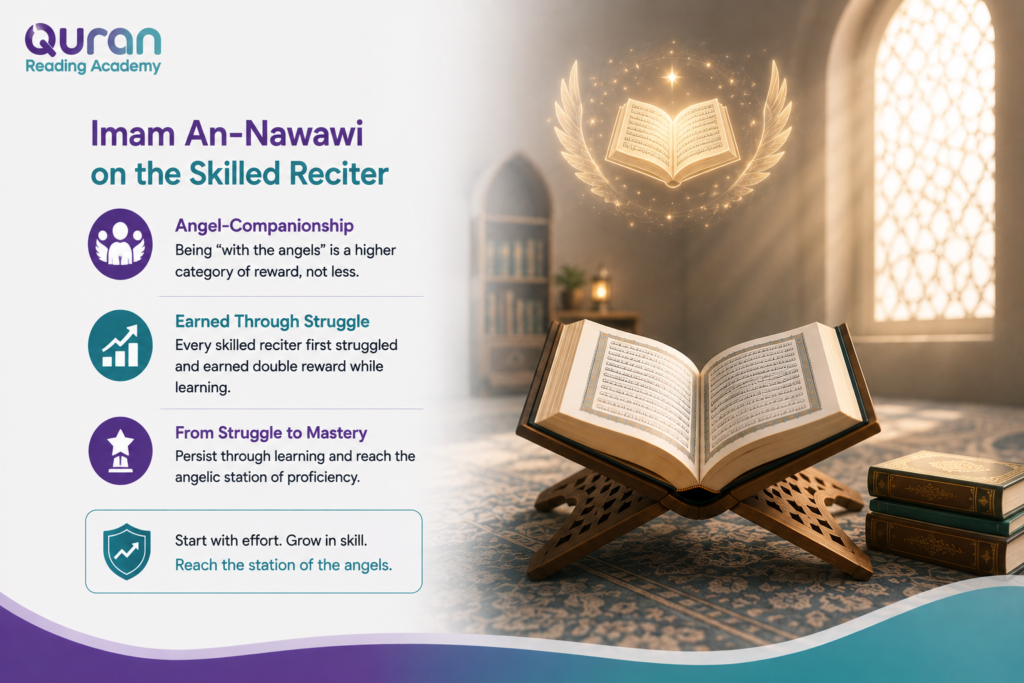
The skilled reciter reached proficiency through an earlier period of struggle and earned double reward during that learning phase. Now, having graduated to mastery, that person occupies a station comparable to the noble recording angels.
This scholarly framework creates a clear progression path: begin with struggle and double reward, persist through learning, and eventually reach the angelic station of proficiency.
Why Learning and Teaching the Quran Are Among the Best Deeds
The Prophet (PBUH) did not leave the ranking ambiguous. He stated clearly which Muslims hold the highest standing based on their relationship with the Quran.
خَيْرُكُمْ مَنْ تَعَلَّمَ الْقُرْآنَ وَعَلَّمَهُ
(Khayrukum man ta’allamal-Qur’aana wa ‘allamah)
(“The best among you are those who learn the Quran and teach it.”)
This hadith honors both the learner and the teacher. A person currently struggling through their first reading of Surah Al-Baqarah falls directly into the “those who learn” category and holds a station the Prophet (PBUH) described as “the best among you.”
Teaching does not require perfection either. A parent who teaches their child the Arabic alphabet using the Noorani Qaida method fulfills this prophetic standard even if that parent is still developing their own recitation skills.
Quran Reading Academy provides a complete Quran Reading Course for Beginners that takes students from absolute zero to reading fluency using the proven Noorani Qaida methodology with live one-on-one instruction.
Start reading the Quran with confidence today
Common Mistakes That Make Quran Reading More Difficult
Not all reading difficulty carries equal spiritual weight. Some struggle comes from avoidable errors in approach, not genuine learning challenges. Identifying and removing these obstacles accelerates the path from difficulty to proficiency.
1. Skipping Makharij and Correct Arabic Letter Articulation
Every Arabic letter has a specific origin point (Makhraj) in the mouth and throat. Skipping this foundational step forces the reader to guess pronunciations, creating compounding errors that make every subsequent verse harder.
For example, the letters Haa (ح) and Haa (هـ) sound identical to untrained ears but originate from completely different throat positions. Confusing them changes word meanings and forces the reader to constantly second-guess their pronunciation.
The fix requires focused drill work on the seventeen articulation points, ideally with a qualified teacher who can hear and correct errors in real time. Most students master all articulation points within eight to twelve dedicated practice sessions.
2. Learning Quran Recitation Without a Qualified Teacher
Self-teaching the Quran creates ingrained pronunciation habits that become increasingly difficult to correct over time. A reader who practices the wrong pronunciation of a letter one thousand times has not improved; they have reinforced an error.
The Prophet (PBUH) himself learned the Quran from Jibreel (Angel Gabriel), establishing the oral transmission model that continues through certified teachers today. Every authentic Quran recitation on earth traces back through an unbroken chain of teacher-to-student transmission.
Even online instruction with a qualified teacher reduces unnecessary difficulty significantly. Live correction after each error prevents bad habits from forming and accelerates the move from struggle to competence.
Inside Our Live Classroom
We believe in complete transparency. Take a look inside our virtual classrooms to experience our premium teaching tools and engaging learning environment firsthand.
Start Your Quran Learning Journey Today
Join Quran Reading Academy and begin structured, step-by-step Quran reading with expert guidance.
Try your first class for freeStart Your Quran Reading Journey With Quran Reading Academy Today
The hadith about reading Quran with difficulty removes every barrier between you and the Book of Allah. Whether you have never read a single Arabic letter or you have been struggling for years, the double reward promise applies to you right now.
Quran Reading Academy offers a Free Trial Session where you can experience live one-on-one instruction with a certified Quran teacher at zero cost. This session evaluates your current level and builds a personalized learning plan designed to move you from difficulty toward mastery.
Our Quran Courses
- Quran Reading Classes
- Quran Reading Classes for Kids
- Quran Reading Classes for Adults
- Quran Reading Classes for Female/Sisters
- Quran Reading Classes for New Muslims
- Quran Reading Course for Beginners
- Online Quran Reading Course with Tajweed
- Reading and Memorizing the Quran Course
- Noorani Qaida Course
- Quran Course for Beginners
- Quran Tajweed Course
- Quran Recitation Course
- Quran Hifz Course
- Online Quran Qirat Classes
- Quranic Arabic Course
- Arabic Reading Practice Course
Book your free Quran reading assessment session now
Conclusion
The hadith about reading Quran with difficulty, recorded in both Sahih Muslim and Sahih al-Bukhari, guarantees that every struggling reader receives two rewards for their effort. The first reward honors the act of recitation, and the second compensates for the patience required to push through difficulty.
The Prophet (PBUH) also encouraged beautifying Quran recitation, listening to its verses, and teaching it to others, with each level of engagement carrying its own specific promise from Allah. The skilled reciter joins the company of noble angels, while the struggling reader earns multiplied compensation.
No Muslim has a valid reason to avoid opening the Quran. The one who finds it easy earns angelic companionship. The one who finds it hard earns double reward. Both stand among the best of this Ummah according to the Prophet’s own words, and both move closer to Allah with every verse they read.
Frequently Asked Questions
What Is the Hadith About Reading Quran With Difficulty?
The Prophet Muhammad (PBUH) said that one who is proficient in the Quran will be with the noble recording angels, and the one who reads it while struggling and finding it difficult will receive two rewards. This hadith is recorded in Sahih Muslim 798a and Sahih al-Bukhari 4937, narrated by Aisha (may Allah be pleased with her).
Why Does the Struggling Quran Reader Get Double Reward?
Scholars explain that the first reward is for the recitation itself, which every reader earns. The second reward is for the patience and effort endured during the struggle. Ibn Hajar Al-Asqalani classified this second reward under the category of Sabr (patience) rewards that Allah grants for any hardship endured in His path.
Does the Skilled Reader Earn Less Than the Struggling One?
No. Imam An-Nawawi clarified that the skilled reciter’s reward of being “with the noble recording angels” represents a distinct, higher category that surpasses numerical multiplication. The skilled reader also earned double reward during their earlier learning phase before reaching proficiency.
Is It Sinful to Read the Quran With Mistakes?
Reading with unintentional mistakes while genuinely trying to improve is not sinful and actually earns extra reward according to the hadith. A Muslim who has the ability to learn correct pronunciation but deliberately neglects doing so bears responsibility for that neglect. The obligation is sincere effort, not perfection.
What Does Beautifying Quran Recitation Mean?
The Prophet (PBUH) commanded Muslims to “beautify the Quran with your voices” in Sunan Abi Dawud 1468. Scholars explain this means reading with proper Tajweed rules, measured pace (Tarteel), correct articulation, and emotional engagement with the meaning, not a requirement for a professionally trained singing voice.
Can Listening to Quran Recitation Earn Reward?
Yes. A hadith in Musnad Ahmad 8494 states that whoever listens to a verse from Allah’s Book receives a multiplied good deed, and whoever recites it will have a light on the Day of Resurrection. This makes listening an accessible starting point for anyone who feels unable to read independently.






Leave a Reply