 Quran
Every Muslim who recites the Quran regularly faces a practical question about pace and completion.
The hadith about reading Quran in 3 days provides a clear prophetic boundary, while several other narrations outline the ideal schedule for finishing the entire Book of Allah.
These narrations from the Prophet (peace be upon him) are not arbitrary limits. They protect the quality of recitation, ensure proper reflection, and balance worship with daily responsibilities.
Below is a full breakdown of every authentic hadith on this topic, along with scholarly commentary and practical reading plans.
Hadith on Completing the Quran in Less Than Three Days
The most direct narration on this topic sets a clear minimum. It establishes that rushing through the Quran below a certain threshold compromises understanding.
Abdullah ibn Amr’s Hadith on the Three-Day Quran Limit
Abdullah ibn Amr (may Allah be pleased with him) reported that the Prophet (peace be upon him) gave a firm statement about rapid Quran completion. This hadith is graded hasan sahih by Imam al-Tirmidhi.
لَمْ يَفْقَهْ مَنْ قَرَأَ الْقُرْآنَ فِي أَقَلَّ مِنْ ثَلاَثٍ
(Lam yafqah man qara’a al-Qur’āna fī aqalla min thalāth)
(“He who recites the Quran in less than three days does not understand it.”)
The word “yafqah” means deep comprehension. The Prophet (peace be upon him) did not say the recitation carries no reward. He said the reader misses the deeper meanings embedded in each verse.
This distinction matters. A person still earns reward per letter recited, as confirmed in other narrations. But the spiritual and intellectual benefit of tadabbur (reflection) is lost when speed overrides contemplation.
What the Three-Day Quran Completion Limit Means in Practice
Completing the Quran in three days means reciting roughly 10 juz per day. That amounts to approximately 200 pages of the standard Madinah mushaf in 72 hours.
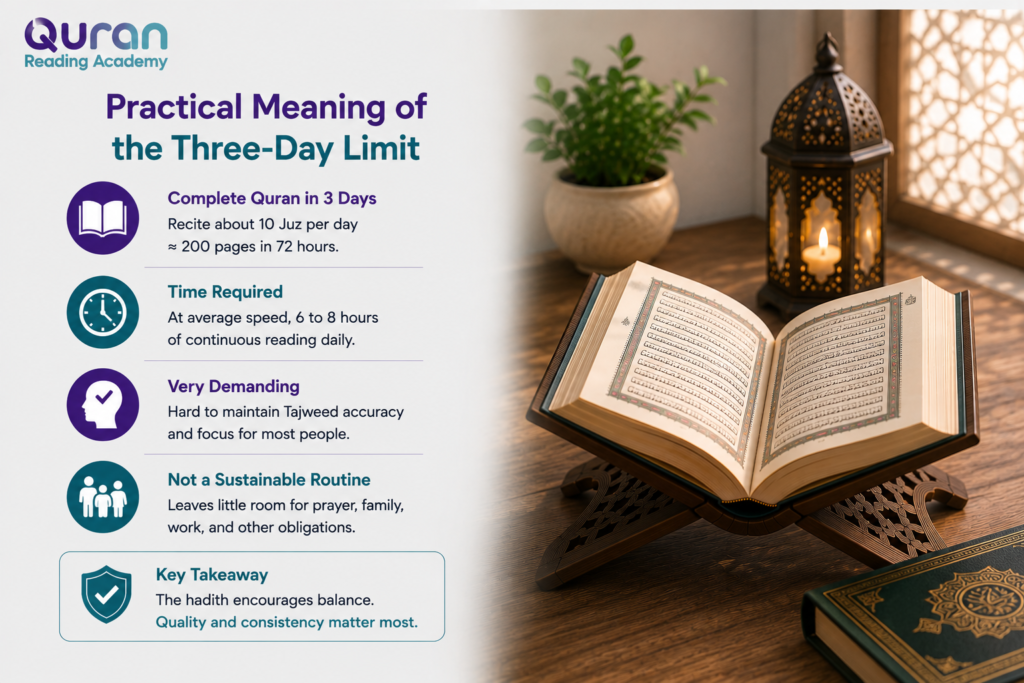
At an average recitation speed, that requires 6 to 8 hours of continuous reading daily. For most people, maintaining tajweed accuracy and mental presence at that pace is extremely difficult.
Scholars note that the hadith about reading Quran in 3 days targets habitual practice. Making this pace a permanent routine leaves little room for prayer, family, work, and other obligations the Shariah also mandates.
The Prophetic Seven-Day Quran Completion Schedule
The Prophet (peace be upon him) did not simply state a minimum. He walked Abdullah ibn Amr through a graduated scale of recommendations, starting from one month and narrowing down to seven days.
The Prophet’s Guidance to Abdullah ibn Amr on Quran Completion
This exchange is recorded in both Sahih al-Bukhari and Sahih Muslim. The Prophet (peace be upon him) began with the easiest recommendation and only reduced the timeframe when Abdullah insisted he could handle more.
اقْرَإِ الْقُرْآنَ فِي كُلِّ شَهْرٍ قَالَ قُلْتُ إِنِّي أَجِدُ قُوَّةً قَالَ فَاقْرَأْهُ فِي عِشْرِينَ لَيْلَةً قَالَ قُلْتُ إِنِّي أَجِدُ قُوَّةً قَالَ فَاقْرَأْهُ فِي سَبْعٍ وَلاَ تَزِدْ عَلَى ذَلِكَ
(Iqra’i al-Qur’āna fī kulli shahr. Qāla qultu innī ajidu quwwah. Qāla faqra’hu fī ‘ishrīna laylah. Qāla qultu innī ajidu quwwah. Qāla faqra’hu fī sab’in wa lā tazid ‘alā dhālik)
(“Recite the whole Quran during every month. I said: I find power to do more. He said: Then recite it in twenty nights. I said: I find power to do more. He said: Then recite it in seven and do not exceed beyond that.”)
The phrase “do not exceed beyond that” is significant. The Prophet (peace be upon him) placed seven days as the absolute fastest recommended pace for regular, sustained recitation.
Read also: Hadith About Reciting Quran Loudly
Quran Completion Schedules From 30 Days to 7 Days
The narrations collectively show the Prophet offered multiple tiers. According to the compilation in Fada’il al-Quran by al-Nasa’i (hadith 94), the full progression was 40 days, 30 days, 20 days, 15 days, 10 days, and finally 7 days.
This graduated approach reveals an important teaching method. The Prophet (peace be upon him) did not impose the strictest schedule immediately.
He started with the most accessible option and only tightened the pace when the companion demonstrated genuine capacity.
| Schedule | Juz Per Day | Daily Pages | Estimated Daily Time |
| 30 days (1 month) | 1 juz | ~20 pages | 25 to 40 minutes |
| 20 days | 1.5 juz | ~30 pages | 40 to 60 minutes |
| 10 days | 3 juz | ~60 pages | 1.5 to 2 hours |
| 7 days | ~4.3 juz | ~86 pages | 2.5 to 3.5 hours |
| 3 days (minimum) | 10 juz | ~200 pages | 6 to 8 hours |
For learners still building fluency in Arabic recitation, the monthly schedule offers the most sustainable path.
Quran Reading Academy offers a structured Online Quran Reading Course with Tajweed that helps students develop the reading speed and accuracy needed to maintain a consistent daily portion.
Start your tajweed journey with Quran Reading Academy today
Sahih al-Bukhari 5052 on Balancing Quran Recitation and Daily Responsibilities
The longest version of this hadith appears in Sahih al-Bukhari, Book of Virtues of the Quran. It provides the full backstory, including why the Prophet (peace be upon him) intervened in Abdullah’s worship habits.
Why the Prophet Advised Abdullah ibn Amr to Slow His Worship
Abdullah ibn Amr’s father arranged his marriage. His wife later reported that Abdullah never came to her bed because he spent every night in prayer and Quran recitation, and every day fasting.
When his father informed the Prophet (peace be upon him), the exchange began. The Prophet asked about his fasting and recitation habits. Abdullah said he fasted daily and completed the entire Quran every single night.
صُمْ فِي كُلِّ شَهْرٍ ثَلاَثَةً وَاقْرَإِ الْقُرْآنَ فِي كُلِّ شَهْرٍ
(Ṣum fī kulli shahrin thalāthatan wa iqra’i al-Qur’āna fī kulli shahr)
(“Fast three days every month and recite the Quran once every month.”)
Abdullah kept insisting he could do more. The Prophet eventually settled on the fasting of Prophet Dawud (every other day) and completing the Quran every seven nights.
Read also: Hadith About Reading Quran
Abdullah ibn Amr’s Regret About His Intense Worship in Old Age
The hadith ends with a powerful statement. Abdullah said in his later years: “I wish I had accepted the permission of Allah’s Messenger, as I have become a weak old man.”
This regret reveals a pattern many dedicated Muslims experience. Intense worship habits adopted in youth become burdensome with age, yet the person feels bound to maintain them. The Prophet’s original advice anticipated this reality.
The narration also notes that Abdullah used to review one-seventh of the Quran during daytime with his family members, preparing for his nighttime recitation. This daylight review method is a practical technique memorizers still use today.
Students working on Quran memorization benefit greatly from structured review schedules. Quran Reading Academy provides a dedicated Quran Hifz Course where certified instructors guide students through memorization with built-in daily review sessions.
Enroll in the Quran Hifz Course and build lasting memorization
How Scholars Reconcile the Three-Day Limit With Early Muslim Practice
Multiple authentic reports describe leading Companions and early scholars completing the Quran in less than three days.
This seems to contradict the hadith about reading Quran in 3 days as a minimum. Scholars have addressed this tension in detail.
Ibn Rajab al-Hanbali on Completing the Quran in Less Than Three Days
Ibn Rajab (may Allah have mercy on him) offered the most cited reconciliation. He stated that the prohibition on finishing the Quran in less than three days refers specifically to doing so persistently as a permanent habit.
At auspicious times, such as the month of Ramadan and especially the last ten nights when Laylat al-Qadr is sought, or in blessed places like Makkah for visitors, reading abundantly is encouraged. This is the view of Imam Ahmad, Ishaq ibn Rahawayh, and other leading scholars.
Qatadah ibn Di’amah (may Allah have mercy on him) regularly completed the Quran every seven days. In Ramadan he completed it every three days. In the last ten nights he completed it every single night.
Three Scholarly Reasons Recommend Avoiding Excessively Fast Recitation
First, completing the Quran faster than three days makes it nearly impossible to observe proper tajweed rules on every letter. Hurried recitation leads to merging letters, skipping ghunnah, and dropping madd counts.
Second, the deeper meanings of Quranic passages require pause. When a reader encounters a verse about Paradise, the Sunnah is to ask Allah for it. When passing a verse about punishment, the Sunnah is to seek refuge. Speed eliminates these moments of spiritual interaction.
Third, a habitual pace faster than three days consumes so many hours that other religious and worldly duties suffer. The Prophet (peace be upon him) explicitly told Abdullah ibn Amr that his body, his wife, and his guests all had rights over him.
See Our Academy in Action
Discover what a typical session looks like! Watch these brief highlights from our live, interactive classes to see how our instructors engage with students of all ages.
Start Your Quran Learning Journey Today
Join Quran Reading Academy and begin structured, step-by-step Quran reading with expert guidance.
Try your first class for freeThe Reward of Daily Quran Recitation Per Letter
Beyond completion schedules, the Prophet (peace be upon him) emphasized the immense reward attached to every single letter of the Quran. This hadith motivates consistent daily reading regardless of pace.
Ibn Mas’ud’s Narration on Ten Rewards for Every Quranic Letter
Abdullah ibn Mas’ud (may Allah be pleased with him) transmitted one of the most encouraging narrations about daily Quran engagement.
مَنْ قَرَأَ حَرْفًا مِنْ كِتَابِ اللَّهِ فَلَهُ بِهِ حَسَنَةٌ وَالْحَسَنَةُ بِعَشْرِ أَمْثَالِهَا لاَ أَقُولُ الم حَرْفٌ وَلَكِنْ أَلِفٌ حَرْفٌ وَلاَمٌ حَرْفٌ وَمِيمٌ حَرْفٌ
(Man qara’a ḥarfan min kitābi Allāhi falahu bihi ḥasanah, wa al-ḥasanatu bi-‘ashri amthālihā. Lā aqūlu Alif Lām Mīm ḥarf, walākin Alif ḥarf, wa Lām ḥarf, wa Mīm ḥarf)
(“Whoever recites a letter from the Book of Allah, then he receives the reward from it, and the reward of ten the like of it. I do not say that Alif Lam Mim is one letter, but Alif is a letter, Lam is a letter, and Mim is a letter.”)
This narration reframes the entire discussion about daily Quran reading. Even a person who reads only half a page daily accumulates thousands of good deeds. The hadith about reading Quran daily is not about speed or volume but about consistency.
How to Build a Sustainable Daily Quran Reading Habit
The one-month schedule recommended first by the Prophet (peace be upon him) translates to just one juz per day. That takes most readers between 25 and 40 minutes depending on their fluency level.
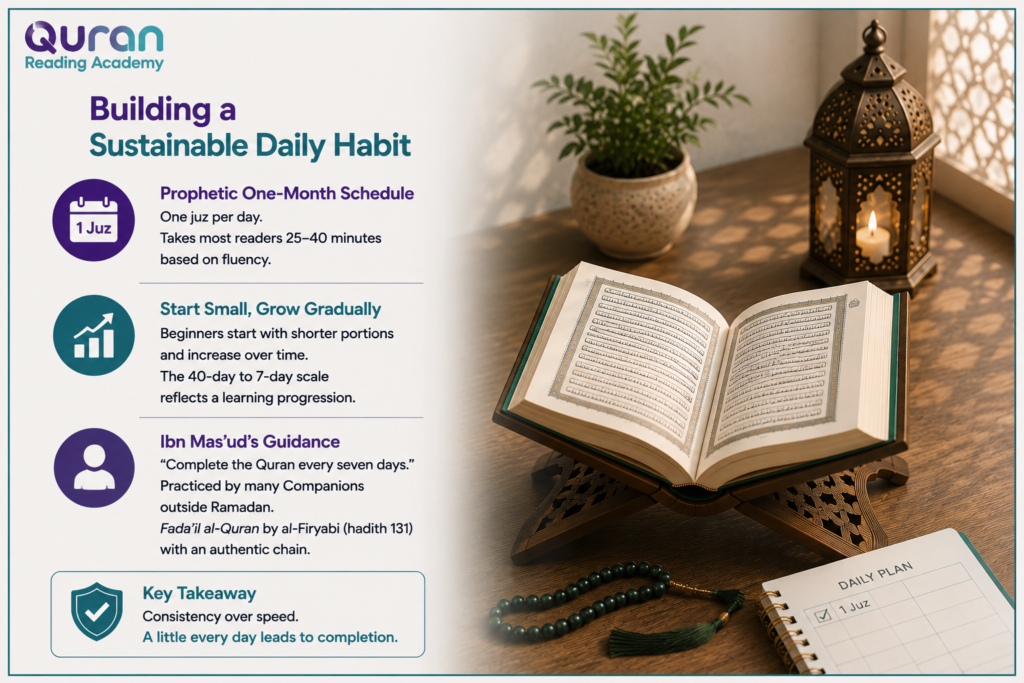
For beginners who cannot yet read Arabic fluently, starting with shorter portions and gradually increasing is the prophetic method itself. The graduated scale from 40 days down to 7 days mirrors a learning progression.
Ibn Mas’ud (may Allah be pleased with him) also advised: “Complete the Quran every seven days.” This became the standard practice of many Companions outside Ramadan, as recorded in Fada’il al-Quran by al-Firyabi (hadith 131) with an authentic chain.
Quranic Command to Recite With Tarteel
Allah Himself addresses the manner of Quran recitation in Surah al-Muzzammil. The verse establishes tarteel as a divine instruction, not merely a scholarly preference.
Surah al-Muzzammil Verse 4 on Slow and Measured Quran Recitation
وَرَتِّلِ الْقُرْآنَ تَرْتِيلًا
(Wa rattili al-Qur’āna tartīlā)
(“And recite the Quran with measured recitation.”)
Tarteel means giving each letter its due right in pronunciation, observing the rules of tajweed, and pausing at the proper stopping points. It stands in direct contrast to hasty, breathless recitation aimed only at finishing quickly.
Imam al-Tirmidhi (may Allah have mercy on him) noted under hadith 2946 that “tarteel (measured recitation) is preferred among the scholars.” This preference aligns with the three-day minimum. Tarteel at a pace faster than three days becomes physically difficult to maintain.
Students who want to perfect their tarteel and apply proper recitation rules can benefit from expert guidance.
Quran Reading Academy offers a Quran Recitation Course designed to refine pronunciation, rhythm, and stopping rules under the supervision of certified Quran teachers.
Perfect your Quran recitation with certified instructors
How the Prophet Recited the Quran Without Rushing
The Prophet’s personal practice provides the strongest evidence for how Muslims should approach Quran completion. Aisha (may Allah be pleased with her) gave a direct testimony recorded in Sahih Muslim.
Aisha’s Hadith on the Prophet’s Quran Recitation Pace
لاَ أَعْلَمُ نَبِيَّ اللَّهِ صلى الله عليه وسلم قَرَأَ الْقُرْآنَ كُلَّهُ فِي لَيْلَةٍ
(Lā a’lamu nabiyya Allāhi ṣallā Allāhu ‘alayhi wa sallam qara’a al-Qur’āna kullahu fī laylah)
(“I do not know that the Prophet, peace be upon him, ever completed the entire Quran in a single night.”)
If the Prophet (peace be upon him) himself, the one to whom the Quran was revealed, did not finish it in one night, then ordinary Muslims have even more reason to pace their recitation thoughtfully.
This narration also refutes the notion that completing the Quran as fast as possible is inherently more virtuous. Quality of engagement consistently outranks speed in the prophetic model.
Read also: Hadith About Reading Quran With Difficulty
Completing the Quran More Frequently During Ramadan
The scholarly consensus allows faster completion during specific seasons. Ramadan, the last ten nights, and time spent in Makkah are the most commonly cited exceptions.
Examples of Intensive Quran Recitation Among Early Scholars
Imam al-Shafi’i (may Allah have mercy on him) used to complete the Quran sixty times during Ramadan, reciting outside of prayer. Something similar was narrated from Imam Abu Hanifah.
Uthman ibn Affan (may Allah be pleased with him) recited the entire Quran in a single rak’ah of witr prayer. Sa’id ibn Jubayr (may Allah have mercy on him) completed it every two nights.
These were exceptional acts by scholars of extraordinary capacity. They are not standard benchmarks. Ibn Abbas (may Allah be pleased with him) advised Abu Jamrah, who used to finish the Quran once or twice in a night:
“It is better to recite one surah with understanding than to rush through the entire Quran.”
This was recorded in al-Sunan al-Kubra by al-Bayhaqi (2/396) with a reliable chain.
Read also: Hadith About Reading Quran with Tajweed
The Difference Between Regular and Occasional Fast Quran Completion
The key principle scholars extract from all these narrations is straightforward. The three-day minimum and seven-day recommendation apply to year-round habitual practice. Occasional acceleration during blessed seasons for those who can maintain quality is permissible.
A person who completes the Quran every three days only during Ramadan’s last ten nights is not violating the prophetic guidance. A person who does this every single week throughout the year is departing from the recommended practice.
For those preparing to maximize their Ramadan Quran engagement, building strong recitation foundations beforehand is essential.
Inside Our Live Classroom
We believe in complete transparency. Take a look inside our virtual classrooms to experience our premium teaching tools and engaging learning environment firsthand.
Start Your Quran Learning Journey Today
Join Quran Reading Academy and begin structured, step-by-step Quran reading with expert guidance.
Try your first class for freeStart Your Quran Journey With a Free Trial Session
Whether you aim to complete the Quran monthly, weekly, or prepare for intensive Ramadan recitation, expert guidance makes the difference between struggling alone and progressing with confidence.
Quran Reading Academy offers a completely free trial lesson with a certified instructor. During this session, your recitation level is assessed and a personalized learning plan is built around your schedule, goals, and current ability.
No commitment is required. Fill in the form, and a qualified tutor will contact you directly to confirm your appointment.
Our Quran Courses
- Quran Reading Classes
- Quran Reading Classes for Kids
- Quran Reading Classes for Adults
- Quran Reading Classes for Female/Sisters
- Quran Reading Classes for New Muslims
- Quran Reading Course for Beginners
- Online Quran Reading Course with Tajweed
- Reading and Memorizing the Quran Course
- Noorani Qaida Course
- Quran Course for Beginners
- Quran Tajweed Course
- Quran Recitation Course
- Quran Hifz Course
- Online Quran Qirat Classes

Book Your Free Trial Session Now
Conclusion
The hadith about reading Quran in 3 days draws a clear prophetic line between devoted recitation and hurried completion.
The Prophet (peace be upon him) advised Abdullah ibn Amr to complete the Quran in seven days as a regular practice, and stated that anyone finishing it in less than three days misses its deeper understanding.
These narrations do not discourage frequent recitation. They channel it toward quality. The reward per letter remains, regardless of pace.
But the spiritual transformation the Quran promises depends on measured reading with reflection, proper tajweed, and consistent daily engagement.
The Companions and early scholars who exceeded the three-day pace did so in exceptional circumstances, primarily Ramadan and sacred locations. For year-round practice, the seven-day cycle remains the gold standard established by prophetic instruction.
Start with one juz per day, build your tajweed accuracy, and let the Quran reshape your life at the pace it was meant to be received.
Frequently Asked Questions
What is the hadith about reading Quran in 3 days?
The Prophet (peace be upon him) said: “He who recites the Quran in less than three days does not understand it.” This is recorded in Jami at-Tirmidhi 2949 and graded hasan sahih. It means completing the entire Quran faster than 72 hours prevents proper reflection and comprehension of its meanings.
Is it haram to finish the Quran in less than three days?
Most scholars classify finishing the Quran in less than three days as makrooh (disliked) rather than haram (forbidden) when done habitually. The prohibition targets those who make it a permanent routine. Occasional rapid completion during Ramadan or in Makkah is considered permissible by scholars including Imam Ahmad and Ishaq ibn Rahawayh.
What is the ideal schedule for reading Quran daily?
The Prophet (peace be upon him) recommended completing the Quran once every seven days as the ideal regular schedule. This equals roughly 4.3 juz per day, or about 86 pages, requiring 2.5 to 3.5 hours of recitation. For those unable to maintain this pace, the one-month cycle of one juz per day is the first recommendation the Prophet offered.
Did the Companions finish the Quran faster than three days?
Yes, several Companions and early scholars did so in specific circumstances. Uthman ibn Affan recited the entire Quran in a single rak’ah. Qatadah completed it nightly during Ramadan’s last ten nights. However, their regular practice outside these seasons followed the seven-day cycle, consistent with prophetic guidance.
How many good deeds does a Muslim earn per letter of Quran?
The Prophet (peace be upon him) said that each letter of the Quran earns ten good deeds. He clarified that Alif Lam Mim counts as three separate letters, not one. This narration is recorded in Jami at-Tirmidhi 2910 and motivates consistent daily recitation even in small amounts.
Does reading Quran quickly still count as valid recitation?
Yes, the recitation is valid and earns reward per letter as long as the Arabic is pronounced correctly. However, the Prophet (peace be upon him) emphasized that speed without reflection means the reader “does not understand it.” Allah also commands tarteel (measured recitation) in Surah al-Muzzammil 73:4, making slow, deliberate reading the preferred method.







Leave a Reply