 Quran
Quran
Muslims who want a consistent connection with the Quran may feel unsure about when reading or recitation is permitted. While some situations have clear scholarly rulings, others are based more on cultural assumptions than Islamic law.
Understanding the difference helps protect both worship and a steady relationship with the Quran.
This article explains when Quran reading or recitation may be restricted or prohibited in Islamic law. It clarifies genuine restrictions, corrects common misunderstandings, and addresses one major misconception: that prayer times determine when you can read the Quran.
1. Quran Recitation During Janabah
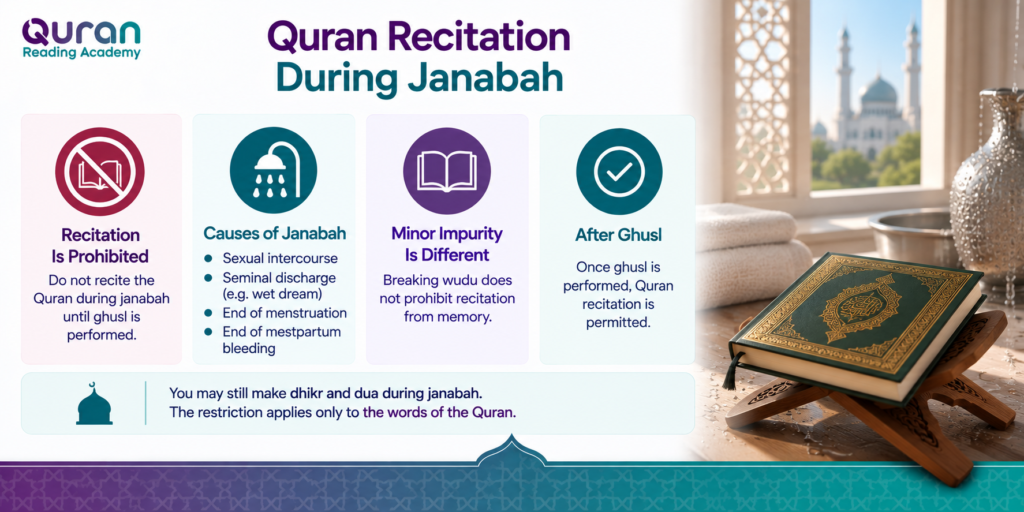
Quran recitation is prohibited during janabah until ghusl is performed. This first condition explains the evidence for the ruling, the difference between janabah and minor impurity, and the causes that require ghusl before recitation.
Menstruation and postpartum bleeding involve restrictions on touching the mushaf that vary by madhab, though most classical scholars permit recitation from memory.
Beyond these states of ritual impurity, very few genuine prohibitions exist for Quran reading. Most of what Muslims hear about “forbidden times” applies to prayer, not recitation.
a. Evidence for the Janabah Ruling
Quran recitation is prohibited during janabah until ghusl is performed, according to all four classical madhhabs. Janabah is the state of major ritual impurity that follows sexual intercourse or seminal discharge, and the restriction applies whether recitation is from memory or from the page.
The evidence for this ruling comes directly from the Sunnah. Ali ibn Abi Talib reported that the Prophet (peace be upon him) would recite Quran in all circumstances, but would not recite it in a state of janabah:
أَنَّ النَّبِيَّ صَلَّى اللَّهُ عَلَيْهِ وَسَلَّمَ كَانَ يَقْرَأُ الْقُرْآنَ عَلَى كُلِّ حَالٍ لَيْسَ الْجَنَابَةَ
(Anna an-Nabiyya sallallahu ‘alayhi wa sallam kana yaqra’u al-Qur’ana ‘ala kulli halin laysa al-janabata)
(“The Prophet (peace be upon him) used to recite the Quran in all states except janabah.”)
This hadith establishes janabah as categorically different from all other states of impurity. Minor ritual impurity (having broken wudu) does not trigger this ban. Only the state of major ritual impurity does.
b. Janabah and Minor Impurity in Quran Recitation
Janabah prohibits Quran recitation until ghusl is performed, whereas minor impurity does not prohibit recitation from memory. The distinction between major and minor impurity runs through Islamic jurisprudence consistently.
Scholars link this to the gravity of the state and the sanctity of the Quran’s words. The Prophet’s practice, as recorded in the hadith above, is the clearest guide available.
c. Causes of Janabah Requiring Ghusl
| Cause of Janabah | Ghusl Required | Recitation Permitted After Ghusl |
| Sexual intercourse | Yes | Yes |
| Seminal discharge (wet dream or otherwise) | Yes | Yes |
| Completion of menstrual period | Yes | Yes |
| End of nifas (postpartum bleeding) | Yes | Yes |
Until ghusl is performed, the restriction on Quran recitation applies fully. A person may make dhikr (remembrance of Allah), say du’a, and engage in other forms of worship, but the specific words of the Quran, as revelation, fall under this restriction.
Quran Reading Academy offers a Quran Recitation Course that trains students to recite with proper pronunciation, rhythm, and adherence to Tajweed rules under the guidance of certified instructors.
Start Your Quran Recitation Training Today
Read also: Can You Go to Heaven Without Reading the Quran?
2. Menstruation and Postpartum Bleeding in Quran Recitation
Scholars differ on Quran recitation during menstruation and nifas (postpartum bleeding), unlike the agreed prohibition during janabah. This question is one of the most frequently discussed in fiqh.
The Hanbali and Shafi’i schools historically prohibited recitation for menstruating women, treating their state as analogous to janabah. The Maliki school, along with many contemporary scholars including Ibn Taymiyyah and Ibn Baz, permitted recitation from memory during menstruation.
Their reasoning holds that menstruation is an involuntary physiological state, not an impurity a woman can remove through ghusl during the period itself, and that cutting a woman off from the Quran for days without a clear, authentic prohibition is too severe a ruling.
a. Quran Recitation From Memory During Menstruation
Some scholars permit Quran recitation from memory during menstruation because no authentic, direct hadith explicitly prohibits it.
The hadith most often cited in support of prohibition refers to the person in janabah, a different state with different rulings.
Second, practical necessity supports permission: women memorizing the Quran (huffaz) or teaching it would face significant disruption to their memorization if barred from recitation for multiple consecutive days each month.
b. Touching the Physical Mushaf During Menstruation
Touching and holding the physical mushaf is a separate question from recitation. The majority of classical scholars, across all four madhabs, hold that touching the mushaf requires tahara (ritual purity). This is grounded in the Quranic verse:
لَّا يَمَسُّهُ إِلَّا الْمُطَهَّرُونَ
(La yamassuhu illal-mutahharun)
Scholars apply this verse to the physical mushaf and conclude that both minor and major states of ritual impurity prevent a person from handling the Quran directly. A woman in menstruation or nifas who wishes to read from the page may do so using a barrier such as a cloth or gloves, according to this scholarly framework.
Quran Reading Academy offers an Online Quran Reading Course with Tajweed that gives students one-on-one sessions with certified female and male instructors who guide them through both recitation and the rules that govern proper Quran reading.

Book Your Free Trial Lesson Now
3. Quran Recitation During Ruku and Sujud
A specific restriction on Quran recitation applies not outside of prayer but within it. During the physical positions of ruku (bowing) and sujud (prostration), reciting the Quran is prohibited.
This ruling is based on a narration from Ali ibn Abi Talib in which the Prophet (peace be upon him) forbade Quran recitation while in ruku and sujud, explaining that these positions are dedicated to glorifying and exalting Allah.
The practical implication is that a person praying who reaches ruku must stop any Quranic recitation and shift to the prescribed glorifications: “Subhana Rabbiyal Adhim” in ruku and “Subhana Rabbiyal A’la” in sujud.
Recitation resumes when the person rises from ruku or sits up from sujud. This restriction exists within the formal act of prayer and does not carry over to any situation outside of salah.
Read also: Can You Read Quran on a Computer Without Wudhu?
4. Quran Recitation at Times When Voluntary Prayer Is Restricted
Quran recitation remains permitted at times when voluntary nafilah prayer is restricted. The restrictions on prayer after Fajr, at zawal (midday), and after Asr apply specifically and exclusively to voluntary nafilah prayer.
A Muslim who has just prayed Fajr is free to open the Quran and read. A person sitting at noon when the sun is at its highest can recite Surah Al-Fatiha or any portion of the Quran without any issue.
There is no scholarly basis for treating these prayer-time restrictions as recitation restrictions. The two categories of worship are governed by entirely different rules.
| Time Period | Voluntary Nafilah Prayer | Quran Recitation |
| After Fajr prayer until sunrise | Prohibited | Permitted |
| At zawal (sun at zenith) | Prohibited | Permitted |
| After Asr prayer until Maghrib | Prohibited | Permitted |
| Any other time of day | Permitted | Permitted |
This misconception likely developed because Muslims are aware of “forbidden times” in Islamic practice and incorrectly generalize the restriction beyond its actual scope. Classical scholars are unanimous that the prayer-time restrictions do not touch Quran recitation.
Quran Reading Academy offers a Quran Tajweed Course that builds a student’s knowledge of recitation rules through structured, instructor-led sessions, including the rules that govern how and when recitation is performed correctly.

Start Your Tajweed Course with a Free Trial
5. Quran Recitation in Bathrooms and Impure Places
Reciting Quran in a bathroom or impure place is considered makruh (strongly disliked) by most scholars, not haram. Islamic jurisprudence draws a clear line between what is prohibited and what is strongly disliked in the matter of where a person recites the Quran.
Reciting Quran in a bathroom or toilet area is considered makruh by scholars, strongly disliked but not haram. The reason is respect and reverence for the words of Allah, not a formal legal prohibition.
If a person accidentally recites an ayah while in the bathroom, no sin is incurred, and the recitation is not invalidated in any formal sense.
Similarly, reciting Quran in places that are physically unclean is disliked. Scholars recommend that recitation take place in clean, dignified settings facing the qiblah, with the reader in a state of wudu, reflecting the proper adab (etiquette) of engaging with the Quran. These are recommendations for spiritual benefit and reverence, not hard prohibitions that carry sin.
Read also: Is It Haram to Force Someone to Read Quran?
6. Reading Quran Without Wudu and Touching the Mushaf
Reciting the Quran from memory without wudu is permitted according to the majority of scholars, while touching the physical Mushaf requires wudu according to the majority view. The question of wudu and Quran reading has two distinct parts, and conflating them leads to confusion.
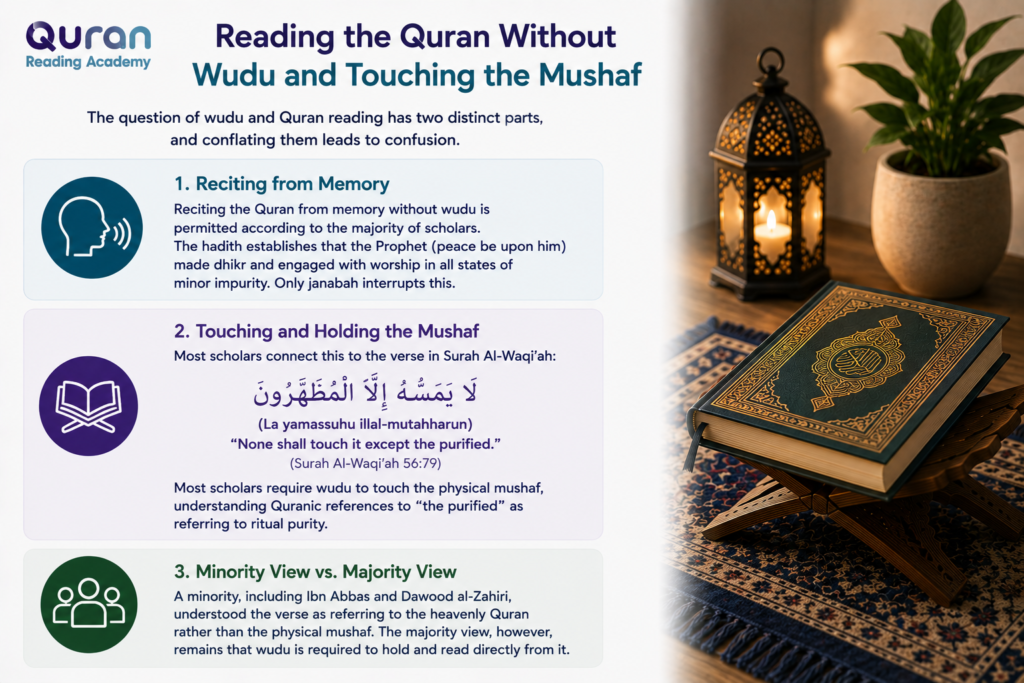
The hadith establishes that the Prophet (peace be upon him) made dhikr and engaged with worship in all states of minor impurity. Only janabah interrupts this.
Touching and holding the physical mushaf is the action that most scholars connect to the verse in Surah Al-Waqi’ah, the requirement that only “the purified” should touch it:
لَّا يَمَسُّهُ إِلَّا الْمُطَهَّرُونَ
(La yamassuhu illal-mutahharun)
Most scholars require wudu to touch the physical mushaf, understanding Quranic references to “the purified” as referring to ritual purity.
A minority, including Ibn Abbas and Dawood al-Zahiri, understood the verse as referring to the heavenly Quran rather than the physical mushaf. The majority view, however, remains that wudu is required to hold and read directly from it
| Condition | Reciting Aloud from Memory | Reading from the Mushaf |
| No wudu (minor impurity) | Permitted | Makruh or prohibited; majority require wudu |
| Janabah (major impurity) | Prohibited | Prohibited |
| Menstruation (memory recitation) | Permitted; majority or majority-leaning view | Prohibited without barrier; majority view |
| Clean state with wudu | Permitted | Permitted |
Quran Reading Academy offers a Quranic Arabic Course that equips students to read and understand the Quran in its original language, enabling a deeper engagement with the text that goes beyond surface-level recitation.
Begin Your Quranic Arabic Journey with a Free Trial
Read also: Can I Recite Quran From Memory On My Period?
Inside Our Live Classroom
We believe in complete transparency. Take a look inside our virtual classrooms to experience our premium teaching tools and engaging learning environment firsthand.
Start Your Quran Learning Journey Today
Join Quran Reading Academy and begin structured, step-by-step Quran reading with expert guidance.
Try your first class for freeLearn Quran with Certified Quran Reading Academy Instructors
If you are working to establish a consistent recitation practice, refine your Tajweed, or deepen your understanding of what you read, structured guidance from qualified instructors makes a clear difference.
Quran Reading Academy pairs each student with certified instructors who deliver live, one-on-one sessions tailored to their current level and goals, with no rigid group schedules and no passive video lessons.
Quran Reading Academy Offers
- Certified instructors with Ijazah credentials who correct pronunciation and Tajweed errors in real time during each session.
- Flexible scheduling for all time zones, with dedicated tracks for children, adults, sisters, and new Muslims.
- A structured progression from basic recitation through to advanced Tajweed and Quranic Arabic comprehension.
Our Quran Courses
- Quran Reading Classes
- Quran Reading Classes for Kids
- Quran Reading Classes for Adults
- Quran Reading Classes for Female/Sisters
- Quran Reading Classes for New Muslims
- Quran Reading Course for Beginners
- Online Quran Reading Course with Tajweed
- Reading and Memorizing the Quran Course
- Noorani Qaida Course
- Quran Course for Beginners
- Quran Tajweed Course
- Quran Recitation Course
- Quran Hifz Course
- Online Quran Qirat Classes

Conclusion
Quran recitation is restricted in fewer situations than many Muslims assume. All scholars prohibit recitation during Janabah until ghusl is performed. Menstruation and postpartum bleeding involve scholarly disagreement, while recitation in formal prayer stops during ruku and sujud.
Prayer times do not restrict Quran reading. Restrictions at certain times apply to voluntary nafilah prayer, not recitation. Wudu mainly affects touching the physical Mushaf rather than reciting from memory.
Knowing these distinctions helps Muslims maintain a confident connection with the Quran without unnecessary interruption. Clear rulings, consistent habits, and proper learning make regular recitation easier and more meaningful.
Frequently Asked Questions
Can You Read Quran on Your Phone Without Wudu?
Yes, reading the Quran on a phone or digital device without wudu is permitted according to the majority of contemporary scholars. The screen of a device is not the mushaf itself, so the ruling on touching the physical mushaf does not apply. Recitation from memory or reading from a screen is allowed without wudu, as long as the reader is not in a state of janabah.
Can a Woman Read Quran During Her Period?
Scholars differ, but the majority of classical scholars and most contemporary fatwa bodies permit a menstruating woman to recite the Quran from memory. She is generally advised not to touch the physical mushaf directly, though she may use a barrier such as a cloth. This ruling reflects the view that menstruation differs from janabah and should not cut a woman off from engagement with the Quran.
What Time Can You Not Read Quran?
There is no prohibited time for Quran recitation. The three forbidden times in Islamic law, after Fajr prayer until sunrise, at zawal, and after Asr prayer, restrict voluntary nafilah prayer only. Scholars are unanimous that these prayer-time restrictions do not apply to Quran recitation, which may be performed at any time of day or night.
Can You Read Quran in the Bathroom?
No, reciting Quran in the bathroom is considered makruh (strongly disliked) by scholars because of the lack of dignity in that setting, not because it is haram. If a person involuntarily recites a verse or completes a sentence they had already begun, no sin is incurred. Scholars recommend avoiding recitation in the bathroom as a matter of proper adab toward the Quran.
Is It Haram to Read Quran While in Janabah?
Yes. Reciting any portion of the Quran while in a state of janabah is prohibited by scholarly consensus across all four classical madhabs. The Prophet (peace be upon him) maintained this restriction consistently, as recorded in Sunan Abi Dawud. Ghusl must be performed before recitation resumes. Dhikr, du’a, and other forms of remembrance remain permitted during janabah







Leave a Reply