 Quran
| Key Takeaways |
| Reading Quran on a computer, phone, or tablet screen without wudhu is permitted according to the majority of contemporary scholars, including Al-Azhar University graduates and major Islamic fatwa bodies worldwide. |
| Islamic law’s prohibition on touching the Quran without wudhu applies specifically to the physical printed mushaf and its pages, not to digital displays or electronic screens. |
| A person in a state of janabah (major ritual impurity) may not recite Quran from any source, including computers and phones, until performing ghusl (the full ritual bath). |
| Wudhu before reading Quran on a computer is strongly recommended as an act of reverence and earns additional spiritual reward, even though it is not legally obligatory in this context. |
Every day, millions of Muslims open a Quran app on a laptop during a lunch break, scroll through verses on a phone before bed, or follow along on a tablet during an online class.
This shift to digital Quran access has placed a very practical question at the center of daily worship: does the purity requirement that applies to a printed mushaf also apply to a screen?
This article examines the Islamic ruling on reading Quran from a computer or digital device without wudhu.
It covers the scholarly reasoning behind why screens and printed pages carry different legal statuses, which states of impurity matter and why, what wudhu before a digital Quran session earns spiritually, and how to engage with digital Quran in the most respectful way.
Can You Read Quran on Computer Without Wudhu?
Yes. Reading Quran displayed on a computer, laptop, tablet, or smartphone screen without wudhu is permitted.
Scholars at Al-Azhar University, IslamQA, and major Islamic fatwa councils have confirmed this ruling consistently, citing that a digital screen does not hold the legal status of a physical mushaf.
The prohibition in Islamic law addresses touching the printed mushaf, its pages, and its cover without wudhu.
A screen displaying Quranic text is not a mushaf in the technical legal sense. Reaching wudhu before a digital Quran session is recommended as an act of reverence but is not obligatory.
Why Wudhu Is Required for Touching a Physical Mushaf
The foundational text behind the wudhu requirement for the physical mushaf comes from Surah Al-Waqiah:
لَّا يَمَسُّهُ إِلَّا الْمُطَهَّرُونَ
(La yamassuhu illal mutahharun)
(“None shall touch it except the purified.”)
Surah Al-Waqiah 56:79
Classical scholars of Fiqh (Islamic jurisprudence) interpreted this verse, alongside corroborating narrations, as establishing that the physical mushaf may not be handled by a person without wudhu.
Direct skin contact with the pages or the cover of a printed Quran falls under this prohibition.Carrying a mushaf wrapped in cloth or inside a bag does not violate this ruling. Skin contact is the operative legal factor, not proximity or awareness of the text.
A student who is not in wudhu but needs to move a mushaf may do so by using a cloth or sleeve without violating the ruling.
Read also: When Can You Not Read Quran?
Why a Digital Quran Screen Is Not Considered a Mushaf
Contemporary Islamic scholars have addressed this question with a consistent position. A smartphone, tablet, or computer screen displaying Quranic text is not a mushaf in the classical legal definition.
A mushaf is defined in Islamic jurisprudence as a physical volume dedicated exclusively to the Arabic Quranic text, inscribed on a material surface.
Digital characters are electronic signals rendered as pixels on a backlit display, not ink fixed on paper. A device that displays Quran also displays email, social media, and browsing content.
This distinction means the ruling of touching the mushaf, with its wudhu requirement, does not extend to unlocking a phone, tapping a screen, or scrolling through a Quran application.
Major scholarly institutions worldwide have confirmed this position over multiple decades of digital Quran use.
Reading Quran From a Computer vs. a Physical Mushaf
A clarifying analogy that scholars draw is useful here. Reading from a computer screen is comparable in ruling to reading from an open physical mushaf without touching it.
If a printed Quran sat open on a stand and a person read from it without any direct contact, no wudhu would be required.
The screen functions the same way as those open pages. The reader’s eyes move across the words without contact with a defined Quranic legal entity.
This analogy is widely cited by scholars when explaining the digital ruling to students.
In practice at Quran Reading Academy, instructors advise students using digital Quran for daily recitation that their sessions are fully valid without wudhu.
Beginning any Quran session with wudhu, on screen or from a physical copy, represents the highest standard of preparation, though it is not required for screen-based reading.
Quran Reading Academy offers an Online Quran Reading Course with Tajweed that trains students in correct recitation from any medium, led by Ijazah-certified instructors who correct pronunciation in real time through live one-on-one sessions.

Begin Your Tajweed Training with a Certified Instructor
Janabah Prohibits Quran Recitation From a Computer
One critical distinction governs digital Quran reading. Janabah, major ritual impurity following sexual intercourse or emission, is an absolute barrier to all Quran recitation.
This prohibition covers reciting from memory, from a printed mushaf, and from a computer or phone screen without exception.
The ruling here does not rest on the question of touching or screens. Janabah suspends the act of recitation itself until the person performs ghusl (the full ritual bath).
No digital or screen-based exception applies to this state.
This is why scholars draw a firm line between minor impurity (the absence of wudhu) and major impurity (janabah).
Minor impurity blocks direct contact with the mushaf but permits recitation from memory and from a digital screen. Major impurity blocks all recitation from any source until purity is restored through ghusl.
Students who engage in daily digital Quran reading sessions should perform ghusl before resuming any recitation after janabah.
This applies regardless of the format: a phone app, a computer, or memory-based recitation.
Quran Reading Academy offers a Quran Recitation Course that builds accurate recitation habits in every setting, taught by instructors who address both technical rules and the practical worship questions that arise in a student’s daily life.

Start Your Recitation Foundation with Expert Guidance
Read also: Can You Go to Heaven Without Reading the Quran?
Women Reading Quran on a Computer During Menstruation
A menstruating woman (ha’id) may read Quran from a computer, phone, or tablet screen without wudhu.
Menstruation carries a different ruling from janabah on the question of Quran recitation, and this distinction matters practically.
The stronger scholarly position, held by Ibn Taymiyyah and Ibn al-Qayyim and supported by contemporary scholars, is that menstruation does not prohibit Quran recitation when reading from memory or from a digital screen.
A menstruating woman may not touch the physical printed mushaf. Engagement with Quran through digital means remains fully permitted.
The reasoning behind this ruling is grounded in practical realities. Menstruation can last seven to ten days.
Scholars note that preventing a woman from all Quran engagement for this extended period lacks explicit textual basis. The Prophet’s instruction to ‘A’ishah during Hajj specified tawaf as the restricted act, not Quran recitation.
Sisters maintaining a daily Quran reading routine on their devices may continue uninterrupted through the menstrual period.
Quran Reading Academy offers Quran Reading Classes for Sisters taught by qualified female instructors who understand the full range of practical worship questions that arise for female students.

Book a Free Trial Lesson with a Female Quran Instructor
See Our Academy in Action
Discover what a typical session looks like! Watch these brief highlights from our live, interactive classes to see how our instructors engage with students of all ages.
Start Your Quran Learning Journey Today
Join Quran Reading Academy and begin structured, step-by-step Quran reading with expert guidance.
Try your first class for freeBenefits of Wudhu Before Reading Quran on a Computer
Even though wudhu is not legally required before reading Quran on a computer, performing wudhu before a digital Quran session carries genuine spiritual value.
The Prophet, peace be upon him, established the reward for Quran recitation in a hadith preserved by Imam Tirmidhi:
مَنْ قَرَأَ حَرْفًا مِنْ كِتَابِ اللَّهِ فَلَهُ بِهِ حَسَنَةٌ وَالْحَسَنَةُ بِعَشْرِ أَمْثَالِهَا لَا أَقُولُ الم حَرْفٌ وَلَكِنْ أَلِفٌ حَرْفٌ وَلَامٌ حَرْفٌ وَمِيمٌ حَرْفٌ
(Man qara’a harfan min kitabi-llahi falahu bihi hasanatun, wal-hasanatu bi-ashri amthaliha, la aqulu ALM harfun walakin alifun harfun wa-lamun harfun wa-mimun harfun)
(“Whoever reads a letter from the Book of Allah will receive a reward, and that reward will be multiplied by ten. I do not say that ‘Alif Lam Meem’ is one letter, but Alif is one letter, Lam is one letter, and Meem is one letter.”)
Jami at-Tirmidhi 2910
Reading in a state of wudhu reflects the reverence Allah’s speech deserves.
Scholars consistently note that wudhu before recitation, even when optional, adds a layer of spiritual preparation that deepens engagement with the words.
Many students report that beginning a computer Quran session in wudhu helps them maintain focus through the reading.
Wudhu signals to the mind and body that what follows is an act of worship, not casual browsing. This habit is especially beneficial for students building a consistent daily practice.
Read also: Is It Haram to Force Someone to Read Quran?
Respectful Practices for Digital Quran Reading
A few consistent practices help maintain proper reverence when using digital devices for Quran reading.
Following them protects the quality of worship without creating hardship.
The following practices help preserve that reverence:
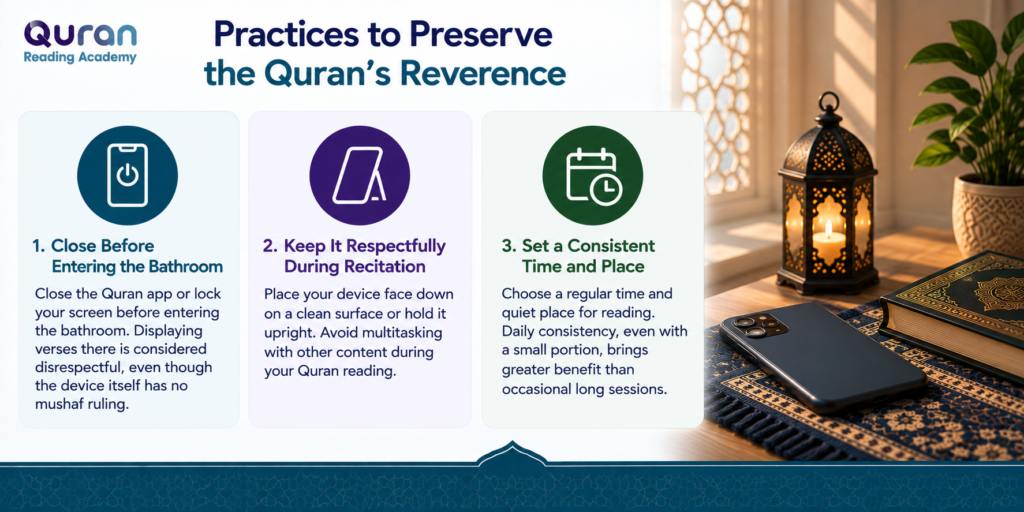
- Close the Quran application or lock the screen before entering the bathroom. Displaying Quranic verses in a place associated with physical impurity is considered disrespectful (ihanah) by scholars, even though the device itself carries no mushaf ruling. Closing the app removes the concern entirely.
- Keep the device positioned respectfully during recitation. Placing the phone face down on a clean surface, or holding the screen upright, signals that this session is distinct from ordinary device use. Avoid multitasking between the Quran app and other content during a reading session.
- Set a consistent time and quiet place for digital Quran reading. Regular daily engagement with even a short portion outperforms occasional long sessions in both retention and spiritual connection. This consistency is a practical implementation of the prophetic encouragement to recite regularly.
Quran Reading Academy offers a Quran Reading Course for Beginners that helps students build these foundational worship habits alongside correct recitation skills.
Instructors address practical questions of daily Quran engagement from the first lesson.

Start Your Quran Reading Foundation Today
Listening to Quran on a Computer Without Wudhu
Listening to Quran played through a computer, phone, or speaker system requires no wudhu under any circumstances.
Listening involves the ears and the heart, not physical contact with any Quranic text.
Allah commands believers to listen attentively when the Quran is recited:
وَإِذَا قُرِئَ الْقُرْآنُ فَاسْتَمِعُوا لَهُ وَأَنصِتُوا لَعَلَّكُمْ تُرْحَمُونَ
(Wa-idha quri-al-Qur’anu fastami’u lahu wa-ansitu la’allakum turhamun)
(“So when the Quran is recited, then listen to it and pay attention that you may receive mercy.”)
Surah Al-A’raf 7:204
This command carries no purity condition.
A person in any state of ritual purity may listen and receive the mercy and reward associated with attentive Quran listening.
Scholars have confirmed that this ruling extends to listening through computers, audio files, and streaming recitation apps.
A person with wudhu, in a state of minor impurity, or menstruating all retain the right to listen to Quran through any device. Listening to Quran on a computer is among the most accessible forms of Quran engagement available to a Muslim throughout the day.
Read also: Can I Recite Quran From Memory On My Period?
Inside Our Live Classroom
We believe in complete transparency. Take a look inside our virtual classrooms to experience our premium teaching tools and engaging learning environment firsthand.
Start Your Quran Learning Journey Today
Join Quran Reading Academy and begin structured, step-by-step Quran reading with expert guidance.
Try your first class for freeBegin Quran Recitation With Quran Reading Academy Instructors
Reading and listening to Quran through a computer or phone keeps the connection with Allah’s words alive throughout every day.
Correct recitation, however, requires structured instruction that no application or audio file can fully replace.
Quran Reading Academy provides live one-on-one online classes with Ijazah-certified instructors and Al-Azhar University graduates who have taught non-Arabic speakers for over a decade.
Sessions cover Tajweed from articulation fundamentals through advanced recitation rules, with scheduling available for students in any time zone.
Students choose Quran Reading Academy for the following reasons:
- Ijazah-certified instructors who correct pronunciation errors in real time, session by session
- One-on-one live classes tailored to each student’s current recitation level and goals
- Flexible scheduling that fits working adults, students, and families in any time zone
Our Quran Courses
- Quran Reading Classes
- Quran Reading Classes for Kids
- Quran Reading Classes for Adults
- Quran Reading Classes for Female/Sisters
- Quran Reading Classes for New Muslims
- Quran Reading Course for Beginners
- Online Quran Reading Course with Tajweed
- Reading and Memorizing the Quran Course
- Noorani Qaida Course
- Quran Course for Beginners
- Quran Tajweed Course
- Quran Recitation Course
- Quran Hifz Course
- Online Quran Qirat Classes

Try a Free Lesson with Quran Reading Academy
Conclusion
Reading Quran on a computer without wudhu is fully permitted under Islamic law.
The wudhu requirement applies to direct physical contact with a printed mushaf, not to reading from digital screens. Listening to Quran through a computer requires no purity condition at all.
Janabah remains the one state that blocks digital Quran recitation entirely.
Ghusl must be performed before resuming recitation from any source after major ritual impurity. Wudhu before screen-based Quran reading is not obligatory, but it earns additional spiritual reward and deepens the quality of worship.
Maintaining daily Quran reading through digital devices is an excellent practice.Pairing that habit with structured instruction from qualified instructors ensures the reading that begins on a screen grows into a complete, accurate, and rewarding recitation practice.
Frequently Asked Questions About Reading Quran on Computer Without Wudhu
Does touching the computer screen count as touching the Quran?
No. Touching a screen that displays Quranic text does not carry the same ruling as touching a printed mushaf. Scholars have confirmed that digital text consists of electronic signals, not inscribed Quranic text on a dedicated physical surface. Wudhu is not required to interact with the device screen.
Can I read Quran on my computer at work without wudhu?
Yes. Reading Quran from a computer or phone screen without wudhu is permitted at home, at work, and in transit. The ruling is consistent regardless of setting, as long as the person is not in a state of janabah requiring ghusl.
Does the ruling change for a Quran PDF on a computer?
No. A Quran PDF displayed on a computer screen carries the same ruling as any other digital Quran display. It is not a physical mushaf and does not require wudhu to open, scroll through, or read from. The ruling applies equally to PDFs, Quran apps, and browser-based Quran websites.
Can children read Quran on a tablet without wudhu?
Yes. Children learning to read Quran on a tablet are not required to be in wudhu for digital Quran engagement. Building the habit of beginning Quran sessions with wudhu from a young age is recommended as an educational practice and a sign of reverence, though it is not legally obligatory.
Is listening to a Quran recitation app on a computer the same as reading?
Listening has a more permissive ruling than reading. Listening to Quran through any device requires no wudhu whatsoever, in any state of ritual purity. The command to listen attentively when Quran is recited applies without a purity condition, making it one of the most accessible forms of Quran engagement available throughout the day.








Leave a Reply